SUBSCRIBE TO OUR FREE NEWSLETTER
Daily news & progressive opinion—funded by the people, not the corporations—delivered straight to your inbox.
5
#000000
#FFFFFF
To donate by check, phone, or other method, see our More Ways to Give page.
Daily news & progressive opinion—funded by the people, not the corporations—delivered straight to your inbox.
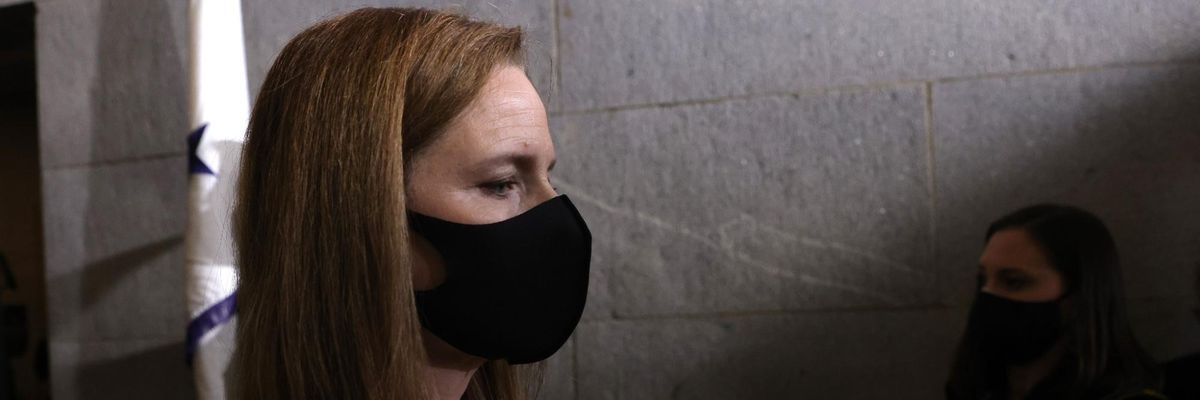
Supreme Court Justice Amy Coney Barrett arrives for the inauguration of Joe Biden as the 46th U.S. president on the West Front of the U.S. Capitol in Washington, D.C. on January 20, 2021. (Photo: Win McNamee/Pool/AFP via Getty Images)
Three Democratic lawmakers on Tuesday urged U.S. Supreme Court Justice Amy Coney Barrett to recuse herself from a pending case revolving around the nonprofit arm of Americans for Prosperity, a Koch-funded political advocacy group that spent heavily to ensure Barrett's confirmation to the bench last October.
In a letter (pdf) to Barrett, Sen. Sheldon Whitehouse (D-R.I.), Sen. Richard Blumenthal (D-Conn.), and Rep. Hank Johnson (D-Ga.) argue that Americans for Prosperity's big spending campaign in support of the newest justice's confirmation casts serious doubt on whether she can be impartial in Americans for Prosperity Foundation v. Rodriquez.
The Americans for Prosperity Foundation (AFPF) is seeking to strike down a California law that requires certain nonprofit groups to disclose their major donors to the state attorney general's office. In March 2019, a federal appeals court upheld the California law on the grounds that it "serves an important governmental interest," prompting AFPF to take its case to the high court, which agreed to hear the challenge earlier this year.
With oral arguments set to begin on April 26, Whitehouse, Blumenthal, and Johnson call on Barrett to "consider seriously and address publicly the question of recusal in this case" given Americans for Prosperity's "full-scale campaign" in favor of her confirmation last year. The Democratic lawmakers argue that "there is no reasonable difference" between AFPF and Americans for Prosperity.
"The American people are alarmed about the seemingly dominant influence of special interests on our politics and government," the lawmakers write. "Our judiciary is a target of this massive influence apparatus. Now, in AFPF, the court takes up an important case that squarely implicates the power of big special interests to exercise their influence from behind veils of secrecy."
In an amicus brief (pdf) filed with the Supreme Court last month, Whitehouse and 14 other Democratic senators warned that a ruling in AFPF's favor would allow "dark-money contributors to secure broad constitutional protection of their anonymous influence, so they can attack any and all disclosure requirements in other contexts--a 'moon shot' to lock in dark money's hold on our politics and policymaking, possibly forever."
"The flotilla of anonymously funded and largely industry-aligned nonprofit organizations filing amicus briefs in support of [AFPF] should set off alarm bells that something bigger than California's tax disclosure law is at issue," the senators write. "The dots are not hard to connect. The bigger prize being sought is blanket constitutional protection of dark money and secret influence."
Vox's Ian Millhiser echoed that warning over the weekend, writing that the conservative-dominated Supreme Court's ruling "could allow political groups to operate with far more secrecy, allowing wealthy donors to shape American politics in the shadows."
Dear Common Dreams reader, It’s been nearly 30 years since I co-founded Common Dreams with my late wife, Lina Newhouser. We had the radical notion that journalism should serve the public good, not corporate profits. It was clear to us from the outset what it would take to build such a project. No paid advertisements. No corporate sponsors. No millionaire publisher telling us what to think or do. Many people said we wouldn't last a year, but we proved those doubters wrong. Together with a tremendous team of journalists and dedicated staff, we built an independent media outlet free from the constraints of profits and corporate control. Our mission has always been simple: To inform. To inspire. To ignite change for the common good. Building Common Dreams was not easy. Our survival was never guaranteed. When you take on the most powerful forces—Wall Street greed, fossil fuel industry destruction, Big Tech lobbyists, and uber-rich oligarchs who have spent billions upon billions rigging the economy and democracy in their favor—the only bulwark you have is supporters who believe in your work. But here’s the urgent message from me today. It's never been this bad out there. And it's never been this hard to keep us going. At the very moment Common Dreams is most needed, the threats we face are intensifying. We need your support now more than ever. We don't accept corporate advertising and never will. We don't have a paywall because we don't think people should be blocked from critical news based on their ability to pay. Everything we do is funded by the donations of readers like you. When everyone does the little they can afford, we are strong. But if that support retreats or dries up, so do we. Will you donate now to make sure Common Dreams not only survives but thrives? —Craig Brown, Co-founder |
Three Democratic lawmakers on Tuesday urged U.S. Supreme Court Justice Amy Coney Barrett to recuse herself from a pending case revolving around the nonprofit arm of Americans for Prosperity, a Koch-funded political advocacy group that spent heavily to ensure Barrett's confirmation to the bench last October.
In a letter (pdf) to Barrett, Sen. Sheldon Whitehouse (D-R.I.), Sen. Richard Blumenthal (D-Conn.), and Rep. Hank Johnson (D-Ga.) argue that Americans for Prosperity's big spending campaign in support of the newest justice's confirmation casts serious doubt on whether she can be impartial in Americans for Prosperity Foundation v. Rodriquez.
The Americans for Prosperity Foundation (AFPF) is seeking to strike down a California law that requires certain nonprofit groups to disclose their major donors to the state attorney general's office. In March 2019, a federal appeals court upheld the California law on the grounds that it "serves an important governmental interest," prompting AFPF to take its case to the high court, which agreed to hear the challenge earlier this year.
With oral arguments set to begin on April 26, Whitehouse, Blumenthal, and Johnson call on Barrett to "consider seriously and address publicly the question of recusal in this case" given Americans for Prosperity's "full-scale campaign" in favor of her confirmation last year. The Democratic lawmakers argue that "there is no reasonable difference" between AFPF and Americans for Prosperity.
"The American people are alarmed about the seemingly dominant influence of special interests on our politics and government," the lawmakers write. "Our judiciary is a target of this massive influence apparatus. Now, in AFPF, the court takes up an important case that squarely implicates the power of big special interests to exercise their influence from behind veils of secrecy."
In an amicus brief (pdf) filed with the Supreme Court last month, Whitehouse and 14 other Democratic senators warned that a ruling in AFPF's favor would allow "dark-money contributors to secure broad constitutional protection of their anonymous influence, so they can attack any and all disclosure requirements in other contexts--a 'moon shot' to lock in dark money's hold on our politics and policymaking, possibly forever."
"The flotilla of anonymously funded and largely industry-aligned nonprofit organizations filing amicus briefs in support of [AFPF] should set off alarm bells that something bigger than California's tax disclosure law is at issue," the senators write. "The dots are not hard to connect. The bigger prize being sought is blanket constitutional protection of dark money and secret influence."
Vox's Ian Millhiser echoed that warning over the weekend, writing that the conservative-dominated Supreme Court's ruling "could allow political groups to operate with far more secrecy, allowing wealthy donors to shape American politics in the shadows."
Three Democratic lawmakers on Tuesday urged U.S. Supreme Court Justice Amy Coney Barrett to recuse herself from a pending case revolving around the nonprofit arm of Americans for Prosperity, a Koch-funded political advocacy group that spent heavily to ensure Barrett's confirmation to the bench last October.
In a letter (pdf) to Barrett, Sen. Sheldon Whitehouse (D-R.I.), Sen. Richard Blumenthal (D-Conn.), and Rep. Hank Johnson (D-Ga.) argue that Americans for Prosperity's big spending campaign in support of the newest justice's confirmation casts serious doubt on whether she can be impartial in Americans for Prosperity Foundation v. Rodriquez.
The Americans for Prosperity Foundation (AFPF) is seeking to strike down a California law that requires certain nonprofit groups to disclose their major donors to the state attorney general's office. In March 2019, a federal appeals court upheld the California law on the grounds that it "serves an important governmental interest," prompting AFPF to take its case to the high court, which agreed to hear the challenge earlier this year.
With oral arguments set to begin on April 26, Whitehouse, Blumenthal, and Johnson call on Barrett to "consider seriously and address publicly the question of recusal in this case" given Americans for Prosperity's "full-scale campaign" in favor of her confirmation last year. The Democratic lawmakers argue that "there is no reasonable difference" between AFPF and Americans for Prosperity.
"The American people are alarmed about the seemingly dominant influence of special interests on our politics and government," the lawmakers write. "Our judiciary is a target of this massive influence apparatus. Now, in AFPF, the court takes up an important case that squarely implicates the power of big special interests to exercise their influence from behind veils of secrecy."
In an amicus brief (pdf) filed with the Supreme Court last month, Whitehouse and 14 other Democratic senators warned that a ruling in AFPF's favor would allow "dark-money contributors to secure broad constitutional protection of their anonymous influence, so they can attack any and all disclosure requirements in other contexts--a 'moon shot' to lock in dark money's hold on our politics and policymaking, possibly forever."
"The flotilla of anonymously funded and largely industry-aligned nonprofit organizations filing amicus briefs in support of [AFPF] should set off alarm bells that something bigger than California's tax disclosure law is at issue," the senators write. "The dots are not hard to connect. The bigger prize being sought is blanket constitutional protection of dark money and secret influence."
Vox's Ian Millhiser echoed that warning over the weekend, writing that the conservative-dominated Supreme Court's ruling "could allow political groups to operate with far more secrecy, allowing wealthy donors to shape American politics in the shadows."