SUBSCRIBE TO OUR FREE NEWSLETTER
Daily news & progressive opinion—funded by the people, not the corporations—delivered straight to your inbox.
5
#000000
#FFFFFF
To donate by check, phone, or other method, see our More Ways to Give page.
Daily news & progressive opinion—funded by the people, not the corporations—delivered straight to your inbox.
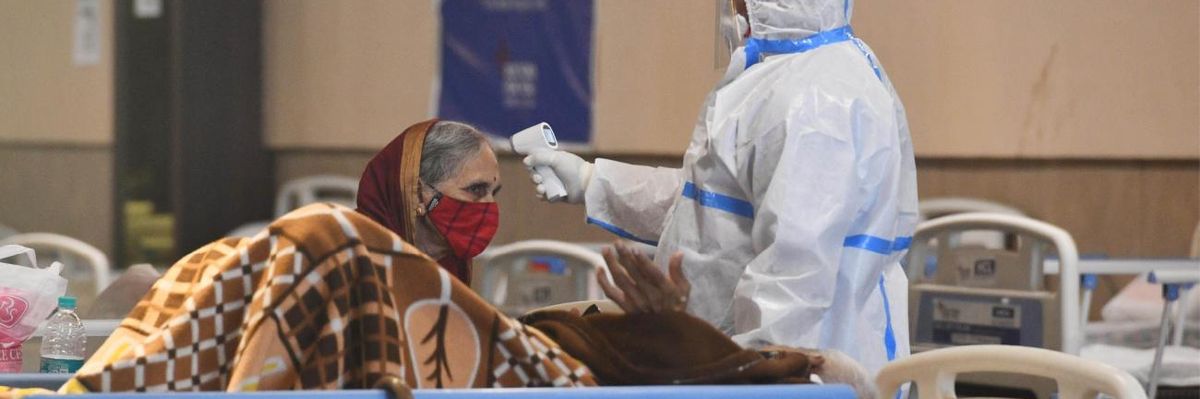
A health worker wearing a protective suit treats Covid-19 patients inside an isolation ward in Shehnai Banquet Hall near government-run Lok Nayak Jai Prakash Narayan LNJP hospital in New Delhi, India, on April 13, 2021. (Photo: Partha Sarkar/Xinhua via Getty Images)
Fueled by surging cases in India, Brazil, and other developing nations, new global coronavirus infections hit a seven-day high of 5.2 million last week as world leaders face growing pressure to take bold action against vaccine inequities that have left much of the world unprotected from the deadly pathogen.
More than 905 million vaccine doses have been administered across the globe as of Monday, but dozens of nations have inoculated less than one percent of their populations--and many countries have yet to report a single vaccination--as strict intellectual property rules keep production of the life-saving shots under the control of large pharmaceutical companies.
"Many countries will wait years for sufficient doses. That risks letting the virus run rampant, leading to new variants and putting our own vaccination program in jeopardy. It would be a reckless act of self-mutilation."
--Gabriel Scally, University of Bristol
As Bloomberg's David Fickling wrote Sunday, "While there's sufficient medicine on order to fully immunize the population of high-income nations nearly two times over, in the lower middle-income ones, where the largest slice of the world's population lives, coverage falls to just 12%."
To prevent the further entrenchment of "vaccine apartheid" and facilitate mass production of generic vaccines, over 100 countries led by India and South Africa are pushing for a temporary waiver of vaccine-related intellectual property rules at the World Trade Organization.
But the United States, European Union member countries, the United Kingdom, and other rich nations have thus far sided with the pharmaceutical industry and repeatedly blocked the proposal. The WTO is expected to discuss the patent waiver idea at an informal meeting in Geneva on Thursday and again at its next formal gathering on May 5.
"By helping block a patent waiver, the U.K. government is stifling vaccine production, which means many countries will wait years for sufficient doses," Gabriel Scally, visiting professor of public health at the University of Bristol, warned in a column for The Guardian on Sunday. "That risks letting the virus run rampant, leading to new variants and putting our own vaccination program in jeopardy. It would be a reckless act of self-mutilation."
According to a Bloomberg analysis of the latest data from Johns Hopkins University, India reported more new coronavirus infections on Sunday--273,802--than any other country in the world as public health experts fear a new Covid-19 variant could be driving the latest surge in the world's second-most populous country.
Al Jazeera reported Monday that "the new variant, which has a so-called double mutation, is thought to be fueling India's deadlier new wave of cases that... has already begun to overwhelm its hospitals and crematoriums."
"The new variant, called B.1.617, was initially detected in India with two mutations--the E484Q and L452R. It was first reported late last year by a scientist in India and more details were presented before the [World Health Organization on Monday," Al Jazeera noted. "The double mutation has been found in several countries like Australia, Belgium, Germany, Ireland, Namibia, New Zealand, Singapore, the U.K., and the U.S."
Last month, a survey of 77 leading epidemiologists from 28 countries across the globe found that two-thirds believe the international community has "a year or less" before vaccine-resistant Covid-19 variants spread widely enough to render a majority of first-generation vaccines ineffective, requiring the production of new or modified shots.
That finding intensified calls for immediate action from world leaders to wrest vaccine recipes from pharmaceutical companies and ensure that generic manufacturers have both the know-how and adequate resources to ramp up production to meet urgent global needs.
"In many rich nations, vaccinated people are starting to feel safer, but unless we vaccinate all nations, there is a huge risk that the protection offered by vaccines will be shattered by fresh mutations," said Anna Marriott, health policy manager at Oxfam International. "We need a people's vaccine, not only to protect people in the world's poorest countries, but to ensure that people all over the world who've already been vaccinated aren't put at risk again."
Dear Common Dreams reader, It’s been nearly 30 years since I co-founded Common Dreams with my late wife, Lina Newhouser. We had the radical notion that journalism should serve the public good, not corporate profits. It was clear to us from the outset what it would take to build such a project. No paid advertisements. No corporate sponsors. No millionaire publisher telling us what to think or do. Many people said we wouldn't last a year, but we proved those doubters wrong. Together with a tremendous team of journalists and dedicated staff, we built an independent media outlet free from the constraints of profits and corporate control. Our mission has always been simple: To inform. To inspire. To ignite change for the common good. Building Common Dreams was not easy. Our survival was never guaranteed. When you take on the most powerful forces—Wall Street greed, fossil fuel industry destruction, Big Tech lobbyists, and uber-rich oligarchs who have spent billions upon billions rigging the economy and democracy in their favor—the only bulwark you have is supporters who believe in your work. But here’s the urgent message from me today. It's never been this bad out there. And it's never been this hard to keep us going. At the very moment Common Dreams is most needed, the threats we face are intensifying. We need your support now more than ever. We don't accept corporate advertising and never will. We don't have a paywall because we don't think people should be blocked from critical news based on their ability to pay. Everything we do is funded by the donations of readers like you. When everyone does the little they can afford, we are strong. But if that support retreats or dries up, so do we. Will you donate now to make sure Common Dreams not only survives but thrives? —Craig Brown, Co-founder |
Fueled by surging cases in India, Brazil, and other developing nations, new global coronavirus infections hit a seven-day high of 5.2 million last week as world leaders face growing pressure to take bold action against vaccine inequities that have left much of the world unprotected from the deadly pathogen.
More than 905 million vaccine doses have been administered across the globe as of Monday, but dozens of nations have inoculated less than one percent of their populations--and many countries have yet to report a single vaccination--as strict intellectual property rules keep production of the life-saving shots under the control of large pharmaceutical companies.
"Many countries will wait years for sufficient doses. That risks letting the virus run rampant, leading to new variants and putting our own vaccination program in jeopardy. It would be a reckless act of self-mutilation."
--Gabriel Scally, University of Bristol
As Bloomberg's David Fickling wrote Sunday, "While there's sufficient medicine on order to fully immunize the population of high-income nations nearly two times over, in the lower middle-income ones, where the largest slice of the world's population lives, coverage falls to just 12%."
To prevent the further entrenchment of "vaccine apartheid" and facilitate mass production of generic vaccines, over 100 countries led by India and South Africa are pushing for a temporary waiver of vaccine-related intellectual property rules at the World Trade Organization.
But the United States, European Union member countries, the United Kingdom, and other rich nations have thus far sided with the pharmaceutical industry and repeatedly blocked the proposal. The WTO is expected to discuss the patent waiver idea at an informal meeting in Geneva on Thursday and again at its next formal gathering on May 5.
"By helping block a patent waiver, the U.K. government is stifling vaccine production, which means many countries will wait years for sufficient doses," Gabriel Scally, visiting professor of public health at the University of Bristol, warned in a column for The Guardian on Sunday. "That risks letting the virus run rampant, leading to new variants and putting our own vaccination program in jeopardy. It would be a reckless act of self-mutilation."
According to a Bloomberg analysis of the latest data from Johns Hopkins University, India reported more new coronavirus infections on Sunday--273,802--than any other country in the world as public health experts fear a new Covid-19 variant could be driving the latest surge in the world's second-most populous country.
Al Jazeera reported Monday that "the new variant, which has a so-called double mutation, is thought to be fueling India's deadlier new wave of cases that... has already begun to overwhelm its hospitals and crematoriums."
"The new variant, called B.1.617, was initially detected in India with two mutations--the E484Q and L452R. It was first reported late last year by a scientist in India and more details were presented before the [World Health Organization on Monday," Al Jazeera noted. "The double mutation has been found in several countries like Australia, Belgium, Germany, Ireland, Namibia, New Zealand, Singapore, the U.K., and the U.S."
Last month, a survey of 77 leading epidemiologists from 28 countries across the globe found that two-thirds believe the international community has "a year or less" before vaccine-resistant Covid-19 variants spread widely enough to render a majority of first-generation vaccines ineffective, requiring the production of new or modified shots.
That finding intensified calls for immediate action from world leaders to wrest vaccine recipes from pharmaceutical companies and ensure that generic manufacturers have both the know-how and adequate resources to ramp up production to meet urgent global needs.
"In many rich nations, vaccinated people are starting to feel safer, but unless we vaccinate all nations, there is a huge risk that the protection offered by vaccines will be shattered by fresh mutations," said Anna Marriott, health policy manager at Oxfam International. "We need a people's vaccine, not only to protect people in the world's poorest countries, but to ensure that people all over the world who've already been vaccinated aren't put at risk again."
Fueled by surging cases in India, Brazil, and other developing nations, new global coronavirus infections hit a seven-day high of 5.2 million last week as world leaders face growing pressure to take bold action against vaccine inequities that have left much of the world unprotected from the deadly pathogen.
More than 905 million vaccine doses have been administered across the globe as of Monday, but dozens of nations have inoculated less than one percent of their populations--and many countries have yet to report a single vaccination--as strict intellectual property rules keep production of the life-saving shots under the control of large pharmaceutical companies.
"Many countries will wait years for sufficient doses. That risks letting the virus run rampant, leading to new variants and putting our own vaccination program in jeopardy. It would be a reckless act of self-mutilation."
--Gabriel Scally, University of Bristol
As Bloomberg's David Fickling wrote Sunday, "While there's sufficient medicine on order to fully immunize the population of high-income nations nearly two times over, in the lower middle-income ones, where the largest slice of the world's population lives, coverage falls to just 12%."
To prevent the further entrenchment of "vaccine apartheid" and facilitate mass production of generic vaccines, over 100 countries led by India and South Africa are pushing for a temporary waiver of vaccine-related intellectual property rules at the World Trade Organization.
But the United States, European Union member countries, the United Kingdom, and other rich nations have thus far sided with the pharmaceutical industry and repeatedly blocked the proposal. The WTO is expected to discuss the patent waiver idea at an informal meeting in Geneva on Thursday and again at its next formal gathering on May 5.
"By helping block a patent waiver, the U.K. government is stifling vaccine production, which means many countries will wait years for sufficient doses," Gabriel Scally, visiting professor of public health at the University of Bristol, warned in a column for The Guardian on Sunday. "That risks letting the virus run rampant, leading to new variants and putting our own vaccination program in jeopardy. It would be a reckless act of self-mutilation."
According to a Bloomberg analysis of the latest data from Johns Hopkins University, India reported more new coronavirus infections on Sunday--273,802--than any other country in the world as public health experts fear a new Covid-19 variant could be driving the latest surge in the world's second-most populous country.
Al Jazeera reported Monday that "the new variant, which has a so-called double mutation, is thought to be fueling India's deadlier new wave of cases that... has already begun to overwhelm its hospitals and crematoriums."
"The new variant, called B.1.617, was initially detected in India with two mutations--the E484Q and L452R. It was first reported late last year by a scientist in India and more details were presented before the [World Health Organization on Monday," Al Jazeera noted. "The double mutation has been found in several countries like Australia, Belgium, Germany, Ireland, Namibia, New Zealand, Singapore, the U.K., and the U.S."
Last month, a survey of 77 leading epidemiologists from 28 countries across the globe found that two-thirds believe the international community has "a year or less" before vaccine-resistant Covid-19 variants spread widely enough to render a majority of first-generation vaccines ineffective, requiring the production of new or modified shots.
That finding intensified calls for immediate action from world leaders to wrest vaccine recipes from pharmaceutical companies and ensure that generic manufacturers have both the know-how and adequate resources to ramp up production to meet urgent global needs.
"In many rich nations, vaccinated people are starting to feel safer, but unless we vaccinate all nations, there is a huge risk that the protection offered by vaccines will be shattered by fresh mutations," said Anna Marriott, health policy manager at Oxfam International. "We need a people's vaccine, not only to protect people in the world's poorest countries, but to ensure that people all over the world who've already been vaccinated aren't put at risk again."