SUBSCRIBE TO OUR FREE NEWSLETTER
Daily news & progressive opinion—funded by the people, not the corporations—delivered straight to your inbox.
5
#000000
#FFFFFF
To donate by check, phone, or other method, see our More Ways to Give page.
Daily news & progressive opinion—funded by the people, not the corporations—delivered straight to your inbox.
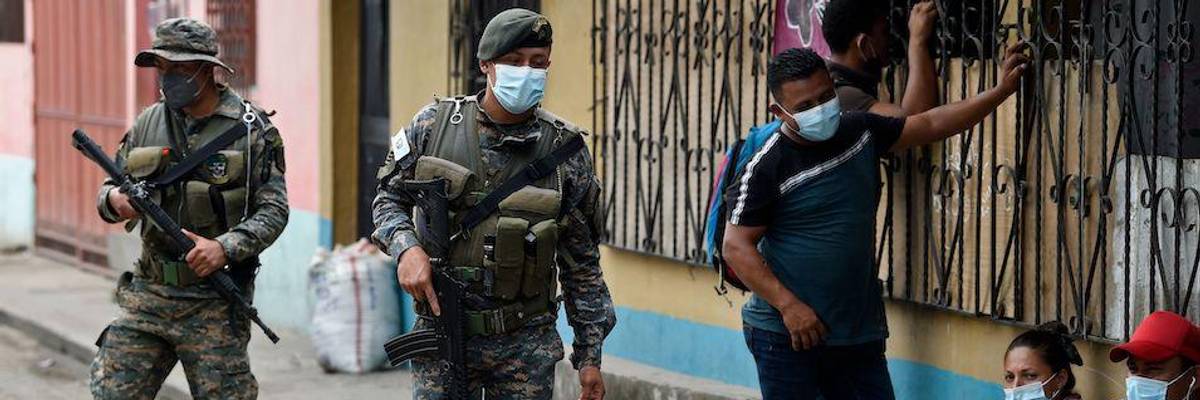
Members of the Guatemalan army walk past a group of Honduran migrants, part of a U.S.-bound migrant caravan, outside a migrant shelter in the municipality of San Marcos, Guatemala, on October 3, 2020. (Photo: Alfredo Estrella/AFP via Getty Images)
Human rights defenders expressed concern Monday after the Biden administration announced it reached agreements with Mexico, Honduras, and Guatemala for those countries to boost their deployments of military forces to stop the flow migrants trying to make their way to the United States.
"I think the objective is to make it more difficult to make the journey and make crossing the borders more difficult," White House press secretary Jen Psaki said Monday.
Psaki said that under the agreements--which were reached over recent weeks--Mexico will keep 10,000 troops at its southern border. Guatemala upped its number of police and military personnel to its southern border with Honduras to 1,500 and will put up 12 checkpoints along the country's migratory route, she said, while "Honduras surged 7,000 police and military to disperse a large contingent of migrants."
Tyler Moran, special assistant to the president for Immigration for the Domestic Policy Council, also spoke about the agreements in an interview with MSNBC earlier Monday.
"We've secured agreements for them to put more troops on their own border. Mexico, Honduras, and Guatemala have all agreed to do this. That not only is going to prevent the traffickers, and the smugglers, and cartels that take advantage of the kids on their way here, but also to protect those children," Moran said.
Dylan Corbett, executive director of the Hope Border Institute, disputed that characterization of the agreements.
"While ostensibly a measure against, 'smugglers, traffickers, and cartels', this is exactly the thing the generates more smuggling, trafficking, and cartel exploitation and the most vulnerable will feel the brunt," tweeted Corbett, who called the development "so disappointing."
"The other day, I met an asylum seeking mom from Guatemala who was assaulted by the Mexican military as she and children tried to cross the border in El Paso," he added. "In [the] mayhem, kids got to the other side and were processed as unaccompanied minors. She hasn't seen them since December."
Erika Guevara-Rosas, the Americas director at Amnesty International, accused Biden of "repeating the mistakes of past administrations by securing agreements with Mexico, Guatemala, and Honduras to further militarize their borders in a bid to stop people who are fleeing from state repression, violent crime, food insecurity, and the devastating effects of the climate crisis."
"Instead of deploying more troops, governments in the region must respect and uphold people's rights to seek asylum and live in safety," she said.
The agreements to further militarize international borders in the region also drew criticism from Clara Long, associate director with the U.S. Program at Human Rights Watch, who tweeted that they "seem to focus on deterrence, rather than protection."
"A focus on deterrence and the coercion of other governments to collaborate with the United States on harsh measures," said Long, "was a major feature of the Trump administration's policies." She called it "particularly worrying" that the agreements "seem to focus on the continued and increased deployment of security forces with problematic human rights records."
"The Biden administration should place human rights at the center of its migration discussions and agreements with regional governments," Long said.
This article has been updated from an earlier version to include comment from Guevara-Rosas.
Dear Common Dreams reader, It’s been nearly 30 years since I co-founded Common Dreams with my late wife, Lina Newhouser. We had the radical notion that journalism should serve the public good, not corporate profits. It was clear to us from the outset what it would take to build such a project. No paid advertisements. No corporate sponsors. No millionaire publisher telling us what to think or do. Many people said we wouldn't last a year, but we proved those doubters wrong. Together with a tremendous team of journalists and dedicated staff, we built an independent media outlet free from the constraints of profits and corporate control. Our mission has always been simple: To inform. To inspire. To ignite change for the common good. Building Common Dreams was not easy. Our survival was never guaranteed. When you take on the most powerful forces—Wall Street greed, fossil fuel industry destruction, Big Tech lobbyists, and uber-rich oligarchs who have spent billions upon billions rigging the economy and democracy in their favor—the only bulwark you have is supporters who believe in your work. But here’s the urgent message from me today. It's never been this bad out there. And it's never been this hard to keep us going. At the very moment Common Dreams is most needed, the threats we face are intensifying. We need your support now more than ever. We don't accept corporate advertising and never will. We don't have a paywall because we don't think people should be blocked from critical news based on their ability to pay. Everything we do is funded by the donations of readers like you. When everyone does the little they can afford, we are strong. But if that support retreats or dries up, so do we. Will you donate now to make sure Common Dreams not only survives but thrives? —Craig Brown, Co-founder |
Human rights defenders expressed concern Monday after the Biden administration announced it reached agreements with Mexico, Honduras, and Guatemala for those countries to boost their deployments of military forces to stop the flow migrants trying to make their way to the United States.
"I think the objective is to make it more difficult to make the journey and make crossing the borders more difficult," White House press secretary Jen Psaki said Monday.
Psaki said that under the agreements--which were reached over recent weeks--Mexico will keep 10,000 troops at its southern border. Guatemala upped its number of police and military personnel to its southern border with Honduras to 1,500 and will put up 12 checkpoints along the country's migratory route, she said, while "Honduras surged 7,000 police and military to disperse a large contingent of migrants."
Tyler Moran, special assistant to the president for Immigration for the Domestic Policy Council, also spoke about the agreements in an interview with MSNBC earlier Monday.
"We've secured agreements for them to put more troops on their own border. Mexico, Honduras, and Guatemala have all agreed to do this. That not only is going to prevent the traffickers, and the smugglers, and cartels that take advantage of the kids on their way here, but also to protect those children," Moran said.
Dylan Corbett, executive director of the Hope Border Institute, disputed that characterization of the agreements.
"While ostensibly a measure against, 'smugglers, traffickers, and cartels', this is exactly the thing the generates more smuggling, trafficking, and cartel exploitation and the most vulnerable will feel the brunt," tweeted Corbett, who called the development "so disappointing."
"The other day, I met an asylum seeking mom from Guatemala who was assaulted by the Mexican military as she and children tried to cross the border in El Paso," he added. "In [the] mayhem, kids got to the other side and were processed as unaccompanied minors. She hasn't seen them since December."
Erika Guevara-Rosas, the Americas director at Amnesty International, accused Biden of "repeating the mistakes of past administrations by securing agreements with Mexico, Guatemala, and Honduras to further militarize their borders in a bid to stop people who are fleeing from state repression, violent crime, food insecurity, and the devastating effects of the climate crisis."
"Instead of deploying more troops, governments in the region must respect and uphold people's rights to seek asylum and live in safety," she said.
The agreements to further militarize international borders in the region also drew criticism from Clara Long, associate director with the U.S. Program at Human Rights Watch, who tweeted that they "seem to focus on deterrence, rather than protection."
"A focus on deterrence and the coercion of other governments to collaborate with the United States on harsh measures," said Long, "was a major feature of the Trump administration's policies." She called it "particularly worrying" that the agreements "seem to focus on the continued and increased deployment of security forces with problematic human rights records."
"The Biden administration should place human rights at the center of its migration discussions and agreements with regional governments," Long said.
This article has been updated from an earlier version to include comment from Guevara-Rosas.
Human rights defenders expressed concern Monday after the Biden administration announced it reached agreements with Mexico, Honduras, and Guatemala for those countries to boost their deployments of military forces to stop the flow migrants trying to make their way to the United States.
"I think the objective is to make it more difficult to make the journey and make crossing the borders more difficult," White House press secretary Jen Psaki said Monday.
Psaki said that under the agreements--which were reached over recent weeks--Mexico will keep 10,000 troops at its southern border. Guatemala upped its number of police and military personnel to its southern border with Honduras to 1,500 and will put up 12 checkpoints along the country's migratory route, she said, while "Honduras surged 7,000 police and military to disperse a large contingent of migrants."
Tyler Moran, special assistant to the president for Immigration for the Domestic Policy Council, also spoke about the agreements in an interview with MSNBC earlier Monday.
"We've secured agreements for them to put more troops on their own border. Mexico, Honduras, and Guatemala have all agreed to do this. That not only is going to prevent the traffickers, and the smugglers, and cartels that take advantage of the kids on their way here, but also to protect those children," Moran said.
Dylan Corbett, executive director of the Hope Border Institute, disputed that characterization of the agreements.
"While ostensibly a measure against, 'smugglers, traffickers, and cartels', this is exactly the thing the generates more smuggling, trafficking, and cartel exploitation and the most vulnerable will feel the brunt," tweeted Corbett, who called the development "so disappointing."
"The other day, I met an asylum seeking mom from Guatemala who was assaulted by the Mexican military as she and children tried to cross the border in El Paso," he added. "In [the] mayhem, kids got to the other side and were processed as unaccompanied minors. She hasn't seen them since December."
Erika Guevara-Rosas, the Americas director at Amnesty International, accused Biden of "repeating the mistakes of past administrations by securing agreements with Mexico, Guatemala, and Honduras to further militarize their borders in a bid to stop people who are fleeing from state repression, violent crime, food insecurity, and the devastating effects of the climate crisis."
"Instead of deploying more troops, governments in the region must respect and uphold people's rights to seek asylum and live in safety," she said.
The agreements to further militarize international borders in the region also drew criticism from Clara Long, associate director with the U.S. Program at Human Rights Watch, who tweeted that they "seem to focus on deterrence, rather than protection."
"A focus on deterrence and the coercion of other governments to collaborate with the United States on harsh measures," said Long, "was a major feature of the Trump administration's policies." She called it "particularly worrying" that the agreements "seem to focus on the continued and increased deployment of security forces with problematic human rights records."
"The Biden administration should place human rights at the center of its migration discussions and agreements with regional governments," Long said.
This article has been updated from an earlier version to include comment from Guevara-Rosas.