SUBSCRIBE TO OUR FREE NEWSLETTER
Daily news & progressive opinion—funded by the people, not the corporations—delivered straight to your inbox.
5
#000000
#FFFFFF
To donate by check, phone, or other method, see our More Ways to Give page.
Daily news & progressive opinion—funded by the people, not the corporations—delivered straight to your inbox.
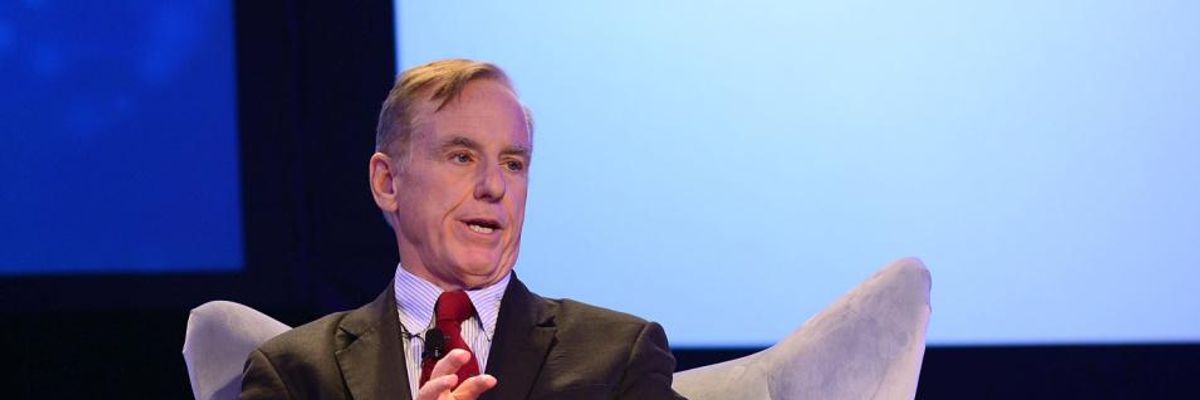
Former Vermont Gov. Howard Dean speaks during an event on November 9, 2017 in Danville, Pennsylvania. (Photo: Lisa Lake/Getty Images for Geisinger Symposium)
Former Vermont governor and erstwhile Democratic presidential candidate Howard Dean is publicly urging President Joe Biden to oppose a South Africa- and India-led effort to temporarily lift coronavirus vaccine patents, a move that would help facilitate broad-based generic production of vaccines for developing nations.
In an op-ed for Barron's last month, Dean--who currently works in the lobbying division of the global law firm Dentons--claimed that India's sponsorship of the proposed intellectual property waiver is nothing more than a "thinly veiled attempt to boost its drug industry" and argued that "President Biden would be wise to reject it."
"Suspending IP protections won't speed up Covid-19 vaccine production," Dean declared. "Every drug manufacturing facility on the planet that's capable of churning out Covid-19 shots is already doing so."
But as The Intercept's Lee Fang noted Thursday, "Dean's claim that global vaccine manufacturing is already at capacity is patently false."
"Foreign firms have lined up to offer pharmaceutical plants to produce vaccines but have been forced to enter into lengthy negotiations under terms set by the intellectual property owners," Fang wrote. "The waiver, however, would allow generic drug producers to begin copying the vaccine without delay."
The Associated Press reported last month that on three continents, it found factories "whose owners say they could start producing hundreds of millions of Covid-19 vaccines on short notice if only they had the blueprints and technical know-how."
Previously a supporter of single-payer healthcare, Dean was considered a "progressive outsider" when he contended for the Democratic presidential nomination in 2004. But Dean has dramatically changed his tune since joining Dentons, a global law firm that has done work on behalf of corporations in a variety of industries, including healthcare.
"Dentons touts its work on drug intellectual property issues, noting on its website that it has represented Pfizer and other firms in the recent past," Fang pointed out. "[Dean's] official role is as a senior advisor to its government affairs practice focused on corporate healthcare clients, though as The Intercept has previously reported, he engages in almost every lobbying activity imaginable."
First introduced at the World Trade Organization (WTO) in October, South Africa and India's patent waiver proposal has since garnered the support of more than a 100 countries, hundreds of progressive advocacy organizations, U.S. members of Congress, Nobel Prize-winning economists, and the head of the World Health Organization. Predictably, the pharmaceutical industry has lobbied against the waiver.
Because the WTO operates on consensus, a small number of rich nations--including the U.S., the U.K., and members of the European Union--have been able to block the proposal, leaving large pharmaceutical companies in control of vaccine production and denying the recipes to low-income nations.
At the current rate of vaccine production and distribution, experts fear that most poor nations could take until 2024 to achieve mass inoculation against Covid-19, a delay that could allow vaccine-resistant variants to emerge and spread widely.
As Common Dreams reported last week, U.S. President Biden is now considering whether to back the patent waiver as a growing number of congressional Democrats voice support for the idea.
"The waiver is supported by over 100 countries and being opposed by only a handful of rich countries," Rep. Jan Schakowsky (D-Ill.) wrote in a Medium post last month. "The world needs as much vaccine manufacturing capacity as it can get. Time is of the essence."
Dear Common Dreams reader, It’s been nearly 30 years since I co-founded Common Dreams with my late wife, Lina Newhouser. We had the radical notion that journalism should serve the public good, not corporate profits. It was clear to us from the outset what it would take to build such a project. No paid advertisements. No corporate sponsors. No millionaire publisher telling us what to think or do. Many people said we wouldn't last a year, but we proved those doubters wrong. Together with a tremendous team of journalists and dedicated staff, we built an independent media outlet free from the constraints of profits and corporate control. Our mission has always been simple: To inform. To inspire. To ignite change for the common good. Building Common Dreams was not easy. Our survival was never guaranteed. When you take on the most powerful forces—Wall Street greed, fossil fuel industry destruction, Big Tech lobbyists, and uber-rich oligarchs who have spent billions upon billions rigging the economy and democracy in their favor—the only bulwark you have is supporters who believe in your work. But here’s the urgent message from me today. It's never been this bad out there. And it's never been this hard to keep us going. At the very moment Common Dreams is most needed, the threats we face are intensifying. We need your support now more than ever. We don't accept corporate advertising and never will. We don't have a paywall because we don't think people should be blocked from critical news based on their ability to pay. Everything we do is funded by the donations of readers like you. When everyone does the little they can afford, we are strong. But if that support retreats or dries up, so do we. Will you donate now to make sure Common Dreams not only survives but thrives? —Craig Brown, Co-founder |
Former Vermont governor and erstwhile Democratic presidential candidate Howard Dean is publicly urging President Joe Biden to oppose a South Africa- and India-led effort to temporarily lift coronavirus vaccine patents, a move that would help facilitate broad-based generic production of vaccines for developing nations.
In an op-ed for Barron's last month, Dean--who currently works in the lobbying division of the global law firm Dentons--claimed that India's sponsorship of the proposed intellectual property waiver is nothing more than a "thinly veiled attempt to boost its drug industry" and argued that "President Biden would be wise to reject it."
"Suspending IP protections won't speed up Covid-19 vaccine production," Dean declared. "Every drug manufacturing facility on the planet that's capable of churning out Covid-19 shots is already doing so."
But as The Intercept's Lee Fang noted Thursday, "Dean's claim that global vaccine manufacturing is already at capacity is patently false."
"Foreign firms have lined up to offer pharmaceutical plants to produce vaccines but have been forced to enter into lengthy negotiations under terms set by the intellectual property owners," Fang wrote. "The waiver, however, would allow generic drug producers to begin copying the vaccine without delay."
The Associated Press reported last month that on three continents, it found factories "whose owners say they could start producing hundreds of millions of Covid-19 vaccines on short notice if only they had the blueprints and technical know-how."
Previously a supporter of single-payer healthcare, Dean was considered a "progressive outsider" when he contended for the Democratic presidential nomination in 2004. But Dean has dramatically changed his tune since joining Dentons, a global law firm that has done work on behalf of corporations in a variety of industries, including healthcare.
"Dentons touts its work on drug intellectual property issues, noting on its website that it has represented Pfizer and other firms in the recent past," Fang pointed out. "[Dean's] official role is as a senior advisor to its government affairs practice focused on corporate healthcare clients, though as The Intercept has previously reported, he engages in almost every lobbying activity imaginable."
First introduced at the World Trade Organization (WTO) in October, South Africa and India's patent waiver proposal has since garnered the support of more than a 100 countries, hundreds of progressive advocacy organizations, U.S. members of Congress, Nobel Prize-winning economists, and the head of the World Health Organization. Predictably, the pharmaceutical industry has lobbied against the waiver.
Because the WTO operates on consensus, a small number of rich nations--including the U.S., the U.K., and members of the European Union--have been able to block the proposal, leaving large pharmaceutical companies in control of vaccine production and denying the recipes to low-income nations.
At the current rate of vaccine production and distribution, experts fear that most poor nations could take until 2024 to achieve mass inoculation against Covid-19, a delay that could allow vaccine-resistant variants to emerge and spread widely.
As Common Dreams reported last week, U.S. President Biden is now considering whether to back the patent waiver as a growing number of congressional Democrats voice support for the idea.
"The waiver is supported by over 100 countries and being opposed by only a handful of rich countries," Rep. Jan Schakowsky (D-Ill.) wrote in a Medium post last month. "The world needs as much vaccine manufacturing capacity as it can get. Time is of the essence."
Former Vermont governor and erstwhile Democratic presidential candidate Howard Dean is publicly urging President Joe Biden to oppose a South Africa- and India-led effort to temporarily lift coronavirus vaccine patents, a move that would help facilitate broad-based generic production of vaccines for developing nations.
In an op-ed for Barron's last month, Dean--who currently works in the lobbying division of the global law firm Dentons--claimed that India's sponsorship of the proposed intellectual property waiver is nothing more than a "thinly veiled attempt to boost its drug industry" and argued that "President Biden would be wise to reject it."
"Suspending IP protections won't speed up Covid-19 vaccine production," Dean declared. "Every drug manufacturing facility on the planet that's capable of churning out Covid-19 shots is already doing so."
But as The Intercept's Lee Fang noted Thursday, "Dean's claim that global vaccine manufacturing is already at capacity is patently false."
"Foreign firms have lined up to offer pharmaceutical plants to produce vaccines but have been forced to enter into lengthy negotiations under terms set by the intellectual property owners," Fang wrote. "The waiver, however, would allow generic drug producers to begin copying the vaccine without delay."
The Associated Press reported last month that on three continents, it found factories "whose owners say they could start producing hundreds of millions of Covid-19 vaccines on short notice if only they had the blueprints and technical know-how."
Previously a supporter of single-payer healthcare, Dean was considered a "progressive outsider" when he contended for the Democratic presidential nomination in 2004. But Dean has dramatically changed his tune since joining Dentons, a global law firm that has done work on behalf of corporations in a variety of industries, including healthcare.
"Dentons touts its work on drug intellectual property issues, noting on its website that it has represented Pfizer and other firms in the recent past," Fang pointed out. "[Dean's] official role is as a senior advisor to its government affairs practice focused on corporate healthcare clients, though as The Intercept has previously reported, he engages in almost every lobbying activity imaginable."
First introduced at the World Trade Organization (WTO) in October, South Africa and India's patent waiver proposal has since garnered the support of more than a 100 countries, hundreds of progressive advocacy organizations, U.S. members of Congress, Nobel Prize-winning economists, and the head of the World Health Organization. Predictably, the pharmaceutical industry has lobbied against the waiver.
Because the WTO operates on consensus, a small number of rich nations--including the U.S., the U.K., and members of the European Union--have been able to block the proposal, leaving large pharmaceutical companies in control of vaccine production and denying the recipes to low-income nations.
At the current rate of vaccine production and distribution, experts fear that most poor nations could take until 2024 to achieve mass inoculation against Covid-19, a delay that could allow vaccine-resistant variants to emerge and spread widely.
As Common Dreams reported last week, U.S. President Biden is now considering whether to back the patent waiver as a growing number of congressional Democrats voice support for the idea.
"The waiver is supported by over 100 countries and being opposed by only a handful of rich countries," Rep. Jan Schakowsky (D-Ill.) wrote in a Medium post last month. "The world needs as much vaccine manufacturing capacity as it can get. Time is of the essence."