

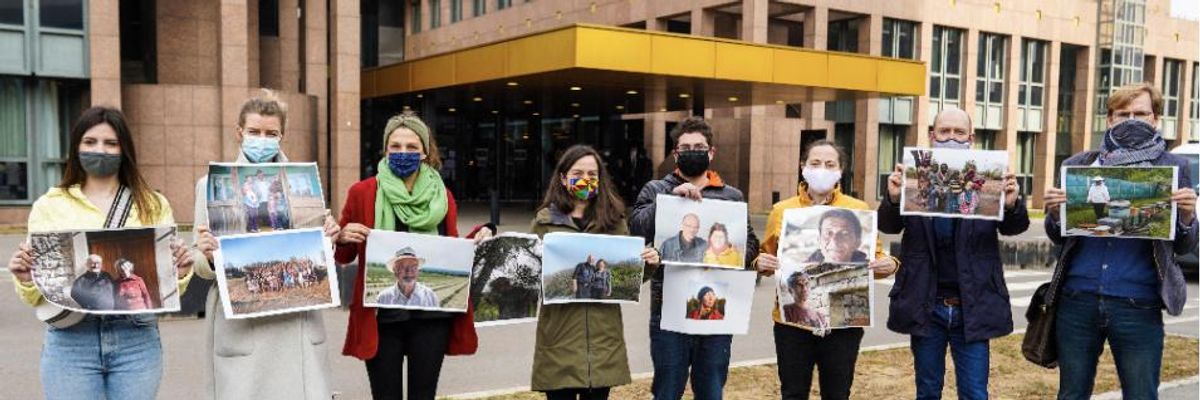
Supporters of the People's Climate Case gathered outside the European Union's top court on Thursday. (Photo: Morris Kemp)
Families and Indigenous Youth Vow to 'Not Give Up' After Top EU Court Dismisses 'People's Climate Case'
"We will keep fighting for justice and for the protection of fundamental rights that are threatened by the unequal and diverse impacts of climate change."
Plaintiffs in the "People's Climate Case" promised to keep fighting for justice after the European Union's top court on Thursday decided to "close its doors to people hit by climate impacts" by upholding a lower court's dismissal of the case on procedural grounds.
"We will continue seeking protection of our rights and demand climate protection until E.U. decision-makers listen to their citizens and take climate change as a priority for Europe."
--Alfredo Sendim, Portuguese farmer
Initiated in 2018 by families from Fiji, France, Germany, Italy, Kenya, Portugal, Romania, and a Sami youth association in Sweden, the case directed at the European Parliament and the Council of the E.U. challenged the bloc's former goal to cut greenhouse gas emissions by at least 40% by 2030 compared to 1990 levels.
The European General Court dismissed the case in 2019, claiming that plaintiffs weren't "individually" impacted by European climate policy. As a statement from Climate Action Network (CAN) Europe--an NGO coalition supporting the case--explained, the higher court also found that "plaintiffs did not have a right to challenge the E.U. for its climate inaction, based on old case law dating back to the 1960s, whereby an individual must be 'uniquely' affected by an E.U. legislative act in order to be allowed to challenge it."
In response to Thursday's ruling, plaintiff attorney Roda Verheyen said that "these families put their trust in the E.U. legal system to protect their rights. But the E.U. courts failed to interpret existing rules in the context of climate change. This judgement is wholly unconvincing and only speaks of the fear of action by citizens. On the contrary: granting access to justice to its citizens would not have hurt the E.U. but made it stronger."
Despite the setback, plaintiffs made clear that they remain dedicated to the fight.
"We started this case to demand climate justice for the people who live on islands like us and for the next generations. We see the impacts of climate change every day on our island," said German plaintiffs Maike and Michael Recktenwald. "The court's decision will not make us stop."
Noting the "dramatic consequences" of consecutive droughts and heatwaves on his family and others across Europe, French lavender farmer Maurice Feschet said that "today, the hope that we put in the legal system to protect us and our co-plaintiffs has failed. But we are not giving up. We will keep fighting for justice and for the protection of fundamental rights that are threatened by the unequal and diverse impacts of climate change. We might have lost today but our voices are getting louder to ensure a viable future for present and next generations."
Portuguese farmer Alfredo Sendim echoed that sentiment: "The court's decision is disappointing, but we will not give up. We will continue seeking protection of our rights and demand climate protection until E.U. decision-makers listen to their citizens and take climate change as a priority for Europe."
Sendim, whose country is also impacted by droughts, said that "it is almost impossible to adapt to the current climate conditions and continue our sustainable agriculture farming that seeks to follow the cycle of nature. We are still in time to change the course of history and have a safer future for next generations, but to do so, we must act now."
Sanna Vannar of the Sami youth organization also emphasized the urgency of ambitious climate action.
"The Sami people live in the middle of the climate crisis every day," Vannar said. "We see how the climate crisis affects the reindeer, nature, and our culture. We have been talking about these changes and their impacts for so long now. Unfortunately no one has listened. It makes me so angry and frustrated that the E.U. does not take this problem seriously and addresses it like an emergency--because it is an emergency for Europe's Indigenous peoples."
As the Associated Press reported:
After the legal effort was initially launched, the European Commission proposed a "European Green Deal" with more ambitious goals toward fighting climate change. European Union leaders reached a deal last year to cut the bloc's net greenhouse gas emissions by at least 55% by 2030 compared with 1990 levels, more than the previous goal of 40%.
However, Europe's updated plan has still been criticized as not bold enough. Last month, a U.N. report revealed that emissions reduction pledges from parties to the Paris agreement are dangerously insufficient. Oxfam's global climate policy lead, Nafkote Dabi, called the findings "appalling" and blasted various nations for not submitting or revising their plans.
"Even the E.U.'s revised target to reduce emissions from 40% to 55%, is still far below their owed 65% reduction fair share to limit global warming," Dabi said. "This is irresponsible."
CAN Europe director Wendel Trio noted Thursday that "with climate urgency growing day by day, the E.U. needs to step up climate action and E.U. citizens are looking at their courts to help them avoid dangerous climate change."
Last year, citing the "importance and urgency of the issues raised," the European Court of Human Rights decided to fast-track a historic lawsuit led by Portuguese youth that has been described as possibly "the most important case" the body has ever tried. In February, that court dismissed a coordinated attempt by governments to overturn the priority decision.
"It is a shame the European Court of Justice distances itself from other courts by refusing to take up the matter and hiding itself beyond outdated procedural rules," said Trio. "If the E.U. is to make sense to its citizens, it will need to recognize that accountability is key to ensure a well functioning democracy. The E.U. urgently needs to step up the protection of its citizens, by both increasing climate action and providing access to justice to all its citizens."
We are at a crossroads
This country and this world are at a monumental crossroads. In a few short weeks, US voters will have an opportunity to beat back the forces of fascism and confront the billionaires who are rigging the economy, our media system, and our democracy, making it increasingly impossible for ordinary people to get by. We’re not just talking about the election. We’re talking about what must be done once these fascist elements are vanquished from power. We need a bolder set of solutions than what either major party has so far been willing to offer and a working-class movement ready to fight like hell for it. Trump didn't emerge from nowhere. The conditions that fueled MAGA authoritarianism were created by decades of radical neoliberal economic policies and a corrupt political system dominated by corporate interests. They slashed taxes on the super-rich, promising that the benefits would trickle down. They said giveaways to the corporate titans would make life more affordable for the rest of us. It was all bullshit. And when a bitter, betrayed populace searches for someone to blame, right-wing demagogues have little trouble finding scapegoats. People know when they're being lied to, but you won't hear any of this from the corporate media. Only independent journalism—powered and funded by people who believe in building a better world—can deliver truly trustworthy daily news. Our Fall Campaign is underway, and we need your help. To power our newsroom through the rest of the year, we need to raise $125,000 by midnight on October 31. So if you share our vision, please contribute whatever you can to sustain our work. |
Plaintiffs in the "People's Climate Case" promised to keep fighting for justice after the European Union's top court on Thursday decided to "close its doors to people hit by climate impacts" by upholding a lower court's dismissal of the case on procedural grounds.
"We will continue seeking protection of our rights and demand climate protection until E.U. decision-makers listen to their citizens and take climate change as a priority for Europe."
--Alfredo Sendim, Portuguese farmer
Initiated in 2018 by families from Fiji, France, Germany, Italy, Kenya, Portugal, Romania, and a Sami youth association in Sweden, the case directed at the European Parliament and the Council of the E.U. challenged the bloc's former goal to cut greenhouse gas emissions by at least 40% by 2030 compared to 1990 levels.
The European General Court dismissed the case in 2019, claiming that plaintiffs weren't "individually" impacted by European climate policy. As a statement from Climate Action Network (CAN) Europe--an NGO coalition supporting the case--explained, the higher court also found that "plaintiffs did not have a right to challenge the E.U. for its climate inaction, based on old case law dating back to the 1960s, whereby an individual must be 'uniquely' affected by an E.U. legislative act in order to be allowed to challenge it."
In response to Thursday's ruling, plaintiff attorney Roda Verheyen said that "these families put their trust in the E.U. legal system to protect their rights. But the E.U. courts failed to interpret existing rules in the context of climate change. This judgement is wholly unconvincing and only speaks of the fear of action by citizens. On the contrary: granting access to justice to its citizens would not have hurt the E.U. but made it stronger."
Despite the setback, plaintiffs made clear that they remain dedicated to the fight.
"We started this case to demand climate justice for the people who live on islands like us and for the next generations. We see the impacts of climate change every day on our island," said German plaintiffs Maike and Michael Recktenwald. "The court's decision will not make us stop."
Noting the "dramatic consequences" of consecutive droughts and heatwaves on his family and others across Europe, French lavender farmer Maurice Feschet said that "today, the hope that we put in the legal system to protect us and our co-plaintiffs has failed. But we are not giving up. We will keep fighting for justice and for the protection of fundamental rights that are threatened by the unequal and diverse impacts of climate change. We might have lost today but our voices are getting louder to ensure a viable future for present and next generations."
Portuguese farmer Alfredo Sendim echoed that sentiment: "The court's decision is disappointing, but we will not give up. We will continue seeking protection of our rights and demand climate protection until E.U. decision-makers listen to their citizens and take climate change as a priority for Europe."
Sendim, whose country is also impacted by droughts, said that "it is almost impossible to adapt to the current climate conditions and continue our sustainable agriculture farming that seeks to follow the cycle of nature. We are still in time to change the course of history and have a safer future for next generations, but to do so, we must act now."
Sanna Vannar of the Sami youth organization also emphasized the urgency of ambitious climate action.
"The Sami people live in the middle of the climate crisis every day," Vannar said. "We see how the climate crisis affects the reindeer, nature, and our culture. We have been talking about these changes and their impacts for so long now. Unfortunately no one has listened. It makes me so angry and frustrated that the E.U. does not take this problem seriously and addresses it like an emergency--because it is an emergency for Europe's Indigenous peoples."
As the Associated Press reported:
After the legal effort was initially launched, the European Commission proposed a "European Green Deal" with more ambitious goals toward fighting climate change. European Union leaders reached a deal last year to cut the bloc's net greenhouse gas emissions by at least 55% by 2030 compared with 1990 levels, more than the previous goal of 40%.
However, Europe's updated plan has still been criticized as not bold enough. Last month, a U.N. report revealed that emissions reduction pledges from parties to the Paris agreement are dangerously insufficient. Oxfam's global climate policy lead, Nafkote Dabi, called the findings "appalling" and blasted various nations for not submitting or revising their plans.
"Even the E.U.'s revised target to reduce emissions from 40% to 55%, is still far below their owed 65% reduction fair share to limit global warming," Dabi said. "This is irresponsible."
CAN Europe director Wendel Trio noted Thursday that "with climate urgency growing day by day, the E.U. needs to step up climate action and E.U. citizens are looking at their courts to help them avoid dangerous climate change."
Last year, citing the "importance and urgency of the issues raised," the European Court of Human Rights decided to fast-track a historic lawsuit led by Portuguese youth that has been described as possibly "the most important case" the body has ever tried. In February, that court dismissed a coordinated attempt by governments to overturn the priority decision.
"It is a shame the European Court of Justice distances itself from other courts by refusing to take up the matter and hiding itself beyond outdated procedural rules," said Trio. "If the E.U. is to make sense to its citizens, it will need to recognize that accountability is key to ensure a well functioning democracy. The E.U. urgently needs to step up the protection of its citizens, by both increasing climate action and providing access to justice to all its citizens."