SUBSCRIBE TO OUR FREE NEWSLETTER
Daily news & progressive opinion—funded by the people, not the corporations—delivered straight to your inbox.
5
#000000
#FFFFFF
To donate by check, phone, or other method, see our More Ways to Give page.
Daily news & progressive opinion—funded by the people, not the corporations—delivered straight to your inbox.
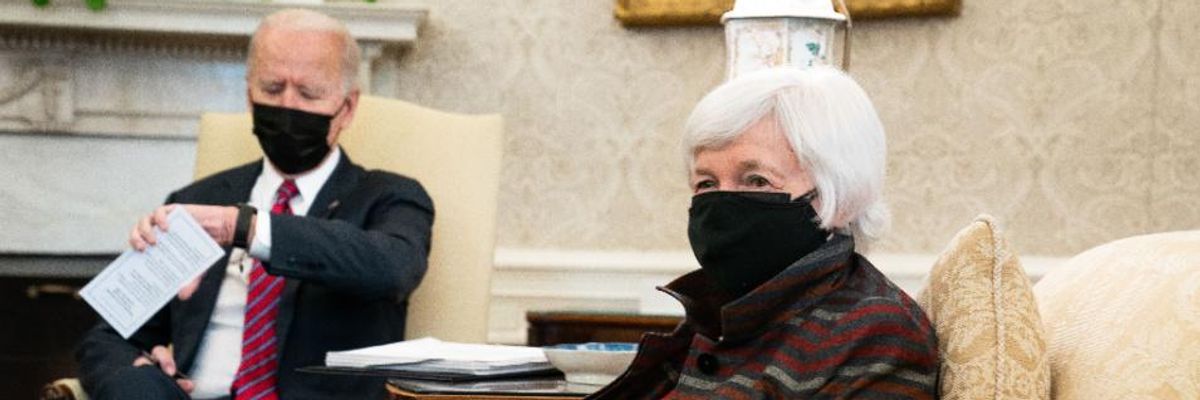
President Joe Biden meets with Treasury Secretary Janet Yellen in the Oval Office of the White House on January 29, 2021 in Washington, D.C. (Photo: Anna Moneymaker-Pool/Getty Images)
Direct payments ranging from $1,400 for individuals to $5,600 for families of four began landing in U.S. bank accounts late Friday, just over 24 hours after President Joe Biden signed into law a $1.9 trillion coronavirus relief package that also includes an extension of emergency unemployment programs, a major expansion of the child tax credit, and billions of dollars for vaccine distribution.
"Mine is already listed as pending in my credit union's account. Wow. This is the kind of speed and efficiency we should always expect from our government," Robert Cruickshank, campaign director at advocacy group Demand Progress, tweeted Friday night--and he was far from alone.
"Stimulus cash is already out the door," wrote NBC News reporter Sahil Kapur, who tweeted out screenshots of bank postings he received from unnamed Americans. "Getting more of these than I can handle now--suffice it to say a lot of people are seeing money tonight."
As the Wall Street Journal reported Friday, "Payments began reaching some bank accounts Friday, according to Current, a banking app that said it had started crediting thousands of customers' accounts shortly after 11 am. Chime, another app, said Friday on Twitter it had put $600 million into accounts already."
The Treasury Department said in a statement Friday that the relief checks, formally known as Economic Impact Payments, would "begin rolling out in tranches to millions of Americans in the coming weeks" as joblessness and hunger remain high across the nation.
In partnership with the IRS and the Bureau of the Fiscal Service, the department "enacted an operational plan to begin processing the first batch of these payments today, which some recipients will start receiving as early as this weekend, and with more receiving this coming week."
"Additional large batches of payments, which will be automatic and require no action by taxpayers, will be sent in the coming weeks by direct deposit and through the mail as a check or debit card," the department said, announcing that eligible Americans will be able to monitor the status of their payments using the IRS' "Get My Payment" tool beginning next week.
Under the American Rescue Plan, only individuals earning $75,000 a year or less, heads of household earning $112,500 or less, and joint filers earning $150,000 or less--based on either 2019 or 2020 income--are eligible to receive full $1,400 payments. Families will also receive $1,400 per child and adult dependent.
The Washington Post's Michelle Singletary emphasized last week that "if your income was too high for a payment based on your adjusted gross income for 2019 but you think you may be eligible based on your circumstances from last year, you should file your tax return as soon as you can."
People whose incomes exceed the above thresholds will receive partial payments, with checks completely cutting off for individuals who earn more than $80,000 a year, heads of household who earn more than $120,000, and joint filers who earn more than $160,000. In total, around 280 million people in the U.S. are expected to receive full or partial payments under the relief law.
"Across the U.S., families like this will soon wake up to $5,600 in their bank accounts," said Rep. Gerry Connolly (D-Va.), pointing to Kapur's Twitter thread. "$5,600 for bills. Or for groceries. Or to repair the family car that broke down months ago but was too costly to fix. I can't describe how proud I am that we were able to get this done."
As the nearly $2 trillion relief package made its way through Congress, progressive lawmakers who have advocated for monthly recurring survival checks were able to fight off attempts by conservative Democrats to dramatically lower the income cutoffs for the new round of payments. But the Senate Democratic leadership--with Biden's blessing--ultimately opted to accelerate the phase-out of the checks, a move that rendered an additional 17 million people ineligible.
Following final passage of the relief legislation on Wednesday, Rep. Cori Bush (D-Mo.) declared that "the fight for monthly, retroactive $2,000 stimulus checks is not over."
Rep. Jamaal Bowman (D-N.Y.) echoed that message, tweeting that "the American Rescue Plan is a good first step but Americans deserve continuing support until this pandemic ends."
"That's why I am proud to support Reps. Rashida Tlaib and Pramila Jayapal's ABC Act for $2,000 monthly relief checks," Bowman wrote.
Dear Common Dreams reader, It’s been nearly 30 years since I co-founded Common Dreams with my late wife, Lina Newhouser. We had the radical notion that journalism should serve the public good, not corporate profits. It was clear to us from the outset what it would take to build such a project. No paid advertisements. No corporate sponsors. No millionaire publisher telling us what to think or do. Many people said we wouldn't last a year, but we proved those doubters wrong. Together with a tremendous team of journalists and dedicated staff, we built an independent media outlet free from the constraints of profits and corporate control. Our mission has always been simple: To inform. To inspire. To ignite change for the common good. Building Common Dreams was not easy. Our survival was never guaranteed. When you take on the most powerful forces—Wall Street greed, fossil fuel industry destruction, Big Tech lobbyists, and uber-rich oligarchs who have spent billions upon billions rigging the economy and democracy in their favor—the only bulwark you have is supporters who believe in your work. But here’s the urgent message from me today. It's never been this bad out there. And it's never been this hard to keep us going. At the very moment Common Dreams is most needed, the threats we face are intensifying. We need your support now more than ever. We don't accept corporate advertising and never will. We don't have a paywall because we don't think people should be blocked from critical news based on their ability to pay. Everything we do is funded by the donations of readers like you. When everyone does the little they can afford, we are strong. But if that support retreats or dries up, so do we. Will you donate now to make sure Common Dreams not only survives but thrives? —Craig Brown, Co-founder |
Direct payments ranging from $1,400 for individuals to $5,600 for families of four began landing in U.S. bank accounts late Friday, just over 24 hours after President Joe Biden signed into law a $1.9 trillion coronavirus relief package that also includes an extension of emergency unemployment programs, a major expansion of the child tax credit, and billions of dollars for vaccine distribution.
"Mine is already listed as pending in my credit union's account. Wow. This is the kind of speed and efficiency we should always expect from our government," Robert Cruickshank, campaign director at advocacy group Demand Progress, tweeted Friday night--and he was far from alone.
"Stimulus cash is already out the door," wrote NBC News reporter Sahil Kapur, who tweeted out screenshots of bank postings he received from unnamed Americans. "Getting more of these than I can handle now--suffice it to say a lot of people are seeing money tonight."
As the Wall Street Journal reported Friday, "Payments began reaching some bank accounts Friday, according to Current, a banking app that said it had started crediting thousands of customers' accounts shortly after 11 am. Chime, another app, said Friday on Twitter it had put $600 million into accounts already."
The Treasury Department said in a statement Friday that the relief checks, formally known as Economic Impact Payments, would "begin rolling out in tranches to millions of Americans in the coming weeks" as joblessness and hunger remain high across the nation.
In partnership with the IRS and the Bureau of the Fiscal Service, the department "enacted an operational plan to begin processing the first batch of these payments today, which some recipients will start receiving as early as this weekend, and with more receiving this coming week."
"Additional large batches of payments, which will be automatic and require no action by taxpayers, will be sent in the coming weeks by direct deposit and through the mail as a check or debit card," the department said, announcing that eligible Americans will be able to monitor the status of their payments using the IRS' "Get My Payment" tool beginning next week.
Under the American Rescue Plan, only individuals earning $75,000 a year or less, heads of household earning $112,500 or less, and joint filers earning $150,000 or less--based on either 2019 or 2020 income--are eligible to receive full $1,400 payments. Families will also receive $1,400 per child and adult dependent.
The Washington Post's Michelle Singletary emphasized last week that "if your income was too high for a payment based on your adjusted gross income for 2019 but you think you may be eligible based on your circumstances from last year, you should file your tax return as soon as you can."
People whose incomes exceed the above thresholds will receive partial payments, with checks completely cutting off for individuals who earn more than $80,000 a year, heads of household who earn more than $120,000, and joint filers who earn more than $160,000. In total, around 280 million people in the U.S. are expected to receive full or partial payments under the relief law.
"Across the U.S., families like this will soon wake up to $5,600 in their bank accounts," said Rep. Gerry Connolly (D-Va.), pointing to Kapur's Twitter thread. "$5,600 for bills. Or for groceries. Or to repair the family car that broke down months ago but was too costly to fix. I can't describe how proud I am that we were able to get this done."
As the nearly $2 trillion relief package made its way through Congress, progressive lawmakers who have advocated for monthly recurring survival checks were able to fight off attempts by conservative Democrats to dramatically lower the income cutoffs for the new round of payments. But the Senate Democratic leadership--with Biden's blessing--ultimately opted to accelerate the phase-out of the checks, a move that rendered an additional 17 million people ineligible.
Following final passage of the relief legislation on Wednesday, Rep. Cori Bush (D-Mo.) declared that "the fight for monthly, retroactive $2,000 stimulus checks is not over."
Rep. Jamaal Bowman (D-N.Y.) echoed that message, tweeting that "the American Rescue Plan is a good first step but Americans deserve continuing support until this pandemic ends."
"That's why I am proud to support Reps. Rashida Tlaib and Pramila Jayapal's ABC Act for $2,000 monthly relief checks," Bowman wrote.
Direct payments ranging from $1,400 for individuals to $5,600 for families of four began landing in U.S. bank accounts late Friday, just over 24 hours after President Joe Biden signed into law a $1.9 trillion coronavirus relief package that also includes an extension of emergency unemployment programs, a major expansion of the child tax credit, and billions of dollars for vaccine distribution.
"Mine is already listed as pending in my credit union's account. Wow. This is the kind of speed and efficiency we should always expect from our government," Robert Cruickshank, campaign director at advocacy group Demand Progress, tweeted Friday night--and he was far from alone.
"Stimulus cash is already out the door," wrote NBC News reporter Sahil Kapur, who tweeted out screenshots of bank postings he received from unnamed Americans. "Getting more of these than I can handle now--suffice it to say a lot of people are seeing money tonight."
As the Wall Street Journal reported Friday, "Payments began reaching some bank accounts Friday, according to Current, a banking app that said it had started crediting thousands of customers' accounts shortly after 11 am. Chime, another app, said Friday on Twitter it had put $600 million into accounts already."
The Treasury Department said in a statement Friday that the relief checks, formally known as Economic Impact Payments, would "begin rolling out in tranches to millions of Americans in the coming weeks" as joblessness and hunger remain high across the nation.
In partnership with the IRS and the Bureau of the Fiscal Service, the department "enacted an operational plan to begin processing the first batch of these payments today, which some recipients will start receiving as early as this weekend, and with more receiving this coming week."
"Additional large batches of payments, which will be automatic and require no action by taxpayers, will be sent in the coming weeks by direct deposit and through the mail as a check or debit card," the department said, announcing that eligible Americans will be able to monitor the status of their payments using the IRS' "Get My Payment" tool beginning next week.
Under the American Rescue Plan, only individuals earning $75,000 a year or less, heads of household earning $112,500 or less, and joint filers earning $150,000 or less--based on either 2019 or 2020 income--are eligible to receive full $1,400 payments. Families will also receive $1,400 per child and adult dependent.
The Washington Post's Michelle Singletary emphasized last week that "if your income was too high for a payment based on your adjusted gross income for 2019 but you think you may be eligible based on your circumstances from last year, you should file your tax return as soon as you can."
People whose incomes exceed the above thresholds will receive partial payments, with checks completely cutting off for individuals who earn more than $80,000 a year, heads of household who earn more than $120,000, and joint filers who earn more than $160,000. In total, around 280 million people in the U.S. are expected to receive full or partial payments under the relief law.
"Across the U.S., families like this will soon wake up to $5,600 in their bank accounts," said Rep. Gerry Connolly (D-Va.), pointing to Kapur's Twitter thread. "$5,600 for bills. Or for groceries. Or to repair the family car that broke down months ago but was too costly to fix. I can't describe how proud I am that we were able to get this done."
As the nearly $2 trillion relief package made its way through Congress, progressive lawmakers who have advocated for monthly recurring survival checks were able to fight off attempts by conservative Democrats to dramatically lower the income cutoffs for the new round of payments. But the Senate Democratic leadership--with Biden's blessing--ultimately opted to accelerate the phase-out of the checks, a move that rendered an additional 17 million people ineligible.
Following final passage of the relief legislation on Wednesday, Rep. Cori Bush (D-Mo.) declared that "the fight for monthly, retroactive $2,000 stimulus checks is not over."
Rep. Jamaal Bowman (D-N.Y.) echoed that message, tweeting that "the American Rescue Plan is a good first step but Americans deserve continuing support until this pandemic ends."
"That's why I am proud to support Reps. Rashida Tlaib and Pramila Jayapal's ABC Act for $2,000 monthly relief checks," Bowman wrote.