SUBSCRIBE TO OUR FREE NEWSLETTER
Daily news & progressive opinion—funded by the people, not the corporations—delivered straight to your inbox.
5
#000000
#FFFFFF
To donate by check, phone, or other method, see our More Ways to Give page.
Daily news & progressive opinion—funded by the people, not the corporations—delivered straight to your inbox.
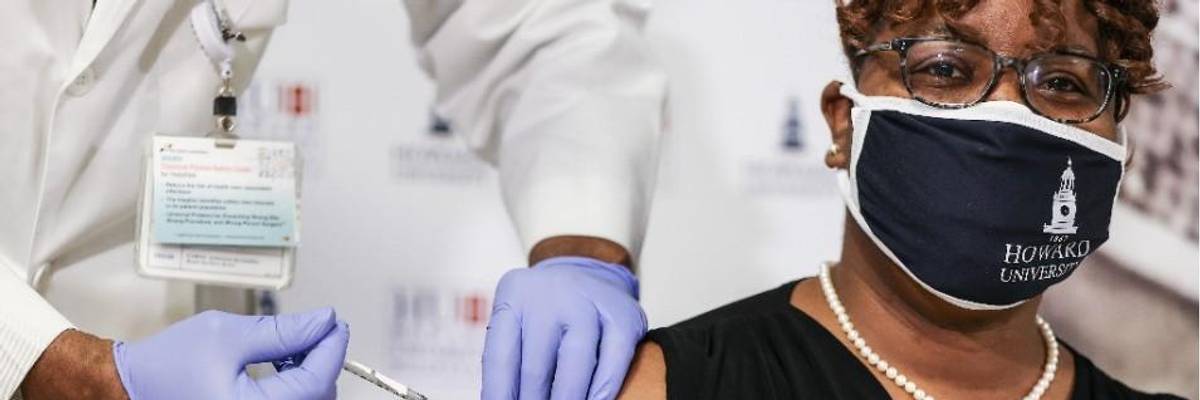
Howard University Hospital staff members received Covid-19 vaccination doses on December 15, 2020 in Washington, D.C. (Photo: Tasos Katopodis/Getty Images)
A new paper from a group of leading economists rebukes the "ugliness of vaccine hoarding" by some wealthy nations and calls for a suspension of pharmaceutical companies' patent rights to counter the unequal access to doses and help end the coronavirus pandemic.
The proposals are laid out in a report released Thursday from the Institute for New Economic Thinking's (INET) Commission on Global Economic Transformation, a body chaired by Nobel laureates Joseph Stiglitz and Michael Spence.
The authors point to "the glaring deficiencies in our global debt regime" and frame their proposals as immediate measures that would foster "robust recovery."
There have been "unseemly and unfair vaccine grabs by the governments of some of the advanced countries," the report says. It cites as an example Canada, which secured jabs "for more than 10 times their current population." And while millions of doses have already been administered in dozens of wealther nations, "[a]s of the time of writing this report, 130 countries were yet to have administered a single dose."
The report notes that COVAX, the World World Health Organization-led initiative working for equitable access to Covid-19 vaccines, is still underfunded despite wealthier nations' ability to boost financing. "COVAX is unable to procure the required vaccines from producers who have received regulatory approval, because of vaccine grabbing by governments," the authors write.
Further distribution of doses is possible, the report argues, if the WHO takes "a proactive approach" to vaccines developed by other nations, including those from Russia and China, once governments' regulatory authorities deem them safe.
But right now, according to the economists, there is "completely unnecessary" vaccine scarcity, as a result of pharmaceutical companies' patent rights that give them "a monopoly on production" despite massive public funding. From the report:
Patents are usually seen as a necessary reward for invention/innovation, yet in the specific case of Covid-19 vaccines, pharma companies have received massive support from governments that have mostly and in some cases completely covered their R&D costs. In the U.S. alone, the six major vaccine companies received over $12 billion in public support; other rich country governments also provided support to these companies for developing these vaccines. They also benefited from prior public research and reduced costs of clinical testing because of more unpaid volunteers for trials. It is likely that the three "leader" vaccines have already received what could be considered as reasonable returns on their own investment, and more.
The economists note that wealthy countries are blocking a demand for the WTO to waive Trade-Related Intellectual Property Rights (TRIPS) rules in order to allow generic manufacturing of the vaccines to boost production. That opposition is self-defeating, the report asserts, given that the waiver would "benefit their own populations by making available more doses of vaccines quickly, and larger supply would reduce costs of additional doses of vaccines, making them cheaper for governments and taxpayers across the world."
A "global move for suspension and/or modification of intellectual property rights, for matters relating to essential public health concerns, is essential," the report says, and urges governments of wealther nations to "press vaccine manufacturers to share their knowledge with local producers and facilitate their ability to do so."
To further aid economic recovering big government spending is needed, including through measures like an extension of unemployment insurance. "This is not the time for austerity," they write.
Richer nations were also cautioned against pushing "fiscal austerity in IMF agreements" or "measures that increase inequality (like regressive taxation)."
The economists also address the crushing debt held by poorer nations. The wrote: "Money that is sent abroad to service their debt is money that could have been spent to rejuvenate the economy, to provide health protection for citizens, to purchase vaccines, etc."
In light of the continued economic downturn, the report says that"what is needed today is not just a debt moratorium, which simply kicks the can down the road while making the debts owed by the developing countries larger, but a deep and timely debt restructuring."
Political leaders, the group added, must "recognize that a healthy world economy is not possible without recovery in its poorer parts."
Stiglitz discussed the report Friday in an interview with Democracy Now!
He told hold Amy Goodman that the lack of suspension of intellectual property rights regarding coronavirus vaccines is "just foolish."
"And it's particularly unconscionable," said Stiglitz, "given that the advanced countries' governments have actually financed a very large fraction of that research, and the companies themselves are already making multiple returns on their investments."
Dear Common Dreams reader, It’s been nearly 30 years since I co-founded Common Dreams with my late wife, Lina Newhouser. We had the radical notion that journalism should serve the public good, not corporate profits. It was clear to us from the outset what it would take to build such a project. No paid advertisements. No corporate sponsors. No millionaire publisher telling us what to think or do. Many people said we wouldn't last a year, but we proved those doubters wrong. Together with a tremendous team of journalists and dedicated staff, we built an independent media outlet free from the constraints of profits and corporate control. Our mission has always been simple: To inform. To inspire. To ignite change for the common good. Building Common Dreams was not easy. Our survival was never guaranteed. When you take on the most powerful forces—Wall Street greed, fossil fuel industry destruction, Big Tech lobbyists, and uber-rich oligarchs who have spent billions upon billions rigging the economy and democracy in their favor—the only bulwark you have is supporters who believe in your work. But here’s the urgent message from me today. It's never been this bad out there. And it's never been this hard to keep us going. At the very moment Common Dreams is most needed, the threats we face are intensifying. We need your support now more than ever. We don't accept corporate advertising and never will. We don't have a paywall because we don't think people should be blocked from critical news based on their ability to pay. Everything we do is funded by the donations of readers like you. When everyone does the little they can afford, we are strong. But if that support retreats or dries up, so do we. Will you donate now to make sure Common Dreams not only survives but thrives? —Craig Brown, Co-founder |
A new paper from a group of leading economists rebukes the "ugliness of vaccine hoarding" by some wealthy nations and calls for a suspension of pharmaceutical companies' patent rights to counter the unequal access to doses and help end the coronavirus pandemic.
The proposals are laid out in a report released Thursday from the Institute for New Economic Thinking's (INET) Commission on Global Economic Transformation, a body chaired by Nobel laureates Joseph Stiglitz and Michael Spence.
The authors point to "the glaring deficiencies in our global debt regime" and frame their proposals as immediate measures that would foster "robust recovery."
There have been "unseemly and unfair vaccine grabs by the governments of some of the advanced countries," the report says. It cites as an example Canada, which secured jabs "for more than 10 times their current population." And while millions of doses have already been administered in dozens of wealther nations, "[a]s of the time of writing this report, 130 countries were yet to have administered a single dose."
The report notes that COVAX, the World World Health Organization-led initiative working for equitable access to Covid-19 vaccines, is still underfunded despite wealthier nations' ability to boost financing. "COVAX is unable to procure the required vaccines from producers who have received regulatory approval, because of vaccine grabbing by governments," the authors write.
Further distribution of doses is possible, the report argues, if the WHO takes "a proactive approach" to vaccines developed by other nations, including those from Russia and China, once governments' regulatory authorities deem them safe.
But right now, according to the economists, there is "completely unnecessary" vaccine scarcity, as a result of pharmaceutical companies' patent rights that give them "a monopoly on production" despite massive public funding. From the report:
Patents are usually seen as a necessary reward for invention/innovation, yet in the specific case of Covid-19 vaccines, pharma companies have received massive support from governments that have mostly and in some cases completely covered their R&D costs. In the U.S. alone, the six major vaccine companies received over $12 billion in public support; other rich country governments also provided support to these companies for developing these vaccines. They also benefited from prior public research and reduced costs of clinical testing because of more unpaid volunteers for trials. It is likely that the three "leader" vaccines have already received what could be considered as reasonable returns on their own investment, and more.
The economists note that wealthy countries are blocking a demand for the WTO to waive Trade-Related Intellectual Property Rights (TRIPS) rules in order to allow generic manufacturing of the vaccines to boost production. That opposition is self-defeating, the report asserts, given that the waiver would "benefit their own populations by making available more doses of vaccines quickly, and larger supply would reduce costs of additional doses of vaccines, making them cheaper for governments and taxpayers across the world."
A "global move for suspension and/or modification of intellectual property rights, for matters relating to essential public health concerns, is essential," the report says, and urges governments of wealther nations to "press vaccine manufacturers to share their knowledge with local producers and facilitate their ability to do so."
To further aid economic recovering big government spending is needed, including through measures like an extension of unemployment insurance. "This is not the time for austerity," they write.
Richer nations were also cautioned against pushing "fiscal austerity in IMF agreements" or "measures that increase inequality (like regressive taxation)."
The economists also address the crushing debt held by poorer nations. The wrote: "Money that is sent abroad to service their debt is money that could have been spent to rejuvenate the economy, to provide health protection for citizens, to purchase vaccines, etc."
In light of the continued economic downturn, the report says that"what is needed today is not just a debt moratorium, which simply kicks the can down the road while making the debts owed by the developing countries larger, but a deep and timely debt restructuring."
Political leaders, the group added, must "recognize that a healthy world economy is not possible without recovery in its poorer parts."
Stiglitz discussed the report Friday in an interview with Democracy Now!
He told hold Amy Goodman that the lack of suspension of intellectual property rights regarding coronavirus vaccines is "just foolish."
"And it's particularly unconscionable," said Stiglitz, "given that the advanced countries' governments have actually financed a very large fraction of that research, and the companies themselves are already making multiple returns on their investments."
A new paper from a group of leading economists rebukes the "ugliness of vaccine hoarding" by some wealthy nations and calls for a suspension of pharmaceutical companies' patent rights to counter the unequal access to doses and help end the coronavirus pandemic.
The proposals are laid out in a report released Thursday from the Institute for New Economic Thinking's (INET) Commission on Global Economic Transformation, a body chaired by Nobel laureates Joseph Stiglitz and Michael Spence.
The authors point to "the glaring deficiencies in our global debt regime" and frame their proposals as immediate measures that would foster "robust recovery."
There have been "unseemly and unfair vaccine grabs by the governments of some of the advanced countries," the report says. It cites as an example Canada, which secured jabs "for more than 10 times their current population." And while millions of doses have already been administered in dozens of wealther nations, "[a]s of the time of writing this report, 130 countries were yet to have administered a single dose."
The report notes that COVAX, the World World Health Organization-led initiative working for equitable access to Covid-19 vaccines, is still underfunded despite wealthier nations' ability to boost financing. "COVAX is unable to procure the required vaccines from producers who have received regulatory approval, because of vaccine grabbing by governments," the authors write.
Further distribution of doses is possible, the report argues, if the WHO takes "a proactive approach" to vaccines developed by other nations, including those from Russia and China, once governments' regulatory authorities deem them safe.
But right now, according to the economists, there is "completely unnecessary" vaccine scarcity, as a result of pharmaceutical companies' patent rights that give them "a monopoly on production" despite massive public funding. From the report:
Patents are usually seen as a necessary reward for invention/innovation, yet in the specific case of Covid-19 vaccines, pharma companies have received massive support from governments that have mostly and in some cases completely covered their R&D costs. In the U.S. alone, the six major vaccine companies received over $12 billion in public support; other rich country governments also provided support to these companies for developing these vaccines. They also benefited from prior public research and reduced costs of clinical testing because of more unpaid volunteers for trials. It is likely that the three "leader" vaccines have already received what could be considered as reasonable returns on their own investment, and more.
The economists note that wealthy countries are blocking a demand for the WTO to waive Trade-Related Intellectual Property Rights (TRIPS) rules in order to allow generic manufacturing of the vaccines to boost production. That opposition is self-defeating, the report asserts, given that the waiver would "benefit their own populations by making available more doses of vaccines quickly, and larger supply would reduce costs of additional doses of vaccines, making them cheaper for governments and taxpayers across the world."
A "global move for suspension and/or modification of intellectual property rights, for matters relating to essential public health concerns, is essential," the report says, and urges governments of wealther nations to "press vaccine manufacturers to share their knowledge with local producers and facilitate their ability to do so."
To further aid economic recovering big government spending is needed, including through measures like an extension of unemployment insurance. "This is not the time for austerity," they write.
Richer nations were also cautioned against pushing "fiscal austerity in IMF agreements" or "measures that increase inequality (like regressive taxation)."
The economists also address the crushing debt held by poorer nations. The wrote: "Money that is sent abroad to service their debt is money that could have been spent to rejuvenate the economy, to provide health protection for citizens, to purchase vaccines, etc."
In light of the continued economic downturn, the report says that"what is needed today is not just a debt moratorium, which simply kicks the can down the road while making the debts owed by the developing countries larger, but a deep and timely debt restructuring."
Political leaders, the group added, must "recognize that a healthy world economy is not possible without recovery in its poorer parts."
Stiglitz discussed the report Friday in an interview with Democracy Now!
He told hold Amy Goodman that the lack of suspension of intellectual property rights regarding coronavirus vaccines is "just foolish."
"And it's particularly unconscionable," said Stiglitz, "given that the advanced countries' governments have actually financed a very large fraction of that research, and the companies themselves are already making multiple returns on their investments."