SUBSCRIBE TO OUR FREE NEWSLETTER
Daily news & progressive opinion—funded by the people, not the corporations—delivered straight to your inbox.
5
#000000
#FFFFFF
To donate by check, phone, or other method, see our More Ways to Give page.
Daily news & progressive opinion—funded by the people, not the corporations—delivered straight to your inbox.
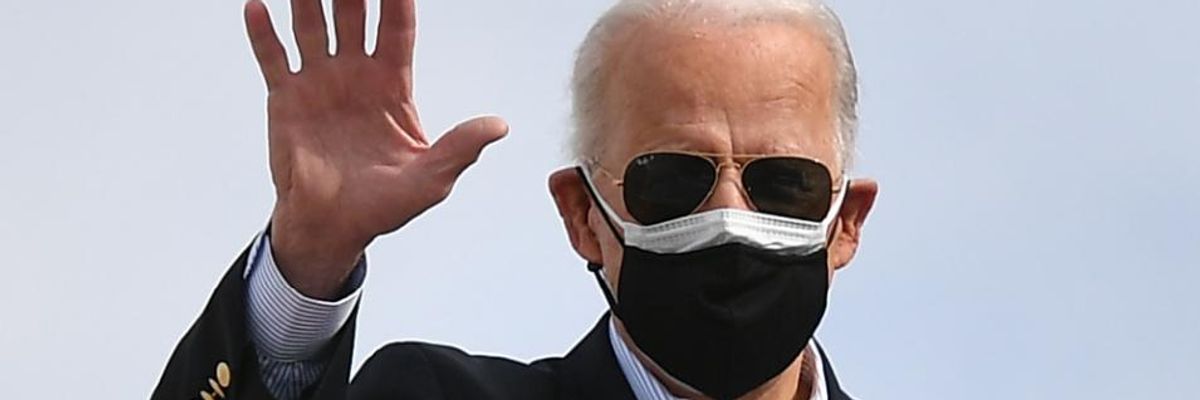
President Joe Biden boards Air Force One at Joint Base Andrews in Maryland on February 26, 2021. (Photo: Mandel Ngan/AFP via Getty Images)
The contrast between the procedural difficulty of pushing a modest pay increase for millions of workers through the Senate and the relative ease with which President Joe Biden--without congressional approval--launched a deadly bombing campaign in Syria late Thursday was the subject of much discussion and outrage as the president's lethal operation overseas coincided almost simultaneously with the Senate parliamentarian's advisory ruling against a popular $15 minimum wage measure.
The two events, according to progressive critics and political commentators, spotlighted how existing institutional constraints are heavily biased against the advancement of working-class interests but do little to prevent the commander-in-chief from unilaterally bombing foreign nations on the basis of highly dubious-to-nonexistent legal authority.
"Can't get Americans their relief checks in the midst of a historic pandemic for which the nation's economy was effectively shut down, but bombing Syria some more is a first 100 days priority. Unbelievable."
--Elizabeth Bruenig, New York Times
"Personally I think it should be easier to raise the minimum wage than to drop bombs on Syria," tweeted The New Republic's Kate Aronoff.
Pointing to the Senate's legislative filibuster as a key obstacle in the way of even minor policy changes, Matt Yglesias of the Slow Boring newsletter wrote sardonically on Thursday that "the genius of America is you need a 60-vote supermajority to raise the minimum wage, but the president can bomb some militia in Iran based on ... I dunno ... an AUMF from two decades ago that was about something else entirely or something."
While Biden had no issue bypassing congressional oversight to launch an attack on border-crossing station in eastern Syria, the White House suggested late Thursday that having Vice President Kamala Harris overrule the non-binding opinion of the Senate parliamentarian--an unelected official with no constitutional authority--would be a bridge too far, despite the fact that the Constitution empowers her to do so.
Biden "respects the parliamentarian's decision and the Senate's process," White House Press Secretary Jen Psaki said in a statement.
"We assassinate people by drone strike and have a literal prison colony in Guantanamo but where we draw the line is ignoring the Senate parliamentarian when [she] says no to a minimum wage hike," tweeted The Intercept's Ken Klippenstein.
After lamenting the highly undemocratic nature of a system in which "some unheard of parliamentarian ends up deciding whether or not a law gets passed to give millions a raise," Rep. Ro Khanna (D-Calif.) tweeted Friday morning that "we cannot stand up for congressional authorization before military strikes only when there is a Republican president."
"The administration should have sought congressional authorization here," said Khanna. "We need to work to extricate from the Middle East, not escalate."
Dear Common Dreams reader, It’s been nearly 30 years since I co-founded Common Dreams with my late wife, Lina Newhouser. We had the radical notion that journalism should serve the public good, not corporate profits. It was clear to us from the outset what it would take to build such a project. No paid advertisements. No corporate sponsors. No millionaire publisher telling us what to think or do. Many people said we wouldn't last a year, but we proved those doubters wrong. Together with a tremendous team of journalists and dedicated staff, we built an independent media outlet free from the constraints of profits and corporate control. Our mission has always been simple: To inform. To inspire. To ignite change for the common good. Building Common Dreams was not easy. Our survival was never guaranteed. When you take on the most powerful forces—Wall Street greed, fossil fuel industry destruction, Big Tech lobbyists, and uber-rich oligarchs who have spent billions upon billions rigging the economy and democracy in their favor—the only bulwark you have is supporters who believe in your work. But here’s the urgent message from me today. It's never been this bad out there. And it's never been this hard to keep us going. At the very moment Common Dreams is most needed, the threats we face are intensifying. We need your support now more than ever. We don't accept corporate advertising and never will. We don't have a paywall because we don't think people should be blocked from critical news based on their ability to pay. Everything we do is funded by the donations of readers like you. When everyone does the little they can afford, we are strong. But if that support retreats or dries up, so do we. Will you donate now to make sure Common Dreams not only survives but thrives? —Craig Brown, Co-founder |
The contrast between the procedural difficulty of pushing a modest pay increase for millions of workers through the Senate and the relative ease with which President Joe Biden--without congressional approval--launched a deadly bombing campaign in Syria late Thursday was the subject of much discussion and outrage as the president's lethal operation overseas coincided almost simultaneously with the Senate parliamentarian's advisory ruling against a popular $15 minimum wage measure.
The two events, according to progressive critics and political commentators, spotlighted how existing institutional constraints are heavily biased against the advancement of working-class interests but do little to prevent the commander-in-chief from unilaterally bombing foreign nations on the basis of highly dubious-to-nonexistent legal authority.
"Can't get Americans their relief checks in the midst of a historic pandemic for which the nation's economy was effectively shut down, but bombing Syria some more is a first 100 days priority. Unbelievable."
--Elizabeth Bruenig, New York Times
"Personally I think it should be easier to raise the minimum wage than to drop bombs on Syria," tweeted The New Republic's Kate Aronoff.
Pointing to the Senate's legislative filibuster as a key obstacle in the way of even minor policy changes, Matt Yglesias of the Slow Boring newsletter wrote sardonically on Thursday that "the genius of America is you need a 60-vote supermajority to raise the minimum wage, but the president can bomb some militia in Iran based on ... I dunno ... an AUMF from two decades ago that was about something else entirely or something."
While Biden had no issue bypassing congressional oversight to launch an attack on border-crossing station in eastern Syria, the White House suggested late Thursday that having Vice President Kamala Harris overrule the non-binding opinion of the Senate parliamentarian--an unelected official with no constitutional authority--would be a bridge too far, despite the fact that the Constitution empowers her to do so.
Biden "respects the parliamentarian's decision and the Senate's process," White House Press Secretary Jen Psaki said in a statement.
"We assassinate people by drone strike and have a literal prison colony in Guantanamo but where we draw the line is ignoring the Senate parliamentarian when [she] says no to a minimum wage hike," tweeted The Intercept's Ken Klippenstein.
After lamenting the highly undemocratic nature of a system in which "some unheard of parliamentarian ends up deciding whether or not a law gets passed to give millions a raise," Rep. Ro Khanna (D-Calif.) tweeted Friday morning that "we cannot stand up for congressional authorization before military strikes only when there is a Republican president."
"The administration should have sought congressional authorization here," said Khanna. "We need to work to extricate from the Middle East, not escalate."
The contrast between the procedural difficulty of pushing a modest pay increase for millions of workers through the Senate and the relative ease with which President Joe Biden--without congressional approval--launched a deadly bombing campaign in Syria late Thursday was the subject of much discussion and outrage as the president's lethal operation overseas coincided almost simultaneously with the Senate parliamentarian's advisory ruling against a popular $15 minimum wage measure.
The two events, according to progressive critics and political commentators, spotlighted how existing institutional constraints are heavily biased against the advancement of working-class interests but do little to prevent the commander-in-chief from unilaterally bombing foreign nations on the basis of highly dubious-to-nonexistent legal authority.
"Can't get Americans their relief checks in the midst of a historic pandemic for which the nation's economy was effectively shut down, but bombing Syria some more is a first 100 days priority. Unbelievable."
--Elizabeth Bruenig, New York Times
"Personally I think it should be easier to raise the minimum wage than to drop bombs on Syria," tweeted The New Republic's Kate Aronoff.
Pointing to the Senate's legislative filibuster as a key obstacle in the way of even minor policy changes, Matt Yglesias of the Slow Boring newsletter wrote sardonically on Thursday that "the genius of America is you need a 60-vote supermajority to raise the minimum wage, but the president can bomb some militia in Iran based on ... I dunno ... an AUMF from two decades ago that was about something else entirely or something."
While Biden had no issue bypassing congressional oversight to launch an attack on border-crossing station in eastern Syria, the White House suggested late Thursday that having Vice President Kamala Harris overrule the non-binding opinion of the Senate parliamentarian--an unelected official with no constitutional authority--would be a bridge too far, despite the fact that the Constitution empowers her to do so.
Biden "respects the parliamentarian's decision and the Senate's process," White House Press Secretary Jen Psaki said in a statement.
"We assassinate people by drone strike and have a literal prison colony in Guantanamo but where we draw the line is ignoring the Senate parliamentarian when [she] says no to a minimum wage hike," tweeted The Intercept's Ken Klippenstein.
After lamenting the highly undemocratic nature of a system in which "some unheard of parliamentarian ends up deciding whether or not a law gets passed to give millions a raise," Rep. Ro Khanna (D-Calif.) tweeted Friday morning that "we cannot stand up for congressional authorization before military strikes only when there is a Republican president."
"The administration should have sought congressional authorization here," said Khanna. "We need to work to extricate from the Middle East, not escalate."