SUBSCRIBE TO OUR FREE NEWSLETTER
Daily news & progressive opinion—funded by the people, not the corporations—delivered straight to your inbox.
5
#000000
#FFFFFF
To donate by check, phone, or other method, see our More Ways to Give page.
Daily news & progressive opinion—funded by the people, not the corporations—delivered straight to your inbox.
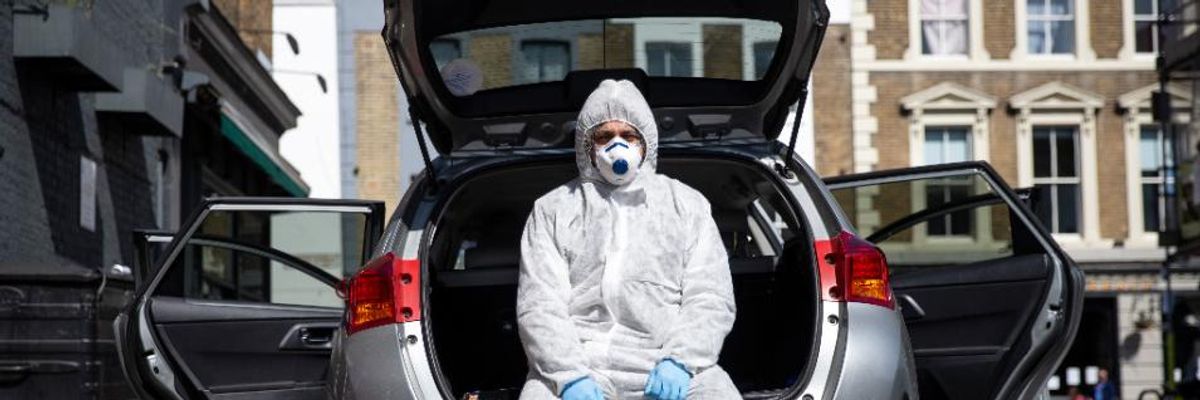
Uber driver Yasar Gorur wears personal protective equipment while cleaning his vehicle on April 14, 2020 in London. (Photo: Hollie Adams/Getty Images)
The United Kingdom's highest court delivered a major win for gig laborers Friday morning by ruling that a group of more than two dozen Uber drivers must be classified as workers--not self-employed independent contractors--and granted rights such as a minimum wage and certain benefits.
While the decision will initially only impact the 25 drivers who brought the case against Uber--which repeatedly appealed earlier lower-court decisions over a four-year period--the U.K. Supreme Court's ruling Friday sets a precedent that could lead to broader victories for gig workers.
"Uber must now stop wasting time and money pursuing lost legal causes and do what's right by the drivers who prop up its empire."
--Mick Rix, GMB Union
Lawyers representing GMB Union, a U.K. labor organization that helped the Uber drivers bring their case, said in a statement Friday that tens of thousands of Uber drivers could be entitled to an average of PS12,000 [or $17,000] each in compensation" thanks to Friday's ruling.
"This has been a grueling four-year legal battle for our members--but it's ended in a historic win," said GMB national officer Mick Rix. "The Supreme Court has upheld the decision of three previous courts, backing up what GMB has said all along; Uber drivers are workers and entitled to breaks, holiday pay, and a minimum wage."
"Uber must now stop wasting time and money pursuing lost legal causes and do what's right by the drivers who prop up its empire," Rix added. "GMB will now consult with our Uber driver members over their forthcoming compensation claim."
Uber, a San Francisco based corporation, insisted in a statement that the ruling would not require it to reclassify all of its drivers as legally-protected workers.
"Today we learned that our case was not successful and this group of drivers from 2016 should have been classified as workers. The verdict does not focus on the other drivers on the app, nor does it relate to couriers who earn on Uber Eats," the company said. "Worker is a U.K. specific legal classification and a worker is not an employee. Employee status was not claimed in the litigation and so this ruling does not find the claimants to be employees."
In its ruling Friday, the U.K. Supreme Court agreed with the Uber driver's case that they "are in a position of subordination and dependency in relation to Uber such that they have little or no ability to improve their economic position through professional or entrepreneurial skill."
"In practice," the court said, "the only way in which they can increase their earnings is by working longer hours while constantly meeting Uber's measures of performance."
As The Verge reported Friday, the high court's decision--which affirms three lower-court rulings dating back to 2016--"could have a significant impact on the U.K.'s estimated 4.7 million gig economy workers, affecting not just tech giants like Uber and food delivery firm Deliveroo, but also less well known companies like couriers CitySprint and plumbing outfit Pimlico Plumbers."
Dear Common Dreams reader, It’s been nearly 30 years since I co-founded Common Dreams with my late wife, Lina Newhouser. We had the radical notion that journalism should serve the public good, not corporate profits. It was clear to us from the outset what it would take to build such a project. No paid advertisements. No corporate sponsors. No millionaire publisher telling us what to think or do. Many people said we wouldn't last a year, but we proved those doubters wrong. Together with a tremendous team of journalists and dedicated staff, we built an independent media outlet free from the constraints of profits and corporate control. Our mission has always been simple: To inform. To inspire. To ignite change for the common good. Building Common Dreams was not easy. Our survival was never guaranteed. When you take on the most powerful forces—Wall Street greed, fossil fuel industry destruction, Big Tech lobbyists, and uber-rich oligarchs who have spent billions upon billions rigging the economy and democracy in their favor—the only bulwark you have is supporters who believe in your work. But here’s the urgent message from me today. It's never been this bad out there. And it's never been this hard to keep us going. At the very moment Common Dreams is most needed, the threats we face are intensifying. We need your support now more than ever. We don't accept corporate advertising and never will. We don't have a paywall because we don't think people should be blocked from critical news based on their ability to pay. Everything we do is funded by the donations of readers like you. When everyone does the little they can afford, we are strong. But if that support retreats or dries up, so do we. Will you donate now to make sure Common Dreams not only survives but thrives? —Craig Brown, Co-founder |
The United Kingdom's highest court delivered a major win for gig laborers Friday morning by ruling that a group of more than two dozen Uber drivers must be classified as workers--not self-employed independent contractors--and granted rights such as a minimum wage and certain benefits.
While the decision will initially only impact the 25 drivers who brought the case against Uber--which repeatedly appealed earlier lower-court decisions over a four-year period--the U.K. Supreme Court's ruling Friday sets a precedent that could lead to broader victories for gig workers.
"Uber must now stop wasting time and money pursuing lost legal causes and do what's right by the drivers who prop up its empire."
--Mick Rix, GMB Union
Lawyers representing GMB Union, a U.K. labor organization that helped the Uber drivers bring their case, said in a statement Friday that tens of thousands of Uber drivers could be entitled to an average of PS12,000 [or $17,000] each in compensation" thanks to Friday's ruling.
"This has been a grueling four-year legal battle for our members--but it's ended in a historic win," said GMB national officer Mick Rix. "The Supreme Court has upheld the decision of three previous courts, backing up what GMB has said all along; Uber drivers are workers and entitled to breaks, holiday pay, and a minimum wage."
"Uber must now stop wasting time and money pursuing lost legal causes and do what's right by the drivers who prop up its empire," Rix added. "GMB will now consult with our Uber driver members over their forthcoming compensation claim."
Uber, a San Francisco based corporation, insisted in a statement that the ruling would not require it to reclassify all of its drivers as legally-protected workers.
"Today we learned that our case was not successful and this group of drivers from 2016 should have been classified as workers. The verdict does not focus on the other drivers on the app, nor does it relate to couriers who earn on Uber Eats," the company said. "Worker is a U.K. specific legal classification and a worker is not an employee. Employee status was not claimed in the litigation and so this ruling does not find the claimants to be employees."
In its ruling Friday, the U.K. Supreme Court agreed with the Uber driver's case that they "are in a position of subordination and dependency in relation to Uber such that they have little or no ability to improve their economic position through professional or entrepreneurial skill."
"In practice," the court said, "the only way in which they can increase their earnings is by working longer hours while constantly meeting Uber's measures of performance."
As The Verge reported Friday, the high court's decision--which affirms three lower-court rulings dating back to 2016--"could have a significant impact on the U.K.'s estimated 4.7 million gig economy workers, affecting not just tech giants like Uber and food delivery firm Deliveroo, but also less well known companies like couriers CitySprint and plumbing outfit Pimlico Plumbers."
The United Kingdom's highest court delivered a major win for gig laborers Friday morning by ruling that a group of more than two dozen Uber drivers must be classified as workers--not self-employed independent contractors--and granted rights such as a minimum wage and certain benefits.
While the decision will initially only impact the 25 drivers who brought the case against Uber--which repeatedly appealed earlier lower-court decisions over a four-year period--the U.K. Supreme Court's ruling Friday sets a precedent that could lead to broader victories for gig workers.
"Uber must now stop wasting time and money pursuing lost legal causes and do what's right by the drivers who prop up its empire."
--Mick Rix, GMB Union
Lawyers representing GMB Union, a U.K. labor organization that helped the Uber drivers bring their case, said in a statement Friday that tens of thousands of Uber drivers could be entitled to an average of PS12,000 [or $17,000] each in compensation" thanks to Friday's ruling.
"This has been a grueling four-year legal battle for our members--but it's ended in a historic win," said GMB national officer Mick Rix. "The Supreme Court has upheld the decision of three previous courts, backing up what GMB has said all along; Uber drivers are workers and entitled to breaks, holiday pay, and a minimum wage."
"Uber must now stop wasting time and money pursuing lost legal causes and do what's right by the drivers who prop up its empire," Rix added. "GMB will now consult with our Uber driver members over their forthcoming compensation claim."
Uber, a San Francisco based corporation, insisted in a statement that the ruling would not require it to reclassify all of its drivers as legally-protected workers.
"Today we learned that our case was not successful and this group of drivers from 2016 should have been classified as workers. The verdict does not focus on the other drivers on the app, nor does it relate to couriers who earn on Uber Eats," the company said. "Worker is a U.K. specific legal classification and a worker is not an employee. Employee status was not claimed in the litigation and so this ruling does not find the claimants to be employees."
In its ruling Friday, the U.K. Supreme Court agreed with the Uber driver's case that they "are in a position of subordination and dependency in relation to Uber such that they have little or no ability to improve their economic position through professional or entrepreneurial skill."
"In practice," the court said, "the only way in which they can increase their earnings is by working longer hours while constantly meeting Uber's measures of performance."
As The Verge reported Friday, the high court's decision--which affirms three lower-court rulings dating back to 2016--"could have a significant impact on the U.K.'s estimated 4.7 million gig economy workers, affecting not just tech giants like Uber and food delivery firm Deliveroo, but also less well known companies like couriers CitySprint and plumbing outfit Pimlico Plumbers."