

SUBSCRIBE TO OUR FREE NEWSLETTER
Daily news & progressive opinion—funded by the people, not the corporations—delivered straight to your inbox.
5
#000000
#FFFFFF
To donate by check, phone, or other method, see our More Ways to Give page.
Daily news & progressive opinion—funded by the people, not the corporations—delivered straight to your inbox.
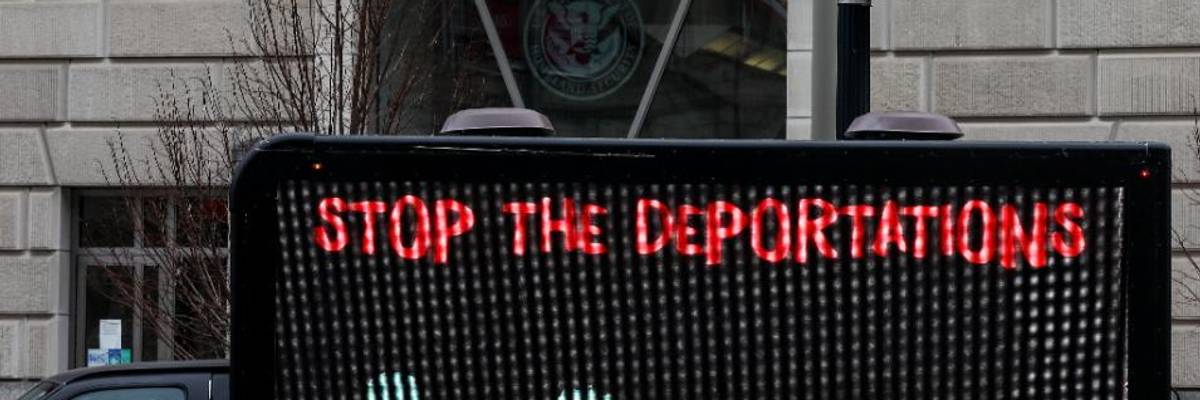
An LED truck displaying messages expressing concern over the continuing mass deportations of Black immigrants drives past the office of U.S. Customs and Border Protection on February 15, 2021 in Washington, D.C. (Photo: Jemal Countess/Getty Images for UndocuBlack Network)
Rights groups are warning that new immigration enforcement guidelines unveiled by the Biden administration on Thursday would leave federal law enforcement officers with "significant discretion" to continue carrying out harmful and unjust deportations, despite the president's promise to move away from the inhumane policies of the Trump era.
The interim guidance (pdf), which took effect immediately, directs Immigration and Customs Enforcement (ICE) officers to prioritize the removal of individuals deemed a threat to national security, border security, or public safety--categories that activists say are far too broad, giving federal officials excessive leeway to deport people who don't pose a threat. For example, the new guidelines define "any noncitizen who unlawfully entered the United States on or after November 1, 2020" as "a border security enforcement and removal priority."
"The interim enforcement priorities detailed today import the injustices of the criminal legal system and will lead to continued disproportionate deportations of Black and Brown immigrants."
--Naureen Shah, ACLU
To deport a person who does not meet any of the three categories, ICE agents will now need preapproval from a field office director or special agent in charge.
Naureen Shah, senior advocacy and policy counsel for the ACLU, said in a statement that the new guidelines represent "a disappointing step backward from the Biden administration's earlier commitments to fully break from the harmful deportation policies of both the Trump and Obama presidencies."
"The interim enforcement priorities detailed today import the injustices of the criminal legal system and will lead to continued disproportionate deportations of Black and Brown immigrants," Shah argued. "The priorities use sweeping and overbroad presumptions of threat that have for decades resulted in biased profiling and harmful immigration consequences for Black and Brown people, including Muslims."
"The priorities presume that all recent border-crossers are threats, in total contravention of President Biden's commitment to ensuring that people seeking asylum are treated with dignity," Shah continued. "We expect better from the Biden administration, and believe that the next 90 days will continue to reaffirm the need to force ICE to downscale its operations."
RAICES, a Texas-based immigrant rights group, echoed Shah's assessment of the new guidance in a tweet on Thursday.
Expected to remain in effect until Department of Homeland Security Secretary Alejandro Mayorkas issues a new directive, the temporary guidelines came as the Biden administration faced backlash over recent mass deportations carried out by ICE, which progressive lawmakers have called a "rogue agency" that must be reined in or abolished.
Last week, as Common Dreams reported, ICE deported at least 72 people to Haiti, including nearly two dozen children. In a February 8 letter to Biden, members of the Congressional Black Caucus said they were "appalled" by the recent wave of deportations and called on the president to take concrete steps to "ensure that our immigration system pursues humane, equitable ends by lawful means."
The deportations were carried out after a federal judge in Texas blocked the Biden administration from enforcing the 100-day deportation moratorium that the president issued on his first day in office. If it had been allowed to take effect, the moratorium likely would have prevented at least some of the latest removals, as well as earlier deportations of hundreds of people to Jamaica, Guatemala, and Honduras.
"President Biden must get these agencies under control immediately," former Housing and Urban Development Secretary Julian Castro tweeted earlier this month, referring to ICE and U.S. Customs and Border Protection.
The Biden administration rolled out its new enforcement guidelines for ICE on the same day that Rep. Linda Sanchez (D-Calif.) and Sen. Bob Menendez (D-N.J.) formally introduced the U.S. Citizenship Act of 2021, immigration reform legislation that the president sent to Congress last month.
"The centerpiece of the legislation is an eight-year path to citizenship for most of the 11 million undocumented immigrants living in the United States as of January 1," the New York Times reported Thursday. "After passing background checks and paying taxes, they would be allowed to live and work in the United States for five years. After that, they could apply for a green card, giving them permanent status in the United States and the opportunity to win citizenship after three more years."
Rights groups, including the ACLU and RAICES, cautiously applauded the legislation as a positive step but stressed that much work remains to be done to end mass deportations and enact humane reforms to the U.S. immigration system.
"The introduction of this bill is a good symbolic gesture, but it's not enough to protect people like me, my family, and my community," Erika Andiola, chief advocacy officer at RAICES, said in a statement. "What we still need is leadership that will ensure there is a path to victory before the end of this year."
"Now is the time for Democrats to use every tool at their disposal to provide protection to the immigrant community without relying on the party of Trump and without compromising on further inhumane enforcement," Andiola added. "The path to victory on legalization is clear. Ending the filibuster, legalizing as many people as possible through the next reconciliation package, and using executive action are all tools that can be used to protect the immigrant community."
Dear Common Dreams reader, It’s been nearly 30 years since I co-founded Common Dreams with my late wife, Lina Newhouser. We had the radical notion that journalism should serve the public good, not corporate profits. It was clear to us from the outset what it would take to build such a project. No paid advertisements. No corporate sponsors. No millionaire publisher telling us what to think or do. Many people said we wouldn't last a year, but we proved those doubters wrong. Together with a tremendous team of journalists and dedicated staff, we built an independent media outlet free from the constraints of profits and corporate control. Our mission has always been simple: To inform. To inspire. To ignite change for the common good. Building Common Dreams was not easy. Our survival was never guaranteed. When you take on the most powerful forces—Wall Street greed, fossil fuel industry destruction, Big Tech lobbyists, and uber-rich oligarchs who have spent billions upon billions rigging the economy and democracy in their favor—the only bulwark you have is supporters who believe in your work. But here’s the urgent message from me today. It's never been this bad out there. And it's never been this hard to keep us going. At the very moment Common Dreams is most needed, the threats we face are intensifying. We need your support now more than ever. We don't accept corporate advertising and never will. We don't have a paywall because we don't think people should be blocked from critical news based on their ability to pay. Everything we do is funded by the donations of readers like you. When everyone does the little they can afford, we are strong. But if that support retreats or dries up, so do we. Will you donate now to make sure Common Dreams not only survives but thrives? —Craig Brown, Co-founder |
Rights groups are warning that new immigration enforcement guidelines unveiled by the Biden administration on Thursday would leave federal law enforcement officers with "significant discretion" to continue carrying out harmful and unjust deportations, despite the president's promise to move away from the inhumane policies of the Trump era.
The interim guidance (pdf), which took effect immediately, directs Immigration and Customs Enforcement (ICE) officers to prioritize the removal of individuals deemed a threat to national security, border security, or public safety--categories that activists say are far too broad, giving federal officials excessive leeway to deport people who don't pose a threat. For example, the new guidelines define "any noncitizen who unlawfully entered the United States on or after November 1, 2020" as "a border security enforcement and removal priority."
"The interim enforcement priorities detailed today import the injustices of the criminal legal system and will lead to continued disproportionate deportations of Black and Brown immigrants."
--Naureen Shah, ACLU
To deport a person who does not meet any of the three categories, ICE agents will now need preapproval from a field office director or special agent in charge.
Naureen Shah, senior advocacy and policy counsel for the ACLU, said in a statement that the new guidelines represent "a disappointing step backward from the Biden administration's earlier commitments to fully break from the harmful deportation policies of both the Trump and Obama presidencies."
"The interim enforcement priorities detailed today import the injustices of the criminal legal system and will lead to continued disproportionate deportations of Black and Brown immigrants," Shah argued. "The priorities use sweeping and overbroad presumptions of threat that have for decades resulted in biased profiling and harmful immigration consequences for Black and Brown people, including Muslims."
"The priorities presume that all recent border-crossers are threats, in total contravention of President Biden's commitment to ensuring that people seeking asylum are treated with dignity," Shah continued. "We expect better from the Biden administration, and believe that the next 90 days will continue to reaffirm the need to force ICE to downscale its operations."
RAICES, a Texas-based immigrant rights group, echoed Shah's assessment of the new guidance in a tweet on Thursday.
Expected to remain in effect until Department of Homeland Security Secretary Alejandro Mayorkas issues a new directive, the temporary guidelines came as the Biden administration faced backlash over recent mass deportations carried out by ICE, which progressive lawmakers have called a "rogue agency" that must be reined in or abolished.
Last week, as Common Dreams reported, ICE deported at least 72 people to Haiti, including nearly two dozen children. In a February 8 letter to Biden, members of the Congressional Black Caucus said they were "appalled" by the recent wave of deportations and called on the president to take concrete steps to "ensure that our immigration system pursues humane, equitable ends by lawful means."
The deportations were carried out after a federal judge in Texas blocked the Biden administration from enforcing the 100-day deportation moratorium that the president issued on his first day in office. If it had been allowed to take effect, the moratorium likely would have prevented at least some of the latest removals, as well as earlier deportations of hundreds of people to Jamaica, Guatemala, and Honduras.
"President Biden must get these agencies under control immediately," former Housing and Urban Development Secretary Julian Castro tweeted earlier this month, referring to ICE and U.S. Customs and Border Protection.
The Biden administration rolled out its new enforcement guidelines for ICE on the same day that Rep. Linda Sanchez (D-Calif.) and Sen. Bob Menendez (D-N.J.) formally introduced the U.S. Citizenship Act of 2021, immigration reform legislation that the president sent to Congress last month.
"The centerpiece of the legislation is an eight-year path to citizenship for most of the 11 million undocumented immigrants living in the United States as of January 1," the New York Times reported Thursday. "After passing background checks and paying taxes, they would be allowed to live and work in the United States for five years. After that, they could apply for a green card, giving them permanent status in the United States and the opportunity to win citizenship after three more years."
Rights groups, including the ACLU and RAICES, cautiously applauded the legislation as a positive step but stressed that much work remains to be done to end mass deportations and enact humane reforms to the U.S. immigration system.
"The introduction of this bill is a good symbolic gesture, but it's not enough to protect people like me, my family, and my community," Erika Andiola, chief advocacy officer at RAICES, said in a statement. "What we still need is leadership that will ensure there is a path to victory before the end of this year."
"Now is the time for Democrats to use every tool at their disposal to provide protection to the immigrant community without relying on the party of Trump and without compromising on further inhumane enforcement," Andiola added. "The path to victory on legalization is clear. Ending the filibuster, legalizing as many people as possible through the next reconciliation package, and using executive action are all tools that can be used to protect the immigrant community."
Rights groups are warning that new immigration enforcement guidelines unveiled by the Biden administration on Thursday would leave federal law enforcement officers with "significant discretion" to continue carrying out harmful and unjust deportations, despite the president's promise to move away from the inhumane policies of the Trump era.
The interim guidance (pdf), which took effect immediately, directs Immigration and Customs Enforcement (ICE) officers to prioritize the removal of individuals deemed a threat to national security, border security, or public safety--categories that activists say are far too broad, giving federal officials excessive leeway to deport people who don't pose a threat. For example, the new guidelines define "any noncitizen who unlawfully entered the United States on or after November 1, 2020" as "a border security enforcement and removal priority."
"The interim enforcement priorities detailed today import the injustices of the criminal legal system and will lead to continued disproportionate deportations of Black and Brown immigrants."
--Naureen Shah, ACLU
To deport a person who does not meet any of the three categories, ICE agents will now need preapproval from a field office director or special agent in charge.
Naureen Shah, senior advocacy and policy counsel for the ACLU, said in a statement that the new guidelines represent "a disappointing step backward from the Biden administration's earlier commitments to fully break from the harmful deportation policies of both the Trump and Obama presidencies."
"The interim enforcement priorities detailed today import the injustices of the criminal legal system and will lead to continued disproportionate deportations of Black and Brown immigrants," Shah argued. "The priorities use sweeping and overbroad presumptions of threat that have for decades resulted in biased profiling and harmful immigration consequences for Black and Brown people, including Muslims."
"The priorities presume that all recent border-crossers are threats, in total contravention of President Biden's commitment to ensuring that people seeking asylum are treated with dignity," Shah continued. "We expect better from the Biden administration, and believe that the next 90 days will continue to reaffirm the need to force ICE to downscale its operations."
RAICES, a Texas-based immigrant rights group, echoed Shah's assessment of the new guidance in a tweet on Thursday.
Expected to remain in effect until Department of Homeland Security Secretary Alejandro Mayorkas issues a new directive, the temporary guidelines came as the Biden administration faced backlash over recent mass deportations carried out by ICE, which progressive lawmakers have called a "rogue agency" that must be reined in or abolished.
Last week, as Common Dreams reported, ICE deported at least 72 people to Haiti, including nearly two dozen children. In a February 8 letter to Biden, members of the Congressional Black Caucus said they were "appalled" by the recent wave of deportations and called on the president to take concrete steps to "ensure that our immigration system pursues humane, equitable ends by lawful means."
The deportations were carried out after a federal judge in Texas blocked the Biden administration from enforcing the 100-day deportation moratorium that the president issued on his first day in office. If it had been allowed to take effect, the moratorium likely would have prevented at least some of the latest removals, as well as earlier deportations of hundreds of people to Jamaica, Guatemala, and Honduras.
"President Biden must get these agencies under control immediately," former Housing and Urban Development Secretary Julian Castro tweeted earlier this month, referring to ICE and U.S. Customs and Border Protection.
The Biden administration rolled out its new enforcement guidelines for ICE on the same day that Rep. Linda Sanchez (D-Calif.) and Sen. Bob Menendez (D-N.J.) formally introduced the U.S. Citizenship Act of 2021, immigration reform legislation that the president sent to Congress last month.
"The centerpiece of the legislation is an eight-year path to citizenship for most of the 11 million undocumented immigrants living in the United States as of January 1," the New York Times reported Thursday. "After passing background checks and paying taxes, they would be allowed to live and work in the United States for five years. After that, they could apply for a green card, giving them permanent status in the United States and the opportunity to win citizenship after three more years."
Rights groups, including the ACLU and RAICES, cautiously applauded the legislation as a positive step but stressed that much work remains to be done to end mass deportations and enact humane reforms to the U.S. immigration system.
"The introduction of this bill is a good symbolic gesture, but it's not enough to protect people like me, my family, and my community," Erika Andiola, chief advocacy officer at RAICES, said in a statement. "What we still need is leadership that will ensure there is a path to victory before the end of this year."
"Now is the time for Democrats to use every tool at their disposal to provide protection to the immigrant community without relying on the party of Trump and without compromising on further inhumane enforcement," Andiola added. "The path to victory on legalization is clear. Ending the filibuster, legalizing as many people as possible through the next reconciliation package, and using executive action are all tools that can be used to protect the immigrant community."

