SUBSCRIBE TO OUR FREE NEWSLETTER
Daily news & progressive opinion—funded by the people, not the corporations—delivered straight to your inbox.
5
#000000
#FFFFFF
To donate by check, phone, or other method, see our More Ways to Give page.
Daily news & progressive opinion—funded by the people, not the corporations—delivered straight to your inbox.
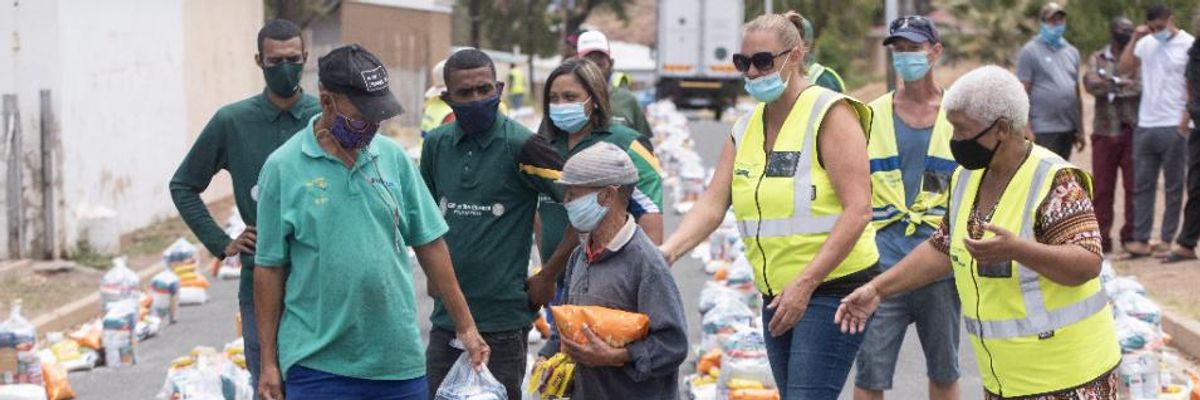
Gift of the Givers distribute food parcels on January 27, 2021 in Touws River, South Africa. Due to the impact of the Covid-19 pandemic and the lockdown restrictions, a reported 93% of the local population is unemployed. (Photo: Brenton Geach/Gallo Images via Getty Images)
As the world nears the one-year mark from when the coronavirus outbreak was officially declared a pandemic, a United Nations envoy raised alarm Monday about the looming threat of food shortages, explaining that many problems which experts warned about in the early days of the crisis have been deferred rather than resolved.
"We are facing a greater threat this year, as economies have shrunk," Agnes Kalibata, special envoy to the U.N. secretary-general for the food systems summit 2021, told The Guardian in an exclusive interview. "That is happening across the globe, everywhere. Countries are in a very distressed situation, and it is not getting easier--it is getting more difficult. Some countries have hung on, but for how long?"
"We have not been able to strengthen our reserves. Now they are under pressure."
--Agnes Kalibata, U.N. special envoy
Though food chain supply issues and increased demand for hunger relief have impacted countries around the world, including the United States, during the pandemic, Kalibata highlighted rising prices in Thailand and various African countries. She is president of the Alliance for a Green Revolution in Africa (AGRA)--which has earned her some criticism--and formerly served as Rwanda's minister of agriculture.
The U.N. expert said that in the face of the public health crisis the past year, "many countries used whatever opportunity they had to keep their food systems going."
Alongside a Covid-19 death toll that keeps climbing despite multiple vaccines, "the price of food is increasing in some cases very fast, which is really challenging. As the coronavirus pandemic and the global economic crisis it has provoked continue, more countries are likely to be drawn into difficulties," added Kalibata. "We have not been able to strengthen our reserves. Now they are under pressure."
In other words, she said, "food is looking more challenging this year than last year."
Kalibata, whose comments come ahead of a food systems summit expected in September, emphasized the importance of making food both accessible--by continuing to move it from where it's produced to where it's distributed--and affordable, especially considering that people worldwide are still losing jobs and income.
"The economy is shrinking and that is impacting millions of people," she said, encouraging governments to stay vigilant amid vaccines rollouts. "Social protection is very important. We also need to keep prices down, we need to keep food available, and we need to strengthen markets, ensure markets are working despite the crisis."
Echoing a wide range of experts throughout the pandemic--such as renowned primatologist and conservationist Jane Goodall, who declared in June that "we have brought this on ourselves because of our absolute disrespect for animals and the environment"--Kalibata also called for learning from how humanity's destruction of nature has heigthened the threat posed by zoonotic diseases, saying that "we need to look at how we as human beings manage the planet."
The Guardian's report came on the heels of an opinion piece Kalibata wrote last week for Devex, a media platform for the global development community, arguing that "global food systems can only be truly transformed with a people's summit," in anticipation of the September event, the planning for which preceded the pandemic.
Kalibata made the case that countries, governments, and the public "need to transform the way they engage with and think about entire food systems," recognizing that current systems don't work for many, especially the world's most marginalized and vulnerable. She wrote that "not only does the planet need improved policies, markets, and processes, it also needs new mechanisms for developing this reimagined system, from the first seed to the last spoonful."
Looking ahead to what she called a "make or break" year, Kalibata also reflected on "success stories during the pandemic"--pointing to crowdsourced meals and mock COP26 talks by youth climate activists--as a source of "hope for what can be achieved when people around the world are enabled and encouraged to join forces for good."
Making global food systems "more inclusive, nutritious, sustainable, and resilient," she explained, requires participation from "public and private sectors, companies and consumers, authorities and individuals," who are all willing to share "platforms, ideas, and learnings on a global level like never before."
To that end, she noted the Food Systems Summit Dialogues as well as a network of "Food Systems Champions and Heroes to advocate not only for better food systems but for better and greater engagement from everyone."
"So, in 2021, I hope to see governments working more closely with the private sector and taking on recommendations on how to manage trade-offs, including repurposing agricultural subsidies toward producing healthier and more sustainable food," she wrote. "Retailers and consumers also have a responsibility to reduce food waste, and civil society can be an engine of engagement better to drive progress."
Dear Common Dreams reader, It’s been nearly 30 years since I co-founded Common Dreams with my late wife, Lina Newhouser. We had the radical notion that journalism should serve the public good, not corporate profits. It was clear to us from the outset what it would take to build such a project. No paid advertisements. No corporate sponsors. No millionaire publisher telling us what to think or do. Many people said we wouldn't last a year, but we proved those doubters wrong. Together with a tremendous team of journalists and dedicated staff, we built an independent media outlet free from the constraints of profits and corporate control. Our mission has always been simple: To inform. To inspire. To ignite change for the common good. Building Common Dreams was not easy. Our survival was never guaranteed. When you take on the most powerful forces—Wall Street greed, fossil fuel industry destruction, Big Tech lobbyists, and uber-rich oligarchs who have spent billions upon billions rigging the economy and democracy in their favor—the only bulwark you have is supporters who believe in your work. But here’s the urgent message from me today. It's never been this bad out there. And it's never been this hard to keep us going. At the very moment Common Dreams is most needed, the threats we face are intensifying. We need your support now more than ever. We don't accept corporate advertising and never will. We don't have a paywall because we don't think people should be blocked from critical news based on their ability to pay. Everything we do is funded by the donations of readers like you. When everyone does the little they can afford, we are strong. But if that support retreats or dries up, so do we. Will you donate now to make sure Common Dreams not only survives but thrives? —Craig Brown, Co-founder |
As the world nears the one-year mark from when the coronavirus outbreak was officially declared a pandemic, a United Nations envoy raised alarm Monday about the looming threat of food shortages, explaining that many problems which experts warned about in the early days of the crisis have been deferred rather than resolved.
"We are facing a greater threat this year, as economies have shrunk," Agnes Kalibata, special envoy to the U.N. secretary-general for the food systems summit 2021, told The Guardian in an exclusive interview. "That is happening across the globe, everywhere. Countries are in a very distressed situation, and it is not getting easier--it is getting more difficult. Some countries have hung on, but for how long?"
"We have not been able to strengthen our reserves. Now they are under pressure."
--Agnes Kalibata, U.N. special envoy
Though food chain supply issues and increased demand for hunger relief have impacted countries around the world, including the United States, during the pandemic, Kalibata highlighted rising prices in Thailand and various African countries. She is president of the Alliance for a Green Revolution in Africa (AGRA)--which has earned her some criticism--and formerly served as Rwanda's minister of agriculture.
The U.N. expert said that in the face of the public health crisis the past year, "many countries used whatever opportunity they had to keep their food systems going."
Alongside a Covid-19 death toll that keeps climbing despite multiple vaccines, "the price of food is increasing in some cases very fast, which is really challenging. As the coronavirus pandemic and the global economic crisis it has provoked continue, more countries are likely to be drawn into difficulties," added Kalibata. "We have not been able to strengthen our reserves. Now they are under pressure."
In other words, she said, "food is looking more challenging this year than last year."
Kalibata, whose comments come ahead of a food systems summit expected in September, emphasized the importance of making food both accessible--by continuing to move it from where it's produced to where it's distributed--and affordable, especially considering that people worldwide are still losing jobs and income.
"The economy is shrinking and that is impacting millions of people," she said, encouraging governments to stay vigilant amid vaccines rollouts. "Social protection is very important. We also need to keep prices down, we need to keep food available, and we need to strengthen markets, ensure markets are working despite the crisis."
Echoing a wide range of experts throughout the pandemic--such as renowned primatologist and conservationist Jane Goodall, who declared in June that "we have brought this on ourselves because of our absolute disrespect for animals and the environment"--Kalibata also called for learning from how humanity's destruction of nature has heigthened the threat posed by zoonotic diseases, saying that "we need to look at how we as human beings manage the planet."
The Guardian's report came on the heels of an opinion piece Kalibata wrote last week for Devex, a media platform for the global development community, arguing that "global food systems can only be truly transformed with a people's summit," in anticipation of the September event, the planning for which preceded the pandemic.
Kalibata made the case that countries, governments, and the public "need to transform the way they engage with and think about entire food systems," recognizing that current systems don't work for many, especially the world's most marginalized and vulnerable. She wrote that "not only does the planet need improved policies, markets, and processes, it also needs new mechanisms for developing this reimagined system, from the first seed to the last spoonful."
Looking ahead to what she called a "make or break" year, Kalibata also reflected on "success stories during the pandemic"--pointing to crowdsourced meals and mock COP26 talks by youth climate activists--as a source of "hope for what can be achieved when people around the world are enabled and encouraged to join forces for good."
Making global food systems "more inclusive, nutritious, sustainable, and resilient," she explained, requires participation from "public and private sectors, companies and consumers, authorities and individuals," who are all willing to share "platforms, ideas, and learnings on a global level like never before."
To that end, she noted the Food Systems Summit Dialogues as well as a network of "Food Systems Champions and Heroes to advocate not only for better food systems but for better and greater engagement from everyone."
"So, in 2021, I hope to see governments working more closely with the private sector and taking on recommendations on how to manage trade-offs, including repurposing agricultural subsidies toward producing healthier and more sustainable food," she wrote. "Retailers and consumers also have a responsibility to reduce food waste, and civil society can be an engine of engagement better to drive progress."
As the world nears the one-year mark from when the coronavirus outbreak was officially declared a pandemic, a United Nations envoy raised alarm Monday about the looming threat of food shortages, explaining that many problems which experts warned about in the early days of the crisis have been deferred rather than resolved.
"We are facing a greater threat this year, as economies have shrunk," Agnes Kalibata, special envoy to the U.N. secretary-general for the food systems summit 2021, told The Guardian in an exclusive interview. "That is happening across the globe, everywhere. Countries are in a very distressed situation, and it is not getting easier--it is getting more difficult. Some countries have hung on, but for how long?"
"We have not been able to strengthen our reserves. Now they are under pressure."
--Agnes Kalibata, U.N. special envoy
Though food chain supply issues and increased demand for hunger relief have impacted countries around the world, including the United States, during the pandemic, Kalibata highlighted rising prices in Thailand and various African countries. She is president of the Alliance for a Green Revolution in Africa (AGRA)--which has earned her some criticism--and formerly served as Rwanda's minister of agriculture.
The U.N. expert said that in the face of the public health crisis the past year, "many countries used whatever opportunity they had to keep their food systems going."
Alongside a Covid-19 death toll that keeps climbing despite multiple vaccines, "the price of food is increasing in some cases very fast, which is really challenging. As the coronavirus pandemic and the global economic crisis it has provoked continue, more countries are likely to be drawn into difficulties," added Kalibata. "We have not been able to strengthen our reserves. Now they are under pressure."
In other words, she said, "food is looking more challenging this year than last year."
Kalibata, whose comments come ahead of a food systems summit expected in September, emphasized the importance of making food both accessible--by continuing to move it from where it's produced to where it's distributed--and affordable, especially considering that people worldwide are still losing jobs and income.
"The economy is shrinking and that is impacting millions of people," she said, encouraging governments to stay vigilant amid vaccines rollouts. "Social protection is very important. We also need to keep prices down, we need to keep food available, and we need to strengthen markets, ensure markets are working despite the crisis."
Echoing a wide range of experts throughout the pandemic--such as renowned primatologist and conservationist Jane Goodall, who declared in June that "we have brought this on ourselves because of our absolute disrespect for animals and the environment"--Kalibata also called for learning from how humanity's destruction of nature has heigthened the threat posed by zoonotic diseases, saying that "we need to look at how we as human beings manage the planet."
The Guardian's report came on the heels of an opinion piece Kalibata wrote last week for Devex, a media platform for the global development community, arguing that "global food systems can only be truly transformed with a people's summit," in anticipation of the September event, the planning for which preceded the pandemic.
Kalibata made the case that countries, governments, and the public "need to transform the way they engage with and think about entire food systems," recognizing that current systems don't work for many, especially the world's most marginalized and vulnerable. She wrote that "not only does the planet need improved policies, markets, and processes, it also needs new mechanisms for developing this reimagined system, from the first seed to the last spoonful."
Looking ahead to what she called a "make or break" year, Kalibata also reflected on "success stories during the pandemic"--pointing to crowdsourced meals and mock COP26 talks by youth climate activists--as a source of "hope for what can be achieved when people around the world are enabled and encouraged to join forces for good."
Making global food systems "more inclusive, nutritious, sustainable, and resilient," she explained, requires participation from "public and private sectors, companies and consumers, authorities and individuals," who are all willing to share "platforms, ideas, and learnings on a global level like never before."
To that end, she noted the Food Systems Summit Dialogues as well as a network of "Food Systems Champions and Heroes to advocate not only for better food systems but for better and greater engagement from everyone."
"So, in 2021, I hope to see governments working more closely with the private sector and taking on recommendations on how to manage trade-offs, including repurposing agricultural subsidies toward producing healthier and more sustainable food," she wrote. "Retailers and consumers also have a responsibility to reduce food waste, and civil society can be an engine of engagement better to drive progress."