SUBSCRIBE TO OUR FREE NEWSLETTER
Daily news & progressive opinion—funded by the people, not the corporations—delivered straight to your inbox.
5
#000000
#FFFFFF
To donate by check, phone, or other method, see our More Ways to Give page.
Daily news & progressive opinion—funded by the people, not the corporations—delivered straight to your inbox.
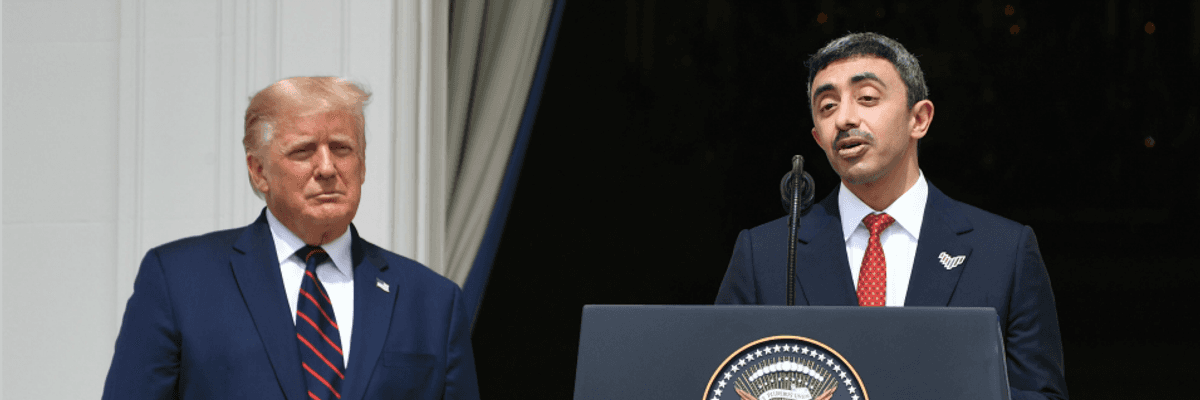
President Donald Trump watches as UAE Foreign Minister Abdullah bin Zayed Al-Nahyan speak on the South Lawn of the White House in Washington, D.C. on September 15, 2020. (Photo: Saul Loeb/AFP via Getty Images)
Following the Senate's failure earlier this week to block President Donald Trump's $23 billion weapons sale to the United Arab Emirates, President-elect Joe Biden is facing pressure from anti-war organizations and activists to put a stop to the deal upon taking office to prevent further U.S. complicity in the slaughter of civilians in Yemen and Libya.
Announced last month after Trump claimed credit for brokering a "peace deal" between the UAE and Israel, the agreement would send 50 F-35 fighter jets, more than a dozen Reaper drones, and billions of dollars worth of munitions to the UAE--part of the U.S.-backed Saudi-led coalition whose assault on Yemen has created the world's worst humanitarian crisis.
"The incoming Biden administration should support peace, democracy, and human rights overseas by canceling the sale upon taking office."
--Nihad Awad, Council on American-Islamic Relations
"Our government should not sell a single bullet to the UAE, much less billions of dollars in deadly military equipment," Nihad Awad, national executive director of the Council on American-Islamic Relations (CAIR), said in a statement Thursday. "The UAE has committed war crimes in Yemen, bolstered dictators and suppressed democracy in the broader Arab world, and smeared Americans who dare to speak up against such human rights abuses."
"Now that the Senate has failed to block the Trump administration's corrupt and dangerous arms deal," said Awad, "the incoming Biden administration should support peace, democracy, and human rights overseas by canceling the sale upon taking office."
Writing in The Nation, Michael Eisner and Sarah Leah Whitson of Democracy for the Arab World Now warned that the UAE weapons sale "would cause devastating harm to both the people in the Middle East and America's standing in the region" and urged Biden to roll it back.
"The harm in the case of the UAE arms deal is wholly foreseeable," wrote Eisner and Whitson. "Just as you can predict the consequence of selling a loaded pistol to a serial murderer, you can anticipate the damage that will be wrought by this arms deal. The UAE has a well-documented track record of using its advanced weaponry to launch aggressive and unlawful incursions into other countries, engaging in systematic human rights violations, and war crimes along the way."
Because the massive sale could take years to execute despite Trump's best efforts to rush the process, Biden--who has vowed to end U.S. support for Saudi massacres in Yemen--could have an opportunity to reverse the deal once he assumes the presidency.
"Three quarters of the U.S. public is opposed to selling weapons to the UAE," Erica Fein, advocacy director at Win Without War, said in a statement Wednesday. "We urge the next administration to heed the changing winds--to reverse course and stop these sales from moving forward, meet its campaign promise of ending U.S. complicity in the war in Yemen, reset U.S. relations in the region, and restore U.S. credibility as a partner for peace."
Sen. Chris Murphy (D-Conn.), one of the leaders of the unsuccessful Senate effort to block the UAE deal, said he is "eager to work with the incoming administration to take a closer look at each of these sales before any transfers are completed."
Progressives have cautiously welcomed Biden's promises to reassess U.S. relationships with Saudi Arabia and the UAE, but some have raised concerns over how retired Gen. Lloyd Austin--the president-elect's nominee for defense secretary--will approach weapons sales, the war on Yemen, and other key foreign policy issues if confirmed to the powerful role.
Austin is currently on the board of Raytheon, a major defense contractor that would profit from the sale of Reaper drones to the UAE.
"The United States' support for the Saudi- and UAE-led intervention in Yemen is one of the most pernicious foreign policy decisions in decades," said Stephen Miles, executive director of Win Without War. "Gen. Austin's leadership of CENTCOM at the time of this decision calls into question his approach to U.S. defense policy."
"Gen. Austin must not only share how he will further President-elect Biden's vision," said Miles, "but what his own views are on the many policy choices he will be confronted with should he be confirmed."
Dear Common Dreams reader, It’s been nearly 30 years since I co-founded Common Dreams with my late wife, Lina Newhouser. We had the radical notion that journalism should serve the public good, not corporate profits. It was clear to us from the outset what it would take to build such a project. No paid advertisements. No corporate sponsors. No millionaire publisher telling us what to think or do. Many people said we wouldn't last a year, but we proved those doubters wrong. Together with a tremendous team of journalists and dedicated staff, we built an independent media outlet free from the constraints of profits and corporate control. Our mission has always been simple: To inform. To inspire. To ignite change for the common good. Building Common Dreams was not easy. Our survival was never guaranteed. When you take on the most powerful forces—Wall Street greed, fossil fuel industry destruction, Big Tech lobbyists, and uber-rich oligarchs who have spent billions upon billions rigging the economy and democracy in their favor—the only bulwark you have is supporters who believe in your work. But here’s the urgent message from me today. It's never been this bad out there. And it's never been this hard to keep us going. At the very moment Common Dreams is most needed, the threats we face are intensifying. We need your support now more than ever. We don't accept corporate advertising and never will. We don't have a paywall because we don't think people should be blocked from critical news based on their ability to pay. Everything we do is funded by the donations of readers like you. When everyone does the little they can afford, we are strong. But if that support retreats or dries up, so do we. Will you donate now to make sure Common Dreams not only survives but thrives? —Craig Brown, Co-founder |
Following the Senate's failure earlier this week to block President Donald Trump's $23 billion weapons sale to the United Arab Emirates, President-elect Joe Biden is facing pressure from anti-war organizations and activists to put a stop to the deal upon taking office to prevent further U.S. complicity in the slaughter of civilians in Yemen and Libya.
Announced last month after Trump claimed credit for brokering a "peace deal" between the UAE and Israel, the agreement would send 50 F-35 fighter jets, more than a dozen Reaper drones, and billions of dollars worth of munitions to the UAE--part of the U.S.-backed Saudi-led coalition whose assault on Yemen has created the world's worst humanitarian crisis.
"The incoming Biden administration should support peace, democracy, and human rights overseas by canceling the sale upon taking office."
--Nihad Awad, Council on American-Islamic Relations
"Our government should not sell a single bullet to the UAE, much less billions of dollars in deadly military equipment," Nihad Awad, national executive director of the Council on American-Islamic Relations (CAIR), said in a statement Thursday. "The UAE has committed war crimes in Yemen, bolstered dictators and suppressed democracy in the broader Arab world, and smeared Americans who dare to speak up against such human rights abuses."
"Now that the Senate has failed to block the Trump administration's corrupt and dangerous arms deal," said Awad, "the incoming Biden administration should support peace, democracy, and human rights overseas by canceling the sale upon taking office."
Writing in The Nation, Michael Eisner and Sarah Leah Whitson of Democracy for the Arab World Now warned that the UAE weapons sale "would cause devastating harm to both the people in the Middle East and America's standing in the region" and urged Biden to roll it back.
"The harm in the case of the UAE arms deal is wholly foreseeable," wrote Eisner and Whitson. "Just as you can predict the consequence of selling a loaded pistol to a serial murderer, you can anticipate the damage that will be wrought by this arms deal. The UAE has a well-documented track record of using its advanced weaponry to launch aggressive and unlawful incursions into other countries, engaging in systematic human rights violations, and war crimes along the way."
Because the massive sale could take years to execute despite Trump's best efforts to rush the process, Biden--who has vowed to end U.S. support for Saudi massacres in Yemen--could have an opportunity to reverse the deal once he assumes the presidency.
"Three quarters of the U.S. public is opposed to selling weapons to the UAE," Erica Fein, advocacy director at Win Without War, said in a statement Wednesday. "We urge the next administration to heed the changing winds--to reverse course and stop these sales from moving forward, meet its campaign promise of ending U.S. complicity in the war in Yemen, reset U.S. relations in the region, and restore U.S. credibility as a partner for peace."
Sen. Chris Murphy (D-Conn.), one of the leaders of the unsuccessful Senate effort to block the UAE deal, said he is "eager to work with the incoming administration to take a closer look at each of these sales before any transfers are completed."
Progressives have cautiously welcomed Biden's promises to reassess U.S. relationships with Saudi Arabia and the UAE, but some have raised concerns over how retired Gen. Lloyd Austin--the president-elect's nominee for defense secretary--will approach weapons sales, the war on Yemen, and other key foreign policy issues if confirmed to the powerful role.
Austin is currently on the board of Raytheon, a major defense contractor that would profit from the sale of Reaper drones to the UAE.
"The United States' support for the Saudi- and UAE-led intervention in Yemen is one of the most pernicious foreign policy decisions in decades," said Stephen Miles, executive director of Win Without War. "Gen. Austin's leadership of CENTCOM at the time of this decision calls into question his approach to U.S. defense policy."
"Gen. Austin must not only share how he will further President-elect Biden's vision," said Miles, "but what his own views are on the many policy choices he will be confronted with should he be confirmed."
Following the Senate's failure earlier this week to block President Donald Trump's $23 billion weapons sale to the United Arab Emirates, President-elect Joe Biden is facing pressure from anti-war organizations and activists to put a stop to the deal upon taking office to prevent further U.S. complicity in the slaughter of civilians in Yemen and Libya.
Announced last month after Trump claimed credit for brokering a "peace deal" between the UAE and Israel, the agreement would send 50 F-35 fighter jets, more than a dozen Reaper drones, and billions of dollars worth of munitions to the UAE--part of the U.S.-backed Saudi-led coalition whose assault on Yemen has created the world's worst humanitarian crisis.
"The incoming Biden administration should support peace, democracy, and human rights overseas by canceling the sale upon taking office."
--Nihad Awad, Council on American-Islamic Relations
"Our government should not sell a single bullet to the UAE, much less billions of dollars in deadly military equipment," Nihad Awad, national executive director of the Council on American-Islamic Relations (CAIR), said in a statement Thursday. "The UAE has committed war crimes in Yemen, bolstered dictators and suppressed democracy in the broader Arab world, and smeared Americans who dare to speak up against such human rights abuses."
"Now that the Senate has failed to block the Trump administration's corrupt and dangerous arms deal," said Awad, "the incoming Biden administration should support peace, democracy, and human rights overseas by canceling the sale upon taking office."
Writing in The Nation, Michael Eisner and Sarah Leah Whitson of Democracy for the Arab World Now warned that the UAE weapons sale "would cause devastating harm to both the people in the Middle East and America's standing in the region" and urged Biden to roll it back.
"The harm in the case of the UAE arms deal is wholly foreseeable," wrote Eisner and Whitson. "Just as you can predict the consequence of selling a loaded pistol to a serial murderer, you can anticipate the damage that will be wrought by this arms deal. The UAE has a well-documented track record of using its advanced weaponry to launch aggressive and unlawful incursions into other countries, engaging in systematic human rights violations, and war crimes along the way."
Because the massive sale could take years to execute despite Trump's best efforts to rush the process, Biden--who has vowed to end U.S. support for Saudi massacres in Yemen--could have an opportunity to reverse the deal once he assumes the presidency.
"Three quarters of the U.S. public is opposed to selling weapons to the UAE," Erica Fein, advocacy director at Win Without War, said in a statement Wednesday. "We urge the next administration to heed the changing winds--to reverse course and stop these sales from moving forward, meet its campaign promise of ending U.S. complicity in the war in Yemen, reset U.S. relations in the region, and restore U.S. credibility as a partner for peace."
Sen. Chris Murphy (D-Conn.), one of the leaders of the unsuccessful Senate effort to block the UAE deal, said he is "eager to work with the incoming administration to take a closer look at each of these sales before any transfers are completed."
Progressives have cautiously welcomed Biden's promises to reassess U.S. relationships with Saudi Arabia and the UAE, but some have raised concerns over how retired Gen. Lloyd Austin--the president-elect's nominee for defense secretary--will approach weapons sales, the war on Yemen, and other key foreign policy issues if confirmed to the powerful role.
Austin is currently on the board of Raytheon, a major defense contractor that would profit from the sale of Reaper drones to the UAE.
"The United States' support for the Saudi- and UAE-led intervention in Yemen is one of the most pernicious foreign policy decisions in decades," said Stephen Miles, executive director of Win Without War. "Gen. Austin's leadership of CENTCOM at the time of this decision calls into question his approach to U.S. defense policy."
"Gen. Austin must not only share how he will further President-elect Biden's vision," said Miles, "but what his own views are on the many policy choices he will be confronted with should he be confirmed."