SUBSCRIBE TO OUR FREE NEWSLETTER
Daily news & progressive opinion—funded by the people, not the corporations—delivered straight to your inbox.
5
#000000
#FFFFFF
To donate by check, phone, or other method, see our More Ways to Give page.


Daily news & progressive opinion—funded by the people, not the corporations—delivered straight to your inbox.

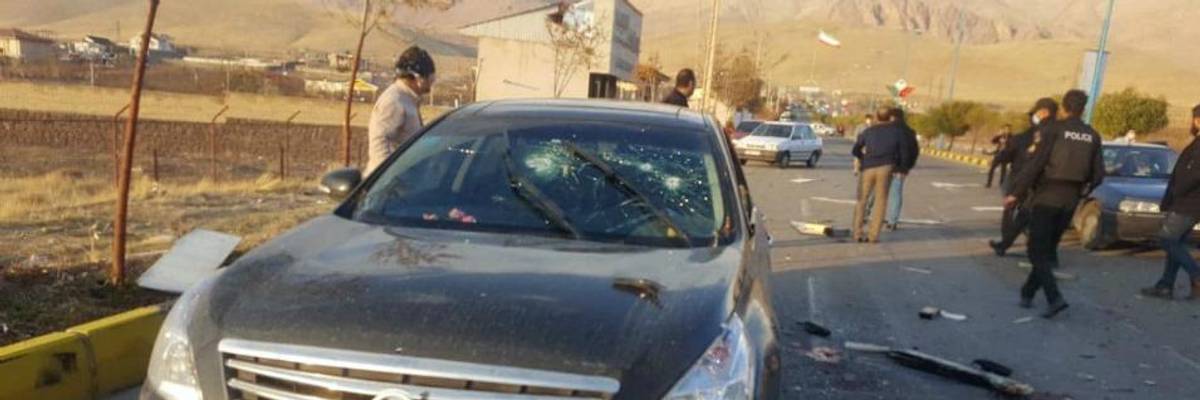
A view of the scene where Mohsen Fakhrizadeh, Iran's chief nuclear scientist, was killed on November 27,2020. (Photo: Iranian State TV/Handout/Anadolu Agency via Getty Images)
This story has been updated.
Mohsen Fakhrizadeh, a leading Iranian nuclear scientist, was assassinated Friday in a drive-by shooting near the nation's capital of Tehran.
"Yet another reckless step that appears intended to poison the well for negotiations under a Biden administration and set the stage for war."
--Ryan Costello, National Iranian American Council
Fakhrizadeh was hospitalized following the shooting but doctors were unable to save his life, according to news reports. Islamic Revolutionary Guard Corps (IRGC) accounts are alleging the assassination was carried out by Mossad, the Israeli spy agency.
Demanding a swift response from the international community, Javad Zarif, Iran's top diplomat, tweeted that "terrorists murdered an eminent Iranian scientist today."
"This cowardice--with serious indications of Israeli role--shows desperate warmongering of perpetrators," said Zarif. "Iran calls on the international community--and especially [the European Union]--to end their shameful double standards and condemn this act of state terror."
First reported by state media outlets and later confirmed by the Iranian defense ministry, the killing of Mohsen Fakhrizadeh comes amid simmering fears of a military attack on Iran by the U.S. or Israel. American and Israeli officials have for years claimed, without evidence, that Iran is developing a nuclear weapon.
Earlier this month, according to the New York Times, U.S. President Donald Trump asked his advisers to provide him with options to bomb Iran's primary nuclear site. And earlier this week, Axios reported that the Israel Defense Forces (IDF) "have in recent weeks been instructed to prepare for the possibility that the U.S. will conduct a military strike against Iran before President Trump leaves office" in January.
A secretive meeting late Sunday between U.S. Secretary of State Mike Pompeo, Israeli Prime Minister Benjamin Netanyahu, and Saudi Crown Prince Mohammed bin Salman only served to intensify warnings that some kind of attack on Iran could be imminent. One unnamed Saudi source told Middle East Eye that "Netanyahu was advocating hitting Iran" during the meeting.
While it remains unclear who was behind the attack, Trita Parsi of the Quincy Institute for Responsible Statecraft argued that "Israel is a prime suspect because of a few factors: It has the expertise and capacity. It has done it before. It has the motivation."
"Conducting attacks in Iran has few down-sides for Israel right now," Parsi tweeted. "Either Iran lashes out and sparks a broader conflict that sucks in the U.S., bringing about a U.S.-Iran confrontation that Netanyahu long has sought."
Hours after the assassination, Trump retweeted a post calling Fakhrizadeh's killing "a major psychological and professional blow for Iran."
Sina Toossi, senior research analyst at the National Iranian American Council, called the U.S. president's move an "implicit approval if there ever was one."
Fakhrizadeh is "by far the most important Iranian nuclear scientist to be assassinated to date," noted Ali Arouzi, Tehran correspondent for NBC News. "Netanyahu had mentioned him by name."
Around the time reports of the assassination began circulating Friday, Hossein Salami, head of the IRGC, tweeted: "The assassination of nuclear scientists is the most obvious violent confrontation of the imperialist system to prevent us from gaining access to modern science."
Ryan Costello, policy director of NIAC, described the assassination as "yet another reckless step that appears intended to poison the well for negotiations under a Biden administration and set the stage for war."
"Assassinations, sabotage, sanctions, and military confrontation have all accelerated the U.S. and Iran on the path to war as well as resulted in an expanding Iranian nuclear program," Costello said in a statement. "The killing of military men and scientists will only result in their replacement and Iran accelerating their pursuit of credible deterrents."
"There is still space for urgent diplomacy to stop a rush to war," Costello added. "Conflict is not inevitable. But it will require restraining those in Washington and around the region who are determined to plunge forward into war."

Dear Common Dreams reader, It’s been nearly 30 years since I co-founded Common Dreams with my late wife, Lina Newhouser. We had the radical notion that journalism should serve the public good, not corporate profits. It was clear to us from the outset what it would take to build such a project. No paid advertisements. No corporate sponsors. No millionaire publisher telling us what to think or do. Many people said we wouldn't last a year, but we proved those doubters wrong. Together with a tremendous team of journalists and dedicated staff, we built an independent media outlet free from the constraints of profits and corporate control. Our mission has always been simple: To inform. To inspire. To ignite change for the common good. Building Common Dreams was not easy. Our survival was never guaranteed. When you take on the most powerful forces—Wall Street greed, fossil fuel industry destruction, Big Tech lobbyists, and uber-rich oligarchs who have spent billions upon billions rigging the economy and democracy in their favor—the only bulwark you have is supporters who believe in your work. But here’s the urgent message from me today. It's never been this bad out there. And it's never been this hard to keep us going. At the very moment Common Dreams is most needed, the threats we face are intensifying. We need your support now more than ever. We don't accept corporate advertising and never will. We don't have a paywall because we don't think people should be blocked from critical news based on their ability to pay. Everything we do is funded by the donations of readers like you. When everyone does the little they can afford, we are strong. But if that support retreats or dries up, so do we. Will you donate now to make sure Common Dreams not only survives but thrives? —Craig Brown, Co-founder |
This story has been updated.
Mohsen Fakhrizadeh, a leading Iranian nuclear scientist, was assassinated Friday in a drive-by shooting near the nation's capital of Tehran.
"Yet another reckless step that appears intended to poison the well for negotiations under a Biden administration and set the stage for war."
--Ryan Costello, National Iranian American Council
Fakhrizadeh was hospitalized following the shooting but doctors were unable to save his life, according to news reports. Islamic Revolutionary Guard Corps (IRGC) accounts are alleging the assassination was carried out by Mossad, the Israeli spy agency.
Demanding a swift response from the international community, Javad Zarif, Iran's top diplomat, tweeted that "terrorists murdered an eminent Iranian scientist today."
"This cowardice--with serious indications of Israeli role--shows desperate warmongering of perpetrators," said Zarif. "Iran calls on the international community--and especially [the European Union]--to end their shameful double standards and condemn this act of state terror."
First reported by state media outlets and later confirmed by the Iranian defense ministry, the killing of Mohsen Fakhrizadeh comes amid simmering fears of a military attack on Iran by the U.S. or Israel. American and Israeli officials have for years claimed, without evidence, that Iran is developing a nuclear weapon.
Earlier this month, according to the New York Times, U.S. President Donald Trump asked his advisers to provide him with options to bomb Iran's primary nuclear site. And earlier this week, Axios reported that the Israel Defense Forces (IDF) "have in recent weeks been instructed to prepare for the possibility that the U.S. will conduct a military strike against Iran before President Trump leaves office" in January.
A secretive meeting late Sunday between U.S. Secretary of State Mike Pompeo, Israeli Prime Minister Benjamin Netanyahu, and Saudi Crown Prince Mohammed bin Salman only served to intensify warnings that some kind of attack on Iran could be imminent. One unnamed Saudi source told Middle East Eye that "Netanyahu was advocating hitting Iran" during the meeting.
While it remains unclear who was behind the attack, Trita Parsi of the Quincy Institute for Responsible Statecraft argued that "Israel is a prime suspect because of a few factors: It has the expertise and capacity. It has done it before. It has the motivation."
"Conducting attacks in Iran has few down-sides for Israel right now," Parsi tweeted. "Either Iran lashes out and sparks a broader conflict that sucks in the U.S., bringing about a U.S.-Iran confrontation that Netanyahu long has sought."
Hours after the assassination, Trump retweeted a post calling Fakhrizadeh's killing "a major psychological and professional blow for Iran."
Sina Toossi, senior research analyst at the National Iranian American Council, called the U.S. president's move an "implicit approval if there ever was one."
Fakhrizadeh is "by far the most important Iranian nuclear scientist to be assassinated to date," noted Ali Arouzi, Tehran correspondent for NBC News. "Netanyahu had mentioned him by name."
Around the time reports of the assassination began circulating Friday, Hossein Salami, head of the IRGC, tweeted: "The assassination of nuclear scientists is the most obvious violent confrontation of the imperialist system to prevent us from gaining access to modern science."
Ryan Costello, policy director of NIAC, described the assassination as "yet another reckless step that appears intended to poison the well for negotiations under a Biden administration and set the stage for war."
"Assassinations, sabotage, sanctions, and military confrontation have all accelerated the U.S. and Iran on the path to war as well as resulted in an expanding Iranian nuclear program," Costello said in a statement. "The killing of military men and scientists will only result in their replacement and Iran accelerating their pursuit of credible deterrents."
"There is still space for urgent diplomacy to stop a rush to war," Costello added. "Conflict is not inevitable. But it will require restraining those in Washington and around the region who are determined to plunge forward into war."
This story has been updated.
Mohsen Fakhrizadeh, a leading Iranian nuclear scientist, was assassinated Friday in a drive-by shooting near the nation's capital of Tehran.
"Yet another reckless step that appears intended to poison the well for negotiations under a Biden administration and set the stage for war."
--Ryan Costello, National Iranian American Council
Fakhrizadeh was hospitalized following the shooting but doctors were unable to save his life, according to news reports. Islamic Revolutionary Guard Corps (IRGC) accounts are alleging the assassination was carried out by Mossad, the Israeli spy agency.
Demanding a swift response from the international community, Javad Zarif, Iran's top diplomat, tweeted that "terrorists murdered an eminent Iranian scientist today."
"This cowardice--with serious indications of Israeli role--shows desperate warmongering of perpetrators," said Zarif. "Iran calls on the international community--and especially [the European Union]--to end their shameful double standards and condemn this act of state terror."
First reported by state media outlets and later confirmed by the Iranian defense ministry, the killing of Mohsen Fakhrizadeh comes amid simmering fears of a military attack on Iran by the U.S. or Israel. American and Israeli officials have for years claimed, without evidence, that Iran is developing a nuclear weapon.
Earlier this month, according to the New York Times, U.S. President Donald Trump asked his advisers to provide him with options to bomb Iran's primary nuclear site. And earlier this week, Axios reported that the Israel Defense Forces (IDF) "have in recent weeks been instructed to prepare for the possibility that the U.S. will conduct a military strike against Iran before President Trump leaves office" in January.
A secretive meeting late Sunday between U.S. Secretary of State Mike Pompeo, Israeli Prime Minister Benjamin Netanyahu, and Saudi Crown Prince Mohammed bin Salman only served to intensify warnings that some kind of attack on Iran could be imminent. One unnamed Saudi source told Middle East Eye that "Netanyahu was advocating hitting Iran" during the meeting.
While it remains unclear who was behind the attack, Trita Parsi of the Quincy Institute for Responsible Statecraft argued that "Israel is a prime suspect because of a few factors: It has the expertise and capacity. It has done it before. It has the motivation."
"Conducting attacks in Iran has few down-sides for Israel right now," Parsi tweeted. "Either Iran lashes out and sparks a broader conflict that sucks in the U.S., bringing about a U.S.-Iran confrontation that Netanyahu long has sought."
Hours after the assassination, Trump retweeted a post calling Fakhrizadeh's killing "a major psychological and professional blow for Iran."
Sina Toossi, senior research analyst at the National Iranian American Council, called the U.S. president's move an "implicit approval if there ever was one."
Fakhrizadeh is "by far the most important Iranian nuclear scientist to be assassinated to date," noted Ali Arouzi, Tehran correspondent for NBC News. "Netanyahu had mentioned him by name."
Around the time reports of the assassination began circulating Friday, Hossein Salami, head of the IRGC, tweeted: "The assassination of nuclear scientists is the most obvious violent confrontation of the imperialist system to prevent us from gaining access to modern science."
Ryan Costello, policy director of NIAC, described the assassination as "yet another reckless step that appears intended to poison the well for negotiations under a Biden administration and set the stage for war."
"Assassinations, sabotage, sanctions, and military confrontation have all accelerated the U.S. and Iran on the path to war as well as resulted in an expanding Iranian nuclear program," Costello said in a statement. "The killing of military men and scientists will only result in their replacement and Iran accelerating their pursuit of credible deterrents."
"There is still space for urgent diplomacy to stop a rush to war," Costello added. "Conflict is not inevitable. But it will require restraining those in Washington and around the region who are determined to plunge forward into war."