SUBSCRIBE TO OUR FREE NEWSLETTER
Daily news & progressive opinion—funded by the people, not the corporations—delivered straight to your inbox.
5
#000000
#FFFFFF
To donate by check, phone, or other method, see our More Ways to Give page.
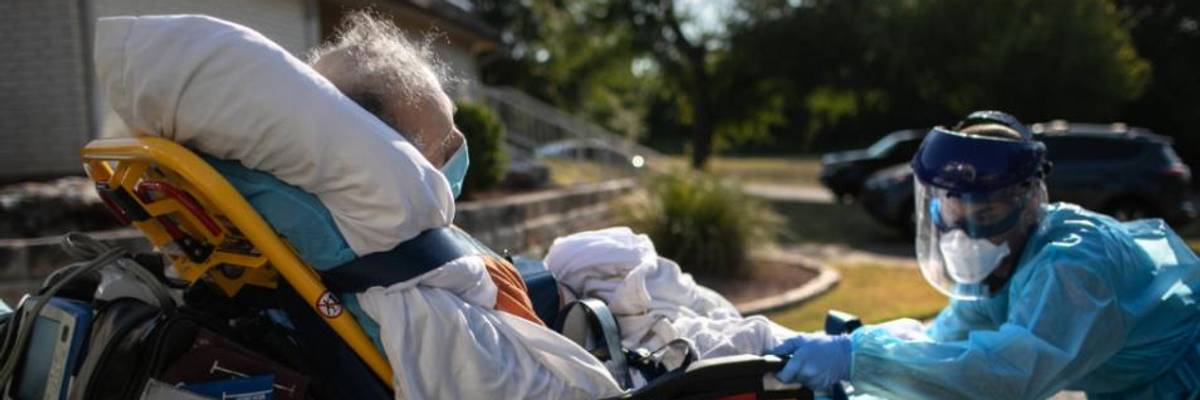
As of the last week of November, Covid-19 has claimed the lives of more than 100,000 people who live and work in long-term care facilities in the United States, according to the Kaiser Family Foundation's latest analysis of state-reported data.
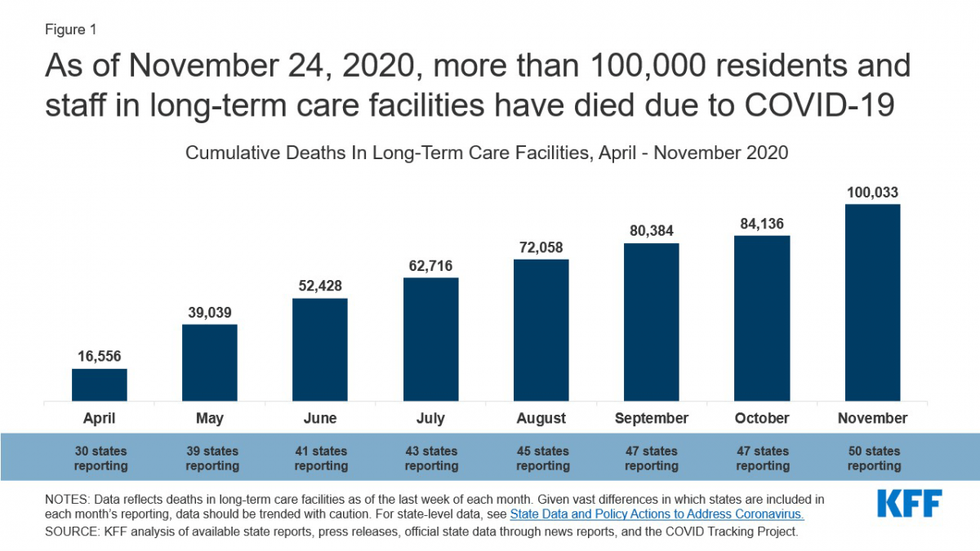
The following chart depicts the growth in Covid-19 deaths among nursing home residents and staff in the U.S. since April. According to the Kaiser Family Foundation (KFF), 40% of the nation's Covid-19 deaths have occurred in long-term care facilities.
"While early action to prevent the spread of coronavirus in long-term care facilities led to strict protocols related to testing, personal protective equipment, and visitor restrictions," KFF pointed out that "several of these measures have been reversed in recent months, and some long-term care facilities continue to report shortages of PPE and staff."
According to physician and public health expert Michael Barnett, 7.7% of the nation's nursing home residents, or one in 13, have now died as a result of Covid-19. "Things have never really gotten better," he tweeted. "Testing is a struggle, PPE and staff are daily challenges."
Soon after reaching the "bleak milestone" of 100,000 pandemic deaths in long-term care facilities, which happened on Tuesday, the U.S. on Thursday experienced a new record-high number of coronavirus-related hospitalizations, as Common Dreams reported earlier Friday.
Millions of Americans have passed through airports in the past week, despite the Centers for Disease Control and Prevention's recommendation against traveling for Thanksgiving. Dr. Anthony Fauci, the nation's top infectious disease expert, does not expect conditions to improve by Christmas and the New Year.
As KFF explained, the predicted "surge in cases after holiday gatherings and increased time indoors due to winter weather... will have ripple effects on hospitals and nursing homes, given the close relationship between community spread and cases in congregate care settings."
The country's Covid-19 death toll surpassed 264,000 on Friday. Meanwhile, Thanksgiving marked the 24th consecutive day of more than 100,000 new daily cases in the U.S.
Given the pandemic's disproportionate impact on the high-risk populations who live and work in long-term care facilities, even more nursing home residents, employees, and their families are expected to be negatively affected by coronavirus as long as the number of infections continues to grow.
"Post-Thanksgiving surges in cases are unlikely to spare this community and will likely lead to an even higher death toll in long-term care facilities," KFF said, "raising questions about whether nursing homes and other facilities are able to protect their residents and, if not, what actions can be taken to mitigate the threat posed by the virus."
As the New York Times reported in June, when the Covid-19 death toll in long-term care facilities was just over 50,000, some critics have argued that the profit-driven nature of the private nursing home industry is the underlying problem, since treating elder care as a commodity rather than a public good can incentivize cost-cutting or money-making measures that put people in harm's way.
An investigation of long-term care facilities in Connecticut, the results of which were published in August, lent credence to that hypothesis. According to the study, "For-profit nursing homes had about 60% more cases and deaths per licensed bed than nonprofit ones," while "larger facilities were hit harder than smaller ones, and... homes serving as part of a chain had worse outcomes," as Reuters reported at the time.
Sen. Sheldon Whitehouse (D-R.I.) noted this week that he and Sen. Bob Casey (D-Pa.) "have a bill to help nursing homes protect their residents and workers from Covid-19."
"It's time," he said, "to pass it."
As of the last week of November, Covid-19 has claimed the lives of more than 100,000 people who live and work in long-term care facilities in the United States, according to the Kaiser Family Foundation's latest analysis of state-reported data.
The following chart depicts the growth in Covid-19 deaths among nursing home residents and staff in the U.S. since April. According to the Kaiser Family Foundation (KFF), 40% of the nation's Covid-19 deaths have occurred in long-term care facilities.
"While early action to prevent the spread of coronavirus in long-term care facilities led to strict protocols related to testing, personal protective equipment, and visitor restrictions," KFF pointed out that "several of these measures have been reversed in recent months, and some long-term care facilities continue to report shortages of PPE and staff."
According to physician and public health expert Michael Barnett, 7.7% of the nation's nursing home residents, or one in 13, have now died as a result of Covid-19. "Things have never really gotten better," he tweeted. "Testing is a struggle, PPE and staff are daily challenges."
Soon after reaching the "bleak milestone" of 100,000 pandemic deaths in long-term care facilities, which happened on Tuesday, the U.S. on Thursday experienced a new record-high number of coronavirus-related hospitalizations, as Common Dreams reported earlier Friday.
Millions of Americans have passed through airports in the past week, despite the Centers for Disease Control and Prevention's recommendation against traveling for Thanksgiving. Dr. Anthony Fauci, the nation's top infectious disease expert, does not expect conditions to improve by Christmas and the New Year.
As KFF explained, the predicted "surge in cases after holiday gatherings and increased time indoors due to winter weather... will have ripple effects on hospitals and nursing homes, given the close relationship between community spread and cases in congregate care settings."
The country's Covid-19 death toll surpassed 264,000 on Friday. Meanwhile, Thanksgiving marked the 24th consecutive day of more than 100,000 new daily cases in the U.S.
Given the pandemic's disproportionate impact on the high-risk populations who live and work in long-term care facilities, even more nursing home residents, employees, and their families are expected to be negatively affected by coronavirus as long as the number of infections continues to grow.
"Post-Thanksgiving surges in cases are unlikely to spare this community and will likely lead to an even higher death toll in long-term care facilities," KFF said, "raising questions about whether nursing homes and other facilities are able to protect their residents and, if not, what actions can be taken to mitigate the threat posed by the virus."
As the New York Times reported in June, when the Covid-19 death toll in long-term care facilities was just over 50,000, some critics have argued that the profit-driven nature of the private nursing home industry is the underlying problem, since treating elder care as a commodity rather than a public good can incentivize cost-cutting or money-making measures that put people in harm's way.
An investigation of long-term care facilities in Connecticut, the results of which were published in August, lent credence to that hypothesis. According to the study, "For-profit nursing homes had about 60% more cases and deaths per licensed bed than nonprofit ones," while "larger facilities were hit harder than smaller ones, and... homes serving as part of a chain had worse outcomes," as Reuters reported at the time.
Sen. Sheldon Whitehouse (D-R.I.) noted this week that he and Sen. Bob Casey (D-Pa.) "have a bill to help nursing homes protect their residents and workers from Covid-19."
"It's time," he said, "to pass it."
As of the last week of November, Covid-19 has claimed the lives of more than 100,000 people who live and work in long-term care facilities in the United States, according to the Kaiser Family Foundation's latest analysis of state-reported data.
The following chart depicts the growth in Covid-19 deaths among nursing home residents and staff in the U.S. since April. According to the Kaiser Family Foundation (KFF), 40% of the nation's Covid-19 deaths have occurred in long-term care facilities.
"While early action to prevent the spread of coronavirus in long-term care facilities led to strict protocols related to testing, personal protective equipment, and visitor restrictions," KFF pointed out that "several of these measures have been reversed in recent months, and some long-term care facilities continue to report shortages of PPE and staff."
According to physician and public health expert Michael Barnett, 7.7% of the nation's nursing home residents, or one in 13, have now died as a result of Covid-19. "Things have never really gotten better," he tweeted. "Testing is a struggle, PPE and staff are daily challenges."
Soon after reaching the "bleak milestone" of 100,000 pandemic deaths in long-term care facilities, which happened on Tuesday, the U.S. on Thursday experienced a new record-high number of coronavirus-related hospitalizations, as Common Dreams reported earlier Friday.
Millions of Americans have passed through airports in the past week, despite the Centers for Disease Control and Prevention's recommendation against traveling for Thanksgiving. Dr. Anthony Fauci, the nation's top infectious disease expert, does not expect conditions to improve by Christmas and the New Year.
As KFF explained, the predicted "surge in cases after holiday gatherings and increased time indoors due to winter weather... will have ripple effects on hospitals and nursing homes, given the close relationship between community spread and cases in congregate care settings."
The country's Covid-19 death toll surpassed 264,000 on Friday. Meanwhile, Thanksgiving marked the 24th consecutive day of more than 100,000 new daily cases in the U.S.
Given the pandemic's disproportionate impact on the high-risk populations who live and work in long-term care facilities, even more nursing home residents, employees, and their families are expected to be negatively affected by coronavirus as long as the number of infections continues to grow.
"Post-Thanksgiving surges in cases are unlikely to spare this community and will likely lead to an even higher death toll in long-term care facilities," KFF said, "raising questions about whether nursing homes and other facilities are able to protect their residents and, if not, what actions can be taken to mitigate the threat posed by the virus."
As the New York Times reported in June, when the Covid-19 death toll in long-term care facilities was just over 50,000, some critics have argued that the profit-driven nature of the private nursing home industry is the underlying problem, since treating elder care as a commodity rather than a public good can incentivize cost-cutting or money-making measures that put people in harm's way.
An investigation of long-term care facilities in Connecticut, the results of which were published in August, lent credence to that hypothesis. According to the study, "For-profit nursing homes had about 60% more cases and deaths per licensed bed than nonprofit ones," while "larger facilities were hit harder than smaller ones, and... homes serving as part of a chain had worse outcomes," as Reuters reported at the time.
Sen. Sheldon Whitehouse (D-R.I.) noted this week that he and Sen. Bob Casey (D-Pa.) "have a bill to help nursing homes protect their residents and workers from Covid-19."
"It's time," he said, "to pass it."