
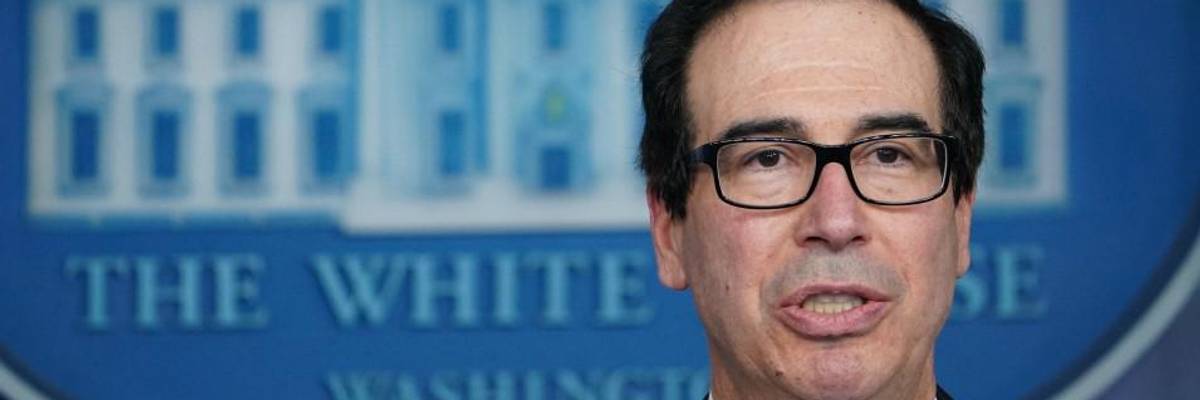
Treasury Secretary Steven Mnuchin speaks during the daily briefing on the novel coronavirus in the Brady Briefing Room of the White House in Washington, D.C. on April 21, 2020. (Photo: Mandel Ngan/AFP via Getty Images)
'Monstrous Behavior': Mnuchin Slammed for Biden 'Snub' That Could Sabotage US Economic Recovery
On his way out the door, said one Nobel-winning economist, "Mnuchin is effectively trying to create a financial crisis.'
Treasury Secretary Steven Mnuchin was accused Friday of taking "exactly the wrong policy move right now" and sabotaging the economy for the incoming Biden administration after announcing an end-of-year cutoff to several key coronavirus relief lending programs at the Federal Reserve.
CNBC's reporting quoted one financial expert who likened the move by Mnuchin to stripping a ship of its lifeboats when they're most needed. The outlet explained:
Mnuchin announced Thursday that he will not extend the Federal Reserve's emergency lending programs that used Congress' CARES Act funds beyond Dec. 31. The move is expected to drastically reduce the central bank's ability to shore up the financial system.
"It's hard to find an economic rationale for it," Carl Weinberg, chief economist at High Frequency Economics, told CNBC's "Squawk Box Europe" on Friday.
"I don't think there's a good economic or public health or social reason to explain why they want to cut these programs," he added, "so it's kind of got to be politics, doesn't it?"
At issue are an array of relief loan programs facilitated by the Fed with funds provided by the Treasury that were authorized by Congress earlier this year. These programs include: the Primary Market Corporate Credit Facility, Secondary Market Corporate Credit Facility, Municipal Liquidity Facility, Main Street Lending Program, and Term Asset-Backed Securities Loan Facility.
"With respect to the facilities that used CARES Act funding," Mnuchin wrote Thursday to Federal Reserve Chair Jerome Powell, "I was personally involved in drafting the relevant part of the legislation and believe the congressional intent as outlined in Section 4029 was to have the authority to originate new loans or purchase new assets (either directly or indirectly) expire on December 31, 2020."
"As such, I am requesting that the Federal Reserve return the unused funds to the Treasury. This will allow Congress to re-appropriate $455 billion, consisting of $429 billion in excess Treasury funds for the Federal Reserve facilities and $26 billion in unused Treasury direct loan funds," wrote Mnuchin.
Mnuchin's letter, as Bloomberg News reported, elicited swift rebuke from Powell. In a statement released "minutes" after Mnuchin's letter, the Fed urged that "the full suite of emergency facilities established during the coronavirus pandemic continue to serve their important role as a backstop for our still-strained and vulnerable economy."
"The central bank," noted Axios, "almost never issues public statements."
The Trump administration's move sparked a chorus of criticism from economists including Paul Krugman.
In a Friday Twitter thread, Krugman said "Mnuchin is effectively trying to create a financial crisis, or at least make one more likely." Krugman added that "basically we're looking at more sabotage by an administration on its way out."
Krugman was far from alone in his criticism:
Mnuchin's announcement also drew scathing rebuke from Neil Barofsky, former inspector general of the Troubled Asset Relief Program, who described the programs' move to the chopping block as a "reckless political decision," and called on the Trump administration "not [to] succumb to the political temptation to straitjacket its successor."
In his Friday op-ed at the New York Times, Barofsky urged Mnuchin to follow the approach of the George W. Bush administration's outgoing Treasury Department when it "did all that it could to preserve President-elect Barack Obama's discretion to use congressionally approved bailout funds from the Troubled Asset Relied Program ... to steer our nation's recovery."
Trump's Treasury Department, wrote Barofsky, "should reverse [its] reckless course and follow the precedent set with TARP by extending these programs to give the newly elected administration as much flexibility as possible."
"It makes no sense to celebrate the programs for the success they have had in calming markets," Barofsky added, "while at the same time pulling the rug out from under them at a time when they are likely to be most needed."
We are at a crossroads
This country and this world are at a monumental crossroads. In a few short weeks, US voters will have an opportunity to beat back the forces of fascism and confront the billionaires who are rigging the economy, our media system, and our democracy, making it increasingly impossible for ordinary people to get by. We’re not just talking about the election. We’re talking about what must be done once these fascist elements are vanquished from power. We need a bolder set of solutions than what either major party has so far been willing to offer and a working-class movement ready to fight like hell for it. Trump didn't emerge from nowhere. The conditions that fueled MAGA authoritarianism were created by decades of radical neoliberal economic policies and a corrupt political system dominated by corporate interests. They slashed taxes on the super-rich, promising that the benefits would trickle down. They said giveaways to the corporate titans would make life more affordable for the rest of us. It was all bullshit. And when a bitter, betrayed populace searches for someone to blame, right-wing demagogues have little trouble finding scapegoats. People know when they're being lied to, but you won't hear any of this from the corporate media. Only independent journalism—powered and funded by people who believe in building a better world—can deliver truly trustworthy daily news. Our Fall Campaign is underway, and we need your help. To power our newsroom through the rest of the year, we need to raise $125,000 by midnight on October 31. So if you share our vision, please contribute whatever you can to sustain our work. |
Treasury Secretary Steven Mnuchin was accused Friday of taking "exactly the wrong policy move right now" and sabotaging the economy for the incoming Biden administration after announcing an end-of-year cutoff to several key coronavirus relief lending programs at the Federal Reserve.
CNBC's reporting quoted one financial expert who likened the move by Mnuchin to stripping a ship of its lifeboats when they're most needed. The outlet explained:
Mnuchin announced Thursday that he will not extend the Federal Reserve's emergency lending programs that used Congress' CARES Act funds beyond Dec. 31. The move is expected to drastically reduce the central bank's ability to shore up the financial system.
"It's hard to find an economic rationale for it," Carl Weinberg, chief economist at High Frequency Economics, told CNBC's "Squawk Box Europe" on Friday.
"I don't think there's a good economic or public health or social reason to explain why they want to cut these programs," he added, "so it's kind of got to be politics, doesn't it?"
At issue are an array of relief loan programs facilitated by the Fed with funds provided by the Treasury that were authorized by Congress earlier this year. These programs include: the Primary Market Corporate Credit Facility, Secondary Market Corporate Credit Facility, Municipal Liquidity Facility, Main Street Lending Program, and Term Asset-Backed Securities Loan Facility.
"With respect to the facilities that used CARES Act funding," Mnuchin wrote Thursday to Federal Reserve Chair Jerome Powell, "I was personally involved in drafting the relevant part of the legislation and believe the congressional intent as outlined in Section 4029 was to have the authority to originate new loans or purchase new assets (either directly or indirectly) expire on December 31, 2020."
"As such, I am requesting that the Federal Reserve return the unused funds to the Treasury. This will allow Congress to re-appropriate $455 billion, consisting of $429 billion in excess Treasury funds for the Federal Reserve facilities and $26 billion in unused Treasury direct loan funds," wrote Mnuchin.
Mnuchin's letter, as Bloomberg News reported, elicited swift rebuke from Powell. In a statement released "minutes" after Mnuchin's letter, the Fed urged that "the full suite of emergency facilities established during the coronavirus pandemic continue to serve their important role as a backstop for our still-strained and vulnerable economy."
"The central bank," noted Axios, "almost never issues public statements."
The Trump administration's move sparked a chorus of criticism from economists including Paul Krugman.
In a Friday Twitter thread, Krugman said "Mnuchin is effectively trying to create a financial crisis, or at least make one more likely." Krugman added that "basically we're looking at more sabotage by an administration on its way out."
Krugman was far from alone in his criticism:
Mnuchin's announcement also drew scathing rebuke from Neil Barofsky, former inspector general of the Troubled Asset Relief Program, who described the programs' move to the chopping block as a "reckless political decision," and called on the Trump administration "not [to] succumb to the political temptation to straitjacket its successor."
In his Friday op-ed at the New York Times, Barofsky urged Mnuchin to follow the approach of the George W. Bush administration's outgoing Treasury Department when it "did all that it could to preserve President-elect Barack Obama's discretion to use congressionally approved bailout funds from the Troubled Asset Relied Program ... to steer our nation's recovery."
Trump's Treasury Department, wrote Barofsky, "should reverse [its] reckless course and follow the precedent set with TARP by extending these programs to give the newly elected administration as much flexibility as possible."
"It makes no sense to celebrate the programs for the success they have had in calming markets," Barofsky added, "while at the same time pulling the rug out from under them at a time when they are likely to be most needed."
Treasury Secretary Steven Mnuchin was accused Friday of taking "exactly the wrong policy move right now" and sabotaging the economy for the incoming Biden administration after announcing an end-of-year cutoff to several key coronavirus relief lending programs at the Federal Reserve.
CNBC's reporting quoted one financial expert who likened the move by Mnuchin to stripping a ship of its lifeboats when they're most needed. The outlet explained:
Mnuchin announced Thursday that he will not extend the Federal Reserve's emergency lending programs that used Congress' CARES Act funds beyond Dec. 31. The move is expected to drastically reduce the central bank's ability to shore up the financial system.
"It's hard to find an economic rationale for it," Carl Weinberg, chief economist at High Frequency Economics, told CNBC's "Squawk Box Europe" on Friday.
"I don't think there's a good economic or public health or social reason to explain why they want to cut these programs," he added, "so it's kind of got to be politics, doesn't it?"
At issue are an array of relief loan programs facilitated by the Fed with funds provided by the Treasury that were authorized by Congress earlier this year. These programs include: the Primary Market Corporate Credit Facility, Secondary Market Corporate Credit Facility, Municipal Liquidity Facility, Main Street Lending Program, and Term Asset-Backed Securities Loan Facility.
"With respect to the facilities that used CARES Act funding," Mnuchin wrote Thursday to Federal Reserve Chair Jerome Powell, "I was personally involved in drafting the relevant part of the legislation and believe the congressional intent as outlined in Section 4029 was to have the authority to originate new loans or purchase new assets (either directly or indirectly) expire on December 31, 2020."
"As such, I am requesting that the Federal Reserve return the unused funds to the Treasury. This will allow Congress to re-appropriate $455 billion, consisting of $429 billion in excess Treasury funds for the Federal Reserve facilities and $26 billion in unused Treasury direct loan funds," wrote Mnuchin.
Mnuchin's letter, as Bloomberg News reported, elicited swift rebuke from Powell. In a statement released "minutes" after Mnuchin's letter, the Fed urged that "the full suite of emergency facilities established during the coronavirus pandemic continue to serve their important role as a backstop for our still-strained and vulnerable economy."
"The central bank," noted Axios, "almost never issues public statements."
The Trump administration's move sparked a chorus of criticism from economists including Paul Krugman.
In a Friday Twitter thread, Krugman said "Mnuchin is effectively trying to create a financial crisis, or at least make one more likely." Krugman added that "basically we're looking at more sabotage by an administration on its way out."
Krugman was far from alone in his criticism:
Mnuchin's announcement also drew scathing rebuke from Neil Barofsky, former inspector general of the Troubled Asset Relief Program, who described the programs' move to the chopping block as a "reckless political decision," and called on the Trump administration "not [to] succumb to the political temptation to straitjacket its successor."
In his Friday op-ed at the New York Times, Barofsky urged Mnuchin to follow the approach of the George W. Bush administration's outgoing Treasury Department when it "did all that it could to preserve President-elect Barack Obama's discretion to use congressionally approved bailout funds from the Troubled Asset Relied Program ... to steer our nation's recovery."
Trump's Treasury Department, wrote Barofsky, "should reverse [its] reckless course and follow the precedent set with TARP by extending these programs to give the newly elected administration as much flexibility as possible."
"It makes no sense to celebrate the programs for the success they have had in calming markets," Barofsky added, "while at the same time pulling the rug out from under them at a time when they are likely to be most needed."