SUBSCRIBE TO OUR FREE NEWSLETTER
Daily news & progressive opinion—funded by the people, not the corporations—delivered straight to your inbox.
5
#000000
#FFFFFF
To donate by check, phone, or other method, see our More Ways to Give page.
Daily news & progressive opinion—funded by the people, not the corporations—delivered straight to your inbox.
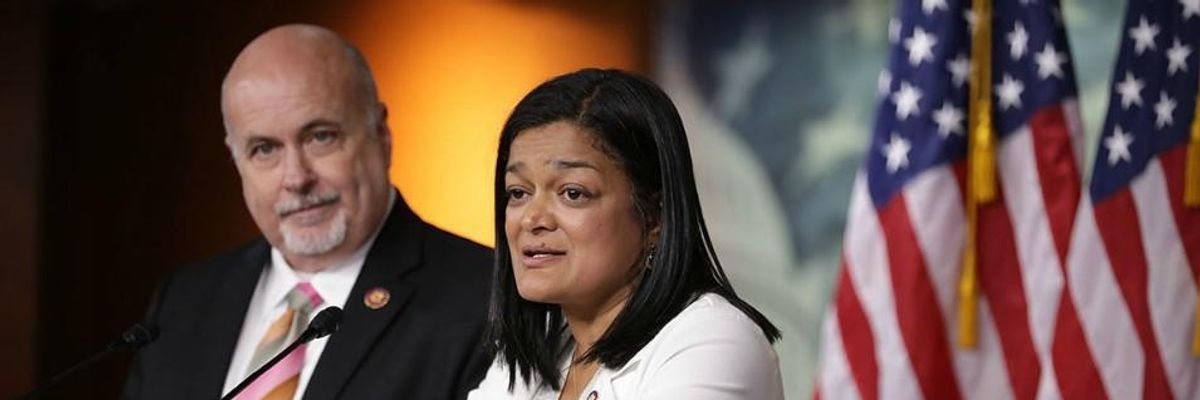
Congressional Progressive Caucus co-chairs Rep. Mark Pocan (D-Wis.) and Rep. Pramila Jayapal (D-Wash.) hold a news conference in the U.S. Capitol Visitors Center on May 17, 2019 in Washington, D.C. (Photo: Chip Somodevilla/Getty Images)
Amid publicized Democratic Party infighting in the wake of elections last week that saw voters nationwide rally behind congressional candidates who champion policies like Medicare for All and the Green New Deal, the majority of the Congressional Progressive Caucus voted on Monday for an overhaul that supporters say will boost the CPC's power on Capitol Hill and potentially push out "free riding members."
As The Intercept detailed on October 26, the caucus of nearly 100 House Democrats--and Sen. Bernie Sanders (I-Vt.)--is restructuring to "shape itself into a more cohesive fighting force come 2021." Politico's Heather Caygle, who also reported on the proposed changes with two colleagues last month, tweeted Monday that of the nearly three-quarters of CPC members who voted on the overhaul, 91% favored it.
The outcome was immediately welcomed by progressive activists and advocacy groups. Former Move On executive director Ilya Sheyman called it "fantastic news" while Matt Stoller of the American Economic Liberties Project pointed out that the changes are "potentially [a] very big deal in terms of Congress."
The changes impact the highest level of the CPC, shifting from a pair of co-chairs to just one leader. Rep. Mark Pocan (D-Wis.) is stepping down from his post and Rep. Pramila Jayapal (D-Wash.) will continue serving at the helm of the caucus. Both members of Congress have expressed support for the reforms.
Pocan told Politico he is "self term-limited" and supports Jayapal leading the CPC into the future. As for concerns that the restructuring gives too much power to one person, the congressman said that "it actually does the opposite of that. ...The heart of this is really around empowering members to be more active."
Jayapal acknowledged to The Intercept that the reforms could mean some members exit the caucus, but she accepts that. "We're ready for that to happen," she said. "I just would rather have people who are really committed to the progressive caucus in the caucus and participating rather than sort of just having it as a label."
Supporters of the "really crucial changes" posited that they will set up the caucus members "to be the power brokers everyone needs them to be" and congratulated Jayapal for "leading the CPC into a new era."
Great news. @PramilaJayapal is leading the CPC into a new era. https://t.co/NXXhu1pgvi
-- Max Berger (@maxberger) November 9, 2020
Advocates of the overhaul believe it will put pressure on CPC members to back progressive policies and actually participate in the caucus. As The Intercept explained:
Under the new rules, if a position wins two-thirds support among the CPC, members of the caucus will be expected to vote as a bloc, which would make it the first Democratic caucus to attempt to bind its members. Yet at the same time, members need only support the official position of the CPC two-thirds of the time before running afoul of the rules and risking expulsion.
[...]
The new rules would also require CPC members to attend a certain number of meetings and to respond to whip requests, which are questions from caucus leadership about how a member feels about a particular bill or position. That such basic requirements are being written into the rules is a reflection of the current lack of participation. Some of that silence amounted to obstruction; a way to undermine a whip count was to simply ignore it. The new rules would strip the nonrespondents from the denominator, meaning a member who doesn't respond can't jam up the process. The caucus will also require members to vote for and sponsor a certain amount of progressive legislation.
Responding to that report last month, Indivisible said that "we need our leaders to govern boldly. This is exactly what we want to see from the CPC--the progressive voting bloc is a critical step towards actually wielding our power in the new Congress."
Jamaal Bowman, a Democrat who won his race in New York's 16th Congressional District last week to join the expanded Squad, had expressed excitement about the potential new direction of the caucus and indicated he would be a part of it:
The initial four members of the Squad--Reps. Alexandria Ocasio-Cortez (D-N.Y.), Ilhan Omar (D-Minn.), Ayanna Pressley (D-Mass.), and Rashida Tlaib (D-Mich.)--all won reelection last week and are members of the CPC. Ocasio-Cortez, Omar, and Pressley are on the task force set up to write the new rules, according to The Intercept.
The congresswomen, particularly Ocasio-Cortez, have in recent days used their platforms--from social networks to interviews with national media--to highlight signals that voters want lawmakers, especially Democrats, to pursue a progressive agenda. The New Yorker has been willing to call out her own party and the CPC since her primary win in 2018; that July, she floated the idea of forming "a sub-caucus of the progressive caucus" that "operates as a bloc" in an effort to "generate real power."
Dear Common Dreams reader, It’s been nearly 30 years since I co-founded Common Dreams with my late wife, Lina Newhouser. We had the radical notion that journalism should serve the public good, not corporate profits. It was clear to us from the outset what it would take to build such a project. No paid advertisements. No corporate sponsors. No millionaire publisher telling us what to think or do. Many people said we wouldn't last a year, but we proved those doubters wrong. Together with a tremendous team of journalists and dedicated staff, we built an independent media outlet free from the constraints of profits and corporate control. Our mission has always been simple: To inform. To inspire. To ignite change for the common good. Building Common Dreams was not easy. Our survival was never guaranteed. When you take on the most powerful forces—Wall Street greed, fossil fuel industry destruction, Big Tech lobbyists, and uber-rich oligarchs who have spent billions upon billions rigging the economy and democracy in their favor—the only bulwark you have is supporters who believe in your work. But here’s the urgent message from me today. It's never been this bad out there. And it's never been this hard to keep us going. At the very moment Common Dreams is most needed, the threats we face are intensifying. We need your support now more than ever. We don't accept corporate advertising and never will. We don't have a paywall because we don't think people should be blocked from critical news based on their ability to pay. Everything we do is funded by the donations of readers like you. When everyone does the little they can afford, we are strong. But if that support retreats or dries up, so do we. Will you donate now to make sure Common Dreams not only survives but thrives? —Craig Brown, Co-founder |
Amid publicized Democratic Party infighting in the wake of elections last week that saw voters nationwide rally behind congressional candidates who champion policies like Medicare for All and the Green New Deal, the majority of the Congressional Progressive Caucus voted on Monday for an overhaul that supporters say will boost the CPC's power on Capitol Hill and potentially push out "free riding members."
As The Intercept detailed on October 26, the caucus of nearly 100 House Democrats--and Sen. Bernie Sanders (I-Vt.)--is restructuring to "shape itself into a more cohesive fighting force come 2021." Politico's Heather Caygle, who also reported on the proposed changes with two colleagues last month, tweeted Monday that of the nearly three-quarters of CPC members who voted on the overhaul, 91% favored it.
The outcome was immediately welcomed by progressive activists and advocacy groups. Former Move On executive director Ilya Sheyman called it "fantastic news" while Matt Stoller of the American Economic Liberties Project pointed out that the changes are "potentially [a] very big deal in terms of Congress."
The changes impact the highest level of the CPC, shifting from a pair of co-chairs to just one leader. Rep. Mark Pocan (D-Wis.) is stepping down from his post and Rep. Pramila Jayapal (D-Wash.) will continue serving at the helm of the caucus. Both members of Congress have expressed support for the reforms.
Pocan told Politico he is "self term-limited" and supports Jayapal leading the CPC into the future. As for concerns that the restructuring gives too much power to one person, the congressman said that "it actually does the opposite of that. ...The heart of this is really around empowering members to be more active."
Jayapal acknowledged to The Intercept that the reforms could mean some members exit the caucus, but she accepts that. "We're ready for that to happen," she said. "I just would rather have people who are really committed to the progressive caucus in the caucus and participating rather than sort of just having it as a label."
Supporters of the "really crucial changes" posited that they will set up the caucus members "to be the power brokers everyone needs them to be" and congratulated Jayapal for "leading the CPC into a new era."
Great news. @PramilaJayapal is leading the CPC into a new era. https://t.co/NXXhu1pgvi
-- Max Berger (@maxberger) November 9, 2020
Advocates of the overhaul believe it will put pressure on CPC members to back progressive policies and actually participate in the caucus. As The Intercept explained:
Under the new rules, if a position wins two-thirds support among the CPC, members of the caucus will be expected to vote as a bloc, which would make it the first Democratic caucus to attempt to bind its members. Yet at the same time, members need only support the official position of the CPC two-thirds of the time before running afoul of the rules and risking expulsion.
[...]
The new rules would also require CPC members to attend a certain number of meetings and to respond to whip requests, which are questions from caucus leadership about how a member feels about a particular bill or position. That such basic requirements are being written into the rules is a reflection of the current lack of participation. Some of that silence amounted to obstruction; a way to undermine a whip count was to simply ignore it. The new rules would strip the nonrespondents from the denominator, meaning a member who doesn't respond can't jam up the process. The caucus will also require members to vote for and sponsor a certain amount of progressive legislation.
Responding to that report last month, Indivisible said that "we need our leaders to govern boldly. This is exactly what we want to see from the CPC--the progressive voting bloc is a critical step towards actually wielding our power in the new Congress."
Jamaal Bowman, a Democrat who won his race in New York's 16th Congressional District last week to join the expanded Squad, had expressed excitement about the potential new direction of the caucus and indicated he would be a part of it:
The initial four members of the Squad--Reps. Alexandria Ocasio-Cortez (D-N.Y.), Ilhan Omar (D-Minn.), Ayanna Pressley (D-Mass.), and Rashida Tlaib (D-Mich.)--all won reelection last week and are members of the CPC. Ocasio-Cortez, Omar, and Pressley are on the task force set up to write the new rules, according to The Intercept.
The congresswomen, particularly Ocasio-Cortez, have in recent days used their platforms--from social networks to interviews with national media--to highlight signals that voters want lawmakers, especially Democrats, to pursue a progressive agenda. The New Yorker has been willing to call out her own party and the CPC since her primary win in 2018; that July, she floated the idea of forming "a sub-caucus of the progressive caucus" that "operates as a bloc" in an effort to "generate real power."
Amid publicized Democratic Party infighting in the wake of elections last week that saw voters nationwide rally behind congressional candidates who champion policies like Medicare for All and the Green New Deal, the majority of the Congressional Progressive Caucus voted on Monday for an overhaul that supporters say will boost the CPC's power on Capitol Hill and potentially push out "free riding members."
As The Intercept detailed on October 26, the caucus of nearly 100 House Democrats--and Sen. Bernie Sanders (I-Vt.)--is restructuring to "shape itself into a more cohesive fighting force come 2021." Politico's Heather Caygle, who also reported on the proposed changes with two colleagues last month, tweeted Monday that of the nearly three-quarters of CPC members who voted on the overhaul, 91% favored it.
The outcome was immediately welcomed by progressive activists and advocacy groups. Former Move On executive director Ilya Sheyman called it "fantastic news" while Matt Stoller of the American Economic Liberties Project pointed out that the changes are "potentially [a] very big deal in terms of Congress."
The changes impact the highest level of the CPC, shifting from a pair of co-chairs to just one leader. Rep. Mark Pocan (D-Wis.) is stepping down from his post and Rep. Pramila Jayapal (D-Wash.) will continue serving at the helm of the caucus. Both members of Congress have expressed support for the reforms.
Pocan told Politico he is "self term-limited" and supports Jayapal leading the CPC into the future. As for concerns that the restructuring gives too much power to one person, the congressman said that "it actually does the opposite of that. ...The heart of this is really around empowering members to be more active."
Jayapal acknowledged to The Intercept that the reforms could mean some members exit the caucus, but she accepts that. "We're ready for that to happen," she said. "I just would rather have people who are really committed to the progressive caucus in the caucus and participating rather than sort of just having it as a label."
Supporters of the "really crucial changes" posited that they will set up the caucus members "to be the power brokers everyone needs them to be" and congratulated Jayapal for "leading the CPC into a new era."
Great news. @PramilaJayapal is leading the CPC into a new era. https://t.co/NXXhu1pgvi
-- Max Berger (@maxberger) November 9, 2020
Advocates of the overhaul believe it will put pressure on CPC members to back progressive policies and actually participate in the caucus. As The Intercept explained:
Under the new rules, if a position wins two-thirds support among the CPC, members of the caucus will be expected to vote as a bloc, which would make it the first Democratic caucus to attempt to bind its members. Yet at the same time, members need only support the official position of the CPC two-thirds of the time before running afoul of the rules and risking expulsion.
[...]
The new rules would also require CPC members to attend a certain number of meetings and to respond to whip requests, which are questions from caucus leadership about how a member feels about a particular bill or position. That such basic requirements are being written into the rules is a reflection of the current lack of participation. Some of that silence amounted to obstruction; a way to undermine a whip count was to simply ignore it. The new rules would strip the nonrespondents from the denominator, meaning a member who doesn't respond can't jam up the process. The caucus will also require members to vote for and sponsor a certain amount of progressive legislation.
Responding to that report last month, Indivisible said that "we need our leaders to govern boldly. This is exactly what we want to see from the CPC--the progressive voting bloc is a critical step towards actually wielding our power in the new Congress."
Jamaal Bowman, a Democrat who won his race in New York's 16th Congressional District last week to join the expanded Squad, had expressed excitement about the potential new direction of the caucus and indicated he would be a part of it:
The initial four members of the Squad--Reps. Alexandria Ocasio-Cortez (D-N.Y.), Ilhan Omar (D-Minn.), Ayanna Pressley (D-Mass.), and Rashida Tlaib (D-Mich.)--all won reelection last week and are members of the CPC. Ocasio-Cortez, Omar, and Pressley are on the task force set up to write the new rules, according to The Intercept.
The congresswomen, particularly Ocasio-Cortez, have in recent days used their platforms--from social networks to interviews with national media--to highlight signals that voters want lawmakers, especially Democrats, to pursue a progressive agenda. The New Yorker has been willing to call out her own party and the CPC since her primary win in 2018; that July, she floated the idea of forming "a sub-caucus of the progressive caucus" that "operates as a bloc" in an effort to "generate real power."