SUBSCRIBE TO OUR FREE NEWSLETTER
Daily news & progressive opinion—funded by the people, not the corporations—delivered straight to your inbox.
5
#000000
#FFFFFF
To donate by check, phone, or other method, see our More Ways to Give page.
Daily news & progressive opinion—funded by the people, not the corporations—delivered straight to your inbox.
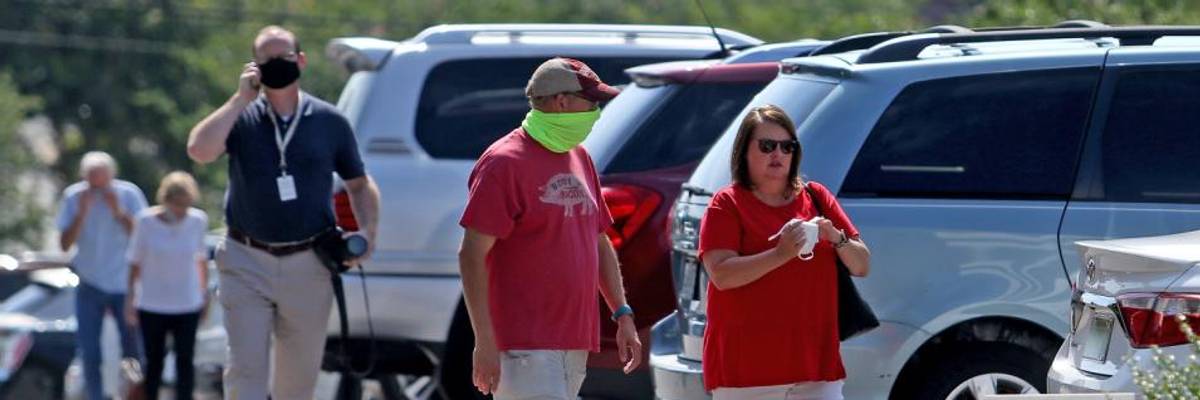
Alabama voters head to the polls at the Volunteers of America Southeast Chapter on July 14, 2020 in Mobile, Alabama. (Photo: Michael DeMocker/Getty Images)
Offering no explanation for their ruling, the five conservative justices who hold the majority on the U.S. Supreme Court sided with Alabama state officials Wednesday night in a decision banning curbside voting in the state.
The ruling will bar counties including Democratic-leaning Montgomery and Jefferson from allowing voters with disabilities or who are at risk of severe, potentially fatal Covid-19 infections from remaining in their cars when they go to the polls to vote in person rather than voting by mail.
Sam Spital of the NAACP Legal Defense and Education Fund, whose client, Howard Porter Jr., was a plaintiff in the case, called the decision an "outrageous 5-3 ruling that puts Alabama voters at risk."
The counties have sought for months to allow curbside voting, in which voters would hand their ballots to a poll worker to avoid having to wait in a crowded polling place and increasing their chances of being exposed to the coronavirus.
"The Department of Justice has sanctioned curbside voting as a remedy to ADA violations, and some 28 States and the District of Columbia already permit curbside voting... The Alabama secretary of state, however, has prohibited counties from offering curbside voting, even for voters with disabilities for whom Covid-19 is disproportionately likely to be fatal."
--Justice Sonia Sotomayor
Secretary of State John Merrill, who has sought to ban the practice, applauded the Supreme Court ruling and called the decision a victory for "election integrity and security" and for "the people of Alabama"--but the five conservative justices did not explain in their ruling how election security might be threatened by a voter receiving assistance from a poll worker while remaining in their car instead of waiting in a crowd of people during a pandemic.
In her dissent on behalf of the three liberal justices, Justice Sonia Sotomayor wrote that the Supreme Court has now flouted public health recommendations by the CDC, which has urged states to adopt curbside voting to prevent the spread of Covid-19.
"This is no radical recommendation," Sotomayor wrote. "The Department of Justice has sanctioned curbside voting as a remedy to ADA violations, and some 28 States and the District of Columbia already permit curbside voting... The Alabama secretary of state, however, has prohibited counties from offering curbside voting, even for voters with disabilities for whom Covid-19 is disproportionately likely to be fatal. If those vulnerable voters wish to vote in person, they must wait inside, for as long as it takes, in a crowd of fellow voters whom Alabama does not require to wear face coverings."
Sotomayor also noted that Merrill has never "meaningfully" disputed that forcing voters with disabilities and pre-existing health conditions to vote in person in the traditional manner could prove fatal this year.
The Supreme Court ruling overturned two lower federal court rulings which stated that Merrill's ban on curbside voting was a violation of the Americans With Disabilities Act, granting state officials a stay of those orders.
Outraged disability rights advocates said the ruling will force people with disabilities "to choose between voting and staying alive."
Kristen Clarke, executive director of the Lawyers' Committee for Civil Rights Under Law, noted that the conservative justices had ruled from the safety of their homes against voters who aim to protect themselves from severe Covid-19 infections.
"Reminder: the Supreme Court is still operating remotely," Clarke tweeted.
Dear Common Dreams reader, It’s been nearly 30 years since I co-founded Common Dreams with my late wife, Lina Newhouser. We had the radical notion that journalism should serve the public good, not corporate profits. It was clear to us from the outset what it would take to build such a project. No paid advertisements. No corporate sponsors. No millionaire publisher telling us what to think or do. Many people said we wouldn't last a year, but we proved those doubters wrong. Together with a tremendous team of journalists and dedicated staff, we built an independent media outlet free from the constraints of profits and corporate control. Our mission has always been simple: To inform. To inspire. To ignite change for the common good. Building Common Dreams was not easy. Our survival was never guaranteed. When you take on the most powerful forces—Wall Street greed, fossil fuel industry destruction, Big Tech lobbyists, and uber-rich oligarchs who have spent billions upon billions rigging the economy and democracy in their favor—the only bulwark you have is supporters who believe in your work. But here’s the urgent message from me today. It's never been this bad out there. And it's never been this hard to keep us going. At the very moment Common Dreams is most needed, the threats we face are intensifying. We need your support now more than ever. We don't accept corporate advertising and never will. We don't have a paywall because we don't think people should be blocked from critical news based on their ability to pay. Everything we do is funded by the donations of readers like you. When everyone does the little they can afford, we are strong. But if that support retreats or dries up, so do we. Will you donate now to make sure Common Dreams not only survives but thrives? —Craig Brown, Co-founder |
Offering no explanation for their ruling, the five conservative justices who hold the majority on the U.S. Supreme Court sided with Alabama state officials Wednesday night in a decision banning curbside voting in the state.
The ruling will bar counties including Democratic-leaning Montgomery and Jefferson from allowing voters with disabilities or who are at risk of severe, potentially fatal Covid-19 infections from remaining in their cars when they go to the polls to vote in person rather than voting by mail.
Sam Spital of the NAACP Legal Defense and Education Fund, whose client, Howard Porter Jr., was a plaintiff in the case, called the decision an "outrageous 5-3 ruling that puts Alabama voters at risk."
The counties have sought for months to allow curbside voting, in which voters would hand their ballots to a poll worker to avoid having to wait in a crowded polling place and increasing their chances of being exposed to the coronavirus.
"The Department of Justice has sanctioned curbside voting as a remedy to ADA violations, and some 28 States and the District of Columbia already permit curbside voting... The Alabama secretary of state, however, has prohibited counties from offering curbside voting, even for voters with disabilities for whom Covid-19 is disproportionately likely to be fatal."
--Justice Sonia Sotomayor
Secretary of State John Merrill, who has sought to ban the practice, applauded the Supreme Court ruling and called the decision a victory for "election integrity and security" and for "the people of Alabama"--but the five conservative justices did not explain in their ruling how election security might be threatened by a voter receiving assistance from a poll worker while remaining in their car instead of waiting in a crowd of people during a pandemic.
In her dissent on behalf of the three liberal justices, Justice Sonia Sotomayor wrote that the Supreme Court has now flouted public health recommendations by the CDC, which has urged states to adopt curbside voting to prevent the spread of Covid-19.
"This is no radical recommendation," Sotomayor wrote. "The Department of Justice has sanctioned curbside voting as a remedy to ADA violations, and some 28 States and the District of Columbia already permit curbside voting... The Alabama secretary of state, however, has prohibited counties from offering curbside voting, even for voters with disabilities for whom Covid-19 is disproportionately likely to be fatal. If those vulnerable voters wish to vote in person, they must wait inside, for as long as it takes, in a crowd of fellow voters whom Alabama does not require to wear face coverings."
Sotomayor also noted that Merrill has never "meaningfully" disputed that forcing voters with disabilities and pre-existing health conditions to vote in person in the traditional manner could prove fatal this year.
The Supreme Court ruling overturned two lower federal court rulings which stated that Merrill's ban on curbside voting was a violation of the Americans With Disabilities Act, granting state officials a stay of those orders.
Outraged disability rights advocates said the ruling will force people with disabilities "to choose between voting and staying alive."
Kristen Clarke, executive director of the Lawyers' Committee for Civil Rights Under Law, noted that the conservative justices had ruled from the safety of their homes against voters who aim to protect themselves from severe Covid-19 infections.
"Reminder: the Supreme Court is still operating remotely," Clarke tweeted.
Offering no explanation for their ruling, the five conservative justices who hold the majority on the U.S. Supreme Court sided with Alabama state officials Wednesday night in a decision banning curbside voting in the state.
The ruling will bar counties including Democratic-leaning Montgomery and Jefferson from allowing voters with disabilities or who are at risk of severe, potentially fatal Covid-19 infections from remaining in their cars when they go to the polls to vote in person rather than voting by mail.
Sam Spital of the NAACP Legal Defense and Education Fund, whose client, Howard Porter Jr., was a plaintiff in the case, called the decision an "outrageous 5-3 ruling that puts Alabama voters at risk."
The counties have sought for months to allow curbside voting, in which voters would hand their ballots to a poll worker to avoid having to wait in a crowded polling place and increasing their chances of being exposed to the coronavirus.
"The Department of Justice has sanctioned curbside voting as a remedy to ADA violations, and some 28 States and the District of Columbia already permit curbside voting... The Alabama secretary of state, however, has prohibited counties from offering curbside voting, even for voters with disabilities for whom Covid-19 is disproportionately likely to be fatal."
--Justice Sonia Sotomayor
Secretary of State John Merrill, who has sought to ban the practice, applauded the Supreme Court ruling and called the decision a victory for "election integrity and security" and for "the people of Alabama"--but the five conservative justices did not explain in their ruling how election security might be threatened by a voter receiving assistance from a poll worker while remaining in their car instead of waiting in a crowd of people during a pandemic.
In her dissent on behalf of the three liberal justices, Justice Sonia Sotomayor wrote that the Supreme Court has now flouted public health recommendations by the CDC, which has urged states to adopt curbside voting to prevent the spread of Covid-19.
"This is no radical recommendation," Sotomayor wrote. "The Department of Justice has sanctioned curbside voting as a remedy to ADA violations, and some 28 States and the District of Columbia already permit curbside voting... The Alabama secretary of state, however, has prohibited counties from offering curbside voting, even for voters with disabilities for whom Covid-19 is disproportionately likely to be fatal. If those vulnerable voters wish to vote in person, they must wait inside, for as long as it takes, in a crowd of fellow voters whom Alabama does not require to wear face coverings."
Sotomayor also noted that Merrill has never "meaningfully" disputed that forcing voters with disabilities and pre-existing health conditions to vote in person in the traditional manner could prove fatal this year.
The Supreme Court ruling overturned two lower federal court rulings which stated that Merrill's ban on curbside voting was a violation of the Americans With Disabilities Act, granting state officials a stay of those orders.
Outraged disability rights advocates said the ruling will force people with disabilities "to choose between voting and staying alive."
Kristen Clarke, executive director of the Lawyers' Committee for Civil Rights Under Law, noted that the conservative justices had ruled from the safety of their homes against voters who aim to protect themselves from severe Covid-19 infections.
"Reminder: the Supreme Court is still operating remotely," Clarke tweeted.