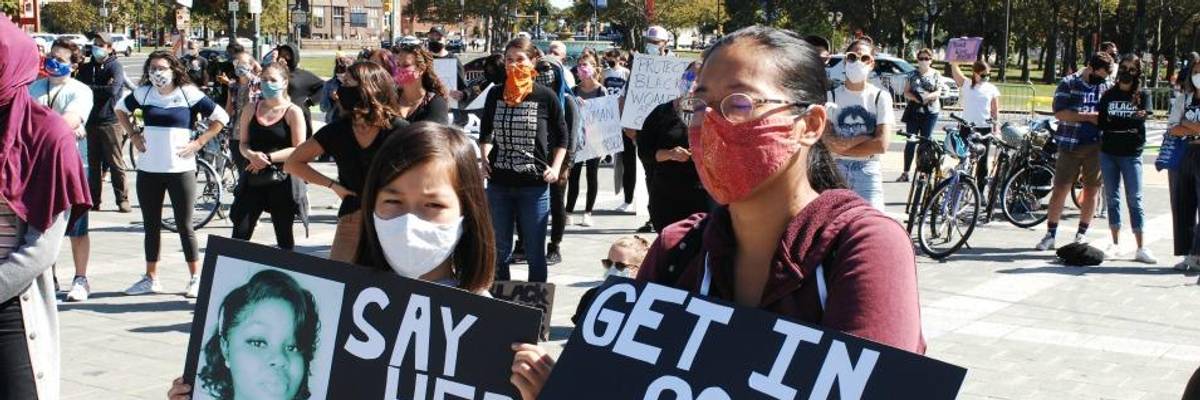
Black Lives Matter Philly held a tally and teach-in in honor of Breonna Taylor, in solidarity with Louisville and all communities mobilizing in defense of Black lives, in Philadelphia on October 3, 2020. (Photo: Cory Clark/NurPhoto via Getty Images)
Grand Juror in Breonna Taylor Case Speaks Out, Accusing AG Cameron of Misrepresenting Proceedings
A judge ruled that grand jury records regarding the Taylor case should be released so the public can determine whether "publicly elected officials are being honest."
Just after a judge in Jefferson County, Kentucky ruled Tuesday that grand jury records from the case of Breonna Taylor's killing by Louisville police officers be unsealed, a grand juror spoke out anonymously against state Attorney General Daniel Cameron.
The juror released a statement saying Cameron and his team gave the grand jury no options for charges in the case other than the three wanton endangerment charges which were filed against Detective Brett Hankison last month, over his firing bullets into the apartments of Taylor's neighbors on the night of March 13.
"The grand jury didn't agree that certain actions were justified, nor did it decide the indictment should be the only charges in the Breonna Taylor case," the juror said, contradicting Cameron's earlier claims that the grand jury agreed with the charges his office filed.
Cameron has also claimed that "the grand jury was given a complete picture" of what happened at Taylor's apartment on March 13 and the charges that could possibly be filed against Hankison, Sergeant Jonathan Mattingly, and Detective Myles Cosgrove. The three officers arrived at Taylor's home with a "no-knock" warrant and forcibly entered the apartment on suspicion that she was connected to a drug operation--an allegation Taylor was later cleared of in an internal memo from the Louisville Metro Police Department.
The grand juror said Tuesday Cameron and his team never addressed the possibility of charging the officers with homicide, even though the 26-year-old Taylor was shot multiple times while she was sleeping.
"The grand jury did not have homicide offenses explained to them," the juror said. "The grand jury never heard anything about those laws. Self-defense or justification was never explained either... Questions were asked about additional charges and the grand jury was told there would be none because the prosecutors didn't feel they could make them stick."
Kevin Glogower, an attorney representing the juror, said Tuesday his client "is aggrieved... that what was presented [in grand jury proceedings] is not being publicly disclosed."
"The concern is truth and transparency," Glogower added.
In ruling that grand jury records should be unsealed in the case, which garnered national attention over the summer and has been a focus of continuing nationwide racial justice demonstrations, O'Connell rejected Cameron's claim that doing so would "destroy the principle of secrecy that serves as the foundation of the grand jury system."
"As applied in this case, this court finds that the traditional justifications for secrecy in this matter are no longer relevant," O'Connell wrote in her ruling. "This is a rare and extraordinary example of a case where, at the time this motion is made, the historical reasons for preserving grand jury secrecy are null."
The records should be released, she added, to allow the public to determine if "publicly elected officials are being honest."
"Grand juries exist to give democratic input into criminal charging decisions," tweeted University of North Carolina criminal law professor Carissa Byrne Hessick. "Attorney General Cameron not only short circuited that input, but he also misled the public."
A second grand juror indicated on Tuesday following O'Connell's ruling that they planned to speak out about the proceedings as well.
We are at a crossroads
This country and this world are at a monumental crossroads. In a few short weeks, US voters will have an opportunity to beat back the forces of fascism and confront the billionaires who are rigging the economy, our media system, and our democracy, making it increasingly impossible for ordinary people to get by. We’re not just talking about the election. We’re talking about what must be done once these fascist elements are vanquished from power. We need a bolder set of solutions than what either major party has so far been willing to offer and a working-class movement ready to fight like hell for it. Trump didn't emerge from nowhere. The conditions that fueled MAGA authoritarianism were created by decades of radical neoliberal economic policies and a corrupt political system dominated by corporate interests. They slashed taxes on the super-rich, promising that the benefits would trickle down. They said giveaways to the corporate titans would make life more affordable for the rest of us. It was all bullshit. And when a bitter, betrayed populace searches for someone to blame, right-wing demagogues have little trouble finding scapegoats. People know when they're being lied to, but you won't hear any of this from the corporate media. Only independent journalism—powered and funded by people who believe in building a better world—can deliver truly trustworthy daily news. Our Fall Campaign is underway, and we need your help. To power our newsroom through the rest of the year, we need to raise $125,000 by midnight on October 31. So if you share our vision, please contribute whatever you can to sustain our work. |
Just after a judge in Jefferson County, Kentucky ruled Tuesday that grand jury records from the case of Breonna Taylor's killing by Louisville police officers be unsealed, a grand juror spoke out anonymously against state Attorney General Daniel Cameron.
The juror released a statement saying Cameron and his team gave the grand jury no options for charges in the case other than the three wanton endangerment charges which were filed against Detective Brett Hankison last month, over his firing bullets into the apartments of Taylor's neighbors on the night of March 13.
"The grand jury didn't agree that certain actions were justified, nor did it decide the indictment should be the only charges in the Breonna Taylor case," the juror said, contradicting Cameron's earlier claims that the grand jury agreed with the charges his office filed.
Cameron has also claimed that "the grand jury was given a complete picture" of what happened at Taylor's apartment on March 13 and the charges that could possibly be filed against Hankison, Sergeant Jonathan Mattingly, and Detective Myles Cosgrove. The three officers arrived at Taylor's home with a "no-knock" warrant and forcibly entered the apartment on suspicion that she was connected to a drug operation--an allegation Taylor was later cleared of in an internal memo from the Louisville Metro Police Department.
The grand juror said Tuesday Cameron and his team never addressed the possibility of charging the officers with homicide, even though the 26-year-old Taylor was shot multiple times while she was sleeping.
"The grand jury did not have homicide offenses explained to them," the juror said. "The grand jury never heard anything about those laws. Self-defense or justification was never explained either... Questions were asked about additional charges and the grand jury was told there would be none because the prosecutors didn't feel they could make them stick."
Kevin Glogower, an attorney representing the juror, said Tuesday his client "is aggrieved... that what was presented [in grand jury proceedings] is not being publicly disclosed."
"The concern is truth and transparency," Glogower added.
In ruling that grand jury records should be unsealed in the case, which garnered national attention over the summer and has been a focus of continuing nationwide racial justice demonstrations, O'Connell rejected Cameron's claim that doing so would "destroy the principle of secrecy that serves as the foundation of the grand jury system."
"As applied in this case, this court finds that the traditional justifications for secrecy in this matter are no longer relevant," O'Connell wrote in her ruling. "This is a rare and extraordinary example of a case where, at the time this motion is made, the historical reasons for preserving grand jury secrecy are null."
The records should be released, she added, to allow the public to determine if "publicly elected officials are being honest."
"Grand juries exist to give democratic input into criminal charging decisions," tweeted University of North Carolina criminal law professor Carissa Byrne Hessick. "Attorney General Cameron not only short circuited that input, but he also misled the public."
A second grand juror indicated on Tuesday following O'Connell's ruling that they planned to speak out about the proceedings as well.
Just after a judge in Jefferson County, Kentucky ruled Tuesday that grand jury records from the case of Breonna Taylor's killing by Louisville police officers be unsealed, a grand juror spoke out anonymously against state Attorney General Daniel Cameron.
The juror released a statement saying Cameron and his team gave the grand jury no options for charges in the case other than the three wanton endangerment charges which were filed against Detective Brett Hankison last month, over his firing bullets into the apartments of Taylor's neighbors on the night of March 13.
"The grand jury didn't agree that certain actions were justified, nor did it decide the indictment should be the only charges in the Breonna Taylor case," the juror said, contradicting Cameron's earlier claims that the grand jury agreed with the charges his office filed.
Cameron has also claimed that "the grand jury was given a complete picture" of what happened at Taylor's apartment on March 13 and the charges that could possibly be filed against Hankison, Sergeant Jonathan Mattingly, and Detective Myles Cosgrove. The three officers arrived at Taylor's home with a "no-knock" warrant and forcibly entered the apartment on suspicion that she was connected to a drug operation--an allegation Taylor was later cleared of in an internal memo from the Louisville Metro Police Department.
The grand juror said Tuesday Cameron and his team never addressed the possibility of charging the officers with homicide, even though the 26-year-old Taylor was shot multiple times while she was sleeping.
"The grand jury did not have homicide offenses explained to them," the juror said. "The grand jury never heard anything about those laws. Self-defense or justification was never explained either... Questions were asked about additional charges and the grand jury was told there would be none because the prosecutors didn't feel they could make them stick."
Kevin Glogower, an attorney representing the juror, said Tuesday his client "is aggrieved... that what was presented [in grand jury proceedings] is not being publicly disclosed."
"The concern is truth and transparency," Glogower added.
In ruling that grand jury records should be unsealed in the case, which garnered national attention over the summer and has been a focus of continuing nationwide racial justice demonstrations, O'Connell rejected Cameron's claim that doing so would "destroy the principle of secrecy that serves as the foundation of the grand jury system."
"As applied in this case, this court finds that the traditional justifications for secrecy in this matter are no longer relevant," O'Connell wrote in her ruling. "This is a rare and extraordinary example of a case where, at the time this motion is made, the historical reasons for preserving grand jury secrecy are null."
The records should be released, she added, to allow the public to determine if "publicly elected officials are being honest."
"Grand juries exist to give democratic input into criminal charging decisions," tweeted University of North Carolina criminal law professor Carissa Byrne Hessick. "Attorney General Cameron not only short circuited that input, but he also misled the public."
A second grand juror indicated on Tuesday following O'Connell's ruling that they planned to speak out about the proceedings as well.