SUBSCRIBE TO OUR FREE NEWSLETTER
Daily news & progressive opinion—funded by the people, not the corporations—delivered straight to your inbox.
5
#000000
#FFFFFF
To donate by check, phone, or other method, see our More Ways to Give page.

With state and local moratoriums on utility shutoffs set to expire and many American families continuing to fall behind on mounting bills, a new report estimates that millions of households in the U.S. will be at risk of losing access to electricity by October, generating renewed calls for Congress to enact a nationwide moratorium on utility shutoffs.
Energy efficiency advocates at Carbon Switch analyzed data provided by public utility commissions (PUCs) as well as data on unemployment and energy spending to understand the extent to which expiring moratoriums are likely to impact U.S. households as the coronavirus pandemic and resulting economic crisis drag on.
In the months since March, when governors and PUCs first began passing moratoriums, a growing number of states have allowed their bans on utility shut-offs to expire. According to the analysis, more than 76 million households will lack protections by October 1st.
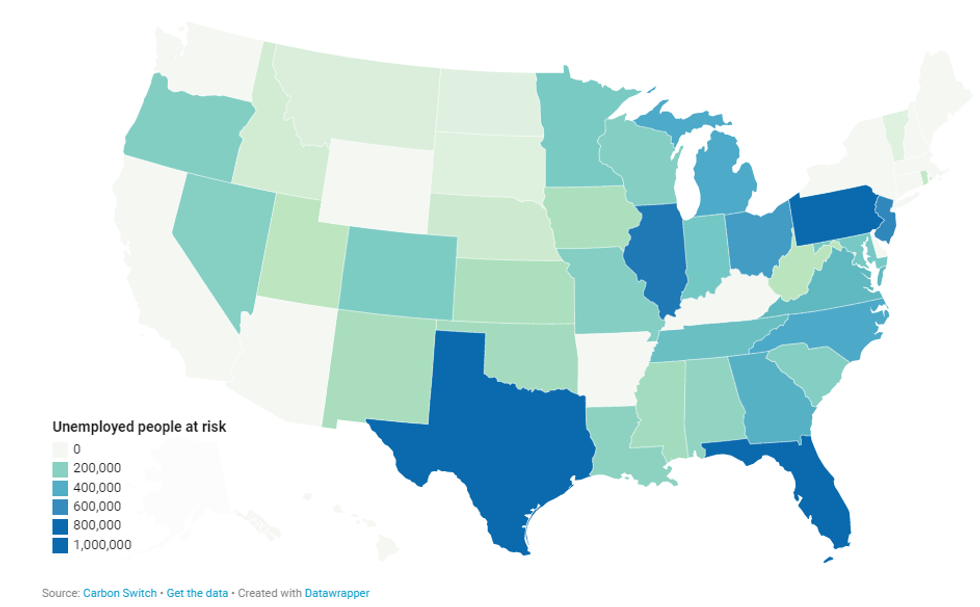
The map below depicts the number of unemployed people in each state who are at risk of utility shutoffs on October 1, when several moratoriums expire.
In the states where moratoriums have expired or are set to expire soon, roughly 10 million households are below the federal poverty line and another 9.5 million people are unemployed, rendering those Americans particularly vulnerable to energy insecurity, according to the report.
Furthermore, the researchers note that in some states, up to one-third of customers can't make payments. In North Carolina, for instance, over 1.3 million households fell behind on utility bills but were spared from disconnection due to the governor's emergency order banning utility shutoffs.
If such moratoriums are allowed to expire across the U.S., "tens of millions of homes may soon go dark," as Luke Savage put it in Jacobin.
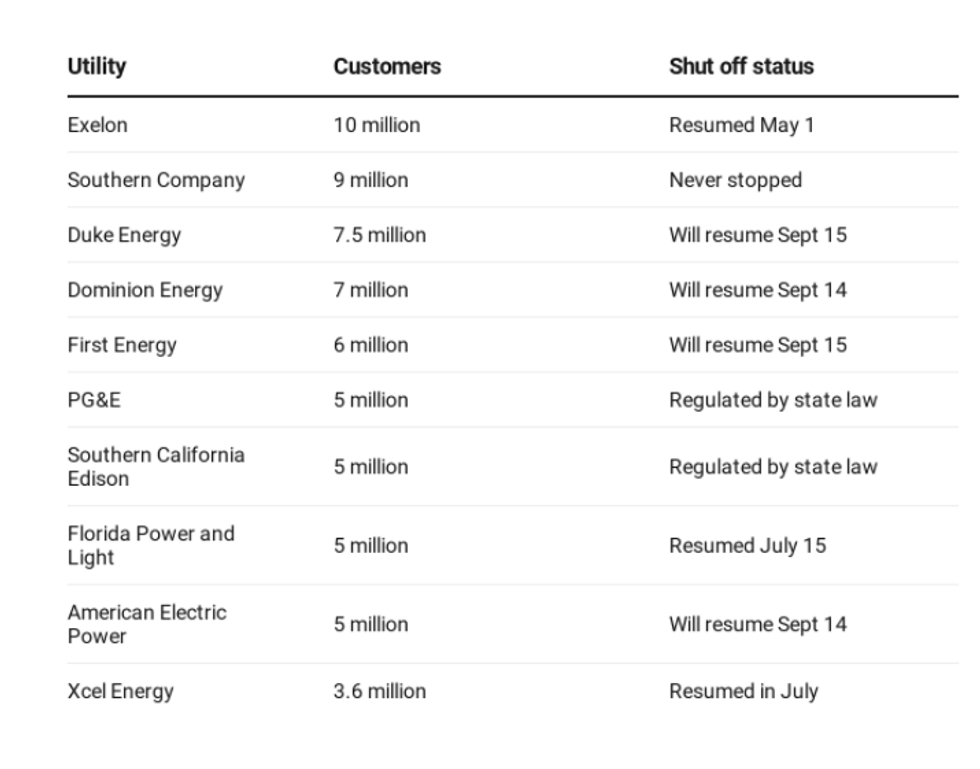
The report explains the varying shutoff policies at the country's ten biggest utility companies, which are sumarized in the table below.
The loss of power can have deadly repercussions--such as heat stroke, carbon monoxide poisoning, freezing, and fires--and the report authors point out that utility shutoffs have a disproportionate impact on nonwhite households, which are more likely to suffer from poverty and its attendant consequences.
The report includes the heartbreaking story of an elderly woman in Arizona who passed away from a heat-related illness after her local utility cut her power. "She had been paying $125 per week--all she could afford on a fixed income--but it wasn't enough," the authors write. "The utility shut her power off because her balance was $176.84 in the negative."
The environmental and climate justice program of the NAACP argued that every utility-related tragedy is "preventable and we cannot, in good conscience, stand by and watch more when we have the means to ensure access for all."
The report authors conclude by arguing that the millions of Americans who lost their jobs as a result of Covid-19 "shouldn't be subjected to more pain. They shouldn't lose more of their dignity. They shouldn't have to forgo more meals just to keep the lights on so their children can attend remote classes."
Last month, Rep. Frank Pallone (D-N.J.), chairman of the House Committee on Energy and Commerce, tweeted: "The House-passed HEROES Act places a moratorium on utility shutoffs until four months after the end of this national emergency."
Pallone was echoing the calls made by more than 830 social justice groups, over 100 lawmakers, and more than 500 faith leaders who--as Common Dreams previously reported--have demanded a national moratorium on utility shutoffs for the duration of the pandemic in order to guarantee access to services essential to survival.
As fears mount that utility companies will resume shutoffs, similar calls continue. In Jacobin, Savage argued that "as Congress gets set to negotiate the next round of stimulus and pandemic relief, a national moratorium on utility shutoffs must be front and center alongside fresh cash payments and other supports."
"The alternative," Savage wrote, "is nothing short of a national human disaster."
It's not only power that worries advocates. Water, perhaps the most basic human need, is crucial in the fight against coronavirus.
"How the hell are you supposed to wash your hands... when your water has been shut off?" Sen. Bernie Sanders (I-Vt.) asked in April.
With state and local moratoriums on utility shutoffs set to expire and many American families continuing to fall behind on mounting bills, a new report estimates that millions of households in the U.S. will be at risk of losing access to electricity by October, generating renewed calls for Congress to enact a nationwide moratorium on utility shutoffs.
Energy efficiency advocates at Carbon Switch analyzed data provided by public utility commissions (PUCs) as well as data on unemployment and energy spending to understand the extent to which expiring moratoriums are likely to impact U.S. households as the coronavirus pandemic and resulting economic crisis drag on.
In the months since March, when governors and PUCs first began passing moratoriums, a growing number of states have allowed their bans on utility shut-offs to expire. According to the analysis, more than 76 million households will lack protections by October 1st.
The map below depicts the number of unemployed people in each state who are at risk of utility shutoffs on October 1, when several moratoriums expire.
In the states where moratoriums have expired or are set to expire soon, roughly 10 million households are below the federal poverty line and another 9.5 million people are unemployed, rendering those Americans particularly vulnerable to energy insecurity, according to the report.
Furthermore, the researchers note that in some states, up to one-third of customers can't make payments. In North Carolina, for instance, over 1.3 million households fell behind on utility bills but were spared from disconnection due to the governor's emergency order banning utility shutoffs.
If such moratoriums are allowed to expire across the U.S., "tens of millions of homes may soon go dark," as Luke Savage put it in Jacobin.
The report explains the varying shutoff policies at the country's ten biggest utility companies, which are sumarized in the table below.
The loss of power can have deadly repercussions--such as heat stroke, carbon monoxide poisoning, freezing, and fires--and the report authors point out that utility shutoffs have a disproportionate impact on nonwhite households, which are more likely to suffer from poverty and its attendant consequences.
The report includes the heartbreaking story of an elderly woman in Arizona who passed away from a heat-related illness after her local utility cut her power. "She had been paying $125 per week--all she could afford on a fixed income--but it wasn't enough," the authors write. "The utility shut her power off because her balance was $176.84 in the negative."
The environmental and climate justice program of the NAACP argued that every utility-related tragedy is "preventable and we cannot, in good conscience, stand by and watch more when we have the means to ensure access for all."
The report authors conclude by arguing that the millions of Americans who lost their jobs as a result of Covid-19 "shouldn't be subjected to more pain. They shouldn't lose more of their dignity. They shouldn't have to forgo more meals just to keep the lights on so their children can attend remote classes."
Last month, Rep. Frank Pallone (D-N.J.), chairman of the House Committee on Energy and Commerce, tweeted: "The House-passed HEROES Act places a moratorium on utility shutoffs until four months after the end of this national emergency."
Pallone was echoing the calls made by more than 830 social justice groups, over 100 lawmakers, and more than 500 faith leaders who--as Common Dreams previously reported--have demanded a national moratorium on utility shutoffs for the duration of the pandemic in order to guarantee access to services essential to survival.
As fears mount that utility companies will resume shutoffs, similar calls continue. In Jacobin, Savage argued that "as Congress gets set to negotiate the next round of stimulus and pandemic relief, a national moratorium on utility shutoffs must be front and center alongside fresh cash payments and other supports."
"The alternative," Savage wrote, "is nothing short of a national human disaster."
It's not only power that worries advocates. Water, perhaps the most basic human need, is crucial in the fight against coronavirus.
"How the hell are you supposed to wash your hands... when your water has been shut off?" Sen. Bernie Sanders (I-Vt.) asked in April.
With state and local moratoriums on utility shutoffs set to expire and many American families continuing to fall behind on mounting bills, a new report estimates that millions of households in the U.S. will be at risk of losing access to electricity by October, generating renewed calls for Congress to enact a nationwide moratorium on utility shutoffs.
Energy efficiency advocates at Carbon Switch analyzed data provided by public utility commissions (PUCs) as well as data on unemployment and energy spending to understand the extent to which expiring moratoriums are likely to impact U.S. households as the coronavirus pandemic and resulting economic crisis drag on.
In the months since March, when governors and PUCs first began passing moratoriums, a growing number of states have allowed their bans on utility shut-offs to expire. According to the analysis, more than 76 million households will lack protections by October 1st.
The map below depicts the number of unemployed people in each state who are at risk of utility shutoffs on October 1, when several moratoriums expire.
In the states where moratoriums have expired or are set to expire soon, roughly 10 million households are below the federal poverty line and another 9.5 million people are unemployed, rendering those Americans particularly vulnerable to energy insecurity, according to the report.
Furthermore, the researchers note that in some states, up to one-third of customers can't make payments. In North Carolina, for instance, over 1.3 million households fell behind on utility bills but were spared from disconnection due to the governor's emergency order banning utility shutoffs.
If such moratoriums are allowed to expire across the U.S., "tens of millions of homes may soon go dark," as Luke Savage put it in Jacobin.
The report explains the varying shutoff policies at the country's ten biggest utility companies, which are sumarized in the table below.
The loss of power can have deadly repercussions--such as heat stroke, carbon monoxide poisoning, freezing, and fires--and the report authors point out that utility shutoffs have a disproportionate impact on nonwhite households, which are more likely to suffer from poverty and its attendant consequences.
The report includes the heartbreaking story of an elderly woman in Arizona who passed away from a heat-related illness after her local utility cut her power. "She had been paying $125 per week--all she could afford on a fixed income--but it wasn't enough," the authors write. "The utility shut her power off because her balance was $176.84 in the negative."
The environmental and climate justice program of the NAACP argued that every utility-related tragedy is "preventable and we cannot, in good conscience, stand by and watch more when we have the means to ensure access for all."
The report authors conclude by arguing that the millions of Americans who lost their jobs as a result of Covid-19 "shouldn't be subjected to more pain. They shouldn't lose more of their dignity. They shouldn't have to forgo more meals just to keep the lights on so their children can attend remote classes."
Last month, Rep. Frank Pallone (D-N.J.), chairman of the House Committee on Energy and Commerce, tweeted: "The House-passed HEROES Act places a moratorium on utility shutoffs until four months after the end of this national emergency."
Pallone was echoing the calls made by more than 830 social justice groups, over 100 lawmakers, and more than 500 faith leaders who--as Common Dreams previously reported--have demanded a national moratorium on utility shutoffs for the duration of the pandemic in order to guarantee access to services essential to survival.
As fears mount that utility companies will resume shutoffs, similar calls continue. In Jacobin, Savage argued that "as Congress gets set to negotiate the next round of stimulus and pandemic relief, a national moratorium on utility shutoffs must be front and center alongside fresh cash payments and other supports."
"The alternative," Savage wrote, "is nothing short of a national human disaster."
It's not only power that worries advocates. Water, perhaps the most basic human need, is crucial in the fight against coronavirus.
"How the hell are you supposed to wash your hands... when your water has been shut off?" Sen. Bernie Sanders (I-Vt.) asked in April.