SUBSCRIBE TO OUR FREE NEWSLETTER
Daily news & progressive opinion—funded by the people, not the corporations—delivered straight to your inbox.
5
#000000
#FFFFFF
To donate by check, phone, or other method, see our More Ways to Give page.
Daily news & progressive opinion—funded by the people, not the corporations—delivered straight to your inbox.
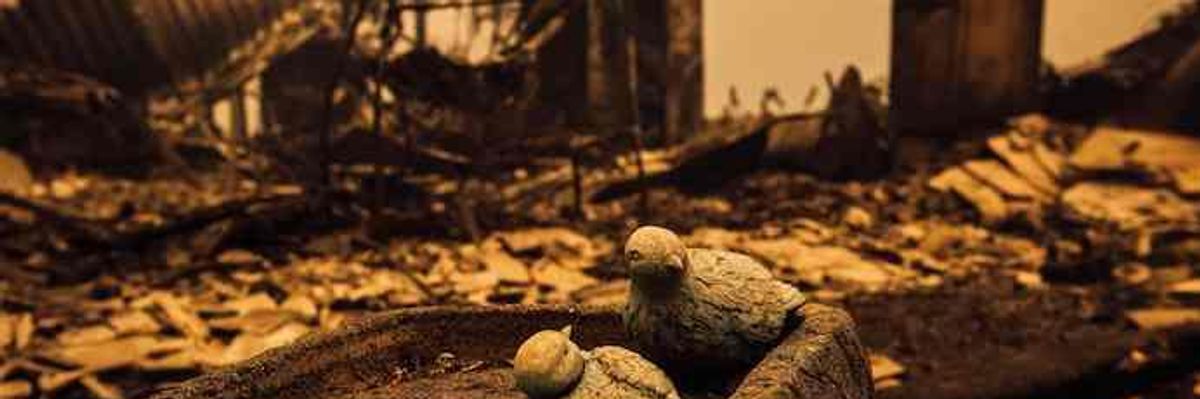
A bird bath is seen in front of the charred remains of a home after the passage of the Santiam Fire in Gates, Oregon, on September 10, 2020. (Photo: Kathryn Elsesser/ AFP via Getty Images)
Oregon Gov. Kate Brown sounded alarm Thursday that the wildfires ravaging the west are "a bellwether of the future"--a warning that came as half a million people were forced to evacuate her state and become "temporary climate refugees."
Thousands of firefighters in Oregon are currently battling 36 fires that have scorched nearly 900,000 acres. State officials said Thursday that 500,000 of Oregon's 4.2 million residents have been forced to evacuate, "and that number continues to grow."
"Half a million Oregonians are temporary climate refugees (and many of them have lost their homes for good)," author and climate activist Bill McKibben tweeted Friday.
Record wildfires have been devastating other western states as well, including California and Washington, with at least 23 people dead as a result of the blazes.
"One hundred large fires have burned more than 4.5 million acres in 12 states," the National Interagency Fire Center announced Friday. "Evacuation orders are in place for residents near 42 large fires across the West."
While President Donald Trump has remained silent about the fires for several weeks, climate activists have pointed to the events as further evidence lawmakers must take urgent climate action including passing the Green New Deal.
In a Thursday tweet, Brown put the wildfires in the context of the climate crisis as well.
"I wish the 2020 wildfires were an anomaly--but this will not be a one-time event. Unfortunately, it is a bellwether of the future. We are seeing the devastating effects of climate change in Oregon, on the entire West Coast, and throughout the world," the Democrat wrote.
Brown's assessment is bolstered by a new resource from the Union of Concerned Scientists (UCS).
The science group released an infographic stating that "wildfires are getting worse," causing more damage, and are fueled by the climate crisis.
The group noted that "ecologically-sound forest and fire management could help limit fire risks" in the near-term.
"But in the long-term, climate action is the best tool we have," UCS said. "When we reduce global warming emissions, we slow the growth of climate risks, including wildfire. Until then, summers will continue getting hotter, forests will get drier, and more and more people will face the threat of wildfire."
Dear Common Dreams reader, It’s been nearly 30 years since I co-founded Common Dreams with my late wife, Lina Newhouser. We had the radical notion that journalism should serve the public good, not corporate profits. It was clear to us from the outset what it would take to build such a project. No paid advertisements. No corporate sponsors. No millionaire publisher telling us what to think or do. Many people said we wouldn't last a year, but we proved those doubters wrong. Together with a tremendous team of journalists and dedicated staff, we built an independent media outlet free from the constraints of profits and corporate control. Our mission has always been simple: To inform. To inspire. To ignite change for the common good. Building Common Dreams was not easy. Our survival was never guaranteed. When you take on the most powerful forces—Wall Street greed, fossil fuel industry destruction, Big Tech lobbyists, and uber-rich oligarchs who have spent billions upon billions rigging the economy and democracy in their favor—the only bulwark you have is supporters who believe in your work. But here’s the urgent message from me today. It's never been this bad out there. And it's never been this hard to keep us going. At the very moment Common Dreams is most needed, the threats we face are intensifying. We need your support now more than ever. We don't accept corporate advertising and never will. We don't have a paywall because we don't think people should be blocked from critical news based on their ability to pay. Everything we do is funded by the donations of readers like you. When everyone does the little they can afford, we are strong. But if that support retreats or dries up, so do we. Will you donate now to make sure Common Dreams not only survives but thrives? —Craig Brown, Co-founder |
Oregon Gov. Kate Brown sounded alarm Thursday that the wildfires ravaging the west are "a bellwether of the future"--a warning that came as half a million people were forced to evacuate her state and become "temporary climate refugees."
Thousands of firefighters in Oregon are currently battling 36 fires that have scorched nearly 900,000 acres. State officials said Thursday that 500,000 of Oregon's 4.2 million residents have been forced to evacuate, "and that number continues to grow."
"Half a million Oregonians are temporary climate refugees (and many of them have lost their homes for good)," author and climate activist Bill McKibben tweeted Friday.
Record wildfires have been devastating other western states as well, including California and Washington, with at least 23 people dead as a result of the blazes.
"One hundred large fires have burned more than 4.5 million acres in 12 states," the National Interagency Fire Center announced Friday. "Evacuation orders are in place for residents near 42 large fires across the West."
While President Donald Trump has remained silent about the fires for several weeks, climate activists have pointed to the events as further evidence lawmakers must take urgent climate action including passing the Green New Deal.
In a Thursday tweet, Brown put the wildfires in the context of the climate crisis as well.
"I wish the 2020 wildfires were an anomaly--but this will not be a one-time event. Unfortunately, it is a bellwether of the future. We are seeing the devastating effects of climate change in Oregon, on the entire West Coast, and throughout the world," the Democrat wrote.
Brown's assessment is bolstered by a new resource from the Union of Concerned Scientists (UCS).
The science group released an infographic stating that "wildfires are getting worse," causing more damage, and are fueled by the climate crisis.
The group noted that "ecologically-sound forest and fire management could help limit fire risks" in the near-term.
"But in the long-term, climate action is the best tool we have," UCS said. "When we reduce global warming emissions, we slow the growth of climate risks, including wildfire. Until then, summers will continue getting hotter, forests will get drier, and more and more people will face the threat of wildfire."
Oregon Gov. Kate Brown sounded alarm Thursday that the wildfires ravaging the west are "a bellwether of the future"--a warning that came as half a million people were forced to evacuate her state and become "temporary climate refugees."
Thousands of firefighters in Oregon are currently battling 36 fires that have scorched nearly 900,000 acres. State officials said Thursday that 500,000 of Oregon's 4.2 million residents have been forced to evacuate, "and that number continues to grow."
"Half a million Oregonians are temporary climate refugees (and many of them have lost their homes for good)," author and climate activist Bill McKibben tweeted Friday.
Record wildfires have been devastating other western states as well, including California and Washington, with at least 23 people dead as a result of the blazes.
"One hundred large fires have burned more than 4.5 million acres in 12 states," the National Interagency Fire Center announced Friday. "Evacuation orders are in place for residents near 42 large fires across the West."
While President Donald Trump has remained silent about the fires for several weeks, climate activists have pointed to the events as further evidence lawmakers must take urgent climate action including passing the Green New Deal.
In a Thursday tweet, Brown put the wildfires in the context of the climate crisis as well.
"I wish the 2020 wildfires were an anomaly--but this will not be a one-time event. Unfortunately, it is a bellwether of the future. We are seeing the devastating effects of climate change in Oregon, on the entire West Coast, and throughout the world," the Democrat wrote.
Brown's assessment is bolstered by a new resource from the Union of Concerned Scientists (UCS).
The science group released an infographic stating that "wildfires are getting worse," causing more damage, and are fueled by the climate crisis.
The group noted that "ecologically-sound forest and fire management could help limit fire risks" in the near-term.
"But in the long-term, climate action is the best tool we have," UCS said. "When we reduce global warming emissions, we slow the growth of climate risks, including wildfire. Until then, summers will continue getting hotter, forests will get drier, and more and more people will face the threat of wildfire."