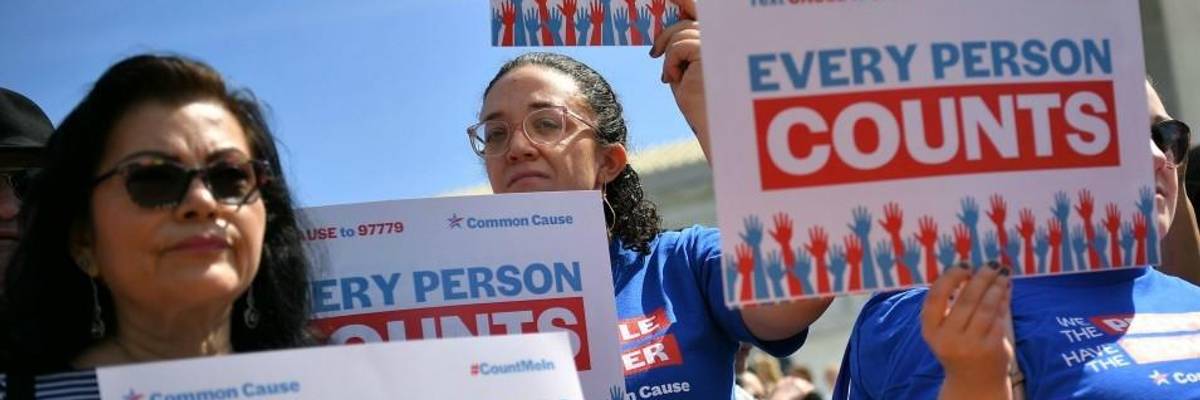
Demonstrators rally at the U.S. Supreme Court in Washington, D.C. on April 23, 2019 to protest a proposal to add a citizenship question in the 2020 census. (Photo: Mandel Ngan/AFP/Getty Images)
Federal Court Blocks 'Nakedly Partisan' Trump Effort to Exclude Undocumented Immigrants From Census
"President Trump has tried and failed yet again to weaponize the census against immigrant communities."
A federal court on Thursday blocked President Donald Trump's effort to exclude undocumented immigrants from the 2020 census, delivering what the ACLU called a "victory" for immigrants' rights.
The ruling stems from legal challenges brought forth by a coalition of organizations led by the ACLU and cities and states led by New York Attorney General Letitia James.
At issue was Trump's July memorandum declaring: "For the purpose of the reapportionment of representatives following the 2020 census, it is the policy of the United States to exclude from the apportionment base aliens who are not in a lawful immigration status under the Immigration and Nationality Act."
The three-judge panel found the president's attempt unlawful, saying Trump did not act "in accordance with, and within the boundaries of, the authority that Congress has granted."
"The merits of the parties' dispute are not particularly close or complicated," the judges wrote, adding that the defendants have "neither text nor history on their side."
"The statutory command to use the 'whole number of persons in each state' as the apportionment base does not give the president discretion to exclude illegal aliens on the basis of their legal status, without regard for their residency," the ruling states.
The judges concluded that the memo represented "an ultra vires violation of Congress's delegation of its constitutional responsibility to count the whole number of persons in each state and to apportion members of the House of Representatives among the states according to their respective numbers."
Dale Ho, who argued the case and is director of the ACLU's Voting Rights Project, welcomed the ruling.
"This is a huge victory for voting rights and for immigrants' rights. President Trump has tried and failed yet again to weaponize the census against immigrant communities. The law is clear--every person counts in the census," Ho said in a statement.
Sen. Brian Schatz (D-Hawaii)--who led an amicus brief in the case warning that Trump's order "would be enormously damaging"--called the ruling "excellent news" and noted that the decision was "not a close call."
"The statute is clear," Schatz tweeted Thursday, "and the Trump administration has been nakedly partisan and dishonest about their administration of the census."
The ruling, which may now head to the U.S. Supreme Court, as NPR noted, comes just three weeks before the census count date ends.
We are at a crossroads
This country and this world are at a monumental crossroads. In a few short weeks, US voters will have an opportunity to beat back the forces of fascism and confront the billionaires who are rigging the economy, our media system, and our democracy, making it increasingly impossible for ordinary people to get by. We’re not just talking about the election. We’re talking about what must be done once these fascist elements are vanquished from power. We need a bolder set of solutions than what either major party has so far been willing to offer and a working-class movement ready to fight like hell for it. Trump didn't emerge from nowhere. The conditions that fueled MAGA authoritarianism were created by decades of radical neoliberal economic policies and a corrupt political system dominated by corporate interests. They slashed taxes on the super-rich, promising that the benefits would trickle down. They said giveaways to the corporate titans would make life more affordable for the rest of us. It was all bullshit. And when a bitter, betrayed populace searches for someone to blame, right-wing demagogues have little trouble finding scapegoats. People know when they're being lied to, but you won't hear any of this from the corporate media. Only independent journalism—powered and funded by people who believe in building a better world—can deliver truly trustworthy daily news. Our Fall Campaign is underway, and we need your help. To power our newsroom through the rest of the year, we need to raise $125,000 by midnight on October 31. So if you share our vision, please contribute whatever you can to sustain our work. |
A federal court on Thursday blocked President Donald Trump's effort to exclude undocumented immigrants from the 2020 census, delivering what the ACLU called a "victory" for immigrants' rights.
The ruling stems from legal challenges brought forth by a coalition of organizations led by the ACLU and cities and states led by New York Attorney General Letitia James.
At issue was Trump's July memorandum declaring: "For the purpose of the reapportionment of representatives following the 2020 census, it is the policy of the United States to exclude from the apportionment base aliens who are not in a lawful immigration status under the Immigration and Nationality Act."
The three-judge panel found the president's attempt unlawful, saying Trump did not act "in accordance with, and within the boundaries of, the authority that Congress has granted."
"The merits of the parties' dispute are not particularly close or complicated," the judges wrote, adding that the defendants have "neither text nor history on their side."
"The statutory command to use the 'whole number of persons in each state' as the apportionment base does not give the president discretion to exclude illegal aliens on the basis of their legal status, without regard for their residency," the ruling states.
The judges concluded that the memo represented "an ultra vires violation of Congress's delegation of its constitutional responsibility to count the whole number of persons in each state and to apportion members of the House of Representatives among the states according to their respective numbers."
Dale Ho, who argued the case and is director of the ACLU's Voting Rights Project, welcomed the ruling.
"This is a huge victory for voting rights and for immigrants' rights. President Trump has tried and failed yet again to weaponize the census against immigrant communities. The law is clear--every person counts in the census," Ho said in a statement.
Sen. Brian Schatz (D-Hawaii)--who led an amicus brief in the case warning that Trump's order "would be enormously damaging"--called the ruling "excellent news" and noted that the decision was "not a close call."
"The statute is clear," Schatz tweeted Thursday, "and the Trump administration has been nakedly partisan and dishonest about their administration of the census."
The ruling, which may now head to the U.S. Supreme Court, as NPR noted, comes just three weeks before the census count date ends.
A federal court on Thursday blocked President Donald Trump's effort to exclude undocumented immigrants from the 2020 census, delivering what the ACLU called a "victory" for immigrants' rights.
The ruling stems from legal challenges brought forth by a coalition of organizations led by the ACLU and cities and states led by New York Attorney General Letitia James.
At issue was Trump's July memorandum declaring: "For the purpose of the reapportionment of representatives following the 2020 census, it is the policy of the United States to exclude from the apportionment base aliens who are not in a lawful immigration status under the Immigration and Nationality Act."
The three-judge panel found the president's attempt unlawful, saying Trump did not act "in accordance with, and within the boundaries of, the authority that Congress has granted."
"The merits of the parties' dispute are not particularly close or complicated," the judges wrote, adding that the defendants have "neither text nor history on their side."
"The statutory command to use the 'whole number of persons in each state' as the apportionment base does not give the president discretion to exclude illegal aliens on the basis of their legal status, without regard for their residency," the ruling states.
The judges concluded that the memo represented "an ultra vires violation of Congress's delegation of its constitutional responsibility to count the whole number of persons in each state and to apportion members of the House of Representatives among the states according to their respective numbers."
Dale Ho, who argued the case and is director of the ACLU's Voting Rights Project, welcomed the ruling.
"This is a huge victory for voting rights and for immigrants' rights. President Trump has tried and failed yet again to weaponize the census against immigrant communities. The law is clear--every person counts in the census," Ho said in a statement.
Sen. Brian Schatz (D-Hawaii)--who led an amicus brief in the case warning that Trump's order "would be enormously damaging"--called the ruling "excellent news" and noted that the decision was "not a close call."
"The statute is clear," Schatz tweeted Thursday, "and the Trump administration has been nakedly partisan and dishonest about their administration of the census."
The ruling, which may now head to the U.S. Supreme Court, as NPR noted, comes just three weeks before the census count date ends.