SUBSCRIBE TO OUR FREE NEWSLETTER
Daily news & progressive opinion—funded by the people, not the corporations—delivered straight to your inbox.
5
#000000
#FFFFFF
To donate by check, phone, or other method, see our More Ways to Give page.
Daily news & progressive opinion—funded by the people, not the corporations—delivered straight to your inbox.
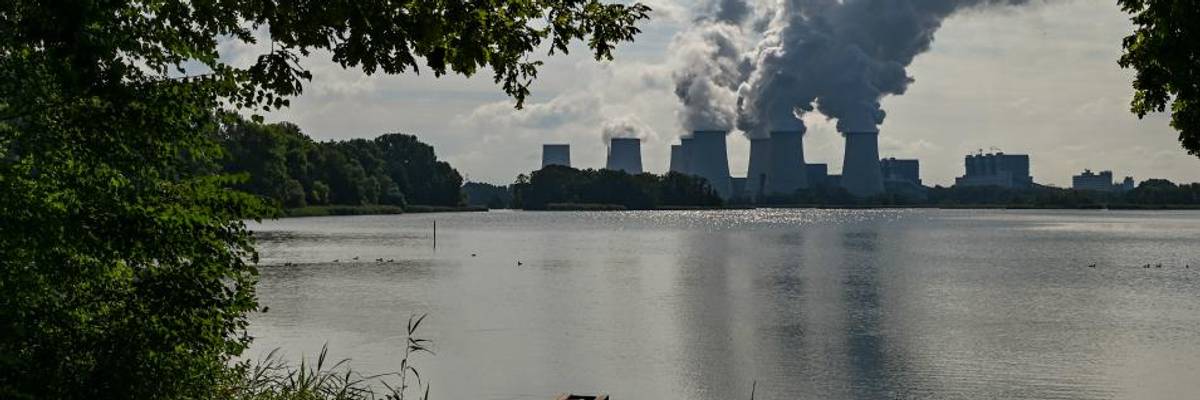
Water vapor rises from the cooling towers of the Janschwalde lignite-fired power plant of Lausitzer Energie Bergbau AG (LEAG) on August 19, 2020 in Peitz, Germany. (Photo: Patrick Pleul/picture alliance via Getty Images)
As the coronavirus pandemic continued to ravage the global community on Tuesday a European Union agency released a new report detailing the continent's pollution problems and the impacts on human health, noting that poor quality environments are tied to an estimated 13% of deaths--or one in eight--across the E.U. annually.
" Covid-19 has been yet another wake-up call, making us acutely aware of the relationship between our ecosystems and our health."
--European Commissioner for Health and Food Safety Stella Kyriakides
The European Environment Agency (EEA) report--titled Healthy Environment, Healthy Lives: How the Environment Influences Health and Well-Being in Europe--addresses the health consequences of air, noise, and water pollution; climate change impacts such as extreme weather; and exposure to hazardous chemicals and electromagnetic fields.
"The Covid-19 pandemic provides a stark example of the inextricable links between human health and ecosystem health," the EEA report says of the global crisis that experts believe started in Wuhan, China late last year. "This novel disease is thought to have emerged in bat populations and subsequently jumped species to infect humans in a seafood and animal market."
"The emergence of such zoonotic pathogens is linked to environmental degradation and human interactions with animals in the food system," the report notes, echoing warnings that have mounted in recent months. "Other factors, such as exposure to air pollution and social status, seem to affect transmission and mortality rates in ways that are not yet fully understood."
European Commissioner for Health and Food Safety Stella Kyriakides said in a statement Tuesday that "Covid-19 has been yet another wake-up call, making us acutely aware of the relationship between our ecosystems and our health and the need to face the facts--the way we live, consume, and produce is detrimental to the climate and impacts negatively on our health."
Whether or not further research ultimately supports the early evidence that long-term exposure to polluted air increases susceptibility to Covid-19, the report says broadly that "air pollution is the principal environmental factor driving disease, with around 400,000 premature deaths attributed to ambient air pollution annually in the E.U."
The EEA also highlights disparities in terms of who suffers the most because of pollution across Europe. "The most vulnerable people in our society are hardest hit by environmental stressors," the report points out, "with citizens in poorer European regions exposed to high levels of air pollution and noise and to high temperatures."
Disproportionate exposure to air pollution and extreme weather "is linked to where they live, work, and go to school, often in socially deprived urban neighborhoods close to heavy traffic," the EEA explains. "Dilapidated buildings allow outdoor air pollution to enter, are harder to keep at a comfortable temperature, and are more likely to be damp and moldy."
"Poorer people, children, the elderly, and people with ill health are more negatively affected than others by environmental health hazards," adds the report, which draws on World Health Organization (WHO) data. "Higher levels of exposure to environmental stressors and the greater burden of health impacts exacerbate existing health inequities."
The report urges European policymakers to embrace "integrated approaches to environment and health" and pursue efforts to protect and restore the environment, particularly in cities. As the EEA puts it:
Green solutions, such as expanding high-quality green and blue spaces in urban areas, offer a 'triple win' by mitigating environmental pollution and supporting biodiversity, improving the health and well-being of urban populations, and fostering social cohesion and integration. High-quality natural environments are a tool for disease prevention, reducing exposure to environmental stressors, and promoting exercise, relaxation, and social interaction in support of health and well-being.
The report's publication comes amid calls across Europe and around the world for the international community to #BuildBackBetter from the ongoing pandemic. E.U. leaders like Kyriakides and Virginijus Sinkevicius--commissioner for environment, oceans, and fisheries--responded to the report by pointing to recent proposals and programs.
"From our Farm to Fork Strategy for sustainable and healthy food to Europe's future Beating Cancer Plan," said Kyriakides, "we have made a strong commitment to protect the health of our citizens and our planet."
Acknowledging the "clear link between the state of the environment and the health of our population," Sinkevicius said that "everyone must understand that by taking care of our planet we are not only saving ecosystems, but also lives, especially the ones who are the most vulnerable."
"The European Union is devoted to this approach and with the new Biodiversity Strategy, the Circular Economy Action Plan, and other forthcoming initiatives we are on the path to build a more resilient and healthier Europe for European citizens and beyond," he added.
EEA executive director Hans Bruyninckx urged E.U. leaders to go even further and referenced the European Green Deal, a set of policy initiatives unveiled last year by the European Commission--the E.U.'s executive arm--that aim to make the continent "climate neutral" by 2050.
"While we see improvements in the environment in Europe and a clear focus in the Green Deal on a sustainable future, the report indicates that strong action is needed to protect the most vulnerable in our society, as poverty often goes together with living in poor environmental conditions and poor health," said Bruyninckx. "Addressing these connections has to be part of an integrated approach towards a more inclusive and sustainable Europe."
Dear Common Dreams reader, It’s been nearly 30 years since I co-founded Common Dreams with my late wife, Lina Newhouser. We had the radical notion that journalism should serve the public good, not corporate profits. It was clear to us from the outset what it would take to build such a project. No paid advertisements. No corporate sponsors. No millionaire publisher telling us what to think or do. Many people said we wouldn't last a year, but we proved those doubters wrong. Together with a tremendous team of journalists and dedicated staff, we built an independent media outlet free from the constraints of profits and corporate control. Our mission has always been simple: To inform. To inspire. To ignite change for the common good. Building Common Dreams was not easy. Our survival was never guaranteed. When you take on the most powerful forces—Wall Street greed, fossil fuel industry destruction, Big Tech lobbyists, and uber-rich oligarchs who have spent billions upon billions rigging the economy and democracy in their favor—the only bulwark you have is supporters who believe in your work. But here’s the urgent message from me today. It's never been this bad out there. And it's never been this hard to keep us going. At the very moment Common Dreams is most needed, the threats we face are intensifying. We need your support now more than ever. We don't accept corporate advertising and never will. We don't have a paywall because we don't think people should be blocked from critical news based on their ability to pay. Everything we do is funded by the donations of readers like you. When everyone does the little they can afford, we are strong. But if that support retreats or dries up, so do we. Will you donate now to make sure Common Dreams not only survives but thrives? —Craig Brown, Co-founder |
As the coronavirus pandemic continued to ravage the global community on Tuesday a European Union agency released a new report detailing the continent's pollution problems and the impacts on human health, noting that poor quality environments are tied to an estimated 13% of deaths--or one in eight--across the E.U. annually.
" Covid-19 has been yet another wake-up call, making us acutely aware of the relationship between our ecosystems and our health."
--European Commissioner for Health and Food Safety Stella Kyriakides
The European Environment Agency (EEA) report--titled Healthy Environment, Healthy Lives: How the Environment Influences Health and Well-Being in Europe--addresses the health consequences of air, noise, and water pollution; climate change impacts such as extreme weather; and exposure to hazardous chemicals and electromagnetic fields.
"The Covid-19 pandemic provides a stark example of the inextricable links between human health and ecosystem health," the EEA report says of the global crisis that experts believe started in Wuhan, China late last year. "This novel disease is thought to have emerged in bat populations and subsequently jumped species to infect humans in a seafood and animal market."
"The emergence of such zoonotic pathogens is linked to environmental degradation and human interactions with animals in the food system," the report notes, echoing warnings that have mounted in recent months. "Other factors, such as exposure to air pollution and social status, seem to affect transmission and mortality rates in ways that are not yet fully understood."
European Commissioner for Health and Food Safety Stella Kyriakides said in a statement Tuesday that "Covid-19 has been yet another wake-up call, making us acutely aware of the relationship between our ecosystems and our health and the need to face the facts--the way we live, consume, and produce is detrimental to the climate and impacts negatively on our health."
Whether or not further research ultimately supports the early evidence that long-term exposure to polluted air increases susceptibility to Covid-19, the report says broadly that "air pollution is the principal environmental factor driving disease, with around 400,000 premature deaths attributed to ambient air pollution annually in the E.U."
The EEA also highlights disparities in terms of who suffers the most because of pollution across Europe. "The most vulnerable people in our society are hardest hit by environmental stressors," the report points out, "with citizens in poorer European regions exposed to high levels of air pollution and noise and to high temperatures."
Disproportionate exposure to air pollution and extreme weather "is linked to where they live, work, and go to school, often in socially deprived urban neighborhoods close to heavy traffic," the EEA explains. "Dilapidated buildings allow outdoor air pollution to enter, are harder to keep at a comfortable temperature, and are more likely to be damp and moldy."
"Poorer people, children, the elderly, and people with ill health are more negatively affected than others by environmental health hazards," adds the report, which draws on World Health Organization (WHO) data. "Higher levels of exposure to environmental stressors and the greater burden of health impacts exacerbate existing health inequities."
The report urges European policymakers to embrace "integrated approaches to environment and health" and pursue efforts to protect and restore the environment, particularly in cities. As the EEA puts it:
Green solutions, such as expanding high-quality green and blue spaces in urban areas, offer a 'triple win' by mitigating environmental pollution and supporting biodiversity, improving the health and well-being of urban populations, and fostering social cohesion and integration. High-quality natural environments are a tool for disease prevention, reducing exposure to environmental stressors, and promoting exercise, relaxation, and social interaction in support of health and well-being.
The report's publication comes amid calls across Europe and around the world for the international community to #BuildBackBetter from the ongoing pandemic. E.U. leaders like Kyriakides and Virginijus Sinkevicius--commissioner for environment, oceans, and fisheries--responded to the report by pointing to recent proposals and programs.
"From our Farm to Fork Strategy for sustainable and healthy food to Europe's future Beating Cancer Plan," said Kyriakides, "we have made a strong commitment to protect the health of our citizens and our planet."
Acknowledging the "clear link between the state of the environment and the health of our population," Sinkevicius said that "everyone must understand that by taking care of our planet we are not only saving ecosystems, but also lives, especially the ones who are the most vulnerable."
"The European Union is devoted to this approach and with the new Biodiversity Strategy, the Circular Economy Action Plan, and other forthcoming initiatives we are on the path to build a more resilient and healthier Europe for European citizens and beyond," he added.
EEA executive director Hans Bruyninckx urged E.U. leaders to go even further and referenced the European Green Deal, a set of policy initiatives unveiled last year by the European Commission--the E.U.'s executive arm--that aim to make the continent "climate neutral" by 2050.
"While we see improvements in the environment in Europe and a clear focus in the Green Deal on a sustainable future, the report indicates that strong action is needed to protect the most vulnerable in our society, as poverty often goes together with living in poor environmental conditions and poor health," said Bruyninckx. "Addressing these connections has to be part of an integrated approach towards a more inclusive and sustainable Europe."
As the coronavirus pandemic continued to ravage the global community on Tuesday a European Union agency released a new report detailing the continent's pollution problems and the impacts on human health, noting that poor quality environments are tied to an estimated 13% of deaths--or one in eight--across the E.U. annually.
" Covid-19 has been yet another wake-up call, making us acutely aware of the relationship between our ecosystems and our health."
--European Commissioner for Health and Food Safety Stella Kyriakides
The European Environment Agency (EEA) report--titled Healthy Environment, Healthy Lives: How the Environment Influences Health and Well-Being in Europe--addresses the health consequences of air, noise, and water pollution; climate change impacts such as extreme weather; and exposure to hazardous chemicals and electromagnetic fields.
"The Covid-19 pandemic provides a stark example of the inextricable links between human health and ecosystem health," the EEA report says of the global crisis that experts believe started in Wuhan, China late last year. "This novel disease is thought to have emerged in bat populations and subsequently jumped species to infect humans in a seafood and animal market."
"The emergence of such zoonotic pathogens is linked to environmental degradation and human interactions with animals in the food system," the report notes, echoing warnings that have mounted in recent months. "Other factors, such as exposure to air pollution and social status, seem to affect transmission and mortality rates in ways that are not yet fully understood."
European Commissioner for Health and Food Safety Stella Kyriakides said in a statement Tuesday that "Covid-19 has been yet another wake-up call, making us acutely aware of the relationship between our ecosystems and our health and the need to face the facts--the way we live, consume, and produce is detrimental to the climate and impacts negatively on our health."
Whether or not further research ultimately supports the early evidence that long-term exposure to polluted air increases susceptibility to Covid-19, the report says broadly that "air pollution is the principal environmental factor driving disease, with around 400,000 premature deaths attributed to ambient air pollution annually in the E.U."
The EEA also highlights disparities in terms of who suffers the most because of pollution across Europe. "The most vulnerable people in our society are hardest hit by environmental stressors," the report points out, "with citizens in poorer European regions exposed to high levels of air pollution and noise and to high temperatures."
Disproportionate exposure to air pollution and extreme weather "is linked to where they live, work, and go to school, often in socially deprived urban neighborhoods close to heavy traffic," the EEA explains. "Dilapidated buildings allow outdoor air pollution to enter, are harder to keep at a comfortable temperature, and are more likely to be damp and moldy."
"Poorer people, children, the elderly, and people with ill health are more negatively affected than others by environmental health hazards," adds the report, which draws on World Health Organization (WHO) data. "Higher levels of exposure to environmental stressors and the greater burden of health impacts exacerbate existing health inequities."
The report urges European policymakers to embrace "integrated approaches to environment and health" and pursue efforts to protect and restore the environment, particularly in cities. As the EEA puts it:
Green solutions, such as expanding high-quality green and blue spaces in urban areas, offer a 'triple win' by mitigating environmental pollution and supporting biodiversity, improving the health and well-being of urban populations, and fostering social cohesion and integration. High-quality natural environments are a tool for disease prevention, reducing exposure to environmental stressors, and promoting exercise, relaxation, and social interaction in support of health and well-being.
The report's publication comes amid calls across Europe and around the world for the international community to #BuildBackBetter from the ongoing pandemic. E.U. leaders like Kyriakides and Virginijus Sinkevicius--commissioner for environment, oceans, and fisheries--responded to the report by pointing to recent proposals and programs.
"From our Farm to Fork Strategy for sustainable and healthy food to Europe's future Beating Cancer Plan," said Kyriakides, "we have made a strong commitment to protect the health of our citizens and our planet."
Acknowledging the "clear link between the state of the environment and the health of our population," Sinkevicius said that "everyone must understand that by taking care of our planet we are not only saving ecosystems, but also lives, especially the ones who are the most vulnerable."
"The European Union is devoted to this approach and with the new Biodiversity Strategy, the Circular Economy Action Plan, and other forthcoming initiatives we are on the path to build a more resilient and healthier Europe for European citizens and beyond," he added.
EEA executive director Hans Bruyninckx urged E.U. leaders to go even further and referenced the European Green Deal, a set of policy initiatives unveiled last year by the European Commission--the E.U.'s executive arm--that aim to make the continent "climate neutral" by 2050.
"While we see improvements in the environment in Europe and a clear focus in the Green Deal on a sustainable future, the report indicates that strong action is needed to protect the most vulnerable in our society, as poverty often goes together with living in poor environmental conditions and poor health," said Bruyninckx. "Addressing these connections has to be part of an integrated approach towards a more inclusive and sustainable Europe."