SUBSCRIBE TO OUR FREE NEWSLETTER
Daily news & progressive opinion—funded by the people, not the corporations—delivered straight to your inbox.
5
#000000
#FFFFFF
To donate by check, phone, or other method, see our More Ways to Give page.
Daily news & progressive opinion—funded by the people, not the corporations—delivered straight to your inbox.
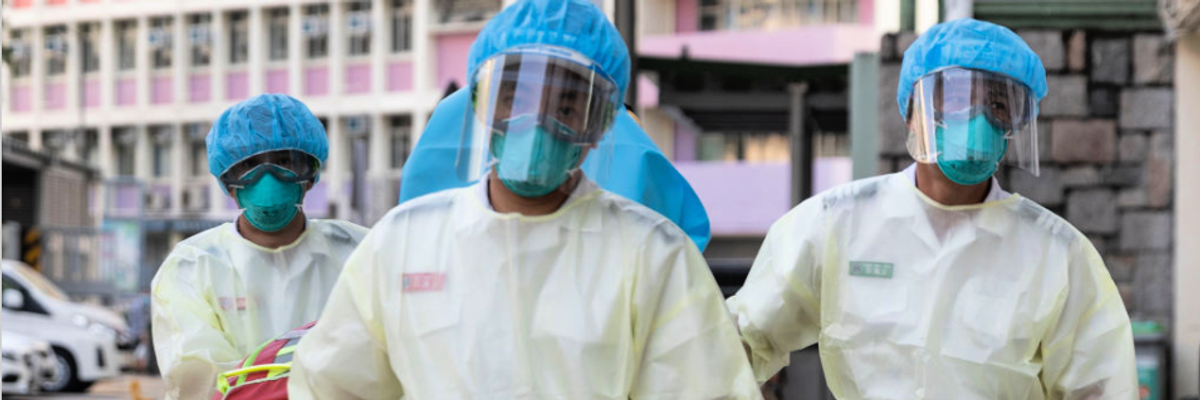
Medical staff wearing personal protective equipment (PPE) as a precautionary measure against the COVID-19 coronavirus approach Lei Muk Shue care home in Hong Kong on August 23, 2020. (Photo: May James, Getty Images/AFP)
A Hong Kong man has become the first confirmed patient to be reinfected with coronavirus, raising fresh concerns Monday that immunity to the potentially deadly virus may be short-lived.
A research team at the University of Hong Kong, led by Dr. Kelvin Kai-Wang, announced on Monday that a 33-year-old man who was first infected by SARS-CoV-2 in March apparently contracted the virus for a second time while recently traveling in Europe. The confirmed reinfection suggests that some patients who recover from Covid-19 may only be temporarily immune to the virus, although scientists pointed to the fact that reinfection is common with other coronaviruses.
"This is the world's first documentation of a patient who recovered from Covid-19 but got another episode of Covid-19 afterwards," the researchers said in a statement reported by the medical news site STAT. "Our findings suggest that Covid-19 may persist in the global human population, as is the case for other common-cold associated human coronaviruses, even if patients have acquired immunity via natural infection."
While there have been several reported cases of presumed reinfection in the United States, none of these have been confirmed by testing. There have also been cases of recovered patients testing positive for the virus a second time because they still carry viral fragments, sometimes for weeks.
The New York Times reports the Hong Kong man was first diagnosed with Covid-19 on March 26. Although he suffered only mild symptoms, he was hospitalized three days later as required by Hong Kong health regulations. He was released from hospital on April 14 after testing negative twice. After returning from a trip to Spain and the United Kingdom, he again tested positive on August 15. The new test revealed he was infected with a strain of the virus that is prevalent in Europe.
Immunologists around the world said it is too soon to determine whether the Hong Kong case was cause for broader concern.
"There have been more than 24 million cases reported to date," World Health Organization coronavirus specialist Maria Van Kerkhov said at a media briefing on Monday. "We need to look at something like this at a population level."
"The second infection was completely asymptomatic--his immune response prevented the disease from getting worse," tweeted Prof. Akiko Iwasaki, a Yale University immunologist who was not involved in the research. "This is no cause for alarm--this is a textbook example of how immunity should work," she added.
However, Iwasaki said that asymptomatic carriers can still infect others with the virus, highlighting the importance of vaccine development.
"In order to provide herd immunity, a potent vaccine is needed to induce immunity that prevents both reinfection and disease," she said.
Dr. Jeffrey Shaman, an epidemiologist at Columbia University in New York, concurred with Iwasaki's assessment that the Hong Kong case is no cause for alarm. However, Shaman told the Times that "it remains very, very concerning... that we may be subject to repeat infection with this virus."
According to the Johns Hopkins University Coronavirus Resource Center, there have been more than 25.5 million worldwide Covid-19 cases and just over 810,000 deaths as of Monday afternoon. The U.S. leads the world in both number of cases (5.7 million) and deaths (just over 177,000). The daily average number of new US coronavirus cases has been on the decline, with new reported cases over the past week averaging around 47,000 per day, down from a peak average of 67,317 on July 22, according to Johns Hopkins.
State health officials attribute the decline in new cases to safety guidelines including social distancing and wearing masks.
"Face coverings have made a difference," Washington state Health Secretary Dr. John Wiesman said last week.
However, government health officials also cautioned that although infections are trending in a positive direction, now is not the time to relax prevention and containment measures.
"This could turn around very quickly if we're not careful," warned Adm. Brett Giroir, the Trump administration physician in charge of supervising coronavirus testing. "We saw that early on after Memorial Day and the couple weeks afterward that sort of started the current outbreak."
As many schools and colleges across the U.S. prepare to re-open for fall classes, there are widespread fears that they will become the next significant incubators of coronavirus outbreaks, especially when summer gives way to autumn and temperatures begin to drop.
The Trump administration recently declared teachers to be "critical infrastructure workers," meaning that educators who may have been exposed to the virus but who show no symptoms can return to classrooms without quarantining for 14 days as recommended by public health agencies.
Many teachers have expressed serious concerns and outrage about returning to work amid a pandemic that is nowhere near under control, despite the administration's claims to the contrary. There have been numerous reports of educators preparing their wills and even writing their own obituaries as they contemplate the worst-case scenarios resulting from being forced back to work.
Dear Common Dreams reader, It’s been nearly 30 years since I co-founded Common Dreams with my late wife, Lina Newhouser. We had the radical notion that journalism should serve the public good, not corporate profits. It was clear to us from the outset what it would take to build such a project. No paid advertisements. No corporate sponsors. No millionaire publisher telling us what to think or do. Many people said we wouldn't last a year, but we proved those doubters wrong. Together with a tremendous team of journalists and dedicated staff, we built an independent media outlet free from the constraints of profits and corporate control. Our mission has always been simple: To inform. To inspire. To ignite change for the common good. Building Common Dreams was not easy. Our survival was never guaranteed. When you take on the most powerful forces—Wall Street greed, fossil fuel industry destruction, Big Tech lobbyists, and uber-rich oligarchs who have spent billions upon billions rigging the economy and democracy in their favor—the only bulwark you have is supporters who believe in your work. But here’s the urgent message from me today. It's never been this bad out there. And it's never been this hard to keep us going. At the very moment Common Dreams is most needed, the threats we face are intensifying. We need your support now more than ever. We don't accept corporate advertising and never will. We don't have a paywall because we don't think people should be blocked from critical news based on their ability to pay. Everything we do is funded by the donations of readers like you. When everyone does the little they can afford, we are strong. But if that support retreats or dries up, so do we. Will you donate now to make sure Common Dreams not only survives but thrives? —Craig Brown, Co-founder |
A Hong Kong man has become the first confirmed patient to be reinfected with coronavirus, raising fresh concerns Monday that immunity to the potentially deadly virus may be short-lived.
A research team at the University of Hong Kong, led by Dr. Kelvin Kai-Wang, announced on Monday that a 33-year-old man who was first infected by SARS-CoV-2 in March apparently contracted the virus for a second time while recently traveling in Europe. The confirmed reinfection suggests that some patients who recover from Covid-19 may only be temporarily immune to the virus, although scientists pointed to the fact that reinfection is common with other coronaviruses.
"This is the world's first documentation of a patient who recovered from Covid-19 but got another episode of Covid-19 afterwards," the researchers said in a statement reported by the medical news site STAT. "Our findings suggest that Covid-19 may persist in the global human population, as is the case for other common-cold associated human coronaviruses, even if patients have acquired immunity via natural infection."
While there have been several reported cases of presumed reinfection in the United States, none of these have been confirmed by testing. There have also been cases of recovered patients testing positive for the virus a second time because they still carry viral fragments, sometimes for weeks.
The New York Times reports the Hong Kong man was first diagnosed with Covid-19 on March 26. Although he suffered only mild symptoms, he was hospitalized three days later as required by Hong Kong health regulations. He was released from hospital on April 14 after testing negative twice. After returning from a trip to Spain and the United Kingdom, he again tested positive on August 15. The new test revealed he was infected with a strain of the virus that is prevalent in Europe.
Immunologists around the world said it is too soon to determine whether the Hong Kong case was cause for broader concern.
"There have been more than 24 million cases reported to date," World Health Organization coronavirus specialist Maria Van Kerkhov said at a media briefing on Monday. "We need to look at something like this at a population level."
"The second infection was completely asymptomatic--his immune response prevented the disease from getting worse," tweeted Prof. Akiko Iwasaki, a Yale University immunologist who was not involved in the research. "This is no cause for alarm--this is a textbook example of how immunity should work," she added.
However, Iwasaki said that asymptomatic carriers can still infect others with the virus, highlighting the importance of vaccine development.
"In order to provide herd immunity, a potent vaccine is needed to induce immunity that prevents both reinfection and disease," she said.
Dr. Jeffrey Shaman, an epidemiologist at Columbia University in New York, concurred with Iwasaki's assessment that the Hong Kong case is no cause for alarm. However, Shaman told the Times that "it remains very, very concerning... that we may be subject to repeat infection with this virus."
According to the Johns Hopkins University Coronavirus Resource Center, there have been more than 25.5 million worldwide Covid-19 cases and just over 810,000 deaths as of Monday afternoon. The U.S. leads the world in both number of cases (5.7 million) and deaths (just over 177,000). The daily average number of new US coronavirus cases has been on the decline, with new reported cases over the past week averaging around 47,000 per day, down from a peak average of 67,317 on July 22, according to Johns Hopkins.
State health officials attribute the decline in new cases to safety guidelines including social distancing and wearing masks.
"Face coverings have made a difference," Washington state Health Secretary Dr. John Wiesman said last week.
However, government health officials also cautioned that although infections are trending in a positive direction, now is not the time to relax prevention and containment measures.
"This could turn around very quickly if we're not careful," warned Adm. Brett Giroir, the Trump administration physician in charge of supervising coronavirus testing. "We saw that early on after Memorial Day and the couple weeks afterward that sort of started the current outbreak."
As many schools and colleges across the U.S. prepare to re-open for fall classes, there are widespread fears that they will become the next significant incubators of coronavirus outbreaks, especially when summer gives way to autumn and temperatures begin to drop.
The Trump administration recently declared teachers to be "critical infrastructure workers," meaning that educators who may have been exposed to the virus but who show no symptoms can return to classrooms without quarantining for 14 days as recommended by public health agencies.
Many teachers have expressed serious concerns and outrage about returning to work amid a pandemic that is nowhere near under control, despite the administration's claims to the contrary. There have been numerous reports of educators preparing their wills and even writing their own obituaries as they contemplate the worst-case scenarios resulting from being forced back to work.
A Hong Kong man has become the first confirmed patient to be reinfected with coronavirus, raising fresh concerns Monday that immunity to the potentially deadly virus may be short-lived.
A research team at the University of Hong Kong, led by Dr. Kelvin Kai-Wang, announced on Monday that a 33-year-old man who was first infected by SARS-CoV-2 in March apparently contracted the virus for a second time while recently traveling in Europe. The confirmed reinfection suggests that some patients who recover from Covid-19 may only be temporarily immune to the virus, although scientists pointed to the fact that reinfection is common with other coronaviruses.
"This is the world's first documentation of a patient who recovered from Covid-19 but got another episode of Covid-19 afterwards," the researchers said in a statement reported by the medical news site STAT. "Our findings suggest that Covid-19 may persist in the global human population, as is the case for other common-cold associated human coronaviruses, even if patients have acquired immunity via natural infection."
While there have been several reported cases of presumed reinfection in the United States, none of these have been confirmed by testing. There have also been cases of recovered patients testing positive for the virus a second time because they still carry viral fragments, sometimes for weeks.
The New York Times reports the Hong Kong man was first diagnosed with Covid-19 on March 26. Although he suffered only mild symptoms, he was hospitalized three days later as required by Hong Kong health regulations. He was released from hospital on April 14 after testing negative twice. After returning from a trip to Spain and the United Kingdom, he again tested positive on August 15. The new test revealed he was infected with a strain of the virus that is prevalent in Europe.
Immunologists around the world said it is too soon to determine whether the Hong Kong case was cause for broader concern.
"There have been more than 24 million cases reported to date," World Health Organization coronavirus specialist Maria Van Kerkhov said at a media briefing on Monday. "We need to look at something like this at a population level."
"The second infection was completely asymptomatic--his immune response prevented the disease from getting worse," tweeted Prof. Akiko Iwasaki, a Yale University immunologist who was not involved in the research. "This is no cause for alarm--this is a textbook example of how immunity should work," she added.
However, Iwasaki said that asymptomatic carriers can still infect others with the virus, highlighting the importance of vaccine development.
"In order to provide herd immunity, a potent vaccine is needed to induce immunity that prevents both reinfection and disease," she said.
Dr. Jeffrey Shaman, an epidemiologist at Columbia University in New York, concurred with Iwasaki's assessment that the Hong Kong case is no cause for alarm. However, Shaman told the Times that "it remains very, very concerning... that we may be subject to repeat infection with this virus."
According to the Johns Hopkins University Coronavirus Resource Center, there have been more than 25.5 million worldwide Covid-19 cases and just over 810,000 deaths as of Monday afternoon. The U.S. leads the world in both number of cases (5.7 million) and deaths (just over 177,000). The daily average number of new US coronavirus cases has been on the decline, with new reported cases over the past week averaging around 47,000 per day, down from a peak average of 67,317 on July 22, according to Johns Hopkins.
State health officials attribute the decline in new cases to safety guidelines including social distancing and wearing masks.
"Face coverings have made a difference," Washington state Health Secretary Dr. John Wiesman said last week.
However, government health officials also cautioned that although infections are trending in a positive direction, now is not the time to relax prevention and containment measures.
"This could turn around very quickly if we're not careful," warned Adm. Brett Giroir, the Trump administration physician in charge of supervising coronavirus testing. "We saw that early on after Memorial Day and the couple weeks afterward that sort of started the current outbreak."
As many schools and colleges across the U.S. prepare to re-open for fall classes, there are widespread fears that they will become the next significant incubators of coronavirus outbreaks, especially when summer gives way to autumn and temperatures begin to drop.
The Trump administration recently declared teachers to be "critical infrastructure workers," meaning that educators who may have been exposed to the virus but who show no symptoms can return to classrooms without quarantining for 14 days as recommended by public health agencies.
Many teachers have expressed serious concerns and outrage about returning to work amid a pandemic that is nowhere near under control, despite the administration's claims to the contrary. There have been numerous reports of educators preparing their wills and even writing their own obituaries as they contemplate the worst-case scenarios resulting from being forced back to work.