

SUBSCRIBE TO OUR FREE NEWSLETTER
Daily news & progressive opinion—funded by the people, not the corporations—delivered straight to your inbox.
5
#000000
#FFFFFF
To donate by check, phone, or other method, see our More Ways to Give page.
Daily news & progressive opinion—funded by the people, not the corporations—delivered straight to your inbox.
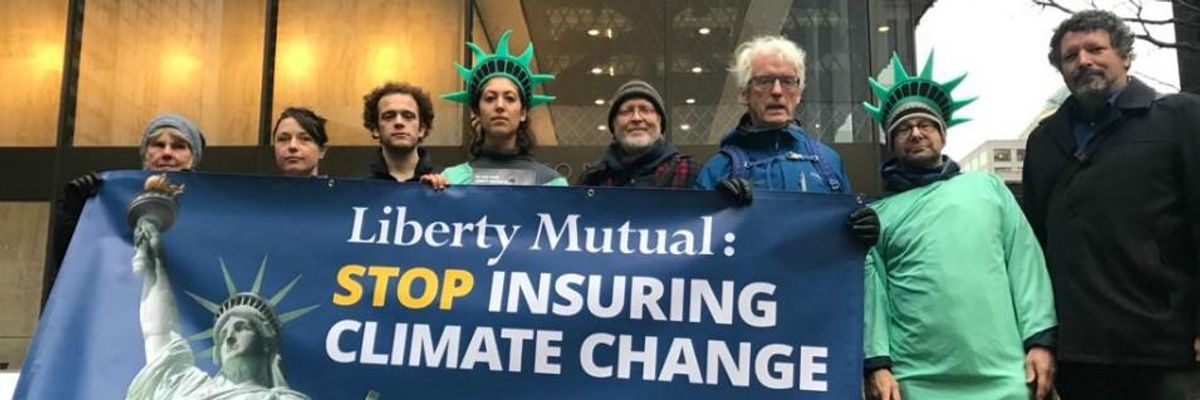
Activists with Insure Our Future gathered outside Liberty Mutual's Boston and Seattle offices in December 2019 to demand the insurer "take bold action in the face of the climate emergency and stop insuring fossil fuels."
Over 140 advocacy groups released an open letter Thursday urging insurers of Trans Mountain to drop their coverage of the tar sands "megaproject" because it "puts Indigenous communities, drinking water, and our shared climate at grave risk."
"With the policy expiring at the end of August, now is the time to decisively say no to this destructive project," says the letter (pdf).
The call is addressed to AIG, Chubb, Energy Insurance Limited, Liberty Mutual, Lloyd's, Munich Re, Starr, Stewart Specialty Risk Underwriting, and W.R. Berkley. Spared from the list is Swiss insurance giant Zurich, which announced in a victory for campaigners two weeks ago that it would no longer cover the project
The demand from the groups including Rainforest Action Network, Greenpeace Canada, and the Union of BC Indian Chiefs is part of a tactic by climate activists to increase pressure on insurers to stop underwriting the fossil fuel project, which would triple the capacity of the Canadian government-owned existing pipeline and has faced multiple legal challenges and sustained resistance from First Nations communities.
The existing pipeline, groups wrote, "is a major public health and environmental hazard with a long history of spills and leaks," and the proposed expansion project "would multiply these risks tremendously."
Risks along supply chain abound, from releasing toxic pollutants and extracting vast amounts of fresh water resources to forest clearing to pipeline workers' threats to Indigenous women.
Problems continue once the oil reaches refiners, as they "are disproportionately located in communities of color, exposing Black and Latinx Americans to toxic chemicals, dangerous air quality, and explosive facilities at alarming rates," the letter says. And with "increased tar sands production, refineries are expanding and intensifying these threats to health and safety."
If the companies choose to continue underwriting the project, it will be a reflection "that your company is choosing corporate greed over people" says the letter, warning that doing so "will pose significant reputational risks to your business."
The groups further called on the insurers to not only discontinue coverage of Trans Mountain but "exit the tar sands sector entirely."
In a Thursday tweet promoting news converge of the letter, the Insure Our Future campaign, which pressures insurers to stop covering fossil fuel projects, singled out one of the companies named in the letter: Lloyd's of London.
Lloyd's "is the pipeline's biggest remaining insurer," the group wrote. "Why is it still ignoring climate science?"
Dear Common Dreams reader, It’s been nearly 30 years since I co-founded Common Dreams with my late wife, Lina Newhouser. We had the radical notion that journalism should serve the public good, not corporate profits. It was clear to us from the outset what it would take to build such a project. No paid advertisements. No corporate sponsors. No millionaire publisher telling us what to think or do. Many people said we wouldn't last a year, but we proved those doubters wrong. Together with a tremendous team of journalists and dedicated staff, we built an independent media outlet free from the constraints of profits and corporate control. Our mission has always been simple: To inform. To inspire. To ignite change for the common good. Building Common Dreams was not easy. Our survival was never guaranteed. When you take on the most powerful forces—Wall Street greed, fossil fuel industry destruction, Big Tech lobbyists, and uber-rich oligarchs who have spent billions upon billions rigging the economy and democracy in their favor—the only bulwark you have is supporters who believe in your work. But here’s the urgent message from me today. It's never been this bad out there. And it's never been this hard to keep us going. At the very moment Common Dreams is most needed, the threats we face are intensifying. We need your support now more than ever. We don't accept corporate advertising and never will. We don't have a paywall because we don't think people should be blocked from critical news based on their ability to pay. Everything we do is funded by the donations of readers like you. When everyone does the little they can afford, we are strong. But if that support retreats or dries up, so do we. Will you donate now to make sure Common Dreams not only survives but thrives? —Craig Brown, Co-founder |
Over 140 advocacy groups released an open letter Thursday urging insurers of Trans Mountain to drop their coverage of the tar sands "megaproject" because it "puts Indigenous communities, drinking water, and our shared climate at grave risk."
"With the policy expiring at the end of August, now is the time to decisively say no to this destructive project," says the letter (pdf).
The call is addressed to AIG, Chubb, Energy Insurance Limited, Liberty Mutual, Lloyd's, Munich Re, Starr, Stewart Specialty Risk Underwriting, and W.R. Berkley. Spared from the list is Swiss insurance giant Zurich, which announced in a victory for campaigners two weeks ago that it would no longer cover the project
The demand from the groups including Rainforest Action Network, Greenpeace Canada, and the Union of BC Indian Chiefs is part of a tactic by climate activists to increase pressure on insurers to stop underwriting the fossil fuel project, which would triple the capacity of the Canadian government-owned existing pipeline and has faced multiple legal challenges and sustained resistance from First Nations communities.
The existing pipeline, groups wrote, "is a major public health and environmental hazard with a long history of spills and leaks," and the proposed expansion project "would multiply these risks tremendously."
Risks along supply chain abound, from releasing toxic pollutants and extracting vast amounts of fresh water resources to forest clearing to pipeline workers' threats to Indigenous women.
Problems continue once the oil reaches refiners, as they "are disproportionately located in communities of color, exposing Black and Latinx Americans to toxic chemicals, dangerous air quality, and explosive facilities at alarming rates," the letter says. And with "increased tar sands production, refineries are expanding and intensifying these threats to health and safety."
If the companies choose to continue underwriting the project, it will be a reflection "that your company is choosing corporate greed over people" says the letter, warning that doing so "will pose significant reputational risks to your business."
The groups further called on the insurers to not only discontinue coverage of Trans Mountain but "exit the tar sands sector entirely."
In a Thursday tweet promoting news converge of the letter, the Insure Our Future campaign, which pressures insurers to stop covering fossil fuel projects, singled out one of the companies named in the letter: Lloyd's of London.
Lloyd's "is the pipeline's biggest remaining insurer," the group wrote. "Why is it still ignoring climate science?"
Over 140 advocacy groups released an open letter Thursday urging insurers of Trans Mountain to drop their coverage of the tar sands "megaproject" because it "puts Indigenous communities, drinking water, and our shared climate at grave risk."
"With the policy expiring at the end of August, now is the time to decisively say no to this destructive project," says the letter (pdf).
The call is addressed to AIG, Chubb, Energy Insurance Limited, Liberty Mutual, Lloyd's, Munich Re, Starr, Stewart Specialty Risk Underwriting, and W.R. Berkley. Spared from the list is Swiss insurance giant Zurich, which announced in a victory for campaigners two weeks ago that it would no longer cover the project
The demand from the groups including Rainforest Action Network, Greenpeace Canada, and the Union of BC Indian Chiefs is part of a tactic by climate activists to increase pressure on insurers to stop underwriting the fossil fuel project, which would triple the capacity of the Canadian government-owned existing pipeline and has faced multiple legal challenges and sustained resistance from First Nations communities.
The existing pipeline, groups wrote, "is a major public health and environmental hazard with a long history of spills and leaks," and the proposed expansion project "would multiply these risks tremendously."
Risks along supply chain abound, from releasing toxic pollutants and extracting vast amounts of fresh water resources to forest clearing to pipeline workers' threats to Indigenous women.
Problems continue once the oil reaches refiners, as they "are disproportionately located in communities of color, exposing Black and Latinx Americans to toxic chemicals, dangerous air quality, and explosive facilities at alarming rates," the letter says. And with "increased tar sands production, refineries are expanding and intensifying these threats to health and safety."
If the companies choose to continue underwriting the project, it will be a reflection "that your company is choosing corporate greed over people" says the letter, warning that doing so "will pose significant reputational risks to your business."
The groups further called on the insurers to not only discontinue coverage of Trans Mountain but "exit the tar sands sector entirely."
In a Thursday tweet promoting news converge of the letter, the Insure Our Future campaign, which pressures insurers to stop covering fossil fuel projects, singled out one of the companies named in the letter: Lloyd's of London.
Lloyd's "is the pipeline's biggest remaining insurer," the group wrote. "Why is it still ignoring climate science?"

