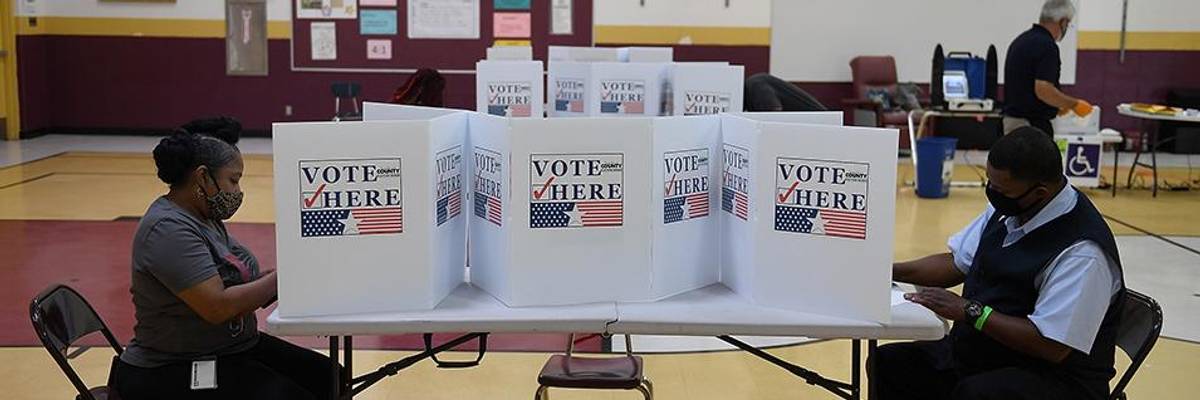
Voters cast their ballots at Keevan Elementary School August 4, 2020 in North St. Louis, Missouri. (Photo: Michael B. Thomas/Getty Images)
People of Missouri Accomplish What Its GOP Lawmakers Refused to Do for Nearly 10 Years: Approve Medicaid Expansion
Called 'victory for health care,' ballot initiative succeeds where legislative efforts were long thwarted by Republican Party.
An estimated 230,000 low-income residents of Missouri will soon be eligible for Medicaid after 53% of the state's voters passed a ballot measure expanding the program in Tuesday's election. The popular approval comes after nearly ten years of obstruction by Republican lawmakers in the state forbid expansion of the program made possible by the 2010 Affordable Care Act.
"It's a huge day for Missouri," Traci Gleason, vice president with the advocacy group Missouri Budget Project, told KCUR. "It's something we have long needed in order to strengthen our state. This is something that will improve the health of our communities."
Per the initiative language, Medicaid expansion in the state is slated to take effect in July of 2021. According to the Fairness Project, similar citizen-led expansion efforts around the country have opened up eligibility for 830,000 low-income people.
The Missouri vote comes in the midst of the ongoing Covid-19 pandemic, which has caused unemployment to spike, and tens of millions of Americans to lose their employer-sponsored insurance due to job loss.
Missouri became 39th state to expand Medicaid under the ACA, and the sixth state to expand Medicaid via ballot initiative. Successful efforts in Maine, Idaho, Nebraska, Utah and Oklahoma--where GOP-led state legislatures and/or GOP governors refused to enact expansion on their own--have helped close the coverage gap that emerged when ACA was enacted.
"Voters are rejecting the idea that health care has to be a partisan issue and they are hungry for change," Jonathan Schleifer, executive director of The Fairness Project, which assisted the initiative efforts in Missouri and other states, said in a statement. "We won't stop fighting until Americans in every state are afforded the same access to affordable health care, regardless of their zip code and income level."
Citizen-led efforts to expand Medicaid have been met with GOP opposition, and some Republican state legislatures and conservative advocacy groups have resisted implementation even after voter approval.
Still, advocates are celebrating the Missouri initiative's victory.
"Amendment 2 won today," Caitlyn Adams, executive director for Missouri Jobs with Justice Voter Action told the Kansas City Star Tuesday, "because no matter what we look like, where we live, or how much money we make, most of us want the same things--the ability to keep our families safe and well. Expanding Medicaid is a big step toward this goal."
We are at a crossroads
This country and this world are at a monumental crossroads. In a few short weeks, US voters will have an opportunity to beat back the forces of fascism and confront the billionaires who are rigging the economy, our media system, and our democracy, making it increasingly impossible for ordinary people to get by. We’re not just talking about the election. We’re talking about what must be done once these fascist elements are vanquished from power. We need a bolder set of solutions than what either major party has so far been willing to offer and a working-class movement ready to fight like hell for it. Trump didn't emerge from nowhere. The conditions that fueled MAGA authoritarianism were created by decades of radical neoliberal economic policies and a corrupt political system dominated by corporate interests. They slashed taxes on the super-rich, promising that the benefits would trickle down. They said giveaways to the corporate titans would make life more affordable for the rest of us. It was all bullshit. And when a bitter, betrayed populace searches for someone to blame, right-wing demagogues have little trouble finding scapegoats. People know when they're being lied to, but you won't hear any of this from the corporate media. Only independent journalism—powered and funded by people who believe in building a better world—can deliver truly trustworthy daily news. Our Fall Campaign is underway, and we need your help. To power our newsroom through the rest of the year, we need to raise $125,000 by midnight on October 31. So if you share our vision, please contribute whatever you can to sustain our work. |
An estimated 230,000 low-income residents of Missouri will soon be eligible for Medicaid after 53% of the state's voters passed a ballot measure expanding the program in Tuesday's election. The popular approval comes after nearly ten years of obstruction by Republican lawmakers in the state forbid expansion of the program made possible by the 2010 Affordable Care Act.
"It's a huge day for Missouri," Traci Gleason, vice president with the advocacy group Missouri Budget Project, told KCUR. "It's something we have long needed in order to strengthen our state. This is something that will improve the health of our communities."
Per the initiative language, Medicaid expansion in the state is slated to take effect in July of 2021. According to the Fairness Project, similar citizen-led expansion efforts around the country have opened up eligibility for 830,000 low-income people.
The Missouri vote comes in the midst of the ongoing Covid-19 pandemic, which has caused unemployment to spike, and tens of millions of Americans to lose their employer-sponsored insurance due to job loss.
Missouri became 39th state to expand Medicaid under the ACA, and the sixth state to expand Medicaid via ballot initiative. Successful efforts in Maine, Idaho, Nebraska, Utah and Oklahoma--where GOP-led state legislatures and/or GOP governors refused to enact expansion on their own--have helped close the coverage gap that emerged when ACA was enacted.
"Voters are rejecting the idea that health care has to be a partisan issue and they are hungry for change," Jonathan Schleifer, executive director of The Fairness Project, which assisted the initiative efforts in Missouri and other states, said in a statement. "We won't stop fighting until Americans in every state are afforded the same access to affordable health care, regardless of their zip code and income level."
Citizen-led efforts to expand Medicaid have been met with GOP opposition, and some Republican state legislatures and conservative advocacy groups have resisted implementation even after voter approval.
Still, advocates are celebrating the Missouri initiative's victory.
"Amendment 2 won today," Caitlyn Adams, executive director for Missouri Jobs with Justice Voter Action told the Kansas City Star Tuesday, "because no matter what we look like, where we live, or how much money we make, most of us want the same things--the ability to keep our families safe and well. Expanding Medicaid is a big step toward this goal."