SUBSCRIBE TO OUR FREE NEWSLETTER
Daily news & progressive opinion—funded by the people, not the corporations—delivered straight to your inbox.
5
#000000
#FFFFFF
To donate by check, phone, or other method, see our More Ways to Give page.
Daily news & progressive opinion—funded by the people, not the corporations—delivered straight to your inbox.
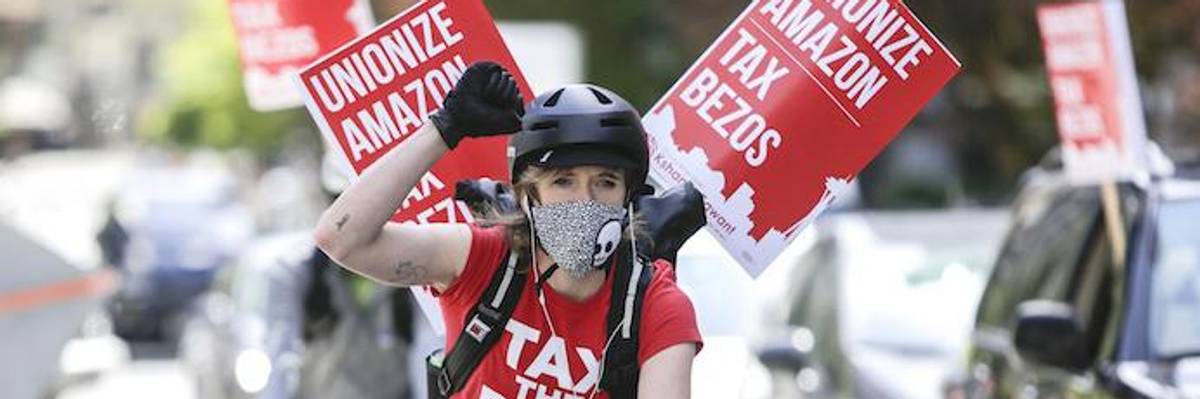
Protesters cycle around the block as they participate in a "car caravan" protest at the Amazon Spheres to demand the Seattle City Council tax the city's largest businesses in Seattle on May 1, 2020. (Photo: Jason Redmond / AFP via Getty Images)
The Tax Amazon movement claimed "a historic victory for working people" on Monday when Seattle's city council passed a new tax on big businesses to fund local economic relief.
The vote on the JumpStart Seattle plan, proposed last month by Councilmember Teresa Mosqueda, was a veto-proof 7-2. The plan targets corporations with payrolls of $7 million or more and employees with salaries above $150,000, with the measure expected to generate at least $200 million a year. The tax rate corporations would pay ranges from 0.7% to 2.4%. The highest rate--which would affect Seattle-based Amazon--would hit businesses with payrolls of at least $1 billion with salaries of $500,000 per year.
Mosqueda has framed the progressive tax plan as "part of the medicine to address both" the public health crisis and economic crisis, referring to the cornavirus pandemic and resulting damage to the local economy. The revenue generated would fund homelessness prevention programs and rental assistance, immigrant and refugee supports, food security programs, and assistance for small businesses.
"Seattle residents have made it clear--now is not the time for government austerity or divisiveness," Mosqueda said in a statement following the vote.
"We are in the midst of a health and economic crisis that even a strong economy like Seattle may not be able to recover from quickly," said Mosqueda, pointing to the fact that "over a million people statewide... have filed for unemployment this year; countless businesses shuttered temporarily and some potentially forever; our immigrant and refugee families have been left out of federal aid, and our homeless neighbors continue to suffer in our streets in the midst of a global pandemic."
Mosqueda said the proposal would live up to its name because it would "jump start our recovery with a relief plan that centers workers, small businesses, and our most vulnerable community members."
In 2018, the city council passed a so-called "head tax" on large companies--including Amazon--to generate $47 million a year only to see the measure repealed weeks later following a well-funded opposition effort, of which Amazon was at the forefront. Councilmember Kshama Sawant at the time dubbed the repeal a "cowardly betrayal of the needs of the working people."
Following the new progressive tax proposal's passage Monday, Sawant thanked the movement that made it possible, giving props to "the thousands of working people, unions, socialists!" Sawant also expressed hope that Seattle's action could be a model for other cities to follow.
Councilmember Tammy Morales also said JumpStart could be a model, tweeting: "The Seattle City Council is boldly leading to create a more equitable way to finance public services. And we challenge elected officials at the state level to join us in choosing investment over austerity."
Rep. Pramila Jayapal (D-Wash.) welcomed the vote as well. "In a city with so much wealth and yet one of the most regressive tax systems, progressive taxation is desperately needed," she tweeted.
"To the big businesses that oppose this: understand that the economic injustice disproportionately hurting Black and brown communities is systemic," Jayapal added. "If you truly believe #BlackLivesMatter, these are the kinds of structural changes that must be adopted to combat racism and inequality."
Dear Common Dreams reader, It’s been nearly 30 years since I co-founded Common Dreams with my late wife, Lina Newhouser. We had the radical notion that journalism should serve the public good, not corporate profits. It was clear to us from the outset what it would take to build such a project. No paid advertisements. No corporate sponsors. No millionaire publisher telling us what to think or do. Many people said we wouldn't last a year, but we proved those doubters wrong. Together with a tremendous team of journalists and dedicated staff, we built an independent media outlet free from the constraints of profits and corporate control. Our mission has always been simple: To inform. To inspire. To ignite change for the common good. Building Common Dreams was not easy. Our survival was never guaranteed. When you take on the most powerful forces—Wall Street greed, fossil fuel industry destruction, Big Tech lobbyists, and uber-rich oligarchs who have spent billions upon billions rigging the economy and democracy in their favor—the only bulwark you have is supporters who believe in your work. But here’s the urgent message from me today. It's never been this bad out there. And it's never been this hard to keep us going. At the very moment Common Dreams is most needed, the threats we face are intensifying. We need your support now more than ever. We don't accept corporate advertising and never will. We don't have a paywall because we don't think people should be blocked from critical news based on their ability to pay. Everything we do is funded by the donations of readers like you. When everyone does the little they can afford, we are strong. But if that support retreats or dries up, so do we. Will you donate now to make sure Common Dreams not only survives but thrives? —Craig Brown, Co-founder |
The Tax Amazon movement claimed "a historic victory for working people" on Monday when Seattle's city council passed a new tax on big businesses to fund local economic relief.
The vote on the JumpStart Seattle plan, proposed last month by Councilmember Teresa Mosqueda, was a veto-proof 7-2. The plan targets corporations with payrolls of $7 million or more and employees with salaries above $150,000, with the measure expected to generate at least $200 million a year. The tax rate corporations would pay ranges from 0.7% to 2.4%. The highest rate--which would affect Seattle-based Amazon--would hit businesses with payrolls of at least $1 billion with salaries of $500,000 per year.
Mosqueda has framed the progressive tax plan as "part of the medicine to address both" the public health crisis and economic crisis, referring to the cornavirus pandemic and resulting damage to the local economy. The revenue generated would fund homelessness prevention programs and rental assistance, immigrant and refugee supports, food security programs, and assistance for small businesses.
"Seattle residents have made it clear--now is not the time for government austerity or divisiveness," Mosqueda said in a statement following the vote.
"We are in the midst of a health and economic crisis that even a strong economy like Seattle may not be able to recover from quickly," said Mosqueda, pointing to the fact that "over a million people statewide... have filed for unemployment this year; countless businesses shuttered temporarily and some potentially forever; our immigrant and refugee families have been left out of federal aid, and our homeless neighbors continue to suffer in our streets in the midst of a global pandemic."
Mosqueda said the proposal would live up to its name because it would "jump start our recovery with a relief plan that centers workers, small businesses, and our most vulnerable community members."
In 2018, the city council passed a so-called "head tax" on large companies--including Amazon--to generate $47 million a year only to see the measure repealed weeks later following a well-funded opposition effort, of which Amazon was at the forefront. Councilmember Kshama Sawant at the time dubbed the repeal a "cowardly betrayal of the needs of the working people."
Following the new progressive tax proposal's passage Monday, Sawant thanked the movement that made it possible, giving props to "the thousands of working people, unions, socialists!" Sawant also expressed hope that Seattle's action could be a model for other cities to follow.
Councilmember Tammy Morales also said JumpStart could be a model, tweeting: "The Seattle City Council is boldly leading to create a more equitable way to finance public services. And we challenge elected officials at the state level to join us in choosing investment over austerity."
Rep. Pramila Jayapal (D-Wash.) welcomed the vote as well. "In a city with so much wealth and yet one of the most regressive tax systems, progressive taxation is desperately needed," she tweeted.
"To the big businesses that oppose this: understand that the economic injustice disproportionately hurting Black and brown communities is systemic," Jayapal added. "If you truly believe #BlackLivesMatter, these are the kinds of structural changes that must be adopted to combat racism and inequality."
The Tax Amazon movement claimed "a historic victory for working people" on Monday when Seattle's city council passed a new tax on big businesses to fund local economic relief.
The vote on the JumpStart Seattle plan, proposed last month by Councilmember Teresa Mosqueda, was a veto-proof 7-2. The plan targets corporations with payrolls of $7 million or more and employees with salaries above $150,000, with the measure expected to generate at least $200 million a year. The tax rate corporations would pay ranges from 0.7% to 2.4%. The highest rate--which would affect Seattle-based Amazon--would hit businesses with payrolls of at least $1 billion with salaries of $500,000 per year.
Mosqueda has framed the progressive tax plan as "part of the medicine to address both" the public health crisis and economic crisis, referring to the cornavirus pandemic and resulting damage to the local economy. The revenue generated would fund homelessness prevention programs and rental assistance, immigrant and refugee supports, food security programs, and assistance for small businesses.
"Seattle residents have made it clear--now is not the time for government austerity or divisiveness," Mosqueda said in a statement following the vote.
"We are in the midst of a health and economic crisis that even a strong economy like Seattle may not be able to recover from quickly," said Mosqueda, pointing to the fact that "over a million people statewide... have filed for unemployment this year; countless businesses shuttered temporarily and some potentially forever; our immigrant and refugee families have been left out of federal aid, and our homeless neighbors continue to suffer in our streets in the midst of a global pandemic."
Mosqueda said the proposal would live up to its name because it would "jump start our recovery with a relief plan that centers workers, small businesses, and our most vulnerable community members."
In 2018, the city council passed a so-called "head tax" on large companies--including Amazon--to generate $47 million a year only to see the measure repealed weeks later following a well-funded opposition effort, of which Amazon was at the forefront. Councilmember Kshama Sawant at the time dubbed the repeal a "cowardly betrayal of the needs of the working people."
Following the new progressive tax proposal's passage Monday, Sawant thanked the movement that made it possible, giving props to "the thousands of working people, unions, socialists!" Sawant also expressed hope that Seattle's action could be a model for other cities to follow.
Councilmember Tammy Morales also said JumpStart could be a model, tweeting: "The Seattle City Council is boldly leading to create a more equitable way to finance public services. And we challenge elected officials at the state level to join us in choosing investment over austerity."
Rep. Pramila Jayapal (D-Wash.) welcomed the vote as well. "In a city with so much wealth and yet one of the most regressive tax systems, progressive taxation is desperately needed," she tweeted.
"To the big businesses that oppose this: understand that the economic injustice disproportionately hurting Black and brown communities is systemic," Jayapal added. "If you truly believe #BlackLivesMatter, these are the kinds of structural changes that must be adopted to combat racism and inequality."