SUBSCRIBE TO OUR FREE NEWSLETTER
Daily news & progressive opinion—funded by the people, not the corporations—delivered straight to your inbox.
5
#000000
#FFFFFF
To donate by check, phone, or other method, see our More Ways to Give page.
Daily news & progressive opinion—funded by the people, not the corporations—delivered straight to your inbox.
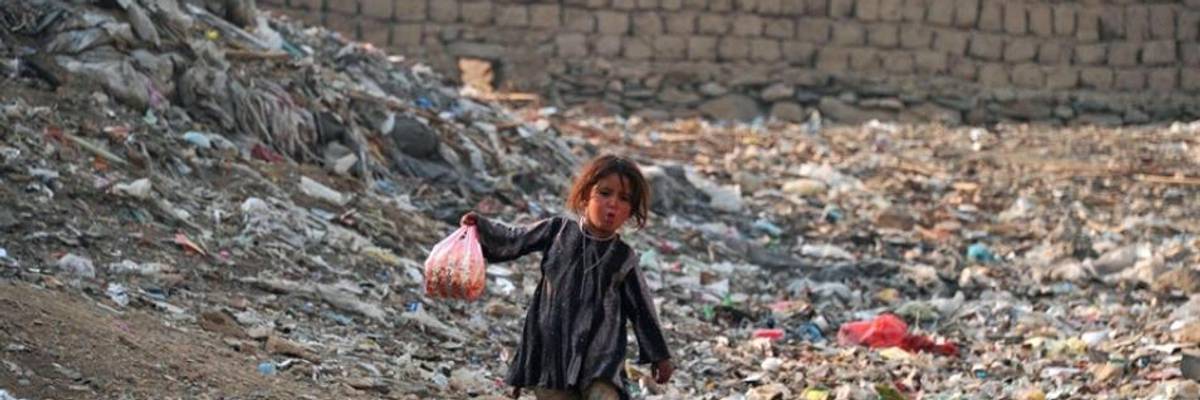
The report warns that the coronavirus pandemic is set to make things worse for the poorest people in the world. (Photo: AFP/Getty Images)
The former United Nations special rapporteur on extreme poverty and human rights on Sunday released his final report, a scathing denunciation of global efforts to combat extreme poverty and a warning that the hurdles in front of such efforts will not disappear when the Covid-19 pandemic is finally brought under control.
"Even before Covid-19, we squandered a decade in the fight against poverty, with misplaced triumphalism blocking the very reforms that could have prevented the worst impacts of the pandemic," Philip Alston, who stepped down from his position as rapporteur in May, said in a statement.
Alston's final report (pdf) excoriates world leaders for using what he describes in the report as "the World Bank's flawed international poverty line" as a measure of poverty. The bank's poverty line, the report says, is based on purchasing power and represents a universal measure that is insufficient to address changes from society to society, does not allow for gender inequality or different family resource allocations of resources, and under-represents marginalized groups whose data is difficult to track.
"The line is scandalously unambitious, and the best evidence shows it doesn't even cover the cost of food or housing in many countries," said Alston. "The poverty decline it purports to show is due largely to rising incomes in a single country, China. And it obscures poverty among women and those often excluded from official surveys, such as migrant workers and refugees."
"The result is a Pyrrhic victory, an undue sense of immense satisfaction, and dangerous complacency," Alston continued. "Using more realistic measures, the extent of global poverty is vastly higher and the trends extremely discouraging."
The report warns that the coronavirus pandemic is set to make things worse:
If social protection floors had been in place, the hundreds of millions left without medical care, adequate food and housing, and basic security would have been spared some of the worst consequences. Instead, endless pressures to promote fiscal consolidation, especially over the last decade, have pushed social protection systems closer towards nineteenth century models rather than late twentieth century aspirations. When combined with the next generation of post-Covid-19 austerity policies, the dramatic transfer of economic and political power to the wealthy elites that has characterized the past forty years will accelerate, at which point the extent and depth of global poverty will be even more politically unsustainable and explosive.
Rather than a continuation of austerity and other inequality-fueling policies, Alston said, world governments must choose a different path.
"It's time for a new approach to poverty eradication that tackles inequality, embraces redistribution, and takes tax justice seriously," he said. "Poverty is a political choice and it will be with us until its elimination is reconceived as a matter of social justice."
Dear Common Dreams reader, It’s been nearly 30 years since I co-founded Common Dreams with my late wife, Lina Newhouser. We had the radical notion that journalism should serve the public good, not corporate profits. It was clear to us from the outset what it would take to build such a project. No paid advertisements. No corporate sponsors. No millionaire publisher telling us what to think or do. Many people said we wouldn't last a year, but we proved those doubters wrong. Together with a tremendous team of journalists and dedicated staff, we built an independent media outlet free from the constraints of profits and corporate control. Our mission has always been simple: To inform. To inspire. To ignite change for the common good. Building Common Dreams was not easy. Our survival was never guaranteed. When you take on the most powerful forces—Wall Street greed, fossil fuel industry destruction, Big Tech lobbyists, and uber-rich oligarchs who have spent billions upon billions rigging the economy and democracy in their favor—the only bulwark you have is supporters who believe in your work. But here’s the urgent message from me today. It's never been this bad out there. And it's never been this hard to keep us going. At the very moment Common Dreams is most needed, the threats we face are intensifying. We need your support now more than ever. We don't accept corporate advertising and never will. We don't have a paywall because we don't think people should be blocked from critical news based on their ability to pay. Everything we do is funded by the donations of readers like you. When everyone does the little they can afford, we are strong. But if that support retreats or dries up, so do we. Will you donate now to make sure Common Dreams not only survives but thrives? —Craig Brown, Co-founder |
The former United Nations special rapporteur on extreme poverty and human rights on Sunday released his final report, a scathing denunciation of global efforts to combat extreme poverty and a warning that the hurdles in front of such efforts will not disappear when the Covid-19 pandemic is finally brought under control.
"Even before Covid-19, we squandered a decade in the fight against poverty, with misplaced triumphalism blocking the very reforms that could have prevented the worst impacts of the pandemic," Philip Alston, who stepped down from his position as rapporteur in May, said in a statement.
Alston's final report (pdf) excoriates world leaders for using what he describes in the report as "the World Bank's flawed international poverty line" as a measure of poverty. The bank's poverty line, the report says, is based on purchasing power and represents a universal measure that is insufficient to address changes from society to society, does not allow for gender inequality or different family resource allocations of resources, and under-represents marginalized groups whose data is difficult to track.
"The line is scandalously unambitious, and the best evidence shows it doesn't even cover the cost of food or housing in many countries," said Alston. "The poverty decline it purports to show is due largely to rising incomes in a single country, China. And it obscures poverty among women and those often excluded from official surveys, such as migrant workers and refugees."
"The result is a Pyrrhic victory, an undue sense of immense satisfaction, and dangerous complacency," Alston continued. "Using more realistic measures, the extent of global poverty is vastly higher and the trends extremely discouraging."
The report warns that the coronavirus pandemic is set to make things worse:
If social protection floors had been in place, the hundreds of millions left without medical care, adequate food and housing, and basic security would have been spared some of the worst consequences. Instead, endless pressures to promote fiscal consolidation, especially over the last decade, have pushed social protection systems closer towards nineteenth century models rather than late twentieth century aspirations. When combined with the next generation of post-Covid-19 austerity policies, the dramatic transfer of economic and political power to the wealthy elites that has characterized the past forty years will accelerate, at which point the extent and depth of global poverty will be even more politically unsustainable and explosive.
Rather than a continuation of austerity and other inequality-fueling policies, Alston said, world governments must choose a different path.
"It's time for a new approach to poverty eradication that tackles inequality, embraces redistribution, and takes tax justice seriously," he said. "Poverty is a political choice and it will be with us until its elimination is reconceived as a matter of social justice."
The former United Nations special rapporteur on extreme poverty and human rights on Sunday released his final report, a scathing denunciation of global efforts to combat extreme poverty and a warning that the hurdles in front of such efforts will not disappear when the Covid-19 pandemic is finally brought under control.
"Even before Covid-19, we squandered a decade in the fight against poverty, with misplaced triumphalism blocking the very reforms that could have prevented the worst impacts of the pandemic," Philip Alston, who stepped down from his position as rapporteur in May, said in a statement.
Alston's final report (pdf) excoriates world leaders for using what he describes in the report as "the World Bank's flawed international poverty line" as a measure of poverty. The bank's poverty line, the report says, is based on purchasing power and represents a universal measure that is insufficient to address changes from society to society, does not allow for gender inequality or different family resource allocations of resources, and under-represents marginalized groups whose data is difficult to track.
"The line is scandalously unambitious, and the best evidence shows it doesn't even cover the cost of food or housing in many countries," said Alston. "The poverty decline it purports to show is due largely to rising incomes in a single country, China. And it obscures poverty among women and those often excluded from official surveys, such as migrant workers and refugees."
"The result is a Pyrrhic victory, an undue sense of immense satisfaction, and dangerous complacency," Alston continued. "Using more realistic measures, the extent of global poverty is vastly higher and the trends extremely discouraging."
The report warns that the coronavirus pandemic is set to make things worse:
If social protection floors had been in place, the hundreds of millions left without medical care, adequate food and housing, and basic security would have been spared some of the worst consequences. Instead, endless pressures to promote fiscal consolidation, especially over the last decade, have pushed social protection systems closer towards nineteenth century models rather than late twentieth century aspirations. When combined with the next generation of post-Covid-19 austerity policies, the dramatic transfer of economic and political power to the wealthy elites that has characterized the past forty years will accelerate, at which point the extent and depth of global poverty will be even more politically unsustainable and explosive.
Rather than a continuation of austerity and other inequality-fueling policies, Alston said, world governments must choose a different path.
"It's time for a new approach to poverty eradication that tackles inequality, embraces redistribution, and takes tax justice seriously," he said. "Poverty is a political choice and it will be with us until its elimination is reconceived as a matter of social justice."