SUBSCRIBE TO OUR FREE NEWSLETTER
Daily news & progressive opinion—funded by the people, not the corporations—delivered straight to your inbox.
5
#000000
#FFFFFF
To donate by check, phone, or other method, see our More Ways to Give page.
Daily news & progressive opinion—funded by the people, not the corporations—delivered straight to your inbox.
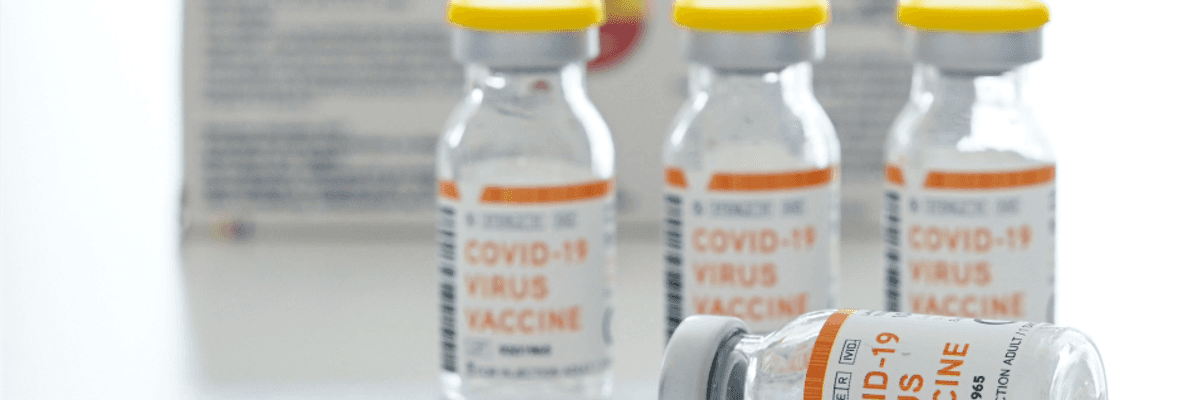
Bottles of a trial Covid-19 vaccine on a table in a lab in Brussels on June 18, 2020. (Photo: Vincent Kalut/Photonews via Getty Images)
Government contracts obtained by consumer advocacy group Knowledge Ecology International show that the Trump administration is giving pharmaceutical companies a green light to charge exorbitant prices for potential coronavirus treatments developed with taxpayer money by refusing to exercise federal authority to constrain costs.
"The government has limited its ability to intervene if the pharmaceutical companies... charge unreasonable prices for the resulting Covid-19 vaccines or treatments."
--Knowledge Ecology International
Through the Freedom of Information Act, Knowledge Ecology International (KEI) last week got hold of a number of heavily redacted agreements between the Trump administration and major pharmaceutical companies like Johnson & Johnson, Regeneron, and Genentech.
Five of the seven documents reviewed by KEI are classified as "other transaction agreements," which allow federal agencies to loosen regulations designed to protect the public in order to help companies streamline the product development process.
In the case of four contracts for potential Covid-19 treatments or vaccines with Johnson & Johnson, Genentech, Regeneron, and Roche issued by the Biomedical Advanced Research and Development Authority (BARDA) and the Pentagon, the Trump administration omitted a standard condition requiring that products developed with taxpayer money be made available to the public "on reasonable terms."
"This means that the government has limited its ability to intervene if the pharmaceutical companies (which are party to the agreements and are receiving hundreds of millions of dollars to conduct the research) charge unreasonable prices for the resulting Covid-19 vaccines or treatments," KEI noted in a press release.
KEI also found that federal contracts with Genentech and Regeneron for coronavirus treatments contain passages restricting the government's ability to "have generic manufacturers make and distribute through pharmacies and other commercial outlets an effective diagnostic test, drug, or vaccine for Covid-19."
The details of the contracts come just days after the Trump administration faced backlash from consumer groups for refusing to require Gilead to charge a reasonable price for its Covid-19 treatment remdesivir. On Monday, as Common Dreams reported, Gilead announced it will charge U.S. hospitals around $3,120 per privately insured patient for a treatment course of remdesivir, which was developed with the help of at least $70.5 million in taxpayer funding.
"Allowing Gilead to set the terms during a pandemic represents a colossal failure of leadership by the Trump administration," Peter Maybarduk, director of Public Citizen's Access to Medicines Program, said in a statement Monday. "The U.S. government has authority and a responsibility to steward the technology it helped develop."
As the Washington Post reported Wednesday, "[Johnson & Johnson] has a $456 million contract with BARDA to develop a coronavirus vaccine and a $152 million contract to conduct screening of drug compounds that could be Covid-19 treatments."
"Regeneron has contracts worth up to $130 million to develop two therapies for the disease," the Post noted. "Roche's Genentech subsidiary has contracts worth $47 million to develop a pair of therapies."
James Love, the director of KEI, told the Post that "the amount of money the government is throwing at companies is unprecedented."
"Normally when you write bigger checks," Love said, "you should have more leverage, not less leverage."
Dear Common Dreams reader, It’s been nearly 30 years since I co-founded Common Dreams with my late wife, Lina Newhouser. We had the radical notion that journalism should serve the public good, not corporate profits. It was clear to us from the outset what it would take to build such a project. No paid advertisements. No corporate sponsors. No millionaire publisher telling us what to think or do. Many people said we wouldn't last a year, but we proved those doubters wrong. Together with a tremendous team of journalists and dedicated staff, we built an independent media outlet free from the constraints of profits and corporate control. Our mission has always been simple: To inform. To inspire. To ignite change for the common good. Building Common Dreams was not easy. Our survival was never guaranteed. When you take on the most powerful forces—Wall Street greed, fossil fuel industry destruction, Big Tech lobbyists, and uber-rich oligarchs who have spent billions upon billions rigging the economy and democracy in their favor—the only bulwark you have is supporters who believe in your work. But here’s the urgent message from me today. It's never been this bad out there. And it's never been this hard to keep us going. At the very moment Common Dreams is most needed, the threats we face are intensifying. We need your support now more than ever. We don't accept corporate advertising and never will. We don't have a paywall because we don't think people should be blocked from critical news based on their ability to pay. Everything we do is funded by the donations of readers like you. When everyone does the little they can afford, we are strong. But if that support retreats or dries up, so do we. Will you donate now to make sure Common Dreams not only survives but thrives? —Craig Brown, Co-founder |
Government contracts obtained by consumer advocacy group Knowledge Ecology International show that the Trump administration is giving pharmaceutical companies a green light to charge exorbitant prices for potential coronavirus treatments developed with taxpayer money by refusing to exercise federal authority to constrain costs.
"The government has limited its ability to intervene if the pharmaceutical companies... charge unreasonable prices for the resulting Covid-19 vaccines or treatments."
--Knowledge Ecology International
Through the Freedom of Information Act, Knowledge Ecology International (KEI) last week got hold of a number of heavily redacted agreements between the Trump administration and major pharmaceutical companies like Johnson & Johnson, Regeneron, and Genentech.
Five of the seven documents reviewed by KEI are classified as "other transaction agreements," which allow federal agencies to loosen regulations designed to protect the public in order to help companies streamline the product development process.
In the case of four contracts for potential Covid-19 treatments or vaccines with Johnson & Johnson, Genentech, Regeneron, and Roche issued by the Biomedical Advanced Research and Development Authority (BARDA) and the Pentagon, the Trump administration omitted a standard condition requiring that products developed with taxpayer money be made available to the public "on reasonable terms."
"This means that the government has limited its ability to intervene if the pharmaceutical companies (which are party to the agreements and are receiving hundreds of millions of dollars to conduct the research) charge unreasonable prices for the resulting Covid-19 vaccines or treatments," KEI noted in a press release.
KEI also found that federal contracts with Genentech and Regeneron for coronavirus treatments contain passages restricting the government's ability to "have generic manufacturers make and distribute through pharmacies and other commercial outlets an effective diagnostic test, drug, or vaccine for Covid-19."
The details of the contracts come just days after the Trump administration faced backlash from consumer groups for refusing to require Gilead to charge a reasonable price for its Covid-19 treatment remdesivir. On Monday, as Common Dreams reported, Gilead announced it will charge U.S. hospitals around $3,120 per privately insured patient for a treatment course of remdesivir, which was developed with the help of at least $70.5 million in taxpayer funding.
"Allowing Gilead to set the terms during a pandemic represents a colossal failure of leadership by the Trump administration," Peter Maybarduk, director of Public Citizen's Access to Medicines Program, said in a statement Monday. "The U.S. government has authority and a responsibility to steward the technology it helped develop."
As the Washington Post reported Wednesday, "[Johnson & Johnson] has a $456 million contract with BARDA to develop a coronavirus vaccine and a $152 million contract to conduct screening of drug compounds that could be Covid-19 treatments."
"Regeneron has contracts worth up to $130 million to develop two therapies for the disease," the Post noted. "Roche's Genentech subsidiary has contracts worth $47 million to develop a pair of therapies."
James Love, the director of KEI, told the Post that "the amount of money the government is throwing at companies is unprecedented."
"Normally when you write bigger checks," Love said, "you should have more leverage, not less leverage."
Government contracts obtained by consumer advocacy group Knowledge Ecology International show that the Trump administration is giving pharmaceutical companies a green light to charge exorbitant prices for potential coronavirus treatments developed with taxpayer money by refusing to exercise federal authority to constrain costs.
"The government has limited its ability to intervene if the pharmaceutical companies... charge unreasonable prices for the resulting Covid-19 vaccines or treatments."
--Knowledge Ecology International
Through the Freedom of Information Act, Knowledge Ecology International (KEI) last week got hold of a number of heavily redacted agreements between the Trump administration and major pharmaceutical companies like Johnson & Johnson, Regeneron, and Genentech.
Five of the seven documents reviewed by KEI are classified as "other transaction agreements," which allow federal agencies to loosen regulations designed to protect the public in order to help companies streamline the product development process.
In the case of four contracts for potential Covid-19 treatments or vaccines with Johnson & Johnson, Genentech, Regeneron, and Roche issued by the Biomedical Advanced Research and Development Authority (BARDA) and the Pentagon, the Trump administration omitted a standard condition requiring that products developed with taxpayer money be made available to the public "on reasonable terms."
"This means that the government has limited its ability to intervene if the pharmaceutical companies (which are party to the agreements and are receiving hundreds of millions of dollars to conduct the research) charge unreasonable prices for the resulting Covid-19 vaccines or treatments," KEI noted in a press release.
KEI also found that federal contracts with Genentech and Regeneron for coronavirus treatments contain passages restricting the government's ability to "have generic manufacturers make and distribute through pharmacies and other commercial outlets an effective diagnostic test, drug, or vaccine for Covid-19."
The details of the contracts come just days after the Trump administration faced backlash from consumer groups for refusing to require Gilead to charge a reasonable price for its Covid-19 treatment remdesivir. On Monday, as Common Dreams reported, Gilead announced it will charge U.S. hospitals around $3,120 per privately insured patient for a treatment course of remdesivir, which was developed with the help of at least $70.5 million in taxpayer funding.
"Allowing Gilead to set the terms during a pandemic represents a colossal failure of leadership by the Trump administration," Peter Maybarduk, director of Public Citizen's Access to Medicines Program, said in a statement Monday. "The U.S. government has authority and a responsibility to steward the technology it helped develop."
As the Washington Post reported Wednesday, "[Johnson & Johnson] has a $456 million contract with BARDA to develop a coronavirus vaccine and a $152 million contract to conduct screening of drug compounds that could be Covid-19 treatments."
"Regeneron has contracts worth up to $130 million to develop two therapies for the disease," the Post noted. "Roche's Genentech subsidiary has contracts worth $47 million to develop a pair of therapies."
James Love, the director of KEI, told the Post that "the amount of money the government is throwing at companies is unprecedented."
"Normally when you write bigger checks," Love said, "you should have more leverage, not less leverage."