

SUBSCRIBE TO OUR FREE NEWSLETTER
Daily news & progressive opinion—funded by the people, not the corporations—delivered straight to your inbox.
5
#000000
#FFFFFF
To donate by check, phone, or other method, see our More Ways to Give page.
Daily news & progressive opinion—funded by the people, not the corporations—delivered straight to your inbox.
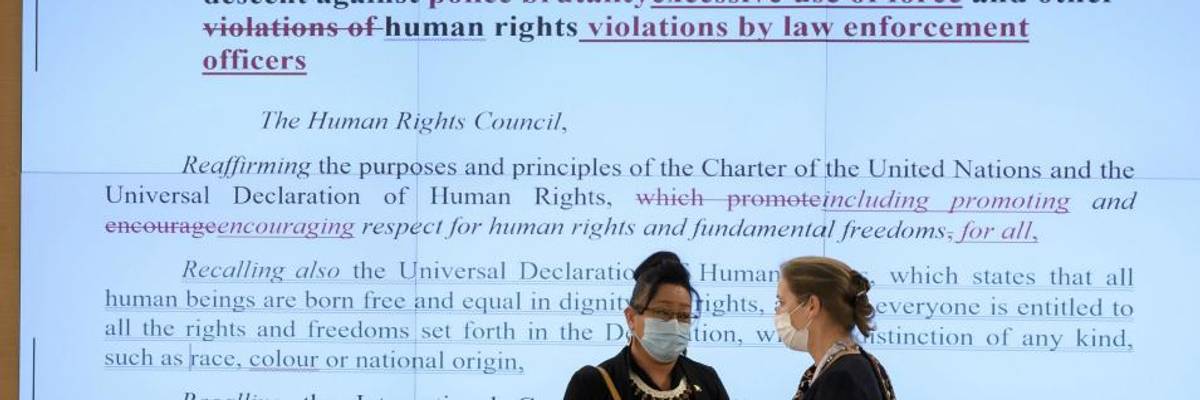
Delegates stand in front of a TV screen during the vote of a watered down resolution condemning structural racism and police brutality in the wake of the death of George Floyd at the United Nations Human Rights Council on June 19, 2020 in Geneva. (Photo: Fabrice Coffrini/Pool/AFP via Getty Images)
The United Nations Human Rights Council on Friday unanimously adopted a resolution condemning police abuses and ordering an inquiry into law enforcement actions that "resulted in the death of George Floyd and other Africans and people of African descent."
But rights groups immediately slammed the resolution as overly broad and "absurd" because it was weakened to remove all references to one particularly relevant country: the United States.
"The final resolution passed by the United Nations strips mention of the United States, where police kill people, particularly Black people, at alarmingly higher rates compared to other developed countries," Jamil Dakwar, director of the ACLU's Human Rights Program, said in a statement.
"The United States is yet again turning its back on victims of police violence and Black people."
--Jamil Dakwar, ACLU
An earlier draft of the resolution--which was introduced by African nations this week in the wake of Floyd's killing on May 25--explicitly called for a U.N. investigation into police violence against black people in the United States, but all references to the world's most powerful country were scrubbed from the text in closed-door negotiations.
Ahead of the vote on the final version of the resolution, Dakwar accused the U.S. of "bullying other countries to water down what would have been an historic resolution and exempting itself from international investigation."
"The United States is yet again turning its back on victims of police violence and Black people," said Dakwar.
Human Rights Watch, an advocacy organization based in the U.S., warned as the resolution was being finalized Thursday that stripping any mention of the United States from a resolution sparked by U.S. police violence "would transform it into an 'all lives matter' text, and risk making it so vague as to be meaningless."
AFP reported Friday that "Washington complained of being singled out in the draft text, and a number of its allies, including Australia and Israel, spoke out against the U.S. focus during the debate." The Trump administration withdrew the U.S. from the Human Rights Council in 2018.
One earlier version of the resolution called for an inquiry into "violations of international human rights law and abuses against Africans and people of African descent in the United States of America and other parts of the world recently affected by law enforcement agencies."
The adopted resolution orders U.N. High Commissioner for Human Rights Michelle Bachelet to prepare a report on systemic racism and law enforcement abuses against people of African descent.
As Reuters reported, the resolution also mandates that Bachelet "examine government responses to peaceful protests, including accusations of the excessive use of force, and deliver findings in a year's time."
Dakwar of the ACLU said in a statement Friday that "the United Nations needs to do its job--not get bullied out of doing it--and hold the United States accountable."
"The country must face independent global scrutiny for its oppression of Black people," said Dakwar.
Dear Common Dreams reader, It’s been nearly 30 years since I co-founded Common Dreams with my late wife, Lina Newhouser. We had the radical notion that journalism should serve the public good, not corporate profits. It was clear to us from the outset what it would take to build such a project. No paid advertisements. No corporate sponsors. No millionaire publisher telling us what to think or do. Many people said we wouldn't last a year, but we proved those doubters wrong. Together with a tremendous team of journalists and dedicated staff, we built an independent media outlet free from the constraints of profits and corporate control. Our mission has always been simple: To inform. To inspire. To ignite change for the common good. Building Common Dreams was not easy. Our survival was never guaranteed. When you take on the most powerful forces—Wall Street greed, fossil fuel industry destruction, Big Tech lobbyists, and uber-rich oligarchs who have spent billions upon billions rigging the economy and democracy in their favor—the only bulwark you have is supporters who believe in your work. But here’s the urgent message from me today. It's never been this bad out there. And it's never been this hard to keep us going. At the very moment Common Dreams is most needed, the threats we face are intensifying. We need your support now more than ever. We don't accept corporate advertising and never will. We don't have a paywall because we don't think people should be blocked from critical news based on their ability to pay. Everything we do is funded by the donations of readers like you. When everyone does the little they can afford, we are strong. But if that support retreats or dries up, so do we. Will you donate now to make sure Common Dreams not only survives but thrives? —Craig Brown, Co-founder |
The United Nations Human Rights Council on Friday unanimously adopted a resolution condemning police abuses and ordering an inquiry into law enforcement actions that "resulted in the death of George Floyd and other Africans and people of African descent."
But rights groups immediately slammed the resolution as overly broad and "absurd" because it was weakened to remove all references to one particularly relevant country: the United States.
"The final resolution passed by the United Nations strips mention of the United States, where police kill people, particularly Black people, at alarmingly higher rates compared to other developed countries," Jamil Dakwar, director of the ACLU's Human Rights Program, said in a statement.
"The United States is yet again turning its back on victims of police violence and Black people."
--Jamil Dakwar, ACLU
An earlier draft of the resolution--which was introduced by African nations this week in the wake of Floyd's killing on May 25--explicitly called for a U.N. investigation into police violence against black people in the United States, but all references to the world's most powerful country were scrubbed from the text in closed-door negotiations.
Ahead of the vote on the final version of the resolution, Dakwar accused the U.S. of "bullying other countries to water down what would have been an historic resolution and exempting itself from international investigation."
"The United States is yet again turning its back on victims of police violence and Black people," said Dakwar.
Human Rights Watch, an advocacy organization based in the U.S., warned as the resolution was being finalized Thursday that stripping any mention of the United States from a resolution sparked by U.S. police violence "would transform it into an 'all lives matter' text, and risk making it so vague as to be meaningless."
AFP reported Friday that "Washington complained of being singled out in the draft text, and a number of its allies, including Australia and Israel, spoke out against the U.S. focus during the debate." The Trump administration withdrew the U.S. from the Human Rights Council in 2018.
One earlier version of the resolution called for an inquiry into "violations of international human rights law and abuses against Africans and people of African descent in the United States of America and other parts of the world recently affected by law enforcement agencies."
The adopted resolution orders U.N. High Commissioner for Human Rights Michelle Bachelet to prepare a report on systemic racism and law enforcement abuses against people of African descent.
As Reuters reported, the resolution also mandates that Bachelet "examine government responses to peaceful protests, including accusations of the excessive use of force, and deliver findings in a year's time."
Dakwar of the ACLU said in a statement Friday that "the United Nations needs to do its job--not get bullied out of doing it--and hold the United States accountable."
"The country must face independent global scrutiny for its oppression of Black people," said Dakwar.
The United Nations Human Rights Council on Friday unanimously adopted a resolution condemning police abuses and ordering an inquiry into law enforcement actions that "resulted in the death of George Floyd and other Africans and people of African descent."
But rights groups immediately slammed the resolution as overly broad and "absurd" because it was weakened to remove all references to one particularly relevant country: the United States.
"The final resolution passed by the United Nations strips mention of the United States, where police kill people, particularly Black people, at alarmingly higher rates compared to other developed countries," Jamil Dakwar, director of the ACLU's Human Rights Program, said in a statement.
"The United States is yet again turning its back on victims of police violence and Black people."
--Jamil Dakwar, ACLU
An earlier draft of the resolution--which was introduced by African nations this week in the wake of Floyd's killing on May 25--explicitly called for a U.N. investigation into police violence against black people in the United States, but all references to the world's most powerful country were scrubbed from the text in closed-door negotiations.
Ahead of the vote on the final version of the resolution, Dakwar accused the U.S. of "bullying other countries to water down what would have been an historic resolution and exempting itself from international investigation."
"The United States is yet again turning its back on victims of police violence and Black people," said Dakwar.
Human Rights Watch, an advocacy organization based in the U.S., warned as the resolution was being finalized Thursday that stripping any mention of the United States from a resolution sparked by U.S. police violence "would transform it into an 'all lives matter' text, and risk making it so vague as to be meaningless."
AFP reported Friday that "Washington complained of being singled out in the draft text, and a number of its allies, including Australia and Israel, spoke out against the U.S. focus during the debate." The Trump administration withdrew the U.S. from the Human Rights Council in 2018.
One earlier version of the resolution called for an inquiry into "violations of international human rights law and abuses against Africans and people of African descent in the United States of America and other parts of the world recently affected by law enforcement agencies."
The adopted resolution orders U.N. High Commissioner for Human Rights Michelle Bachelet to prepare a report on systemic racism and law enforcement abuses against people of African descent.
As Reuters reported, the resolution also mandates that Bachelet "examine government responses to peaceful protests, including accusations of the excessive use of force, and deliver findings in a year's time."
Dakwar of the ACLU said in a statement Friday that "the United Nations needs to do its job--not get bullied out of doing it--and hold the United States accountable."
"The country must face independent global scrutiny for its oppression of Black people," said Dakwar.

