

SUBSCRIBE TO OUR FREE NEWSLETTER
Daily news & progressive opinion—funded by the people, not the corporations—delivered straight to your inbox.
5
#000000
#FFFFFF
To donate by check, phone, or other method, see our More Ways to Give page.
Daily news & progressive opinion—funded by the people, not the corporations—delivered straight to your inbox.
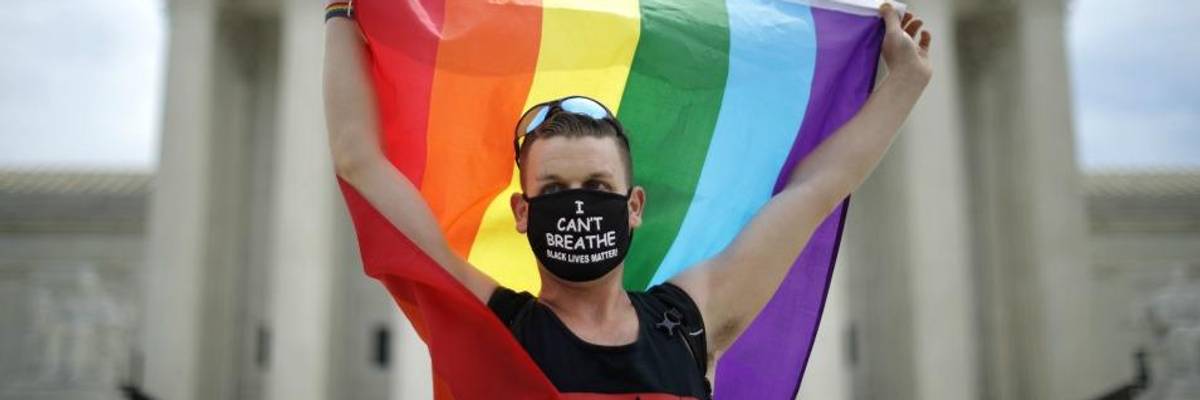
Joseph Fons holds a Pride Flag in front of the U.S. Supreme Court building after the court ruled that LGBTQ people can not be disciplined or fired based on their sexual orientation on June 15, 2020 in Washington, D.C. (Photo: Chip Somodevilla/Getty Images)
Labor and LGBTQ rights advocates celebrated Monday after the U.S. Supreme Court ruled that job discrimination on the basis of sexual orientation or identity is prohibited under long-standing federal law.
The ruling, handed down by Trump appointee Justice Neil Gorsuch, is a rebuke to the White House, which argued Title VII of the Civil Rights Act of 1964 does not cover sexual orientation and that "the ordinary meaning of 'sex' is biologically make or female."
The court ruled in a 6-3 decision that the law makes it illegal for employers to discriminate against a worker because of their transgender status and their sexual orientation, in addition to their sex assigned at birth.
"Those who adopted the Civil Rights Act might not have anticipated their work would lead to this particular result, but the limits of the drafters' imagination supply no reason to ignore the law's demands. Only the written word is the law, and all persons are entitled to its benefit."
-- Supreme Court Justice Neil Gorsuch
"An employer who fired an individual for being homosexual or transgender fires that person for traits or actions it would not have questioned in members of a different sex," wrote Gorsuch. "Those who adopted the Civil Rights Act might not have anticipated their work would lead to this particular result, but the limits of the drafters' imagination supply no reason to ignore the law's demands."
"Only the written word is the law, and all persons are entitled to its benefit," he added.
Gorsuch and Chief Justice John Roberts, both appointed by Republicans, joined the four liberal-leaning justices on the high court in the ruling.
The ACLU, which represented two plaintiffs in the Supreme Court case, gave credit to the victory to countless LGBTQ Americans who fought over the past five decades for equality in the workplace.
"This is a huge victory for LGBTQ equality," said James Esseks, director of the ACLU's LGBTQ & HIV Project. "Over 50 years ago, Black and Brown trans women, drag queens, and butch lesbians fought back against police brutality and discrimination that too many LGBTQ people still face. The Supreme Court's clarification that it's unlawful to fire people because they're LGBTQ is the result of decades of advocates fighting for our rights."
"The court has caught up to the majority of our country, which already knows that discriminating against LGBTQ people is both unfair and against the law," Esseks added, referring to 28 states which already protect LGBTQ employees from discrimination.
The ruling comes a month after the death of Aimee Stephens, a woman who was fired from her job at a funeral home after telling her employer she was transgender.
"For the last seven years of Aimee's life, she rose as a leader who fought against discrimination against transgender people, starting when she was fired for coming out as a woman, despite her recent promotion at the time," said Donna Stephens, Aimee's wife. "I am grateful for this victory to honor the legacy of Aimee, and to ensure people are treated fairly regardless of their sexual orientation or gender identity."
Advocates celebrated the decision on social media.
The ruling was handed down a day after thousands of people across the country rallied for the rights of black transgender Americans following the killings of two black trans women in the past week.
"It's worth noting that employment, perhaps more than anything, is a concrete predictor of the safety of Black trans women in this country," tweeted journalist Kate Sosin as the nation awaited the Supreme Court's ruling.
Advocates noted on Monday that the LGBTQ community still faces a fight to secure full civil rights.
"Our work is not done. There are still alarming gaps in federal civil rights laws that leave people--particularly Black and Brown LGBTQ people--open to discrimination in businesses open to the public and taxpayer-funded programs," said Esseks. "Congress must affirm today's decision and update our laws to ensure comprehensive and explicit protections for LGBTQ people and all people who face discrimination."
The U.S. also has work to do to protect all LGBTQ people from unjust treatment in all public spaces, added GLBTQ Legal Advocates & Defenders (GLAD).
"Our federal and many state laws still leave too many LGBTQ people and others unprotected in critical areas of life including access to public places like stores or public transportation, or in federally funded vital social services," said Mary Bonauto, Civil Rights Project director for GLAD. "Today's ruling also arrives against the backdrop of pervasive systemic racism and racist violence, that imposes incalculable and intolerable costs on Black Americans and all people of color, including those who are LGBTQ."
Amnesty International expressed hope that the Supreme Court's decision would resonate with lawmakers throughout the country and represent a major step toward full recognition of equal rights.
"No one should be afraid to be who they are in order to work or live their lives," said Tarah Demant, director of the group's Gender, Sexuality, and Identity Program. "LGBTQI people have a right to the same protections as everyone else, and they deserve to be able to live their lives without fear of discrimination--something the Supreme Court has affirmed today."
Dear Common Dreams reader, It’s been nearly 30 years since I co-founded Common Dreams with my late wife, Lina Newhouser. We had the radical notion that journalism should serve the public good, not corporate profits. It was clear to us from the outset what it would take to build such a project. No paid advertisements. No corporate sponsors. No millionaire publisher telling us what to think or do. Many people said we wouldn't last a year, but we proved those doubters wrong. Together with a tremendous team of journalists and dedicated staff, we built an independent media outlet free from the constraints of profits and corporate control. Our mission has always been simple: To inform. To inspire. To ignite change for the common good. Building Common Dreams was not easy. Our survival was never guaranteed. When you take on the most powerful forces—Wall Street greed, fossil fuel industry destruction, Big Tech lobbyists, and uber-rich oligarchs who have spent billions upon billions rigging the economy and democracy in their favor—the only bulwark you have is supporters who believe in your work. But here’s the urgent message from me today. It's never been this bad out there. And it's never been this hard to keep us going. At the very moment Common Dreams is most needed, the threats we face are intensifying. We need your support now more than ever. We don't accept corporate advertising and never will. We don't have a paywall because we don't think people should be blocked from critical news based on their ability to pay. Everything we do is funded by the donations of readers like you. When everyone does the little they can afford, we are strong. But if that support retreats or dries up, so do we. Will you donate now to make sure Common Dreams not only survives but thrives? —Craig Brown, Co-founder |
Labor and LGBTQ rights advocates celebrated Monday after the U.S. Supreme Court ruled that job discrimination on the basis of sexual orientation or identity is prohibited under long-standing federal law.
The ruling, handed down by Trump appointee Justice Neil Gorsuch, is a rebuke to the White House, which argued Title VII of the Civil Rights Act of 1964 does not cover sexual orientation and that "the ordinary meaning of 'sex' is biologically make or female."
The court ruled in a 6-3 decision that the law makes it illegal for employers to discriminate against a worker because of their transgender status and their sexual orientation, in addition to their sex assigned at birth.
"Those who adopted the Civil Rights Act might not have anticipated their work would lead to this particular result, but the limits of the drafters' imagination supply no reason to ignore the law's demands. Only the written word is the law, and all persons are entitled to its benefit."
-- Supreme Court Justice Neil Gorsuch
"An employer who fired an individual for being homosexual or transgender fires that person for traits or actions it would not have questioned in members of a different sex," wrote Gorsuch. "Those who adopted the Civil Rights Act might not have anticipated their work would lead to this particular result, but the limits of the drafters' imagination supply no reason to ignore the law's demands."
"Only the written word is the law, and all persons are entitled to its benefit," he added.
Gorsuch and Chief Justice John Roberts, both appointed by Republicans, joined the four liberal-leaning justices on the high court in the ruling.
The ACLU, which represented two plaintiffs in the Supreme Court case, gave credit to the victory to countless LGBTQ Americans who fought over the past five decades for equality in the workplace.
"This is a huge victory for LGBTQ equality," said James Esseks, director of the ACLU's LGBTQ & HIV Project. "Over 50 years ago, Black and Brown trans women, drag queens, and butch lesbians fought back against police brutality and discrimination that too many LGBTQ people still face. The Supreme Court's clarification that it's unlawful to fire people because they're LGBTQ is the result of decades of advocates fighting for our rights."
"The court has caught up to the majority of our country, which already knows that discriminating against LGBTQ people is both unfair and against the law," Esseks added, referring to 28 states which already protect LGBTQ employees from discrimination.
The ruling comes a month after the death of Aimee Stephens, a woman who was fired from her job at a funeral home after telling her employer she was transgender.
"For the last seven years of Aimee's life, she rose as a leader who fought against discrimination against transgender people, starting when she was fired for coming out as a woman, despite her recent promotion at the time," said Donna Stephens, Aimee's wife. "I am grateful for this victory to honor the legacy of Aimee, and to ensure people are treated fairly regardless of their sexual orientation or gender identity."
Advocates celebrated the decision on social media.
The ruling was handed down a day after thousands of people across the country rallied for the rights of black transgender Americans following the killings of two black trans women in the past week.
"It's worth noting that employment, perhaps more than anything, is a concrete predictor of the safety of Black trans women in this country," tweeted journalist Kate Sosin as the nation awaited the Supreme Court's ruling.
Advocates noted on Monday that the LGBTQ community still faces a fight to secure full civil rights.
"Our work is not done. There are still alarming gaps in federal civil rights laws that leave people--particularly Black and Brown LGBTQ people--open to discrimination in businesses open to the public and taxpayer-funded programs," said Esseks. "Congress must affirm today's decision and update our laws to ensure comprehensive and explicit protections for LGBTQ people and all people who face discrimination."
The U.S. also has work to do to protect all LGBTQ people from unjust treatment in all public spaces, added GLBTQ Legal Advocates & Defenders (GLAD).
"Our federal and many state laws still leave too many LGBTQ people and others unprotected in critical areas of life including access to public places like stores or public transportation, or in federally funded vital social services," said Mary Bonauto, Civil Rights Project director for GLAD. "Today's ruling also arrives against the backdrop of pervasive systemic racism and racist violence, that imposes incalculable and intolerable costs on Black Americans and all people of color, including those who are LGBTQ."
Amnesty International expressed hope that the Supreme Court's decision would resonate with lawmakers throughout the country and represent a major step toward full recognition of equal rights.
"No one should be afraid to be who they are in order to work or live their lives," said Tarah Demant, director of the group's Gender, Sexuality, and Identity Program. "LGBTQI people have a right to the same protections as everyone else, and they deserve to be able to live their lives without fear of discrimination--something the Supreme Court has affirmed today."
Labor and LGBTQ rights advocates celebrated Monday after the U.S. Supreme Court ruled that job discrimination on the basis of sexual orientation or identity is prohibited under long-standing federal law.
The ruling, handed down by Trump appointee Justice Neil Gorsuch, is a rebuke to the White House, which argued Title VII of the Civil Rights Act of 1964 does not cover sexual orientation and that "the ordinary meaning of 'sex' is biologically make or female."
The court ruled in a 6-3 decision that the law makes it illegal for employers to discriminate against a worker because of their transgender status and their sexual orientation, in addition to their sex assigned at birth.
"Those who adopted the Civil Rights Act might not have anticipated their work would lead to this particular result, but the limits of the drafters' imagination supply no reason to ignore the law's demands. Only the written word is the law, and all persons are entitled to its benefit."
-- Supreme Court Justice Neil Gorsuch
"An employer who fired an individual for being homosexual or transgender fires that person for traits or actions it would not have questioned in members of a different sex," wrote Gorsuch. "Those who adopted the Civil Rights Act might not have anticipated their work would lead to this particular result, but the limits of the drafters' imagination supply no reason to ignore the law's demands."
"Only the written word is the law, and all persons are entitled to its benefit," he added.
Gorsuch and Chief Justice John Roberts, both appointed by Republicans, joined the four liberal-leaning justices on the high court in the ruling.
The ACLU, which represented two plaintiffs in the Supreme Court case, gave credit to the victory to countless LGBTQ Americans who fought over the past five decades for equality in the workplace.
"This is a huge victory for LGBTQ equality," said James Esseks, director of the ACLU's LGBTQ & HIV Project. "Over 50 years ago, Black and Brown trans women, drag queens, and butch lesbians fought back against police brutality and discrimination that too many LGBTQ people still face. The Supreme Court's clarification that it's unlawful to fire people because they're LGBTQ is the result of decades of advocates fighting for our rights."
"The court has caught up to the majority of our country, which already knows that discriminating against LGBTQ people is both unfair and against the law," Esseks added, referring to 28 states which already protect LGBTQ employees from discrimination.
The ruling comes a month after the death of Aimee Stephens, a woman who was fired from her job at a funeral home after telling her employer she was transgender.
"For the last seven years of Aimee's life, she rose as a leader who fought against discrimination against transgender people, starting when she was fired for coming out as a woman, despite her recent promotion at the time," said Donna Stephens, Aimee's wife. "I am grateful for this victory to honor the legacy of Aimee, and to ensure people are treated fairly regardless of their sexual orientation or gender identity."
Advocates celebrated the decision on social media.
The ruling was handed down a day after thousands of people across the country rallied for the rights of black transgender Americans following the killings of two black trans women in the past week.
"It's worth noting that employment, perhaps more than anything, is a concrete predictor of the safety of Black trans women in this country," tweeted journalist Kate Sosin as the nation awaited the Supreme Court's ruling.
Advocates noted on Monday that the LGBTQ community still faces a fight to secure full civil rights.
"Our work is not done. There are still alarming gaps in federal civil rights laws that leave people--particularly Black and Brown LGBTQ people--open to discrimination in businesses open to the public and taxpayer-funded programs," said Esseks. "Congress must affirm today's decision and update our laws to ensure comprehensive and explicit protections for LGBTQ people and all people who face discrimination."
The U.S. also has work to do to protect all LGBTQ people from unjust treatment in all public spaces, added GLBTQ Legal Advocates & Defenders (GLAD).
"Our federal and many state laws still leave too many LGBTQ people and others unprotected in critical areas of life including access to public places like stores or public transportation, or in federally funded vital social services," said Mary Bonauto, Civil Rights Project director for GLAD. "Today's ruling also arrives against the backdrop of pervasive systemic racism and racist violence, that imposes incalculable and intolerable costs on Black Americans and all people of color, including those who are LGBTQ."
Amnesty International expressed hope that the Supreme Court's decision would resonate with lawmakers throughout the country and represent a major step toward full recognition of equal rights.
"No one should be afraid to be who they are in order to work or live their lives," said Tarah Demant, director of the group's Gender, Sexuality, and Identity Program. "LGBTQI people have a right to the same protections as everyone else, and they deserve to be able to live their lives without fear of discrimination--something the Supreme Court has affirmed today."

