

SUBSCRIBE TO OUR FREE NEWSLETTER
Daily news & progressive opinion—funded by the people, not the corporations—delivered straight to your inbox.
5
#000000
#FFFFFF
To donate by check, phone, or other method, see our More Ways to Give page.
Daily news & progressive opinion—funded by the people, not the corporations—delivered straight to your inbox.
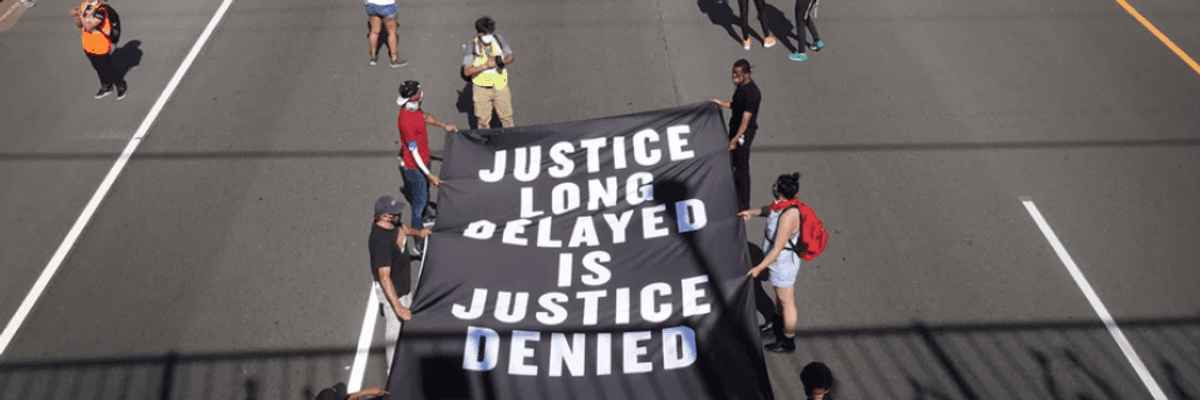
Demonstrators march down I-94 in St. Paul, Minnesota on May 31 during a protest over the death in police custody of George Floyd.
Since announcing Wednesday he will hold his first campaign rally in months next week, President Donald Trump has come in for harsh criticism from advocates and lawmakers for scheduling the event to take place in the city of Tulsa, Oklahoma--the site of a brutal racist massacre in 1921--on the specific date of June 19th, the holiday known as Juneteenth which commemorates the end of slavery in the United States.
"This isn't just a wink to white supremacists--he's throwing them a welcome home party," Sen. Kamala Harris (D-Calif.) said on Twitter.
Trump's rally will come in the midst of what has become a moment of national reckoning on racism and policing. Demonstrations in the wake of the killing of George Floyd by four Minneapolis police officers have sparked a worldwide movement against racial injustice and police brutality.
In that context, the history of the location and the timing of next Friday's rally was not lost on critics.
It was on June 19, 1865, that enslaved Africans in Texas first learned they were free--two years after Abraham Lincoln signed the Emancipation Proclamation. The day is now celebrated as Juneteenth.
Tulsa recently marked the 99th anniversary of one of the deadliest mass killings of African Americans in U.S. history. In 1921, a white mob killed as many as 300 people, most of them Black, after a Black man was accused of assaulting a white elevator operator. The white mobs destroyed a thriving African American business district known at the time as the Black Wall Street of America.
Trump's decision to rally supporters at the site of racist violence is nothing new for the Republican Party. On August 3, 1980, then-candidate Ronald Reagan addressed supporters at the Neshoba County Fair, just a few miles from the Philadelphia, Mississippi site of the Freedom Summer murders of three civil rights advocates in June 1964.
The decision by Trump to head to Tulsa was announced Wednesday during a roundtable with a group of black supporters at the White House. On Thursday, press secretary Kayleigh McEnany addressed the growing controversy over the date and location, telling reporters that Trump "often shares the great work he has done for minority communities" during his campaign rallies.
"It's a meaningful day to him, and it's a day where wants to share some of the progress that's been made as we look forward and more that needs to be done," said McEnany.
But the president's critics weren't buying it, referring to Trump's longstanding and well-established history of racist comments and behavior stemming from long before his entry into presidential politics in 2015.
"It's not only offensive but it also feels like a desecration," author Morgan Jerkins said on Twitter. "We still haven't found all the graves of those who were massacred there back in 1921."
I hate to break it to you but this is absolutely deliberate and the only thing shittier than doing it in Tulsa would be doing it in Galveston (it is Juneteenth next Friday) https://t.co/W3u3dKZOnj
-- vaccine haver (@kerrence) June 10, 2020
Rep. Al Green (D-Tex.), a frequent critic of the president who has regularly introduced articles of impeachment in the House against Trump, tweeted that the decision was meant to send a message of hate.
"Trump rally with rebel flags (a symbol of slavery and racism) in Tulsa, OK (the place of #TulsaMassacre) on Juneteenth (a day of emancipation recognition) is more than a slap in the face to African Americans; it is overt racism from the highest office in the land," Green said.
Other lawmakers weighed in on the decision, calling Trump out in stark terms.
" Donald Trump is a racist," said Sen. Ed Markey (D-Mass.). "He has contempt for the history of Black Americans and the Black lives destroyed by white mobs at the Tulsa Massacre. We need to do more than defeat him, we need to root out the systemic racism in our country that enabled him to ever come to power."
Dear Common Dreams reader, It’s been nearly 30 years since I co-founded Common Dreams with my late wife, Lina Newhouser. We had the radical notion that journalism should serve the public good, not corporate profits. It was clear to us from the outset what it would take to build such a project. No paid advertisements. No corporate sponsors. No millionaire publisher telling us what to think or do. Many people said we wouldn't last a year, but we proved those doubters wrong. Together with a tremendous team of journalists and dedicated staff, we built an independent media outlet free from the constraints of profits and corporate control. Our mission has always been simple: To inform. To inspire. To ignite change for the common good. Building Common Dreams was not easy. Our survival was never guaranteed. When you take on the most powerful forces—Wall Street greed, fossil fuel industry destruction, Big Tech lobbyists, and uber-rich oligarchs who have spent billions upon billions rigging the economy and democracy in their favor—the only bulwark you have is supporters who believe in your work. But here’s the urgent message from me today. It's never been this bad out there. And it's never been this hard to keep us going. At the very moment Common Dreams is most needed, the threats we face are intensifying. We need your support now more than ever. We don't accept corporate advertising and never will. We don't have a paywall because we don't think people should be blocked from critical news based on their ability to pay. Everything we do is funded by the donations of readers like you. When everyone does the little they can afford, we are strong. But if that support retreats or dries up, so do we. Will you donate now to make sure Common Dreams not only survives but thrives? —Craig Brown, Co-founder |
Since announcing Wednesday he will hold his first campaign rally in months next week, President Donald Trump has come in for harsh criticism from advocates and lawmakers for scheduling the event to take place in the city of Tulsa, Oklahoma--the site of a brutal racist massacre in 1921--on the specific date of June 19th, the holiday known as Juneteenth which commemorates the end of slavery in the United States.
"This isn't just a wink to white supremacists--he's throwing them a welcome home party," Sen. Kamala Harris (D-Calif.) said on Twitter.
Trump's rally will come in the midst of what has become a moment of national reckoning on racism and policing. Demonstrations in the wake of the killing of George Floyd by four Minneapolis police officers have sparked a worldwide movement against racial injustice and police brutality.
In that context, the history of the location and the timing of next Friday's rally was not lost on critics.
It was on June 19, 1865, that enslaved Africans in Texas first learned they were free--two years after Abraham Lincoln signed the Emancipation Proclamation. The day is now celebrated as Juneteenth.
Tulsa recently marked the 99th anniversary of one of the deadliest mass killings of African Americans in U.S. history. In 1921, a white mob killed as many as 300 people, most of them Black, after a Black man was accused of assaulting a white elevator operator. The white mobs destroyed a thriving African American business district known at the time as the Black Wall Street of America.
Trump's decision to rally supporters at the site of racist violence is nothing new for the Republican Party. On August 3, 1980, then-candidate Ronald Reagan addressed supporters at the Neshoba County Fair, just a few miles from the Philadelphia, Mississippi site of the Freedom Summer murders of three civil rights advocates in June 1964.
The decision by Trump to head to Tulsa was announced Wednesday during a roundtable with a group of black supporters at the White House. On Thursday, press secretary Kayleigh McEnany addressed the growing controversy over the date and location, telling reporters that Trump "often shares the great work he has done for minority communities" during his campaign rallies.
"It's a meaningful day to him, and it's a day where wants to share some of the progress that's been made as we look forward and more that needs to be done," said McEnany.
But the president's critics weren't buying it, referring to Trump's longstanding and well-established history of racist comments and behavior stemming from long before his entry into presidential politics in 2015.
"It's not only offensive but it also feels like a desecration," author Morgan Jerkins said on Twitter. "We still haven't found all the graves of those who were massacred there back in 1921."
I hate to break it to you but this is absolutely deliberate and the only thing shittier than doing it in Tulsa would be doing it in Galveston (it is Juneteenth next Friday) https://t.co/W3u3dKZOnj
-- vaccine haver (@kerrence) June 10, 2020
Rep. Al Green (D-Tex.), a frequent critic of the president who has regularly introduced articles of impeachment in the House against Trump, tweeted that the decision was meant to send a message of hate.
"Trump rally with rebel flags (a symbol of slavery and racism) in Tulsa, OK (the place of #TulsaMassacre) on Juneteenth (a day of emancipation recognition) is more than a slap in the face to African Americans; it is overt racism from the highest office in the land," Green said.
Other lawmakers weighed in on the decision, calling Trump out in stark terms.
" Donald Trump is a racist," said Sen. Ed Markey (D-Mass.). "He has contempt for the history of Black Americans and the Black lives destroyed by white mobs at the Tulsa Massacre. We need to do more than defeat him, we need to root out the systemic racism in our country that enabled him to ever come to power."
Since announcing Wednesday he will hold his first campaign rally in months next week, President Donald Trump has come in for harsh criticism from advocates and lawmakers for scheduling the event to take place in the city of Tulsa, Oklahoma--the site of a brutal racist massacre in 1921--on the specific date of June 19th, the holiday known as Juneteenth which commemorates the end of slavery in the United States.
"This isn't just a wink to white supremacists--he's throwing them a welcome home party," Sen. Kamala Harris (D-Calif.) said on Twitter.
Trump's rally will come in the midst of what has become a moment of national reckoning on racism and policing. Demonstrations in the wake of the killing of George Floyd by four Minneapolis police officers have sparked a worldwide movement against racial injustice and police brutality.
In that context, the history of the location and the timing of next Friday's rally was not lost on critics.
It was on June 19, 1865, that enslaved Africans in Texas first learned they were free--two years after Abraham Lincoln signed the Emancipation Proclamation. The day is now celebrated as Juneteenth.
Tulsa recently marked the 99th anniversary of one of the deadliest mass killings of African Americans in U.S. history. In 1921, a white mob killed as many as 300 people, most of them Black, after a Black man was accused of assaulting a white elevator operator. The white mobs destroyed a thriving African American business district known at the time as the Black Wall Street of America.
Trump's decision to rally supporters at the site of racist violence is nothing new for the Republican Party. On August 3, 1980, then-candidate Ronald Reagan addressed supporters at the Neshoba County Fair, just a few miles from the Philadelphia, Mississippi site of the Freedom Summer murders of three civil rights advocates in June 1964.
The decision by Trump to head to Tulsa was announced Wednesday during a roundtable with a group of black supporters at the White House. On Thursday, press secretary Kayleigh McEnany addressed the growing controversy over the date and location, telling reporters that Trump "often shares the great work he has done for minority communities" during his campaign rallies.
"It's a meaningful day to him, and it's a day where wants to share some of the progress that's been made as we look forward and more that needs to be done," said McEnany.
But the president's critics weren't buying it, referring to Trump's longstanding and well-established history of racist comments and behavior stemming from long before his entry into presidential politics in 2015.
"It's not only offensive but it also feels like a desecration," author Morgan Jerkins said on Twitter. "We still haven't found all the graves of those who were massacred there back in 1921."
I hate to break it to you but this is absolutely deliberate and the only thing shittier than doing it in Tulsa would be doing it in Galveston (it is Juneteenth next Friday) https://t.co/W3u3dKZOnj
-- vaccine haver (@kerrence) June 10, 2020
Rep. Al Green (D-Tex.), a frequent critic of the president who has regularly introduced articles of impeachment in the House against Trump, tweeted that the decision was meant to send a message of hate.
"Trump rally with rebel flags (a symbol of slavery and racism) in Tulsa, OK (the place of #TulsaMassacre) on Juneteenth (a day of emancipation recognition) is more than a slap in the face to African Americans; it is overt racism from the highest office in the land," Green said.
Other lawmakers weighed in on the decision, calling Trump out in stark terms.
" Donald Trump is a racist," said Sen. Ed Markey (D-Mass.). "He has contempt for the history of Black Americans and the Black lives destroyed by white mobs at the Tulsa Massacre. We need to do more than defeat him, we need to root out the systemic racism in our country that enabled him to ever come to power."

