SUBSCRIBE TO OUR FREE NEWSLETTER
Daily news & progressive opinion—funded by the people, not the corporations—delivered straight to your inbox.
5
#000000
#FFFFFF
To donate by check, phone, or other method, see our More Ways to Give page.
Daily news & progressive opinion—funded by the people, not the corporations—delivered straight to your inbox.
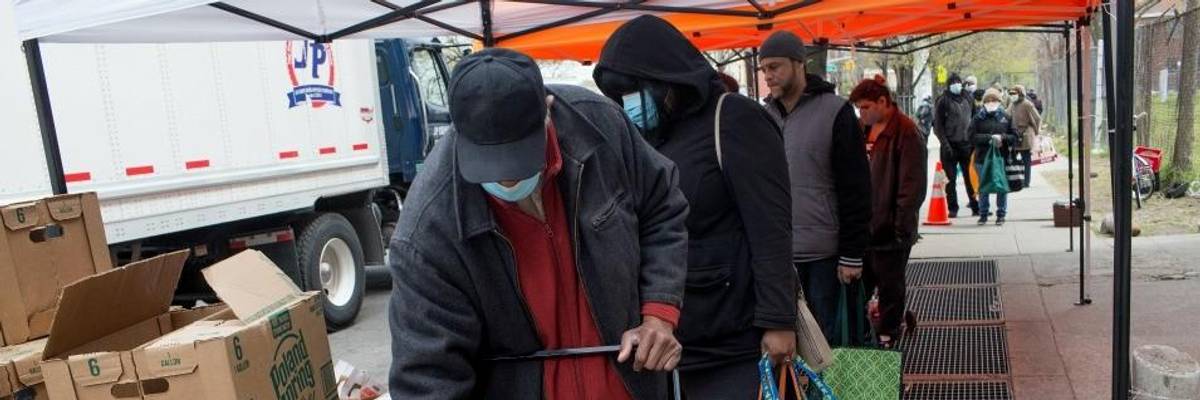
Local residents line up outside the food pantry Bed Stuy Campaign Against Hunger to receive free food during the Covid-19 pandemic on April 23, 2020 in the Bedford-Stuyvesant neighborhood of Brooklyn, New York. (Photo: Andrew Lichtenstein/Corbis via Getty Images)
A Bloomberg analysis released Tuesday estimates that nearly a third of the unemployment benefits owed to jobless Americans have not yet been paid out, a finding critics described as a "scandal" deserving of more media attention as millions of people struggle to afford basic expenses due to the Covid-19 pandemic.
"The Treasury disbursed $146 billion in unemployment benefits in the three months through May," Bloomberg reported. "But even that historic figure falls short of a total bill that should have reached about $214 billion for the period, according to Bloomberg calculations based on weekly unemployment filings and the average size of those claims."
That calculation likely understates the total amount of unpaid unemployment benefits, Bloomberg noted, because "it doesn't include the millions of workers around the country still waiting to have claims processed by overloaded systems, or the retroactive benefits owed to some of the 7.8 million people now claiming under the Pandemic Unemployment Assistance program for independent contractors."
HuffPost reporter Arthur Delaney suggested that at least part of the estimated $67 billion in unpaid benefits may be the result of people "getting cut off according to the Trump administration's return-to-work policy."
More than 40 million Americans have filed for unemployment benefits since mid-March, according to the U.S. Department of Labor. The unprecedented wave of jobless claims in such a short period produced enormous backlogs of unpaid benefits as outdated state and federal systems struggled to cope with the surge in benefit applications.
Heidi Shierholz of the Economic Policy Institute noted in a blog post last week that more than one in five U.S. workers are currently either receiving unemployment benefits or waiting for approval. Shierholz said "policymakers need to do more" to provide people with financial relief as the economic fallout of the coronavirus pandemic continues.
To that end, Shierholz urged Congress to extend the $600 weekly boost in unemployment benefits provided under the CARES Act, which is set to expire on July 31.
"We also must provide more funding to state [unemployment insurance] agencies to hire staff to speed up processing and to make improvements to websites and other administrative infrastructure," wrote Shierholz.
A Washington Post/ABC News poll released Monday showed that nearly 60% of Americans support extending the benefits, but President Donald Trump and Senate Majority Leader Mitch McConnell (R-Ky.) have both said they support allowing them to expire at the end of next month.
Dear Common Dreams reader, It’s been nearly 30 years since I co-founded Common Dreams with my late wife, Lina Newhouser. We had the radical notion that journalism should serve the public good, not corporate profits. It was clear to us from the outset what it would take to build such a project. No paid advertisements. No corporate sponsors. No millionaire publisher telling us what to think or do. Many people said we wouldn't last a year, but we proved those doubters wrong. Together with a tremendous team of journalists and dedicated staff, we built an independent media outlet free from the constraints of profits and corporate control. Our mission has always been simple: To inform. To inspire. To ignite change for the common good. Building Common Dreams was not easy. Our survival was never guaranteed. When you take on the most powerful forces—Wall Street greed, fossil fuel industry destruction, Big Tech lobbyists, and uber-rich oligarchs who have spent billions upon billions rigging the economy and democracy in their favor—the only bulwark you have is supporters who believe in your work. But here’s the urgent message from me today. It's never been this bad out there. And it's never been this hard to keep us going. At the very moment Common Dreams is most needed, the threats we face are intensifying. We need your support now more than ever. We don't accept corporate advertising and never will. We don't have a paywall because we don't think people should be blocked from critical news based on their ability to pay. Everything we do is funded by the donations of readers like you. When everyone does the little they can afford, we are strong. But if that support retreats or dries up, so do we. Will you donate now to make sure Common Dreams not only survives but thrives? —Craig Brown, Co-founder |
A Bloomberg analysis released Tuesday estimates that nearly a third of the unemployment benefits owed to jobless Americans have not yet been paid out, a finding critics described as a "scandal" deserving of more media attention as millions of people struggle to afford basic expenses due to the Covid-19 pandemic.
"The Treasury disbursed $146 billion in unemployment benefits in the three months through May," Bloomberg reported. "But even that historic figure falls short of a total bill that should have reached about $214 billion for the period, according to Bloomberg calculations based on weekly unemployment filings and the average size of those claims."
That calculation likely understates the total amount of unpaid unemployment benefits, Bloomberg noted, because "it doesn't include the millions of workers around the country still waiting to have claims processed by overloaded systems, or the retroactive benefits owed to some of the 7.8 million people now claiming under the Pandemic Unemployment Assistance program for independent contractors."
HuffPost reporter Arthur Delaney suggested that at least part of the estimated $67 billion in unpaid benefits may be the result of people "getting cut off according to the Trump administration's return-to-work policy."
More than 40 million Americans have filed for unemployment benefits since mid-March, according to the U.S. Department of Labor. The unprecedented wave of jobless claims in such a short period produced enormous backlogs of unpaid benefits as outdated state and federal systems struggled to cope with the surge in benefit applications.
Heidi Shierholz of the Economic Policy Institute noted in a blog post last week that more than one in five U.S. workers are currently either receiving unemployment benefits or waiting for approval. Shierholz said "policymakers need to do more" to provide people with financial relief as the economic fallout of the coronavirus pandemic continues.
To that end, Shierholz urged Congress to extend the $600 weekly boost in unemployment benefits provided under the CARES Act, which is set to expire on July 31.
"We also must provide more funding to state [unemployment insurance] agencies to hire staff to speed up processing and to make improvements to websites and other administrative infrastructure," wrote Shierholz.
A Washington Post/ABC News poll released Monday showed that nearly 60% of Americans support extending the benefits, but President Donald Trump and Senate Majority Leader Mitch McConnell (R-Ky.) have both said they support allowing them to expire at the end of next month.
A Bloomberg analysis released Tuesday estimates that nearly a third of the unemployment benefits owed to jobless Americans have not yet been paid out, a finding critics described as a "scandal" deserving of more media attention as millions of people struggle to afford basic expenses due to the Covid-19 pandemic.
"The Treasury disbursed $146 billion in unemployment benefits in the three months through May," Bloomberg reported. "But even that historic figure falls short of a total bill that should have reached about $214 billion for the period, according to Bloomberg calculations based on weekly unemployment filings and the average size of those claims."
That calculation likely understates the total amount of unpaid unemployment benefits, Bloomberg noted, because "it doesn't include the millions of workers around the country still waiting to have claims processed by overloaded systems, or the retroactive benefits owed to some of the 7.8 million people now claiming under the Pandemic Unemployment Assistance program for independent contractors."
HuffPost reporter Arthur Delaney suggested that at least part of the estimated $67 billion in unpaid benefits may be the result of people "getting cut off according to the Trump administration's return-to-work policy."
More than 40 million Americans have filed for unemployment benefits since mid-March, according to the U.S. Department of Labor. The unprecedented wave of jobless claims in such a short period produced enormous backlogs of unpaid benefits as outdated state and federal systems struggled to cope with the surge in benefit applications.
Heidi Shierholz of the Economic Policy Institute noted in a blog post last week that more than one in five U.S. workers are currently either receiving unemployment benefits or waiting for approval. Shierholz said "policymakers need to do more" to provide people with financial relief as the economic fallout of the coronavirus pandemic continues.
To that end, Shierholz urged Congress to extend the $600 weekly boost in unemployment benefits provided under the CARES Act, which is set to expire on July 31.
"We also must provide more funding to state [unemployment insurance] agencies to hire staff to speed up processing and to make improvements to websites and other administrative infrastructure," wrote Shierholz.
A Washington Post/ABC News poll released Monday showed that nearly 60% of Americans support extending the benefits, but President Donald Trump and Senate Majority Leader Mitch McConnell (R-Ky.) have both said they support allowing them to expire at the end of next month.