SUBSCRIBE TO OUR FREE NEWSLETTER
Daily news & progressive opinion—funded by the people, not the corporations—delivered straight to your inbox.
5
#000000
#FFFFFF
To donate by check, phone, or other method, see our More Ways to Give page.
Daily news & progressive opinion—funded by the people, not the corporations—delivered straight to your inbox.
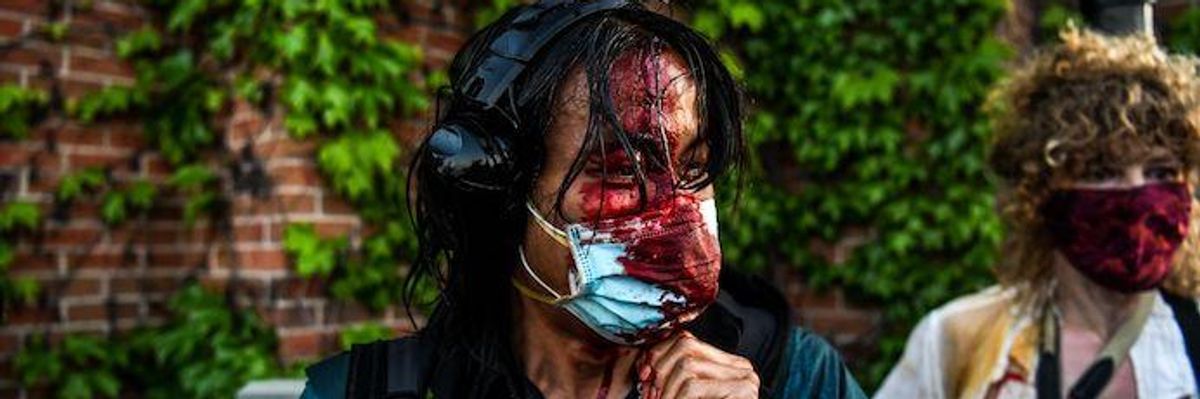
A journalist is seen bleeding after police started firing tear gas and rubber bullets near the 5th police precinct following a demonstration to call for justice for George Floyd, a black man who died while in custody of the Minneapolis police, on May 30, 2020 in Minneapolis. (Photo: Chandan Khanna/AFP via Getty Images)
Leading journalism groups on Monday urged U.S. police forces to stop targeting members of the media covering the nationwide protests catalyzed by the police killing of George Floyd, writing, "When you silence the press with rubber bullets, you silence the voice of the public."
The demand comes in an open letter from 18 organizations including the National Press Club (NPC), Reporters Without Borders (RSF), the Committee to Protect Journalists (CPJ), and PEN America.
"Over the past 72 hours police have opened fire with rubber bullets, tear gas, pepper spray, pepper balls and have used nightsticks and shields to attack the working press as never before in this nation. This must stop," the groups write.
"A few years ago in Ferguson, Missouri, police attempted some of these tactics and they failed. Courts found against governments that illegally arrested journalists and then tried to ban them from their state. It was devastating for Missouri's reputation," the letter says.
"This will happen again," the groups predict, singling out law enforcement in "Minneapolis, Philadelphia, Las Vegas, Denver, Fargo, Pittsburgh, Dallas, Atlanta, Seattle, Washington, D.C. and other cities."
"Do not fire upon them. Do not arrest them. The world is watching. Let the Press tell the story," states the letter.
The new open letter came as CPJ said in a statement Monday evening that at least 125 incidents involving violations of press freedom had occurred in the three-day period beginning May 29 in the context of the current social uprising.
"We are horrified by the continued use of harsh and sometimes violent actions of police against journalists doing their jobs. These are direct violations of press freedom, a fundamental Constitutional value of the United States," said CPJ program director Carlos Martinez de la Serna.
"We call on local and state officials to explicitly exempt the news media from curfew regulations so that journalists are able to report freely," he added.
CPJ pointed to a new database from the U.S. Press Freedom Tracker, a project from Freedom of the Press Foundation and CPJ. The log has a running tally of incidents during the ongoing George Floyd protests including arrests, assaults--including whether the incident was committed by police and if a weapon such as tear gas or rubber bullets were used--and equipment damage.
Laura Hazard Owen wrote Monday at NiemanLab that "it's becoming clear that attacks by police on journalists are becoming a widespread pattern, not one-off incidents."
A number of news reports and videos shared on social media in recent days provide evidence of that pattern.
"I researched countless protests for my first book. I've written about many since. I think it's safe to say that we've never seen the widespread, deliberate targeting of journalists by police that we've seen over the last few days. Something has changed," journalist Radley Balko tweeted Monday.
Another organization, Free Press, this week amplified the demand for press safety and said the need for journalists to be in the streets alongside protesters to amplify their perspectives was more crucial than ever.
"It bears repeating," Free Press News Voices organizing manager Alicia Bell said Monday. "The First Amendment prevents law enforcement from silencing the voices of protesters and from beating back the journalists who seek to share their concerns with the world."
"Reporters need to turn their cameras and microphones toward the local organizers who have long engaged in the fight for Black dignity alongside those who are now taking to the streets with legitimate grievances against a system that devalues the lives of our people," she continued.
"This moment underscores the importance of deep relationship building between newsrooms and communities," said Bell. "Newsrooms must replace police ride-alongs with community-listening sessions and other intentional tactics for shifting power."
Dear Common Dreams reader, It’s been nearly 30 years since I co-founded Common Dreams with my late wife, Lina Newhouser. We had the radical notion that journalism should serve the public good, not corporate profits. It was clear to us from the outset what it would take to build such a project. No paid advertisements. No corporate sponsors. No millionaire publisher telling us what to think or do. Many people said we wouldn't last a year, but we proved those doubters wrong. Together with a tremendous team of journalists and dedicated staff, we built an independent media outlet free from the constraints of profits and corporate control. Our mission has always been simple: To inform. To inspire. To ignite change for the common good. Building Common Dreams was not easy. Our survival was never guaranteed. When you take on the most powerful forces—Wall Street greed, fossil fuel industry destruction, Big Tech lobbyists, and uber-rich oligarchs who have spent billions upon billions rigging the economy and democracy in their favor—the only bulwark you have is supporters who believe in your work. But here’s the urgent message from me today. It's never been this bad out there. And it's never been this hard to keep us going. At the very moment Common Dreams is most needed, the threats we face are intensifying. We need your support now more than ever. We don't accept corporate advertising and never will. We don't have a paywall because we don't think people should be blocked from critical news based on their ability to pay. Everything we do is funded by the donations of readers like you. When everyone does the little they can afford, we are strong. But if that support retreats or dries up, so do we. Will you donate now to make sure Common Dreams not only survives but thrives? —Craig Brown, Co-founder |
Leading journalism groups on Monday urged U.S. police forces to stop targeting members of the media covering the nationwide protests catalyzed by the police killing of George Floyd, writing, "When you silence the press with rubber bullets, you silence the voice of the public."
The demand comes in an open letter from 18 organizations including the National Press Club (NPC), Reporters Without Borders (RSF), the Committee to Protect Journalists (CPJ), and PEN America.
"Over the past 72 hours police have opened fire with rubber bullets, tear gas, pepper spray, pepper balls and have used nightsticks and shields to attack the working press as never before in this nation. This must stop," the groups write.
"A few years ago in Ferguson, Missouri, police attempted some of these tactics and they failed. Courts found against governments that illegally arrested journalists and then tried to ban them from their state. It was devastating for Missouri's reputation," the letter says.
"This will happen again," the groups predict, singling out law enforcement in "Minneapolis, Philadelphia, Las Vegas, Denver, Fargo, Pittsburgh, Dallas, Atlanta, Seattle, Washington, D.C. and other cities."
"Do not fire upon them. Do not arrest them. The world is watching. Let the Press tell the story," states the letter.
The new open letter came as CPJ said in a statement Monday evening that at least 125 incidents involving violations of press freedom had occurred in the three-day period beginning May 29 in the context of the current social uprising.
"We are horrified by the continued use of harsh and sometimes violent actions of police against journalists doing their jobs. These are direct violations of press freedom, a fundamental Constitutional value of the United States," said CPJ program director Carlos Martinez de la Serna.
"We call on local and state officials to explicitly exempt the news media from curfew regulations so that journalists are able to report freely," he added.
CPJ pointed to a new database from the U.S. Press Freedom Tracker, a project from Freedom of the Press Foundation and CPJ. The log has a running tally of incidents during the ongoing George Floyd protests including arrests, assaults--including whether the incident was committed by police and if a weapon such as tear gas or rubber bullets were used--and equipment damage.
Laura Hazard Owen wrote Monday at NiemanLab that "it's becoming clear that attacks by police on journalists are becoming a widespread pattern, not one-off incidents."
A number of news reports and videos shared on social media in recent days provide evidence of that pattern.
"I researched countless protests for my first book. I've written about many since. I think it's safe to say that we've never seen the widespread, deliberate targeting of journalists by police that we've seen over the last few days. Something has changed," journalist Radley Balko tweeted Monday.
Another organization, Free Press, this week amplified the demand for press safety and said the need for journalists to be in the streets alongside protesters to amplify their perspectives was more crucial than ever.
"It bears repeating," Free Press News Voices organizing manager Alicia Bell said Monday. "The First Amendment prevents law enforcement from silencing the voices of protesters and from beating back the journalists who seek to share their concerns with the world."
"Reporters need to turn their cameras and microphones toward the local organizers who have long engaged in the fight for Black dignity alongside those who are now taking to the streets with legitimate grievances against a system that devalues the lives of our people," she continued.
"This moment underscores the importance of deep relationship building between newsrooms and communities," said Bell. "Newsrooms must replace police ride-alongs with community-listening sessions and other intentional tactics for shifting power."
Leading journalism groups on Monday urged U.S. police forces to stop targeting members of the media covering the nationwide protests catalyzed by the police killing of George Floyd, writing, "When you silence the press with rubber bullets, you silence the voice of the public."
The demand comes in an open letter from 18 organizations including the National Press Club (NPC), Reporters Without Borders (RSF), the Committee to Protect Journalists (CPJ), and PEN America.
"Over the past 72 hours police have opened fire with rubber bullets, tear gas, pepper spray, pepper balls and have used nightsticks and shields to attack the working press as never before in this nation. This must stop," the groups write.
"A few years ago in Ferguson, Missouri, police attempted some of these tactics and they failed. Courts found against governments that illegally arrested journalists and then tried to ban them from their state. It was devastating for Missouri's reputation," the letter says.
"This will happen again," the groups predict, singling out law enforcement in "Minneapolis, Philadelphia, Las Vegas, Denver, Fargo, Pittsburgh, Dallas, Atlanta, Seattle, Washington, D.C. and other cities."
"Do not fire upon them. Do not arrest them. The world is watching. Let the Press tell the story," states the letter.
The new open letter came as CPJ said in a statement Monday evening that at least 125 incidents involving violations of press freedom had occurred in the three-day period beginning May 29 in the context of the current social uprising.
"We are horrified by the continued use of harsh and sometimes violent actions of police against journalists doing their jobs. These are direct violations of press freedom, a fundamental Constitutional value of the United States," said CPJ program director Carlos Martinez de la Serna.
"We call on local and state officials to explicitly exempt the news media from curfew regulations so that journalists are able to report freely," he added.
CPJ pointed to a new database from the U.S. Press Freedom Tracker, a project from Freedom of the Press Foundation and CPJ. The log has a running tally of incidents during the ongoing George Floyd protests including arrests, assaults--including whether the incident was committed by police and if a weapon such as tear gas or rubber bullets were used--and equipment damage.
Laura Hazard Owen wrote Monday at NiemanLab that "it's becoming clear that attacks by police on journalists are becoming a widespread pattern, not one-off incidents."
A number of news reports and videos shared on social media in recent days provide evidence of that pattern.
"I researched countless protests for my first book. I've written about many since. I think it's safe to say that we've never seen the widespread, deliberate targeting of journalists by police that we've seen over the last few days. Something has changed," journalist Radley Balko tweeted Monday.
Another organization, Free Press, this week amplified the demand for press safety and said the need for journalists to be in the streets alongside protesters to amplify their perspectives was more crucial than ever.
"It bears repeating," Free Press News Voices organizing manager Alicia Bell said Monday. "The First Amendment prevents law enforcement from silencing the voices of protesters and from beating back the journalists who seek to share their concerns with the world."
"Reporters need to turn their cameras and microphones toward the local organizers who have long engaged in the fight for Black dignity alongside those who are now taking to the streets with legitimate grievances against a system that devalues the lives of our people," she continued.
"This moment underscores the importance of deep relationship building between newsrooms and communities," said Bell. "Newsrooms must replace police ride-alongs with community-listening sessions and other intentional tactics for shifting power."