SUBSCRIBE TO OUR FREE NEWSLETTER
Daily news & progressive opinion—funded by the people, not the corporations—delivered straight to your inbox.
5
#000000
#FFFFFF
To donate by check, phone, or other method, see our More Ways to Give page.
Daily news & progressive opinion—funded by the people, not the corporations—delivered straight to your inbox.
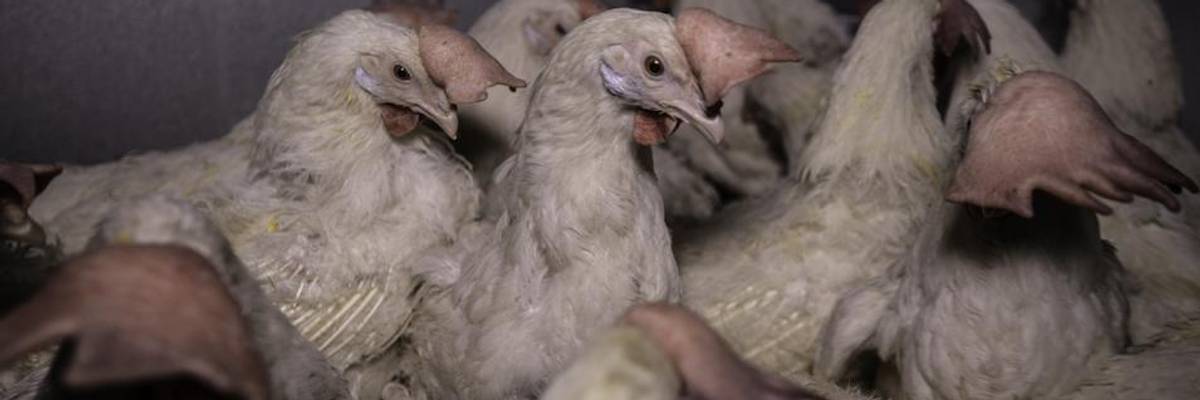
Hens rescued by Animal Place await transportation to the group's California facility. (Photo: Kezia Jauron/Animal Place)
As reports continue to come out of the nation's meat processing industry's planned slaughter of millions of pigs and chickens due to labor and health concerns in the midst of the Covid-19 outbreak, animal rights groups are stepping up to rescue as many creatures as possible from mechanized death and calling for a post-coronavirus plant-based food future.
"It is animal agriculture that is wrong, not simply the logistical phenomena that have caused mass culling," Harvard student Joseph Winters wrote Tuesday. "As we negotiate a return to normalcy, we must critically examine and dismantle the country's unsustainable and unethical meat production pipeline."
Activists with California animal rescue organization Animal Place on Saturday rescued a "lucky 1,000" hens from an Iowan egg farm planning to kill 100,000 chickens with carbon dioxide gas due to the continuing damage the coronavirus pandemic is wreaking on the nation's agricultural supply chain. The group drove 30 hours to get the animals, who were transported on two planes back to Animal Place's Grass Valley sanctuary.
"The entire process, from the 27-hour drive, arriving at the farm at 3 am, loading and unloading full crates from the planes and vehicles, and going straight to caring for them once we arrived at the sanctuary was the most exhausting experience I've ever had," the group's animal care director Hannah Beins said in a statement.
Beins said the exhaustion was a price she was more than willing to pay to rescue the birds.
"I would do it again in a heartbeat," she said, "because until their rescue these hens never got to touch grass or feel the sunshine, and now they can live out the rest of their lives as chickens should."
The group's executive director Kim Sturla said that she was proud of Animal Place staff and supporters for stepping up but that the real fight against the meat industry would continue past the end of the pandemic.
"Unfortunately not even we can take in 100,000 hens," said Sturla, "which is a drop in the bucket of the hundreds of million hens killed annually by the egg industry, even in a typical year without a global pandemic."
As Common Dreams reported at the end of April, the meat industry is expected to kill millions of animals by means including suffocating chickens in foam and gassing animals, extreme measures nonetheless approved by the American Veterinary Medical Association (AVMA).
According to a report in the Guardian Tuesday, those efforts are continuing, with the tactics used to "depopulate" the pig population some of the most extreme:
For pig culls, AVMA "preferred methods" include injectable anesthetic overdose, gassing, shooting with guns or bolts, electrocution and manual blunt force trauma. AVMA methods "permitted in constrained circumstances" include ventilator shutdown (VSD), potentially combined with carbon dioxide gassing, and sodium nitrite which would be ingested by pigs.
Speaking more graphically, [Mercy for Animals president Leah] Garces said manual blunt force trauma can mean slamming piglets against the ground while VSD would "essentially cook the pigs alive."
The barbarity of the industrial meat industry, wrote Harvard's Winters, makes the case for a new beginning after the pandemic is over.
"We must not waste this opportunity to start mending our broken relationship with animals," Winters wrote. "This begins with the end of factory farming and the redirection of all government relief and future subsidies towards plant-based agriculture and food processing."
"These kinds of systemic solutions are the only way to truly show compassion to animals," he added.
Dear Common Dreams reader, It’s been nearly 30 years since I co-founded Common Dreams with my late wife, Lina Newhouser. We had the radical notion that journalism should serve the public good, not corporate profits. It was clear to us from the outset what it would take to build such a project. No paid advertisements. No corporate sponsors. No millionaire publisher telling us what to think or do. Many people said we wouldn't last a year, but we proved those doubters wrong. Together with a tremendous team of journalists and dedicated staff, we built an independent media outlet free from the constraints of profits and corporate control. Our mission has always been simple: To inform. To inspire. To ignite change for the common good. Building Common Dreams was not easy. Our survival was never guaranteed. When you take on the most powerful forces—Wall Street greed, fossil fuel industry destruction, Big Tech lobbyists, and uber-rich oligarchs who have spent billions upon billions rigging the economy and democracy in their favor—the only bulwark you have is supporters who believe in your work. But here’s the urgent message from me today. It's never been this bad out there. And it's never been this hard to keep us going. At the very moment Common Dreams is most needed, the threats we face are intensifying. We need your support now more than ever. We don't accept corporate advertising and never will. We don't have a paywall because we don't think people should be blocked from critical news based on their ability to pay. Everything we do is funded by the donations of readers like you. When everyone does the little they can afford, we are strong. But if that support retreats or dries up, so do we. Will you donate now to make sure Common Dreams not only survives but thrives? —Craig Brown, Co-founder |
As reports continue to come out of the nation's meat processing industry's planned slaughter of millions of pigs and chickens due to labor and health concerns in the midst of the Covid-19 outbreak, animal rights groups are stepping up to rescue as many creatures as possible from mechanized death and calling for a post-coronavirus plant-based food future.
"It is animal agriculture that is wrong, not simply the logistical phenomena that have caused mass culling," Harvard student Joseph Winters wrote Tuesday. "As we negotiate a return to normalcy, we must critically examine and dismantle the country's unsustainable and unethical meat production pipeline."
Activists with California animal rescue organization Animal Place on Saturday rescued a "lucky 1,000" hens from an Iowan egg farm planning to kill 100,000 chickens with carbon dioxide gas due to the continuing damage the coronavirus pandemic is wreaking on the nation's agricultural supply chain. The group drove 30 hours to get the animals, who were transported on two planes back to Animal Place's Grass Valley sanctuary.
"The entire process, from the 27-hour drive, arriving at the farm at 3 am, loading and unloading full crates from the planes and vehicles, and going straight to caring for them once we arrived at the sanctuary was the most exhausting experience I've ever had," the group's animal care director Hannah Beins said in a statement.
Beins said the exhaustion was a price she was more than willing to pay to rescue the birds.
"I would do it again in a heartbeat," she said, "because until their rescue these hens never got to touch grass or feel the sunshine, and now they can live out the rest of their lives as chickens should."
The group's executive director Kim Sturla said that she was proud of Animal Place staff and supporters for stepping up but that the real fight against the meat industry would continue past the end of the pandemic.
"Unfortunately not even we can take in 100,000 hens," said Sturla, "which is a drop in the bucket of the hundreds of million hens killed annually by the egg industry, even in a typical year without a global pandemic."
As Common Dreams reported at the end of April, the meat industry is expected to kill millions of animals by means including suffocating chickens in foam and gassing animals, extreme measures nonetheless approved by the American Veterinary Medical Association (AVMA).
According to a report in the Guardian Tuesday, those efforts are continuing, with the tactics used to "depopulate" the pig population some of the most extreme:
For pig culls, AVMA "preferred methods" include injectable anesthetic overdose, gassing, shooting with guns or bolts, electrocution and manual blunt force trauma. AVMA methods "permitted in constrained circumstances" include ventilator shutdown (VSD), potentially combined with carbon dioxide gassing, and sodium nitrite which would be ingested by pigs.
Speaking more graphically, [Mercy for Animals president Leah] Garces said manual blunt force trauma can mean slamming piglets against the ground while VSD would "essentially cook the pigs alive."
The barbarity of the industrial meat industry, wrote Harvard's Winters, makes the case for a new beginning after the pandemic is over.
"We must not waste this opportunity to start mending our broken relationship with animals," Winters wrote. "This begins with the end of factory farming and the redirection of all government relief and future subsidies towards plant-based agriculture and food processing."
"These kinds of systemic solutions are the only way to truly show compassion to animals," he added.
As reports continue to come out of the nation's meat processing industry's planned slaughter of millions of pigs and chickens due to labor and health concerns in the midst of the Covid-19 outbreak, animal rights groups are stepping up to rescue as many creatures as possible from mechanized death and calling for a post-coronavirus plant-based food future.
"It is animal agriculture that is wrong, not simply the logistical phenomena that have caused mass culling," Harvard student Joseph Winters wrote Tuesday. "As we negotiate a return to normalcy, we must critically examine and dismantle the country's unsustainable and unethical meat production pipeline."
Activists with California animal rescue organization Animal Place on Saturday rescued a "lucky 1,000" hens from an Iowan egg farm planning to kill 100,000 chickens with carbon dioxide gas due to the continuing damage the coronavirus pandemic is wreaking on the nation's agricultural supply chain. The group drove 30 hours to get the animals, who were transported on two planes back to Animal Place's Grass Valley sanctuary.
"The entire process, from the 27-hour drive, arriving at the farm at 3 am, loading and unloading full crates from the planes and vehicles, and going straight to caring for them once we arrived at the sanctuary was the most exhausting experience I've ever had," the group's animal care director Hannah Beins said in a statement.
Beins said the exhaustion was a price she was more than willing to pay to rescue the birds.
"I would do it again in a heartbeat," she said, "because until their rescue these hens never got to touch grass or feel the sunshine, and now they can live out the rest of their lives as chickens should."
The group's executive director Kim Sturla said that she was proud of Animal Place staff and supporters for stepping up but that the real fight against the meat industry would continue past the end of the pandemic.
"Unfortunately not even we can take in 100,000 hens," said Sturla, "which is a drop in the bucket of the hundreds of million hens killed annually by the egg industry, even in a typical year without a global pandemic."
As Common Dreams reported at the end of April, the meat industry is expected to kill millions of animals by means including suffocating chickens in foam and gassing animals, extreme measures nonetheless approved by the American Veterinary Medical Association (AVMA).
According to a report in the Guardian Tuesday, those efforts are continuing, with the tactics used to "depopulate" the pig population some of the most extreme:
For pig culls, AVMA "preferred methods" include injectable anesthetic overdose, gassing, shooting with guns or bolts, electrocution and manual blunt force trauma. AVMA methods "permitted in constrained circumstances" include ventilator shutdown (VSD), potentially combined with carbon dioxide gassing, and sodium nitrite which would be ingested by pigs.
Speaking more graphically, [Mercy for Animals president Leah] Garces said manual blunt force trauma can mean slamming piglets against the ground while VSD would "essentially cook the pigs alive."
The barbarity of the industrial meat industry, wrote Harvard's Winters, makes the case for a new beginning after the pandemic is over.
"We must not waste this opportunity to start mending our broken relationship with animals," Winters wrote. "This begins with the end of factory farming and the redirection of all government relief and future subsidies towards plant-based agriculture and food processing."
"These kinds of systemic solutions are the only way to truly show compassion to animals," he added.