

SUBSCRIBE TO OUR FREE NEWSLETTER
Daily news & progressive opinion—funded by the people, not the corporations—delivered straight to your inbox.
5
#000000
#FFFFFF
To donate by check, phone, or other method, see our More Ways to Give page.
Daily news & progressive opinion—funded by the people, not the corporations—delivered straight to your inbox.
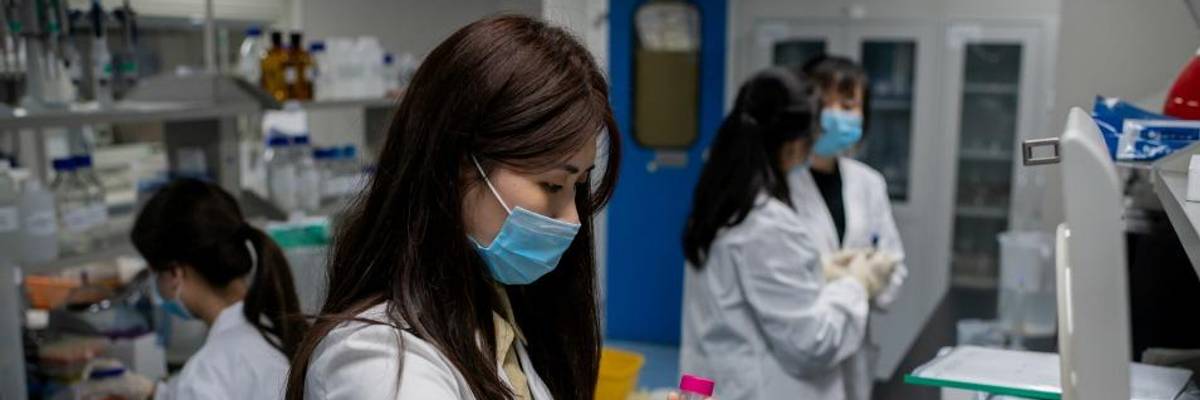
In this picture taken on April 29, 2020, engineers work on an experimental vaccine for the COVID-19 coronavirus at the Quality Control Laboratory at the Sinovac Biotech facilities in Beijing. (Photo: Nicolas Asfouri/AFP via Getty Images)
As the World Health Organization met virtually on Monday for its first international summit since the coronavirus pandemic began, public health experts called for a firm stand against "vaccine nationalism" in favor of a cooperative approach that would ensure equitable and universal access to the treatments created to battle the deadly outbreak.
At the summit, WHO is creating a list of "priority recipients" for a vaccine, which is being researched by 130 organizations worldwide and which, in some cases, could be ready for initial human trials as early as July. Healthcare workers and elderly and immunocompromised people should have access to the vaccine first, WHO says, but the rule should apply to those in the country where the vaccine is discovered as well as internationally.
"If we have vaccine nationalism, and one country looks after itself first, and at the expense of the rest of the world, everyone is going to continue to suffer," Coalition for Epidemic Preparedness Innovations chair Jane Halton told The Guardian.
"Now is the time for unity, for the international community to work together in solidarity to stop this virus and its shattering consequences. We cannot contemplate a future of fear and insecurity."
-- Antonio Guterres, U.N. Secretary-General
The U.S. is among the countries experts have raised alarm over regarding the potential for a nationalistic response to the outbreak, as President Donald Trump declined to send representatives to last week's summit hosted by the European Union, where dozens of countries joined with the Bill and Melinda Gates Foundation to pledge $8 billion to vaccine research efforts.
The president has claimed that he doesn't care whether his task force, Operation Warp Speed, discovers a vaccine by the end of 2020 as it aims to, or if scientists in another country find a solution to the pandemic first--but his administration has indicated otherwise.
On March 30, Trump's Health and Human Services Department said in a statement that the administration's primary goal is to make a "Covid-19 vaccine available for emergency use in the United States in early 2021."
Pharmaceutical developers in the U.K. and India have also suggested they would prioritize making a vaccine available domestically first.
Trump has repeatedly said that his response to the Covid-19 pandemic has been a "great success" and that statements to the contrary are the result of partisanship, suggesting that the pandemic is a battle for his administration to win alone.
"Do you believe that Trump's base will be content with a vaccine strategy that does not 'make America great again'?" David Salisbury, a former director of immunization for the British Department of Health, said to NBC News Monday. "If your country develops the vaccine before anyone else, immediately exporting it to another country is not a vote-winner."
Trump has also focused on placing blame for the pandemic on WHO and China, cutting funding for the global health organization and demanding an investigation into China's response to the coronavirus.
Chinese President Xi Jinping told the virtual WHO assembly on Monday that he also supports an investigation--after a vaccine is found and the pandemic is over.
In an address to the assembly, United Nations Secretary-General Antonio Guterres urged cooperation and solidarity among all countries to find a vaccine and said that research must take precedence over any questions regarding how the pandemic spread across the world.
"We are as strong as the weakest health systems," Guterres said. "Protecting the developing world is not a matter of charity or generosity but a question of enlightened self-interest. The global North cannot defeat COVID-19 unless the global South defeats it at the same time."
"Now is the time for unity, for the international community to work together in solidarity to stop this virus and its shattering consequences. We cannot contemplate a future of fear and insecurity," he added. "Either we get through this pandemic together, or we fail. Either we stand together, or we fall apart."
In the U.K., Jeremy Farrar of the health research foundation Wellcome Trust joined the call for global cooperation, and said a failure to distribute a vaccine globally would leave the entire planet vulnerable once again to outbreaks.
"A fragmented approach will not succeed in an interconnected world. It will only prolong the current situation, leading to a rolling cycle of lockdowns, limited travel and trade, and even more strain on our healthcare system," said Farrar in an op-ed published in The Telegraph. "Even if every person in the UK was vaccinated, epidemics in other countries would have a knock-on impact on our livelihoods and economy."
"No single country can do this alone," he added.
Dear Common Dreams reader, It’s been nearly 30 years since I co-founded Common Dreams with my late wife, Lina Newhouser. We had the radical notion that journalism should serve the public good, not corporate profits. It was clear to us from the outset what it would take to build such a project. No paid advertisements. No corporate sponsors. No millionaire publisher telling us what to think or do. Many people said we wouldn't last a year, but we proved those doubters wrong. Together with a tremendous team of journalists and dedicated staff, we built an independent media outlet free from the constraints of profits and corporate control. Our mission has always been simple: To inform. To inspire. To ignite change for the common good. Building Common Dreams was not easy. Our survival was never guaranteed. When you take on the most powerful forces—Wall Street greed, fossil fuel industry destruction, Big Tech lobbyists, and uber-rich oligarchs who have spent billions upon billions rigging the economy and democracy in their favor—the only bulwark you have is supporters who believe in your work. But here’s the urgent message from me today. It's never been this bad out there. And it's never been this hard to keep us going. At the very moment Common Dreams is most needed, the threats we face are intensifying. We need your support now more than ever. We don't accept corporate advertising and never will. We don't have a paywall because we don't think people should be blocked from critical news based on their ability to pay. Everything we do is funded by the donations of readers like you. When everyone does the little they can afford, we are strong. But if that support retreats or dries up, so do we. Will you donate now to make sure Common Dreams not only survives but thrives? —Craig Brown, Co-founder |
As the World Health Organization met virtually on Monday for its first international summit since the coronavirus pandemic began, public health experts called for a firm stand against "vaccine nationalism" in favor of a cooperative approach that would ensure equitable and universal access to the treatments created to battle the deadly outbreak.
At the summit, WHO is creating a list of "priority recipients" for a vaccine, which is being researched by 130 organizations worldwide and which, in some cases, could be ready for initial human trials as early as July. Healthcare workers and elderly and immunocompromised people should have access to the vaccine first, WHO says, but the rule should apply to those in the country where the vaccine is discovered as well as internationally.
"If we have vaccine nationalism, and one country looks after itself first, and at the expense of the rest of the world, everyone is going to continue to suffer," Coalition for Epidemic Preparedness Innovations chair Jane Halton told The Guardian.
"Now is the time for unity, for the international community to work together in solidarity to stop this virus and its shattering consequences. We cannot contemplate a future of fear and insecurity."
-- Antonio Guterres, U.N. Secretary-General
The U.S. is among the countries experts have raised alarm over regarding the potential for a nationalistic response to the outbreak, as President Donald Trump declined to send representatives to last week's summit hosted by the European Union, where dozens of countries joined with the Bill and Melinda Gates Foundation to pledge $8 billion to vaccine research efforts.
The president has claimed that he doesn't care whether his task force, Operation Warp Speed, discovers a vaccine by the end of 2020 as it aims to, or if scientists in another country find a solution to the pandemic first--but his administration has indicated otherwise.
On March 30, Trump's Health and Human Services Department said in a statement that the administration's primary goal is to make a "Covid-19 vaccine available for emergency use in the United States in early 2021."
Pharmaceutical developers in the U.K. and India have also suggested they would prioritize making a vaccine available domestically first.
Trump has repeatedly said that his response to the Covid-19 pandemic has been a "great success" and that statements to the contrary are the result of partisanship, suggesting that the pandemic is a battle for his administration to win alone.
"Do you believe that Trump's base will be content with a vaccine strategy that does not 'make America great again'?" David Salisbury, a former director of immunization for the British Department of Health, said to NBC News Monday. "If your country develops the vaccine before anyone else, immediately exporting it to another country is not a vote-winner."
Trump has also focused on placing blame for the pandemic on WHO and China, cutting funding for the global health organization and demanding an investigation into China's response to the coronavirus.
Chinese President Xi Jinping told the virtual WHO assembly on Monday that he also supports an investigation--after a vaccine is found and the pandemic is over.
In an address to the assembly, United Nations Secretary-General Antonio Guterres urged cooperation and solidarity among all countries to find a vaccine and said that research must take precedence over any questions regarding how the pandemic spread across the world.
"We are as strong as the weakest health systems," Guterres said. "Protecting the developing world is not a matter of charity or generosity but a question of enlightened self-interest. The global North cannot defeat COVID-19 unless the global South defeats it at the same time."
"Now is the time for unity, for the international community to work together in solidarity to stop this virus and its shattering consequences. We cannot contemplate a future of fear and insecurity," he added. "Either we get through this pandemic together, or we fail. Either we stand together, or we fall apart."
In the U.K., Jeremy Farrar of the health research foundation Wellcome Trust joined the call for global cooperation, and said a failure to distribute a vaccine globally would leave the entire planet vulnerable once again to outbreaks.
"A fragmented approach will not succeed in an interconnected world. It will only prolong the current situation, leading to a rolling cycle of lockdowns, limited travel and trade, and even more strain on our healthcare system," said Farrar in an op-ed published in The Telegraph. "Even if every person in the UK was vaccinated, epidemics in other countries would have a knock-on impact on our livelihoods and economy."
"No single country can do this alone," he added.
As the World Health Organization met virtually on Monday for its first international summit since the coronavirus pandemic began, public health experts called for a firm stand against "vaccine nationalism" in favor of a cooperative approach that would ensure equitable and universal access to the treatments created to battle the deadly outbreak.
At the summit, WHO is creating a list of "priority recipients" for a vaccine, which is being researched by 130 organizations worldwide and which, in some cases, could be ready for initial human trials as early as July. Healthcare workers and elderly and immunocompromised people should have access to the vaccine first, WHO says, but the rule should apply to those in the country where the vaccine is discovered as well as internationally.
"If we have vaccine nationalism, and one country looks after itself first, and at the expense of the rest of the world, everyone is going to continue to suffer," Coalition for Epidemic Preparedness Innovations chair Jane Halton told The Guardian.
"Now is the time for unity, for the international community to work together in solidarity to stop this virus and its shattering consequences. We cannot contemplate a future of fear and insecurity."
-- Antonio Guterres, U.N. Secretary-General
The U.S. is among the countries experts have raised alarm over regarding the potential for a nationalistic response to the outbreak, as President Donald Trump declined to send representatives to last week's summit hosted by the European Union, where dozens of countries joined with the Bill and Melinda Gates Foundation to pledge $8 billion to vaccine research efforts.
The president has claimed that he doesn't care whether his task force, Operation Warp Speed, discovers a vaccine by the end of 2020 as it aims to, or if scientists in another country find a solution to the pandemic first--but his administration has indicated otherwise.
On March 30, Trump's Health and Human Services Department said in a statement that the administration's primary goal is to make a "Covid-19 vaccine available for emergency use in the United States in early 2021."
Pharmaceutical developers in the U.K. and India have also suggested they would prioritize making a vaccine available domestically first.
Trump has repeatedly said that his response to the Covid-19 pandemic has been a "great success" and that statements to the contrary are the result of partisanship, suggesting that the pandemic is a battle for his administration to win alone.
"Do you believe that Trump's base will be content with a vaccine strategy that does not 'make America great again'?" David Salisbury, a former director of immunization for the British Department of Health, said to NBC News Monday. "If your country develops the vaccine before anyone else, immediately exporting it to another country is not a vote-winner."
Trump has also focused on placing blame for the pandemic on WHO and China, cutting funding for the global health organization and demanding an investigation into China's response to the coronavirus.
Chinese President Xi Jinping told the virtual WHO assembly on Monday that he also supports an investigation--after a vaccine is found and the pandemic is over.
In an address to the assembly, United Nations Secretary-General Antonio Guterres urged cooperation and solidarity among all countries to find a vaccine and said that research must take precedence over any questions regarding how the pandemic spread across the world.
"We are as strong as the weakest health systems," Guterres said. "Protecting the developing world is not a matter of charity or generosity but a question of enlightened self-interest. The global North cannot defeat COVID-19 unless the global South defeats it at the same time."
"Now is the time for unity, for the international community to work together in solidarity to stop this virus and its shattering consequences. We cannot contemplate a future of fear and insecurity," he added. "Either we get through this pandemic together, or we fail. Either we stand together, or we fall apart."
In the U.K., Jeremy Farrar of the health research foundation Wellcome Trust joined the call for global cooperation, and said a failure to distribute a vaccine globally would leave the entire planet vulnerable once again to outbreaks.
"A fragmented approach will not succeed in an interconnected world. It will only prolong the current situation, leading to a rolling cycle of lockdowns, limited travel and trade, and even more strain on our healthcare system," said Farrar in an op-ed published in The Telegraph. "Even if every person in the UK was vaccinated, epidemics in other countries would have a knock-on impact on our livelihoods and economy."
"No single country can do this alone," he added.

