SUBSCRIBE TO OUR FREE NEWSLETTER
Daily news & progressive opinion—funded by the people, not the corporations—delivered straight to your inbox.
5
#000000
#FFFFFF
To donate by check, phone, or other method, see our More Ways to Give page.
Daily news & progressive opinion—funded by the people, not the corporations—delivered straight to your inbox.
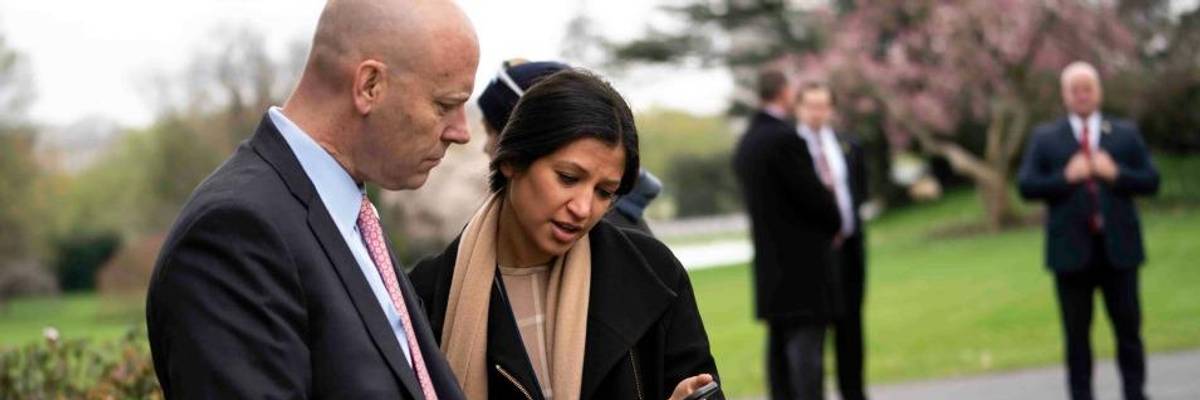
Marc Short, Chief of Staff for Vice President Mike Pence talks with Katie Miller, Pence's press secretary, in the Rose Garden of the White House on March 24, 2020 in Washington, DC. Miller tested positive for the coronavirus, the White House reported Friday. (Photo by Doug Mills-Pool/Getty Images)
Reports of at least two positive coronavirus cases among White House employees in recent days illustrated how easily Covid-19 can spread in enclosed workplaces, even when workers are being tested regularly--deepening concerns about the likely effects of President Donald Trump's aggressive push to reopen the U.S. economy even as the pandemic shows no sign of containment.
Vice President Mike Pence's press secretary, Katie Miller, tested positive for the coronavirus on Friday. One of Trump's valets, who has served the president meals without wearing a mask, also tested positive for the virus last week. The diagnoses followed reports that at least 11 members of the U.S. Secret Service had contracted Covid-19.
Although the CDC recommends wearing face masks to stop the spread of Covid-19, especially in enclosed places like the West Wing, the White House has not been enforcing rules regarding face coverings in recent weeks.
According to a senior administration official who spoke to the New York Times, Trump was angered this week at the news that he may have been exposed to the coronavirus. Over the weekend, the White House went beyond its previous guidance advising staffers to work from home if possible, telling several staff members in the White House press office to stay at home in case they've been exposed, and requiring members of the president's personal staff to wear face masks.
On "Face the Nation" Sunday, White House economic adviser Kevin Hassett admitted, "It is scary to go to work."
Publicly, however, the president has continued downplaying the country's need to contain the coronavirus for the good of all Americans, claiming again on Friday in a meeting with Republican lawmakers that the virus will eventually go away without a vaccine.
"Well, I feel about vaccines like I feel about tests," Trump said. "This is going to go away without a vaccine. It's going to go away, and we're not going to see it again, hopefully, after a period of time."
The president and Republican governors have also pushed aggressively for states to reopen their economies, with some Republican-run states threatening residents with a loss of their unemployment benefits if they don't report to work once their industry reopens, regardless of whether case numbers in their state are rising.
On Sunday, Treasury Secretary Steven Mnuchin reiterated the need to reopen the economy as swiftly as possible.
"I think there's a considerable risk of not reopening. You're talking about what would be permanent economic damage to the American public," Mnuchin said on "Fox News Sunday." On Friday, the president said the administration is "in no rush" to pass an additional relief package that may offer more financial assistance to Americans.
David Nakamura of the Washington Post highlighted the contrast between the White House's new precautionary measures--and the access West Wing staffers have to daily testing--compared to the safety precautions available to the vast majority of Americans who work in manufacturing facilities, offices, construction sites, and other sectors where employees are being urged to return to work.
"The do what I say, not what I do, mindset at the White House continues," Margaret Brennan said Sunday on CBS's "Face the Nation."
Dear Common Dreams reader, It’s been nearly 30 years since I co-founded Common Dreams with my late wife, Lina Newhouser. We had the radical notion that journalism should serve the public good, not corporate profits. It was clear to us from the outset what it would take to build such a project. No paid advertisements. No corporate sponsors. No millionaire publisher telling us what to think or do. Many people said we wouldn't last a year, but we proved those doubters wrong. Together with a tremendous team of journalists and dedicated staff, we built an independent media outlet free from the constraints of profits and corporate control. Our mission has always been simple: To inform. To inspire. To ignite change for the common good. Building Common Dreams was not easy. Our survival was never guaranteed. When you take on the most powerful forces—Wall Street greed, fossil fuel industry destruction, Big Tech lobbyists, and uber-rich oligarchs who have spent billions upon billions rigging the economy and democracy in their favor—the only bulwark you have is supporters who believe in your work. But here’s the urgent message from me today. It's never been this bad out there. And it's never been this hard to keep us going. At the very moment Common Dreams is most needed, the threats we face are intensifying. We need your support now more than ever. We don't accept corporate advertising and never will. We don't have a paywall because we don't think people should be blocked from critical news based on their ability to pay. Everything we do is funded by the donations of readers like you. When everyone does the little they can afford, we are strong. But if that support retreats or dries up, so do we. Will you donate now to make sure Common Dreams not only survives but thrives? —Craig Brown, Co-founder |
Reports of at least two positive coronavirus cases among White House employees in recent days illustrated how easily Covid-19 can spread in enclosed workplaces, even when workers are being tested regularly--deepening concerns about the likely effects of President Donald Trump's aggressive push to reopen the U.S. economy even as the pandemic shows no sign of containment.
Vice President Mike Pence's press secretary, Katie Miller, tested positive for the coronavirus on Friday. One of Trump's valets, who has served the president meals without wearing a mask, also tested positive for the virus last week. The diagnoses followed reports that at least 11 members of the U.S. Secret Service had contracted Covid-19.
Although the CDC recommends wearing face masks to stop the spread of Covid-19, especially in enclosed places like the West Wing, the White House has not been enforcing rules regarding face coverings in recent weeks.
According to a senior administration official who spoke to the New York Times, Trump was angered this week at the news that he may have been exposed to the coronavirus. Over the weekend, the White House went beyond its previous guidance advising staffers to work from home if possible, telling several staff members in the White House press office to stay at home in case they've been exposed, and requiring members of the president's personal staff to wear face masks.
On "Face the Nation" Sunday, White House economic adviser Kevin Hassett admitted, "It is scary to go to work."
Publicly, however, the president has continued downplaying the country's need to contain the coronavirus for the good of all Americans, claiming again on Friday in a meeting with Republican lawmakers that the virus will eventually go away without a vaccine.
"Well, I feel about vaccines like I feel about tests," Trump said. "This is going to go away without a vaccine. It's going to go away, and we're not going to see it again, hopefully, after a period of time."
The president and Republican governors have also pushed aggressively for states to reopen their economies, with some Republican-run states threatening residents with a loss of their unemployment benefits if they don't report to work once their industry reopens, regardless of whether case numbers in their state are rising.
On Sunday, Treasury Secretary Steven Mnuchin reiterated the need to reopen the economy as swiftly as possible.
"I think there's a considerable risk of not reopening. You're talking about what would be permanent economic damage to the American public," Mnuchin said on "Fox News Sunday." On Friday, the president said the administration is "in no rush" to pass an additional relief package that may offer more financial assistance to Americans.
David Nakamura of the Washington Post highlighted the contrast between the White House's new precautionary measures--and the access West Wing staffers have to daily testing--compared to the safety precautions available to the vast majority of Americans who work in manufacturing facilities, offices, construction sites, and other sectors where employees are being urged to return to work.
"The do what I say, not what I do, mindset at the White House continues," Margaret Brennan said Sunday on CBS's "Face the Nation."
Reports of at least two positive coronavirus cases among White House employees in recent days illustrated how easily Covid-19 can spread in enclosed workplaces, even when workers are being tested regularly--deepening concerns about the likely effects of President Donald Trump's aggressive push to reopen the U.S. economy even as the pandemic shows no sign of containment.
Vice President Mike Pence's press secretary, Katie Miller, tested positive for the coronavirus on Friday. One of Trump's valets, who has served the president meals without wearing a mask, also tested positive for the virus last week. The diagnoses followed reports that at least 11 members of the U.S. Secret Service had contracted Covid-19.
Although the CDC recommends wearing face masks to stop the spread of Covid-19, especially in enclosed places like the West Wing, the White House has not been enforcing rules regarding face coverings in recent weeks.
According to a senior administration official who spoke to the New York Times, Trump was angered this week at the news that he may have been exposed to the coronavirus. Over the weekend, the White House went beyond its previous guidance advising staffers to work from home if possible, telling several staff members in the White House press office to stay at home in case they've been exposed, and requiring members of the president's personal staff to wear face masks.
On "Face the Nation" Sunday, White House economic adviser Kevin Hassett admitted, "It is scary to go to work."
Publicly, however, the president has continued downplaying the country's need to contain the coronavirus for the good of all Americans, claiming again on Friday in a meeting with Republican lawmakers that the virus will eventually go away without a vaccine.
"Well, I feel about vaccines like I feel about tests," Trump said. "This is going to go away without a vaccine. It's going to go away, and we're not going to see it again, hopefully, after a period of time."
The president and Republican governors have also pushed aggressively for states to reopen their economies, with some Republican-run states threatening residents with a loss of their unemployment benefits if they don't report to work once their industry reopens, regardless of whether case numbers in their state are rising.
On Sunday, Treasury Secretary Steven Mnuchin reiterated the need to reopen the economy as swiftly as possible.
"I think there's a considerable risk of not reopening. You're talking about what would be permanent economic damage to the American public," Mnuchin said on "Fox News Sunday." On Friday, the president said the administration is "in no rush" to pass an additional relief package that may offer more financial assistance to Americans.
David Nakamura of the Washington Post highlighted the contrast between the White House's new precautionary measures--and the access West Wing staffers have to daily testing--compared to the safety precautions available to the vast majority of Americans who work in manufacturing facilities, offices, construction sites, and other sectors where employees are being urged to return to work.
"The do what I say, not what I do, mindset at the White House continues," Margaret Brennan said Sunday on CBS's "Face the Nation."