SUBSCRIBE TO OUR FREE NEWSLETTER
Daily news & progressive opinion—funded by the people, not the corporations—delivered straight to your inbox.
5
#000000
#FFFFFF
To donate by check, phone, or other method, see our More Ways to Give page.
Daily news & progressive opinion—funded by the people, not the corporations—delivered straight to your inbox.
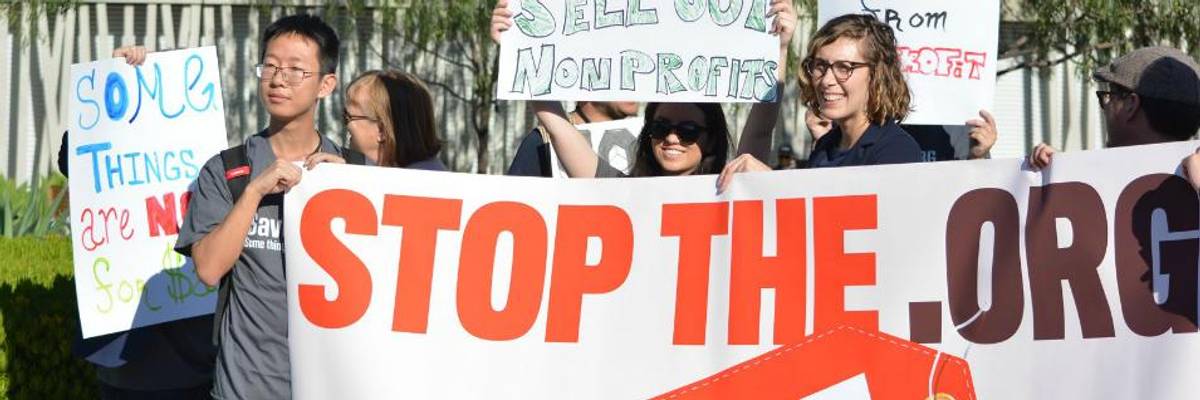
Critics of the proposed private equity takeover of the .org domain held a protest in Los Angeles in January 2020. (Photo: EFF/Facebook)
In a move celebrated by advocacy groups across the globe as "a major victory for the millions of nonprofits, civil society organizations, and individuals who make .org their home online," a body that oversees web addresses on Thursday blocked a takeover of the top-level domain by the private equity firm Ethos Capital.
The decision by the Internet Corporation for Assigned Names and Numbers (ICANN) board to reject the $1.1 billion deal, announced in November 2019, came ahead of a May 4 deadline and followed months of mounting concerns that the takeover could lead to censorship from corporate interests, increased costs, and service issues.
The group Access Now--which works to protect privacy, free expression, digital security, and human rights among internet users--welcomed the news on Twitter:
Access Now global campaign strategist Carolyn Tackett had warned earlier this week that "human rights defenders around the world are fighting an uphill battle against censorship, surveillance, reputational attacks, and other online threats, not to mention threats to their physical safety. Handing over .org--the backbone of online civic space--to investors only puts all of us at further risk, now and for decades to come."
Under the deal, Ethos Capital would have acquired the Public Interest Registry (PIR) created by the Internet Society (ISOC) in 2002 to manage the .org domain, primarily used by nonprofit and nongovernmental organizations. All three entities claimed the acquisition would "ensure a bright future for PIR and .org registrants and users."
ICANN's board explained the decision with a blog post which said in part that "after completing its evaluation, the ICANN board finds that the public interest is better served in withholding consent as a result of various factors that create unacceptable uncertainty over the future of the third largest [generic top-level domain] registry."
Critics of the attempted private equity takeover--who came together for a global #SaveDotOrg campaign--included NGOs, tech leaders, U.S. lawmakers, and U.N. special rapporteurs. According to the tech nonprofit NTEN, which managed SaveDotOrg.org, nearly 900 groups and 64,000 individuals signed various petitions opposing the sale.
Access Now executive director Brett Solomon on Friday wrote about ICANN's decision to block the deal in a op-ed for the Los Angeles Times:
Around the world, people and organizations are using 10.5 million .org domains to host their websites, run campaigns, share educational content, collaborate on open-source development, and much more. We all knew it was of critical importance that we maintain .org as a space insulated from private sector interests--and stewarded by people who prioritize the needs of civil society, including nonprofit groups, charities, and foundations.
From downloading government health guidelines to online learning to connecting with isolated friends and family, the internet has become a lifeline. It has become the town square, the hospital, and the schoolyard all at once. Now was clearly the time to protect it, not sell it off to private equity.
As the Covid-19 pandemic has shown, "it has been left to civil society organizations, and individual volunteers, to step up and fill in the gaps left by governments and corporations," wrote Solomon. "Privatizing resources established for the public good has a poor track record--think hospitals, prison systems, aged-care facilities, postal services--and privatizing control of the .org domain would have been catastrophic."
The Web Foundation, founded by World Wide Web inventor Tim Berners-Lee, also referenced the pandemic while applauding ICANN's decision:
Karen Gullo and Mitch Stoltz of the Electronic Frontier Foundation (EFF) called ICANN's move "a stunning victory for nonprofits and NGOs around the world working in the public interest," but noted that PIR "still needs a faithful steward, because the Internet Society has made clear it no longer wants that responsibility."
In a blog post for EFF--which helped lead the fight against the blocked deal--Gullo and Stoltz wrote that "ICANN should hold an open consultation, as they did in 2002, to select a new operator of the .org domain that will give nonprofits a real voice in its governance, and a real guarantee against censorship and financial exploitation."
Dear Common Dreams reader, It’s been nearly 30 years since I co-founded Common Dreams with my late wife, Lina Newhouser. We had the radical notion that journalism should serve the public good, not corporate profits. It was clear to us from the outset what it would take to build such a project. No paid advertisements. No corporate sponsors. No millionaire publisher telling us what to think or do. Many people said we wouldn't last a year, but we proved those doubters wrong. Together with a tremendous team of journalists and dedicated staff, we built an independent media outlet free from the constraints of profits and corporate control. Our mission has always been simple: To inform. To inspire. To ignite change for the common good. Building Common Dreams was not easy. Our survival was never guaranteed. When you take on the most powerful forces—Wall Street greed, fossil fuel industry destruction, Big Tech lobbyists, and uber-rich oligarchs who have spent billions upon billions rigging the economy and democracy in their favor—the only bulwark you have is supporters who believe in your work. But here’s the urgent message from me today. It's never been this bad out there. And it's never been this hard to keep us going. At the very moment Common Dreams is most needed, the threats we face are intensifying. We need your support now more than ever. We don't accept corporate advertising and never will. We don't have a paywall because we don't think people should be blocked from critical news based on their ability to pay. Everything we do is funded by the donations of readers like you. When everyone does the little they can afford, we are strong. But if that support retreats or dries up, so do we. Will you donate now to make sure Common Dreams not only survives but thrives? —Craig Brown, Co-founder |
In a move celebrated by advocacy groups across the globe as "a major victory for the millions of nonprofits, civil society organizations, and individuals who make .org their home online," a body that oversees web addresses on Thursday blocked a takeover of the top-level domain by the private equity firm Ethos Capital.
The decision by the Internet Corporation for Assigned Names and Numbers (ICANN) board to reject the $1.1 billion deal, announced in November 2019, came ahead of a May 4 deadline and followed months of mounting concerns that the takeover could lead to censorship from corporate interests, increased costs, and service issues.
The group Access Now--which works to protect privacy, free expression, digital security, and human rights among internet users--welcomed the news on Twitter:
Access Now global campaign strategist Carolyn Tackett had warned earlier this week that "human rights defenders around the world are fighting an uphill battle against censorship, surveillance, reputational attacks, and other online threats, not to mention threats to their physical safety. Handing over .org--the backbone of online civic space--to investors only puts all of us at further risk, now and for decades to come."
Under the deal, Ethos Capital would have acquired the Public Interest Registry (PIR) created by the Internet Society (ISOC) in 2002 to manage the .org domain, primarily used by nonprofit and nongovernmental organizations. All three entities claimed the acquisition would "ensure a bright future for PIR and .org registrants and users."
ICANN's board explained the decision with a blog post which said in part that "after completing its evaluation, the ICANN board finds that the public interest is better served in withholding consent as a result of various factors that create unacceptable uncertainty over the future of the third largest [generic top-level domain] registry."
Critics of the attempted private equity takeover--who came together for a global #SaveDotOrg campaign--included NGOs, tech leaders, U.S. lawmakers, and U.N. special rapporteurs. According to the tech nonprofit NTEN, which managed SaveDotOrg.org, nearly 900 groups and 64,000 individuals signed various petitions opposing the sale.
Access Now executive director Brett Solomon on Friday wrote about ICANN's decision to block the deal in a op-ed for the Los Angeles Times:
Around the world, people and organizations are using 10.5 million .org domains to host their websites, run campaigns, share educational content, collaborate on open-source development, and much more. We all knew it was of critical importance that we maintain .org as a space insulated from private sector interests--and stewarded by people who prioritize the needs of civil society, including nonprofit groups, charities, and foundations.
From downloading government health guidelines to online learning to connecting with isolated friends and family, the internet has become a lifeline. It has become the town square, the hospital, and the schoolyard all at once. Now was clearly the time to protect it, not sell it off to private equity.
As the Covid-19 pandemic has shown, "it has been left to civil society organizations, and individual volunteers, to step up and fill in the gaps left by governments and corporations," wrote Solomon. "Privatizing resources established for the public good has a poor track record--think hospitals, prison systems, aged-care facilities, postal services--and privatizing control of the .org domain would have been catastrophic."
The Web Foundation, founded by World Wide Web inventor Tim Berners-Lee, also referenced the pandemic while applauding ICANN's decision:
Karen Gullo and Mitch Stoltz of the Electronic Frontier Foundation (EFF) called ICANN's move "a stunning victory for nonprofits and NGOs around the world working in the public interest," but noted that PIR "still needs a faithful steward, because the Internet Society has made clear it no longer wants that responsibility."
In a blog post for EFF--which helped lead the fight against the blocked deal--Gullo and Stoltz wrote that "ICANN should hold an open consultation, as they did in 2002, to select a new operator of the .org domain that will give nonprofits a real voice in its governance, and a real guarantee against censorship and financial exploitation."
In a move celebrated by advocacy groups across the globe as "a major victory for the millions of nonprofits, civil society organizations, and individuals who make .org their home online," a body that oversees web addresses on Thursday blocked a takeover of the top-level domain by the private equity firm Ethos Capital.
The decision by the Internet Corporation for Assigned Names and Numbers (ICANN) board to reject the $1.1 billion deal, announced in November 2019, came ahead of a May 4 deadline and followed months of mounting concerns that the takeover could lead to censorship from corporate interests, increased costs, and service issues.
The group Access Now--which works to protect privacy, free expression, digital security, and human rights among internet users--welcomed the news on Twitter:
Access Now global campaign strategist Carolyn Tackett had warned earlier this week that "human rights defenders around the world are fighting an uphill battle against censorship, surveillance, reputational attacks, and other online threats, not to mention threats to their physical safety. Handing over .org--the backbone of online civic space--to investors only puts all of us at further risk, now and for decades to come."
Under the deal, Ethos Capital would have acquired the Public Interest Registry (PIR) created by the Internet Society (ISOC) in 2002 to manage the .org domain, primarily used by nonprofit and nongovernmental organizations. All three entities claimed the acquisition would "ensure a bright future for PIR and .org registrants and users."
ICANN's board explained the decision with a blog post which said in part that "after completing its evaluation, the ICANN board finds that the public interest is better served in withholding consent as a result of various factors that create unacceptable uncertainty over the future of the third largest [generic top-level domain] registry."
Critics of the attempted private equity takeover--who came together for a global #SaveDotOrg campaign--included NGOs, tech leaders, U.S. lawmakers, and U.N. special rapporteurs. According to the tech nonprofit NTEN, which managed SaveDotOrg.org, nearly 900 groups and 64,000 individuals signed various petitions opposing the sale.
Access Now executive director Brett Solomon on Friday wrote about ICANN's decision to block the deal in a op-ed for the Los Angeles Times:
Around the world, people and organizations are using 10.5 million .org domains to host their websites, run campaigns, share educational content, collaborate on open-source development, and much more. We all knew it was of critical importance that we maintain .org as a space insulated from private sector interests--and stewarded by people who prioritize the needs of civil society, including nonprofit groups, charities, and foundations.
From downloading government health guidelines to online learning to connecting with isolated friends and family, the internet has become a lifeline. It has become the town square, the hospital, and the schoolyard all at once. Now was clearly the time to protect it, not sell it off to private equity.
As the Covid-19 pandemic has shown, "it has been left to civil society organizations, and individual volunteers, to step up and fill in the gaps left by governments and corporations," wrote Solomon. "Privatizing resources established for the public good has a poor track record--think hospitals, prison systems, aged-care facilities, postal services--and privatizing control of the .org domain would have been catastrophic."
The Web Foundation, founded by World Wide Web inventor Tim Berners-Lee, also referenced the pandemic while applauding ICANN's decision:
Karen Gullo and Mitch Stoltz of the Electronic Frontier Foundation (EFF) called ICANN's move "a stunning victory for nonprofits and NGOs around the world working in the public interest," but noted that PIR "still needs a faithful steward, because the Internet Society has made clear it no longer wants that responsibility."
In a blog post for EFF--which helped lead the fight against the blocked deal--Gullo and Stoltz wrote that "ICANN should hold an open consultation, as they did in 2002, to select a new operator of the .org domain that will give nonprofits a real voice in its governance, and a real guarantee against censorship and financial exploitation."