SUBSCRIBE TO OUR FREE NEWSLETTER
Daily news & progressive opinion—funded by the people, not the corporations—delivered straight to your inbox.
5
#000000
#FFFFFF
To donate by check, phone, or other method, see our More Ways to Give page.
Daily news & progressive opinion—funded by the people, not the corporations—delivered straight to your inbox.
Amazon workers at Amazon's Staten Island warehouse strike on March 30, 2020 in demand that the facility be shut down and cleaned after one staffer tested positive for the coronavirus. (Photo: Angela Weiss/AFP/Getty Images)
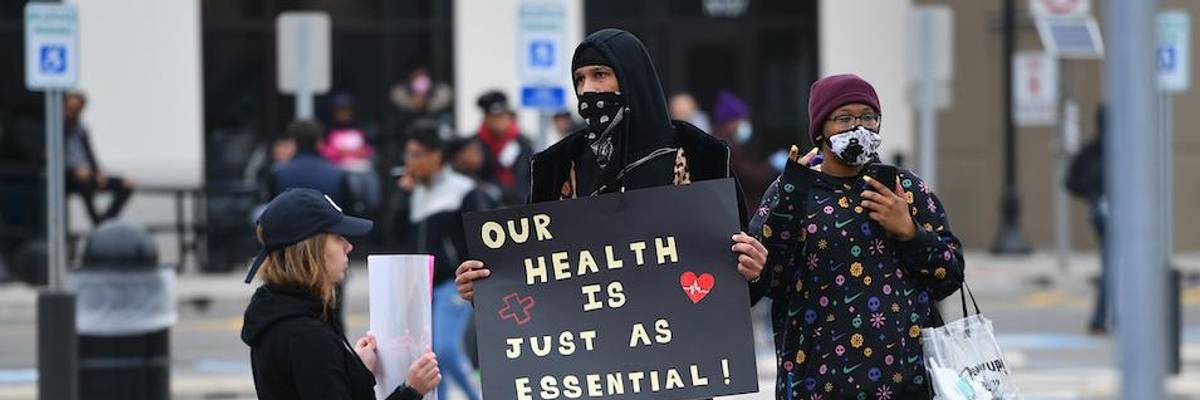
Jay Carney, the former White House press secretary who now serves as Amazon's senior vice president of global corporate affairs, came under fire overnight for defending the retail behemoth's firing this week of a warehouse employee who had organized a worker protest demanding safer conditions amid the coronavirus outbreak.
In a tweet Wednesday night, Carney went after Sen. Bernie Sanders (I-Vt.), a candidate for the Democratic Party's 2020 presidential nomination, after the Vermont lawmaker defended Chris Smalls, a team manager at a fulfillment center in Staten Island who was terminated just a day after helping stage a walkout at the facility.
"That is absolutely immoral," Sanders said on Twitter Wednesday of Amazon's firing of worker Chris Smalls.
Carney, in response, claimed that Smalls was let go for violating social distancing rules put in place by Amazon for its workers and endangering the company's staff from the coronavirus, or COVID-19.
"Knowingly putting our team at risk is unacceptable," said Carney, who served in former President Barack Obama's White House as press secretary from 2011-2014.
But, as a number of observers pointed out, that reasoning rings hollow in the face of both the impetus for the strike--unsafe conditions, a lack of cleaning of the facilities, and little to no personal protective equipment (PPE) for employees--and an avalanche of reports indicating the company is putting profits over people as much as possible in its warehouses and distribution centers around the world.
"Why are you attacking your own workers for putting each other at risk of infection when your company is the one doing that?" asked economist Marshall Steinbaum.
One week ago, on March 26, HuffPost reported on the conditions in Amazon warehouses and the company's reluctance to take proactive measures to protect workers:
At least 10 Amazon warehouse workers have been diagnosed with COVID-19 as of Thursday, according to public reports. Employees say many more are likely sick. The company is not making cases public; news about cases have filtered out via warehouse workers. The company just shut down a Kentucky warehouse because of the outbreak, only after staffers protested because three workers tested positive for coronavirus.
The retail giant's safety record has been the subject of in-depth reporting over the past year, including:
Amazon CEO Jeff Bezos is the richest man in the world, which observers noted in their tweets to Carney after his comments on Smalls' firing.
"Your boss is the richest person on Earth, and he just became $3.4 billion richer last month dumping stock in anticipation of this pandemic," said Claire Sandberg, national organizing director for the Sanders campaign. "How much does he pay you to pretend he can't afford to give his workers PPE and a sane paid sick leave policy?"
Smalls, in an open letter published at the Guardian Thursday to Bezos, wrote that it was clear his firing was related to the walkout. But, Smalls said, he remained undeterred in his efforts to help the company's workers ensure safe working conditions and promised there was more action to come.
"I believe they targeted me because the spotlight is on me," wrote Smalls. "The thing is, it won't work. I am getting calls from Amazon workers across the country and they all want to stage walk-outs, too. We are starting a revolution and people around the country support us."
Dear Common Dreams reader, It’s been nearly 30 years since I co-founded Common Dreams with my late wife, Lina Newhouser. We had the radical notion that journalism should serve the public good, not corporate profits. It was clear to us from the outset what it would take to build such a project. No paid advertisements. No corporate sponsors. No millionaire publisher telling us what to think or do. Many people said we wouldn't last a year, but we proved those doubters wrong. Together with a tremendous team of journalists and dedicated staff, we built an independent media outlet free from the constraints of profits and corporate control. Our mission has always been simple: To inform. To inspire. To ignite change for the common good. Building Common Dreams was not easy. Our survival was never guaranteed. When you take on the most powerful forces—Wall Street greed, fossil fuel industry destruction, Big Tech lobbyists, and uber-rich oligarchs who have spent billions upon billions rigging the economy and democracy in their favor—the only bulwark you have is supporters who believe in your work. But here’s the urgent message from me today. It's never been this bad out there. And it's never been this hard to keep us going. At the very moment Common Dreams is most needed, the threats we face are intensifying. We need your support now more than ever. We don't accept corporate advertising and never will. We don't have a paywall because we don't think people should be blocked from critical news based on their ability to pay. Everything we do is funded by the donations of readers like you. When everyone does the little they can afford, we are strong. But if that support retreats or dries up, so do we. Will you donate now to make sure Common Dreams not only survives but thrives? —Craig Brown, Co-founder |
Jay Carney, the former White House press secretary who now serves as Amazon's senior vice president of global corporate affairs, came under fire overnight for defending the retail behemoth's firing this week of a warehouse employee who had organized a worker protest demanding safer conditions amid the coronavirus outbreak.
In a tweet Wednesday night, Carney went after Sen. Bernie Sanders (I-Vt.), a candidate for the Democratic Party's 2020 presidential nomination, after the Vermont lawmaker defended Chris Smalls, a team manager at a fulfillment center in Staten Island who was terminated just a day after helping stage a walkout at the facility.
"That is absolutely immoral," Sanders said on Twitter Wednesday of Amazon's firing of worker Chris Smalls.
Carney, in response, claimed that Smalls was let go for violating social distancing rules put in place by Amazon for its workers and endangering the company's staff from the coronavirus, or COVID-19.
"Knowingly putting our team at risk is unacceptable," said Carney, who served in former President Barack Obama's White House as press secretary from 2011-2014.
But, as a number of observers pointed out, that reasoning rings hollow in the face of both the impetus for the strike--unsafe conditions, a lack of cleaning of the facilities, and little to no personal protective equipment (PPE) for employees--and an avalanche of reports indicating the company is putting profits over people as much as possible in its warehouses and distribution centers around the world.
"Why are you attacking your own workers for putting each other at risk of infection when your company is the one doing that?" asked economist Marshall Steinbaum.
One week ago, on March 26, HuffPost reported on the conditions in Amazon warehouses and the company's reluctance to take proactive measures to protect workers:
At least 10 Amazon warehouse workers have been diagnosed with COVID-19 as of Thursday, according to public reports. Employees say many more are likely sick. The company is not making cases public; news about cases have filtered out via warehouse workers. The company just shut down a Kentucky warehouse because of the outbreak, only after staffers protested because three workers tested positive for coronavirus.
The retail giant's safety record has been the subject of in-depth reporting over the past year, including:
Amazon CEO Jeff Bezos is the richest man in the world, which observers noted in their tweets to Carney after his comments on Smalls' firing.
"Your boss is the richest person on Earth, and he just became $3.4 billion richer last month dumping stock in anticipation of this pandemic," said Claire Sandberg, national organizing director for the Sanders campaign. "How much does he pay you to pretend he can't afford to give his workers PPE and a sane paid sick leave policy?"
Smalls, in an open letter published at the Guardian Thursday to Bezos, wrote that it was clear his firing was related to the walkout. But, Smalls said, he remained undeterred in his efforts to help the company's workers ensure safe working conditions and promised there was more action to come.
"I believe they targeted me because the spotlight is on me," wrote Smalls. "The thing is, it won't work. I am getting calls from Amazon workers across the country and they all want to stage walk-outs, too. We are starting a revolution and people around the country support us."
Jay Carney, the former White House press secretary who now serves as Amazon's senior vice president of global corporate affairs, came under fire overnight for defending the retail behemoth's firing this week of a warehouse employee who had organized a worker protest demanding safer conditions amid the coronavirus outbreak.
In a tweet Wednesday night, Carney went after Sen. Bernie Sanders (I-Vt.), a candidate for the Democratic Party's 2020 presidential nomination, after the Vermont lawmaker defended Chris Smalls, a team manager at a fulfillment center in Staten Island who was terminated just a day after helping stage a walkout at the facility.
"That is absolutely immoral," Sanders said on Twitter Wednesday of Amazon's firing of worker Chris Smalls.
Carney, in response, claimed that Smalls was let go for violating social distancing rules put in place by Amazon for its workers and endangering the company's staff from the coronavirus, or COVID-19.
"Knowingly putting our team at risk is unacceptable," said Carney, who served in former President Barack Obama's White House as press secretary from 2011-2014.
But, as a number of observers pointed out, that reasoning rings hollow in the face of both the impetus for the strike--unsafe conditions, a lack of cleaning of the facilities, and little to no personal protective equipment (PPE) for employees--and an avalanche of reports indicating the company is putting profits over people as much as possible in its warehouses and distribution centers around the world.
"Why are you attacking your own workers for putting each other at risk of infection when your company is the one doing that?" asked economist Marshall Steinbaum.
One week ago, on March 26, HuffPost reported on the conditions in Amazon warehouses and the company's reluctance to take proactive measures to protect workers:
At least 10 Amazon warehouse workers have been diagnosed with COVID-19 as of Thursday, according to public reports. Employees say many more are likely sick. The company is not making cases public; news about cases have filtered out via warehouse workers. The company just shut down a Kentucky warehouse because of the outbreak, only after staffers protested because three workers tested positive for coronavirus.
The retail giant's safety record has been the subject of in-depth reporting over the past year, including:
Amazon CEO Jeff Bezos is the richest man in the world, which observers noted in their tweets to Carney after his comments on Smalls' firing.
"Your boss is the richest person on Earth, and he just became $3.4 billion richer last month dumping stock in anticipation of this pandemic," said Claire Sandberg, national organizing director for the Sanders campaign. "How much does he pay you to pretend he can't afford to give his workers PPE and a sane paid sick leave policy?"
Smalls, in an open letter published at the Guardian Thursday to Bezos, wrote that it was clear his firing was related to the walkout. But, Smalls said, he remained undeterred in his efforts to help the company's workers ensure safe working conditions and promised there was more action to come.
"I believe they targeted me because the spotlight is on me," wrote Smalls. "The thing is, it won't work. I am getting calls from Amazon workers across the country and they all want to stage walk-outs, too. We are starting a revolution and people around the country support us."