SUBSCRIBE TO OUR FREE NEWSLETTER
Daily news & progressive opinion—funded by the people, not the corporations—delivered straight to your inbox.
5
#000000
#FFFFFF
To donate by check, phone, or other method, see our More Ways to Give page.
Daily news & progressive opinion—funded by the people, not the corporations—delivered straight to your inbox.
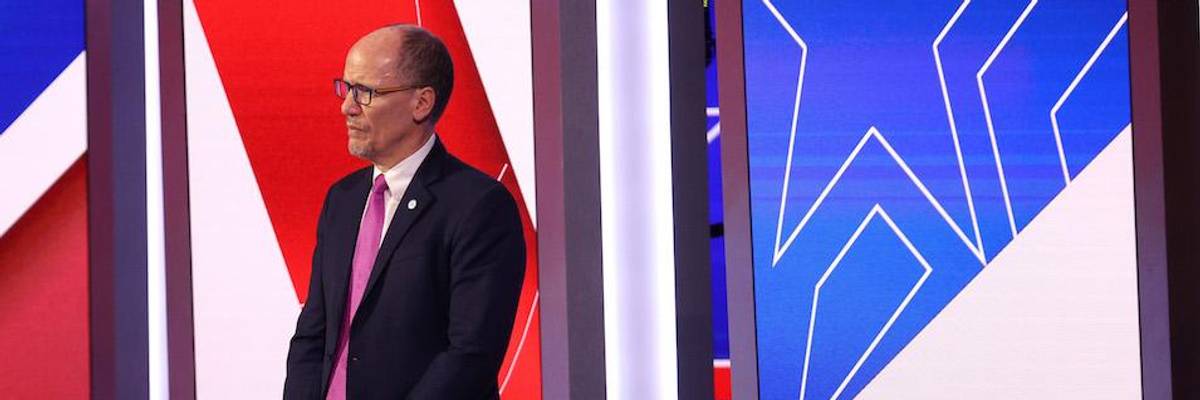
DNC chair Tom Perez stands on stage before the Democratic presidential primary debate at the Charleston Gaillard Center on February 25, 2020. (Photo: Win McNamee/Getty Images)
The Democratic National Convention scheduled for this July in Milwaukee has been pushed back to August due to public health concerns about the coronavirus outbreak even as Wisconsin is forging ahead with plans to have statewide elections--including party primaries--next week on April 7 despite concerns raised by public health officials and voting rights advocates.
"The DNC is delaying a convention that was set to take place in Wisconsin in July," tweeted CNN national political reporter Eric Bradner. "But the Democratic governor and Republican legislature there won't move--or cancel the in-person portion of--a primary that's happening there next Tuesday."
In a statement Thursday, convention CEO Joe Solmonese said he was certain that the show would go on, albeit delayed.
"I'm confident our convention planning team and our partners will find a way to deliver a convention in Milwaukee this summer that places our Democratic nominee on the path to victory in November," said Solmonese.
A DNC official told Politico that the convention would be a more modest affair than recent events given the likely continuation and exacerbation of coronavirus-fueled economic recession.
"People are going to be hurting," the official said. "It's not a time be lavish."
As the New York Times reported, the proposed August rescheduling is hardly more certain to be safe than July as there is no way to predict what stage the pandemic will be at by that point. Former Vice President Joe Biden, who currently enjoys a substantial delegate lead in the presidential primary over his remaining rival Sen. Bernie Sanders (I-Vt.), on Wednesday night suggested delaying the convention to August would be necessary due to the outbreak.
The Times noted that the coronavirus outbreak has thrown the entire nominating process into chaos, with multiple states postponing their primary elections due to the disease and Sanders maintaining his position in the contest as long as he has a path to victory:
Democratic officials, including Mr. Perez, had hoped that the party would have a nominee by late April, but with so many states postponing their primaries because of public health concerns about the coronavirus, Mr. Biden cannot clinch the nomination until June at the earliest if Mr. Sanders remains in the race.
On Wednesday, Sanders called on Wisconsin to delay its primary election in the interest of public health, as Common Dreams reported.
"People should not be forced to put their lives on the line to vote, which is why 15 states are now following the advice of public health experts and delaying their elections," Sanders said in a statement.
Wisconsin state officials appeared determined Thursday to go ahead with in-person voting despite calls for delay. A coming court ruling on the elections is seen as likely to be in favor of keeping the schedule--but Federal Judge William Conley on Wednesday nonetheless warned public health consequences of the vote could be disastrous and implied the ramifications were on state lawmakers.
"You don't get to go to a federal judge and say (conditions are) impinging on voting rights so you get to stop a statewide election," said Conley. "I'm sorry that's what the situation is, but this is a public health crisis that the state legislature and governor have refused to accept as severe enough to stop this statewide election."
Wisconsin has seen an unprecedented level of requests for mail-in ballots, the state's Elections Commission administrator Meagan Wolfe said Tuesday.
"There's no one place where we're seeing shortages," said Wolfe, "it truly is all across the state."
Thursday is the deadline to request an absentee ballot.
Meanwhile, polling places around Wisconsin are closing--possibly dropping from 31 to four in Green Bay--leaving voters with limited options on where to cast a ballot and presenting a potential crush of people at voting locations at a time when social distancing is most important.
Gov. Tony Evers on Wednesday ordered the National Guard to help at polling places, a move that is still expected be insufficient to meet the needs of the state's election.
"It is anticipated that the assistance of the National Guard will not satisfy all of the current staffing needs," Wisconsin Assistant Attorney General Hannah Jurss told CBS News.
As Vox's Ian Milhiser pointed out Thursday, the Wisconsin election's resolution is still up in the air in light of the pandemic, Conley's expected ruling, and the state's electoral process.
"It is far from clear, in other words, whether the election will happen on Tuesday, how that election will be run, or who will get to decide how the election is run," wrote Milhiser.
This country and this world are at a monumental crossroads. US voters have an opportunity to beat back the forces of fascism and confront the billionaires who are rigging the economy, our media system, and our democracy, making it increasingly impossible for ordinary people to get by. We’re not just talking about the election. We’re talking about what must be done once these fascist elements are vanquished from power. We need a bolder set of solutions than what either major party has so far been willing to offer and a working-class movement ready to fight like hell for it. Trump didn't emerge from nowhere. The conditions that fueled MAGA authoritarianism were created by decades of radical neoliberal economic policies and a corrupt political system dominated by corporate interests. They slashed taxes on the super-rich, promising that the benefits would trickle down. They said giveaways to the corporate titans would make life more affordable for the rest of us. It was all bullshit. And when a bitter, betrayed populace searches for someone to blame, right-wing demagogues have little trouble finding scapegoats. People know when they're being lied to, but you won't hear any of this from the corporate media. Only independent journalism—powered and funded by people who believe in building a better world—can deliver truly trustworthy daily news. If you share our vision, please contribute whatever you can to sustain our work. |
The Democratic National Convention scheduled for this July in Milwaukee has been pushed back to August due to public health concerns about the coronavirus outbreak even as Wisconsin is forging ahead with plans to have statewide elections--including party primaries--next week on April 7 despite concerns raised by public health officials and voting rights advocates.
"The DNC is delaying a convention that was set to take place in Wisconsin in July," tweeted CNN national political reporter Eric Bradner. "But the Democratic governor and Republican legislature there won't move--or cancel the in-person portion of--a primary that's happening there next Tuesday."
In a statement Thursday, convention CEO Joe Solmonese said he was certain that the show would go on, albeit delayed.
"I'm confident our convention planning team and our partners will find a way to deliver a convention in Milwaukee this summer that places our Democratic nominee on the path to victory in November," said Solmonese.
A DNC official told Politico that the convention would be a more modest affair than recent events given the likely continuation and exacerbation of coronavirus-fueled economic recession.
"People are going to be hurting," the official said. "It's not a time be lavish."
As the New York Times reported, the proposed August rescheduling is hardly more certain to be safe than July as there is no way to predict what stage the pandemic will be at by that point. Former Vice President Joe Biden, who currently enjoys a substantial delegate lead in the presidential primary over his remaining rival Sen. Bernie Sanders (I-Vt.), on Wednesday night suggested delaying the convention to August would be necessary due to the outbreak.
The Times noted that the coronavirus outbreak has thrown the entire nominating process into chaos, with multiple states postponing their primary elections due to the disease and Sanders maintaining his position in the contest as long as he has a path to victory:
Democratic officials, including Mr. Perez, had hoped that the party would have a nominee by late April, but with so many states postponing their primaries because of public health concerns about the coronavirus, Mr. Biden cannot clinch the nomination until June at the earliest if Mr. Sanders remains in the race.
On Wednesday, Sanders called on Wisconsin to delay its primary election in the interest of public health, as Common Dreams reported.
"People should not be forced to put their lives on the line to vote, which is why 15 states are now following the advice of public health experts and delaying their elections," Sanders said in a statement.
Wisconsin state officials appeared determined Thursday to go ahead with in-person voting despite calls for delay. A coming court ruling on the elections is seen as likely to be in favor of keeping the schedule--but Federal Judge William Conley on Wednesday nonetheless warned public health consequences of the vote could be disastrous and implied the ramifications were on state lawmakers.
"You don't get to go to a federal judge and say (conditions are) impinging on voting rights so you get to stop a statewide election," said Conley. "I'm sorry that's what the situation is, but this is a public health crisis that the state legislature and governor have refused to accept as severe enough to stop this statewide election."
Wisconsin has seen an unprecedented level of requests for mail-in ballots, the state's Elections Commission administrator Meagan Wolfe said Tuesday.
"There's no one place where we're seeing shortages," said Wolfe, "it truly is all across the state."
Thursday is the deadline to request an absentee ballot.
Meanwhile, polling places around Wisconsin are closing--possibly dropping from 31 to four in Green Bay--leaving voters with limited options on where to cast a ballot and presenting a potential crush of people at voting locations at a time when social distancing is most important.
Gov. Tony Evers on Wednesday ordered the National Guard to help at polling places, a move that is still expected be insufficient to meet the needs of the state's election.
"It is anticipated that the assistance of the National Guard will not satisfy all of the current staffing needs," Wisconsin Assistant Attorney General Hannah Jurss told CBS News.
As Vox's Ian Milhiser pointed out Thursday, the Wisconsin election's resolution is still up in the air in light of the pandemic, Conley's expected ruling, and the state's electoral process.
"It is far from clear, in other words, whether the election will happen on Tuesday, how that election will be run, or who will get to decide how the election is run," wrote Milhiser.