SUBSCRIBE TO OUR FREE NEWSLETTER
Daily news & progressive opinion—funded by the people, not the corporations—delivered straight to your inbox.
5
#000000
#FFFFFF
To donate by check, phone, or other method, see our More Ways to Give page.
Daily news & progressive opinion—funded by the people, not the corporations—delivered straight to your inbox.
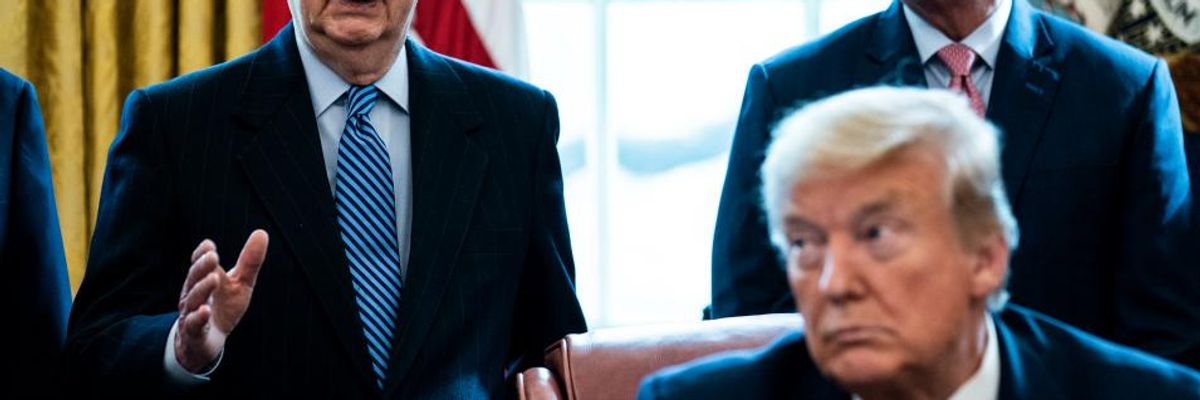
Senate Majority Leader Mitch McConnell (R-Ky.) speaks as House Minority Leader Kevin McCarthy (R-Calif.) and President Donald Trump listen during a signing ceremony in the Oval Office of the White House on March 27, 2020 in Washington, D.C. (Photo: Erin Schaff-Pool/Getty Images)
Republican Senate Majority Leader Mitch McConnell on Tuesday offered a new--and, according to critics, "ridiculous" and baseless--excuse for the failure of the White House and the federal government more broadly to take early action against the coronavirus outbreak: The impeachment trial of President Donald Trump got in the way.
"While Trump's impeachment and trial were ongoing, Trump found time for his priorities--holding campaign rallies and playing golf."
--Judd Legum
In an appearance on NBC News contributor Hugh Hewitt's talk show, McConnell said the coronavirus outbreak "came up while we were, you know, tied down in the impeachment trial."
"And I think it diverted the attention of the government, because everything, every day, was all about impeachment," McConnell claimed.
But as Inae Oh and Dan Friedman of Mother Jones wrote Tuesday, the Kentucky Republican's argument "ignores reality on multiple counts."
First, there's the fact that senior administration officials, according to the Washington Post, spent weeks in January warning Trump about the virus' potential for disaster in the United States. "Donald Trump may not have been expecting this, but a lot of other people in the government were--they just couldn't get him to do anything about it," one official told the Post. "The system was blinking red."
While Trump ignored those national security warnings, he played a lot of golf, hitting the links at least five times from mid-January through early March. Did impeachment cause that?
McConnell's attempt to blame the Trump impeachment trial--which ended in acquittal on Feb. 5--for Senate inaction also doesn't fit the facts, Oh and Friedman noted.
"The trial didn't stop the Senate's health committee from receiving a briefing about the virus from U.S. public health officials on January 24," they wrote. "If impeachment really had prevented McConnell from taking action on coronavirus, one would have expected him to deal with the issue immediately after the trial concluded on February 5. He did not. The first thing senators did after acquitting Trump was take a five-day weekend. Upon their return, the Senate did not turn to pandemic preparation measures."
Asked about McConnell's claim during a press briefing Tuesday evening, Trump said the impeachment trial "probably did" hinder his response to the coronavirus outbreak, which has been widely condemned as slow and inadequate.
But Trump went on to say that he doesn't think he "would have acted any faster" had he not been impeached by the House of Representatives.
Watch:
Addressing McConnell's comments, Senate Minority Leader Chuck Schumer (D-N.Y.) tweeted Tuesday night that the Kentucky Republican "may have been distracted by impeachment from acting to fight coronavirus, but not everyone was."
"I called for President Trump to declare a public health emergency to fight coronavirus on January 26!" Schumer said.
In his "Popular Information" newsletter Wednesday morning, Judd Legum wrote that "if the federal government failed to respond to an imminent pandemic because it was too concerned about the political fate of Trump, it would be an outrage. But the reality is even worse."
"Years before Trump was impeached, he decimated the government's capacity to respond to a pandemic," Legum noted. "Moreover, while Trump's impeachment and trial were ongoing, Trump found time for his priorities--holding campaign rallies and playing golf. And after Trump was acquitted by the Senate on February 5, Trump continued to downplay the threat of the coronavirus and for many weeks."
Dear Common Dreams reader, It’s been nearly 30 years since I co-founded Common Dreams with my late wife, Lina Newhouser. We had the radical notion that journalism should serve the public good, not corporate profits. It was clear to us from the outset what it would take to build such a project. No paid advertisements. No corporate sponsors. No millionaire publisher telling us what to think or do. Many people said we wouldn't last a year, but we proved those doubters wrong. Together with a tremendous team of journalists and dedicated staff, we built an independent media outlet free from the constraints of profits and corporate control. Our mission has always been simple: To inform. To inspire. To ignite change for the common good. Building Common Dreams was not easy. Our survival was never guaranteed. When you take on the most powerful forces—Wall Street greed, fossil fuel industry destruction, Big Tech lobbyists, and uber-rich oligarchs who have spent billions upon billions rigging the economy and democracy in their favor—the only bulwark you have is supporters who believe in your work. But here’s the urgent message from me today. It's never been this bad out there. And it's never been this hard to keep us going. At the very moment Common Dreams is most needed, the threats we face are intensifying. We need your support now more than ever. We don't accept corporate advertising and never will. We don't have a paywall because we don't think people should be blocked from critical news based on their ability to pay. Everything we do is funded by the donations of readers like you. When everyone does the little they can afford, we are strong. But if that support retreats or dries up, so do we. Will you donate now to make sure Common Dreams not only survives but thrives? —Craig Brown, Co-founder |
Republican Senate Majority Leader Mitch McConnell on Tuesday offered a new--and, according to critics, "ridiculous" and baseless--excuse for the failure of the White House and the federal government more broadly to take early action against the coronavirus outbreak: The impeachment trial of President Donald Trump got in the way.
"While Trump's impeachment and trial were ongoing, Trump found time for his priorities--holding campaign rallies and playing golf."
--Judd Legum
In an appearance on NBC News contributor Hugh Hewitt's talk show, McConnell said the coronavirus outbreak "came up while we were, you know, tied down in the impeachment trial."
"And I think it diverted the attention of the government, because everything, every day, was all about impeachment," McConnell claimed.
But as Inae Oh and Dan Friedman of Mother Jones wrote Tuesday, the Kentucky Republican's argument "ignores reality on multiple counts."
First, there's the fact that senior administration officials, according to the Washington Post, spent weeks in January warning Trump about the virus' potential for disaster in the United States. "Donald Trump may not have been expecting this, but a lot of other people in the government were--they just couldn't get him to do anything about it," one official told the Post. "The system was blinking red."
While Trump ignored those national security warnings, he played a lot of golf, hitting the links at least five times from mid-January through early March. Did impeachment cause that?
McConnell's attempt to blame the Trump impeachment trial--which ended in acquittal on Feb. 5--for Senate inaction also doesn't fit the facts, Oh and Friedman noted.
"The trial didn't stop the Senate's health committee from receiving a briefing about the virus from U.S. public health officials on January 24," they wrote. "If impeachment really had prevented McConnell from taking action on coronavirus, one would have expected him to deal with the issue immediately after the trial concluded on February 5. He did not. The first thing senators did after acquitting Trump was take a five-day weekend. Upon their return, the Senate did not turn to pandemic preparation measures."
Asked about McConnell's claim during a press briefing Tuesday evening, Trump said the impeachment trial "probably did" hinder his response to the coronavirus outbreak, which has been widely condemned as slow and inadequate.
But Trump went on to say that he doesn't think he "would have acted any faster" had he not been impeached by the House of Representatives.
Watch:
Addressing McConnell's comments, Senate Minority Leader Chuck Schumer (D-N.Y.) tweeted Tuesday night that the Kentucky Republican "may have been distracted by impeachment from acting to fight coronavirus, but not everyone was."
"I called for President Trump to declare a public health emergency to fight coronavirus on January 26!" Schumer said.
In his "Popular Information" newsletter Wednesday morning, Judd Legum wrote that "if the federal government failed to respond to an imminent pandemic because it was too concerned about the political fate of Trump, it would be an outrage. But the reality is even worse."
"Years before Trump was impeached, he decimated the government's capacity to respond to a pandemic," Legum noted. "Moreover, while Trump's impeachment and trial were ongoing, Trump found time for his priorities--holding campaign rallies and playing golf. And after Trump was acquitted by the Senate on February 5, Trump continued to downplay the threat of the coronavirus and for many weeks."
Republican Senate Majority Leader Mitch McConnell on Tuesday offered a new--and, according to critics, "ridiculous" and baseless--excuse for the failure of the White House and the federal government more broadly to take early action against the coronavirus outbreak: The impeachment trial of President Donald Trump got in the way.
"While Trump's impeachment and trial were ongoing, Trump found time for his priorities--holding campaign rallies and playing golf."
--Judd Legum
In an appearance on NBC News contributor Hugh Hewitt's talk show, McConnell said the coronavirus outbreak "came up while we were, you know, tied down in the impeachment trial."
"And I think it diverted the attention of the government, because everything, every day, was all about impeachment," McConnell claimed.
But as Inae Oh and Dan Friedman of Mother Jones wrote Tuesday, the Kentucky Republican's argument "ignores reality on multiple counts."
First, there's the fact that senior administration officials, according to the Washington Post, spent weeks in January warning Trump about the virus' potential for disaster in the United States. "Donald Trump may not have been expecting this, but a lot of other people in the government were--they just couldn't get him to do anything about it," one official told the Post. "The system was blinking red."
While Trump ignored those national security warnings, he played a lot of golf, hitting the links at least five times from mid-January through early March. Did impeachment cause that?
McConnell's attempt to blame the Trump impeachment trial--which ended in acquittal on Feb. 5--for Senate inaction also doesn't fit the facts, Oh and Friedman noted.
"The trial didn't stop the Senate's health committee from receiving a briefing about the virus from U.S. public health officials on January 24," they wrote. "If impeachment really had prevented McConnell from taking action on coronavirus, one would have expected him to deal with the issue immediately after the trial concluded on February 5. He did not. The first thing senators did after acquitting Trump was take a five-day weekend. Upon their return, the Senate did not turn to pandemic preparation measures."
Asked about McConnell's claim during a press briefing Tuesday evening, Trump said the impeachment trial "probably did" hinder his response to the coronavirus outbreak, which has been widely condemned as slow and inadequate.
But Trump went on to say that he doesn't think he "would have acted any faster" had he not been impeached by the House of Representatives.
Watch:
Addressing McConnell's comments, Senate Minority Leader Chuck Schumer (D-N.Y.) tweeted Tuesday night that the Kentucky Republican "may have been distracted by impeachment from acting to fight coronavirus, but not everyone was."
"I called for President Trump to declare a public health emergency to fight coronavirus on January 26!" Schumer said.
In his "Popular Information" newsletter Wednesday morning, Judd Legum wrote that "if the federal government failed to respond to an imminent pandemic because it was too concerned about the political fate of Trump, it would be an outrage. But the reality is even worse."
"Years before Trump was impeached, he decimated the government's capacity to respond to a pandemic," Legum noted. "Moreover, while Trump's impeachment and trial were ongoing, Trump found time for his priorities--holding campaign rallies and playing golf. And after Trump was acquitted by the Senate on February 5, Trump continued to downplay the threat of the coronavirus and for many weeks."