SUBSCRIBE TO OUR FREE NEWSLETTER
Daily news & progressive opinion—funded by the people, not the corporations—delivered straight to your inbox.
5
#000000
#FFFFFF
To donate by check, phone, or other method, see our More Ways to Give page.
Daily news & progressive opinion—funded by the people, not the corporations—delivered straight to your inbox.
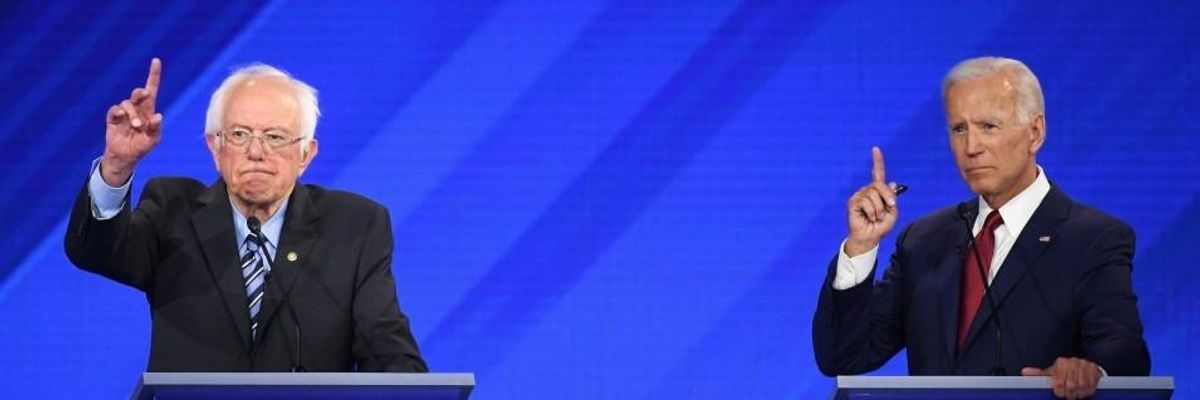
Democratic presidential hopefuls Sen. Bernie Sanders (I-Vt.) and former Vice President Joe Biden speak during the third Democratic primary debate of the 2020 presidential campaign season at Texas Southern University in Houston on September 12, 2019. (Photo: Robyn Beck/AFP/Getty Images)
Former Vice President Joe Biden on Tuesday night said he found it "hard to envision" the Democratic National Convention scheduled for July going forward as planned as his rival for the party's 2020 presidential nomination Sen. Bernie Sanders declared that in his mind, the race is still far from over.
"We ought to be able--we were able to do it in the middle of the Civil War all the way through to World War II--have Democratic and Republican conventions and primaries and elections and still have public safety," Biden told MSNBC's Brian Williams. "And we're able to do both. But the fact is it may have to be different."
Biden, who currently enjoys a healthy delegate lead over Sanders in the Democratic primary with around half of delegates still to be awarded, made the remarks after Williams asked whether the coronavirus, or COVID-19, outbreak that has paralyzed the U.S. would lead to a canceled, delayed, or virtual convention. Thus far the DNC, led by Tom Perez, has resisted making such a change to the July 13-16 Milwaukee convention--even as large events cross the country are being rescheduled or canceled outright due to the pandemic.
In his comments to Williams, Biden emphasized that he did not believe the general election set for November 3 should be delayed, citing the possibility of expanding absentee voting as a possible solution to the danger of disease.
"There's no rationale for eliminating or delaying the election," said Biden.
The former vice president has, however, expressed a desire to wrap up the primary process, floating the idea of dispensing with further debates between himself and Sanders even as states push off their elections until June.
"I think we should get on with this," said Biden Biden said last week in comments widely seen as an indication he believes the race is over and Sanders should drop out.
But Sanders, in comments to NBC's "Late Night With Seth Meyers" that aired Tuesday, said he had no intention of withdrawing from the race and cited a narrow, but possible, path to the nomination and the strength of the grassroots movement that has led to the Vermont senator breaking small-dollar fundraising records and, before the outbreak, drawing huge crowds.
"There is a path," said Sanders. "It is admittedly a narrow path. But I would tell you, Seth, that there are a lot of people who are supporting me. We have a strong grassroots movement who believe that we have got to stay in, in order to continue the fight."
The Sanders campaign's focus on transformative and egalitarian solutions like Medicare for All to the nation's domestic problems has received fresh attention in the past month as the coronavirus outbreak has exposed flaws in the American system that are making the crisis worse, as Sanders told Meyers.
According to the New York Times:
Sanders also argued that the outbreak of the coronavirus crystallized the need for his sweeping single-payer health care proposal, "Medicare for All." He said the crisis highlighted how vulnerable many Americans were without insurance and showed how the current public health system is "so weak, so incredibly weak," that doctors and nurses don't have access to basic protective equipment.
On Tuesday, Princeton professor Keeanga-Yamahtta Taylor wrote a piece for the New Yorker entitled "Reality Has Endorsed Bernie Sanders," making the case that the collapsing neoliberal social order in the U.S. is presenting Sanders' solutions as the most realistic way forward for the country.
As Taylor explained:
The Sanders campaign was an entry point to this discussion. It has shown public appetite, even desire, for vast spending and new programs. These desires did not translate into votes because they seemed like a risky endeavor when the consequence was four more years of Trump. But the mushrooming crisis of covid-19 is changing the calculus.
Sanders has spent the past few weeks holding virtual roundtables and forums with experts and supporters to discuss the coronavirus and possible solutions to the crisis.
Dear Common Dreams reader, It’s been nearly 30 years since I co-founded Common Dreams with my late wife, Lina Newhouser. We had the radical notion that journalism should serve the public good, not corporate profits. It was clear to us from the outset what it would take to build such a project. No paid advertisements. No corporate sponsors. No millionaire publisher telling us what to think or do. Many people said we wouldn't last a year, but we proved those doubters wrong. Together with a tremendous team of journalists and dedicated staff, we built an independent media outlet free from the constraints of profits and corporate control. Our mission has always been simple: To inform. To inspire. To ignite change for the common good. Building Common Dreams was not easy. Our survival was never guaranteed. When you take on the most powerful forces—Wall Street greed, fossil fuel industry destruction, Big Tech lobbyists, and uber-rich oligarchs who have spent billions upon billions rigging the economy and democracy in their favor—the only bulwark you have is supporters who believe in your work. But here’s the urgent message from me today. It's never been this bad out there. And it's never been this hard to keep us going. At the very moment Common Dreams is most needed, the threats we face are intensifying. We need your support now more than ever. We don't accept corporate advertising and never will. We don't have a paywall because we don't think people should be blocked from critical news based on their ability to pay. Everything we do is funded by the donations of readers like you. When everyone does the little they can afford, we are strong. But if that support retreats or dries up, so do we. Will you donate now to make sure Common Dreams not only survives but thrives? —Craig Brown, Co-founder |
Former Vice President Joe Biden on Tuesday night said he found it "hard to envision" the Democratic National Convention scheduled for July going forward as planned as his rival for the party's 2020 presidential nomination Sen. Bernie Sanders declared that in his mind, the race is still far from over.
"We ought to be able--we were able to do it in the middle of the Civil War all the way through to World War II--have Democratic and Republican conventions and primaries and elections and still have public safety," Biden told MSNBC's Brian Williams. "And we're able to do both. But the fact is it may have to be different."
Biden, who currently enjoys a healthy delegate lead over Sanders in the Democratic primary with around half of delegates still to be awarded, made the remarks after Williams asked whether the coronavirus, or COVID-19, outbreak that has paralyzed the U.S. would lead to a canceled, delayed, or virtual convention. Thus far the DNC, led by Tom Perez, has resisted making such a change to the July 13-16 Milwaukee convention--even as large events cross the country are being rescheduled or canceled outright due to the pandemic.
In his comments to Williams, Biden emphasized that he did not believe the general election set for November 3 should be delayed, citing the possibility of expanding absentee voting as a possible solution to the danger of disease.
"There's no rationale for eliminating or delaying the election," said Biden.
The former vice president has, however, expressed a desire to wrap up the primary process, floating the idea of dispensing with further debates between himself and Sanders even as states push off their elections until June.
"I think we should get on with this," said Biden Biden said last week in comments widely seen as an indication he believes the race is over and Sanders should drop out.
But Sanders, in comments to NBC's "Late Night With Seth Meyers" that aired Tuesday, said he had no intention of withdrawing from the race and cited a narrow, but possible, path to the nomination and the strength of the grassroots movement that has led to the Vermont senator breaking small-dollar fundraising records and, before the outbreak, drawing huge crowds.
"There is a path," said Sanders. "It is admittedly a narrow path. But I would tell you, Seth, that there are a lot of people who are supporting me. We have a strong grassroots movement who believe that we have got to stay in, in order to continue the fight."
The Sanders campaign's focus on transformative and egalitarian solutions like Medicare for All to the nation's domestic problems has received fresh attention in the past month as the coronavirus outbreak has exposed flaws in the American system that are making the crisis worse, as Sanders told Meyers.
According to the New York Times:
Sanders also argued that the outbreak of the coronavirus crystallized the need for his sweeping single-payer health care proposal, "Medicare for All." He said the crisis highlighted how vulnerable many Americans were without insurance and showed how the current public health system is "so weak, so incredibly weak," that doctors and nurses don't have access to basic protective equipment.
On Tuesday, Princeton professor Keeanga-Yamahtta Taylor wrote a piece for the New Yorker entitled "Reality Has Endorsed Bernie Sanders," making the case that the collapsing neoliberal social order in the U.S. is presenting Sanders' solutions as the most realistic way forward for the country.
As Taylor explained:
The Sanders campaign was an entry point to this discussion. It has shown public appetite, even desire, for vast spending and new programs. These desires did not translate into votes because they seemed like a risky endeavor when the consequence was four more years of Trump. But the mushrooming crisis of covid-19 is changing the calculus.
Sanders has spent the past few weeks holding virtual roundtables and forums with experts and supporters to discuss the coronavirus and possible solutions to the crisis.
Former Vice President Joe Biden on Tuesday night said he found it "hard to envision" the Democratic National Convention scheduled for July going forward as planned as his rival for the party's 2020 presidential nomination Sen. Bernie Sanders declared that in his mind, the race is still far from over.
"We ought to be able--we were able to do it in the middle of the Civil War all the way through to World War II--have Democratic and Republican conventions and primaries and elections and still have public safety," Biden told MSNBC's Brian Williams. "And we're able to do both. But the fact is it may have to be different."
Biden, who currently enjoys a healthy delegate lead over Sanders in the Democratic primary with around half of delegates still to be awarded, made the remarks after Williams asked whether the coronavirus, or COVID-19, outbreak that has paralyzed the U.S. would lead to a canceled, delayed, or virtual convention. Thus far the DNC, led by Tom Perez, has resisted making such a change to the July 13-16 Milwaukee convention--even as large events cross the country are being rescheduled or canceled outright due to the pandemic.
In his comments to Williams, Biden emphasized that he did not believe the general election set for November 3 should be delayed, citing the possibility of expanding absentee voting as a possible solution to the danger of disease.
"There's no rationale for eliminating or delaying the election," said Biden.
The former vice president has, however, expressed a desire to wrap up the primary process, floating the idea of dispensing with further debates between himself and Sanders even as states push off their elections until June.
"I think we should get on with this," said Biden Biden said last week in comments widely seen as an indication he believes the race is over and Sanders should drop out.
But Sanders, in comments to NBC's "Late Night With Seth Meyers" that aired Tuesday, said he had no intention of withdrawing from the race and cited a narrow, but possible, path to the nomination and the strength of the grassroots movement that has led to the Vermont senator breaking small-dollar fundraising records and, before the outbreak, drawing huge crowds.
"There is a path," said Sanders. "It is admittedly a narrow path. But I would tell you, Seth, that there are a lot of people who are supporting me. We have a strong grassroots movement who believe that we have got to stay in, in order to continue the fight."
The Sanders campaign's focus on transformative and egalitarian solutions like Medicare for All to the nation's domestic problems has received fresh attention in the past month as the coronavirus outbreak has exposed flaws in the American system that are making the crisis worse, as Sanders told Meyers.
According to the New York Times:
Sanders also argued that the outbreak of the coronavirus crystallized the need for his sweeping single-payer health care proposal, "Medicare for All." He said the crisis highlighted how vulnerable many Americans were without insurance and showed how the current public health system is "so weak, so incredibly weak," that doctors and nurses don't have access to basic protective equipment.
On Tuesday, Princeton professor Keeanga-Yamahtta Taylor wrote a piece for the New Yorker entitled "Reality Has Endorsed Bernie Sanders," making the case that the collapsing neoliberal social order in the U.S. is presenting Sanders' solutions as the most realistic way forward for the country.
As Taylor explained:
The Sanders campaign was an entry point to this discussion. It has shown public appetite, even desire, for vast spending and new programs. These desires did not translate into votes because they seemed like a risky endeavor when the consequence was four more years of Trump. But the mushrooming crisis of covid-19 is changing the calculus.
Sanders has spent the past few weeks holding virtual roundtables and forums with experts and supporters to discuss the coronavirus and possible solutions to the crisis.