

SUBSCRIBE TO OUR FREE NEWSLETTER
Daily news & progressive opinion—funded by the people, not the corporations—delivered straight to your inbox.
5
#000000
#FFFFFF
To donate by check, phone, or other method, see our More Ways to Give page.
Daily news & progressive opinion—funded by the people, not the corporations—delivered straight to your inbox.
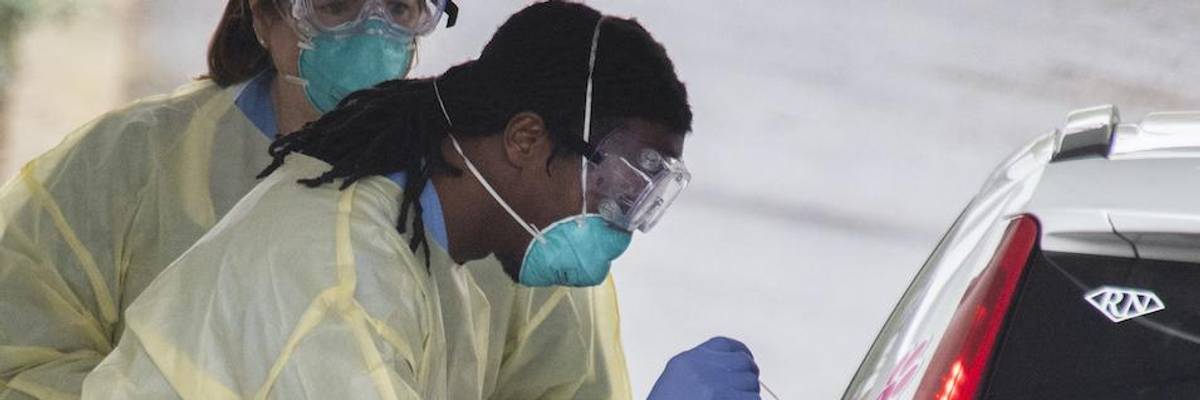
A health care professional applies a swab at a drive-thru coronavirus testing facility for residents who have an order from a provider on Quincy Street in Arlington, Va., on Thursday, March 19, 2020. (Photo: Tom Williams/CQ-Roll Call, Inc via Getty Images)
Health professionals are increaingly sounding the alarm over the U.S. healthcare system, warning that the coronavirus outbreak could quickly overwhelm unprepareed hospitals without swift action to provide equipment to nurses and doctors.
"This is a nationwide problem, even on the private side," an anonymous doctor told NBC News. "No clinic in this country, or hospital for that matter, is going to have enough equipment."
NBC News reported that around 250 doctors and nurses responded to an informal survey request and painted a bleak picture of a healthcare system already on the verge of collapse with at least a month to go before coronavirus cases peak in the U.S.--citing in particular a lack of personal protective equipment (PPE).
According to NBC News:
Nearly all who responded said there were shortages of PPE in the hospitals, outpatient clinics and offices where they worked.
Many reported being forced to ration or reuse supplies, including surgical and N95 masks, for fear of running out. Many also said they were facing shortages of basic sanitary supplies, including hand sanitizer and disinfectant wipes.
One Philadelphia doctor interviewed by NBC News said her husband--also a doctor--is on the frontlines in the city.
"I am so scared," she said. "I can't even begin to tell you."
Calls for the federal government to step in and order manufacturers to produce equipment increased Friday, with the union National Nurses United issuing a demand for immediate action to protect healthcare workers.
"We need to act now and act fast," Bonnie Castillo, National Nurses United executive director, said in a statement. "Priority number one is to protect the health and safety of our nurses and health care workers so that they can continue to take care of patients and keep our communities as healthy as possible through this pandemic. If our health facilities no longer stay as centers of healing and instead turn into disease vectors, many more people will needlessly suffer from this terrible disease."
It's not just PPE. Testing kits are near-impossible to obtain for hospitals and health professionals, leading to difficult decisions on who to treat, when to treat them, and how to track the virus. In Los Angeles County, health officials are instructing doctors and nurses "to test patients only if a positive result could change how they would be treated."
As the Los Angeles Times reported:
A front-line healthcare provider who was not authorized to speak to the media and requested anonymity said county doctors are interpreting Thursday's letter and other advice coming from senior L.A. County public health officials to mean they should only test patients who are going to be hospitalized or have something unique about the way they contracted the virus.
They are not planning to test patients who have the symptoms but are otherwise healthy enough to be sent home to self-quarantine -- meaning they may never show up in official tallies of people who tested positive.
The coming crisis, as one nurse in Michigan told NBC News, is the result of a societal failure to prioritize public health.
"I don't feel like my hospital is failing us," said the nurse. "It's the whole system that's failing us."
Dear Common Dreams reader, It’s been nearly 30 years since I co-founded Common Dreams with my late wife, Lina Newhouser. We had the radical notion that journalism should serve the public good, not corporate profits. It was clear to us from the outset what it would take to build such a project. No paid advertisements. No corporate sponsors. No millionaire publisher telling us what to think or do. Many people said we wouldn't last a year, but we proved those doubters wrong. Together with a tremendous team of journalists and dedicated staff, we built an independent media outlet free from the constraints of profits and corporate control. Our mission has always been simple: To inform. To inspire. To ignite change for the common good. Building Common Dreams was not easy. Our survival was never guaranteed. When you take on the most powerful forces—Wall Street greed, fossil fuel industry destruction, Big Tech lobbyists, and uber-rich oligarchs who have spent billions upon billions rigging the economy and democracy in their favor—the only bulwark you have is supporters who believe in your work. But here’s the urgent message from me today. It's never been this bad out there. And it's never been this hard to keep us going. At the very moment Common Dreams is most needed, the threats we face are intensifying. We need your support now more than ever. We don't accept corporate advertising and never will. We don't have a paywall because we don't think people should be blocked from critical news based on their ability to pay. Everything we do is funded by the donations of readers like you. When everyone does the little they can afford, we are strong. But if that support retreats or dries up, so do we. Will you donate now to make sure Common Dreams not only survives but thrives? —Craig Brown, Co-founder |
Health professionals are increaingly sounding the alarm over the U.S. healthcare system, warning that the coronavirus outbreak could quickly overwhelm unprepareed hospitals without swift action to provide equipment to nurses and doctors.
"This is a nationwide problem, even on the private side," an anonymous doctor told NBC News. "No clinic in this country, or hospital for that matter, is going to have enough equipment."
NBC News reported that around 250 doctors and nurses responded to an informal survey request and painted a bleak picture of a healthcare system already on the verge of collapse with at least a month to go before coronavirus cases peak in the U.S.--citing in particular a lack of personal protective equipment (PPE).
According to NBC News:
Nearly all who responded said there were shortages of PPE in the hospitals, outpatient clinics and offices where they worked.
Many reported being forced to ration or reuse supplies, including surgical and N95 masks, for fear of running out. Many also said they were facing shortages of basic sanitary supplies, including hand sanitizer and disinfectant wipes.
One Philadelphia doctor interviewed by NBC News said her husband--also a doctor--is on the frontlines in the city.
"I am so scared," she said. "I can't even begin to tell you."
Calls for the federal government to step in and order manufacturers to produce equipment increased Friday, with the union National Nurses United issuing a demand for immediate action to protect healthcare workers.
"We need to act now and act fast," Bonnie Castillo, National Nurses United executive director, said in a statement. "Priority number one is to protect the health and safety of our nurses and health care workers so that they can continue to take care of patients and keep our communities as healthy as possible through this pandemic. If our health facilities no longer stay as centers of healing and instead turn into disease vectors, many more people will needlessly suffer from this terrible disease."
It's not just PPE. Testing kits are near-impossible to obtain for hospitals and health professionals, leading to difficult decisions on who to treat, when to treat them, and how to track the virus. In Los Angeles County, health officials are instructing doctors and nurses "to test patients only if a positive result could change how they would be treated."
As the Los Angeles Times reported:
A front-line healthcare provider who was not authorized to speak to the media and requested anonymity said county doctors are interpreting Thursday's letter and other advice coming from senior L.A. County public health officials to mean they should only test patients who are going to be hospitalized or have something unique about the way they contracted the virus.
They are not planning to test patients who have the symptoms but are otherwise healthy enough to be sent home to self-quarantine -- meaning they may never show up in official tallies of people who tested positive.
The coming crisis, as one nurse in Michigan told NBC News, is the result of a societal failure to prioritize public health.
"I don't feel like my hospital is failing us," said the nurse. "It's the whole system that's failing us."
Health professionals are increaingly sounding the alarm over the U.S. healthcare system, warning that the coronavirus outbreak could quickly overwhelm unprepareed hospitals without swift action to provide equipment to nurses and doctors.
"This is a nationwide problem, even on the private side," an anonymous doctor told NBC News. "No clinic in this country, or hospital for that matter, is going to have enough equipment."
NBC News reported that around 250 doctors and nurses responded to an informal survey request and painted a bleak picture of a healthcare system already on the verge of collapse with at least a month to go before coronavirus cases peak in the U.S.--citing in particular a lack of personal protective equipment (PPE).
According to NBC News:
Nearly all who responded said there were shortages of PPE in the hospitals, outpatient clinics and offices where they worked.
Many reported being forced to ration or reuse supplies, including surgical and N95 masks, for fear of running out. Many also said they were facing shortages of basic sanitary supplies, including hand sanitizer and disinfectant wipes.
One Philadelphia doctor interviewed by NBC News said her husband--also a doctor--is on the frontlines in the city.
"I am so scared," she said. "I can't even begin to tell you."
Calls for the federal government to step in and order manufacturers to produce equipment increased Friday, with the union National Nurses United issuing a demand for immediate action to protect healthcare workers.
"We need to act now and act fast," Bonnie Castillo, National Nurses United executive director, said in a statement. "Priority number one is to protect the health and safety of our nurses and health care workers so that they can continue to take care of patients and keep our communities as healthy as possible through this pandemic. If our health facilities no longer stay as centers of healing and instead turn into disease vectors, many more people will needlessly suffer from this terrible disease."
It's not just PPE. Testing kits are near-impossible to obtain for hospitals and health professionals, leading to difficult decisions on who to treat, when to treat them, and how to track the virus. In Los Angeles County, health officials are instructing doctors and nurses "to test patients only if a positive result could change how they would be treated."
As the Los Angeles Times reported:
A front-line healthcare provider who was not authorized to speak to the media and requested anonymity said county doctors are interpreting Thursday's letter and other advice coming from senior L.A. County public health officials to mean they should only test patients who are going to be hospitalized or have something unique about the way they contracted the virus.
They are not planning to test patients who have the symptoms but are otherwise healthy enough to be sent home to self-quarantine -- meaning they may never show up in official tallies of people who tested positive.
The coming crisis, as one nurse in Michigan told NBC News, is the result of a societal failure to prioritize public health.
"I don't feel like my hospital is failing us," said the nurse. "It's the whole system that's failing us."

