SUBSCRIBE TO OUR FREE NEWSLETTER
Daily news & progressive opinion—funded by the people, not the corporations—delivered straight to your inbox.
5
#000000
#FFFFFF
To donate by check, phone, or other method, see our More Ways to Give page.
Daily news & progressive opinion—funded by the people, not the corporations—delivered straight to your inbox.
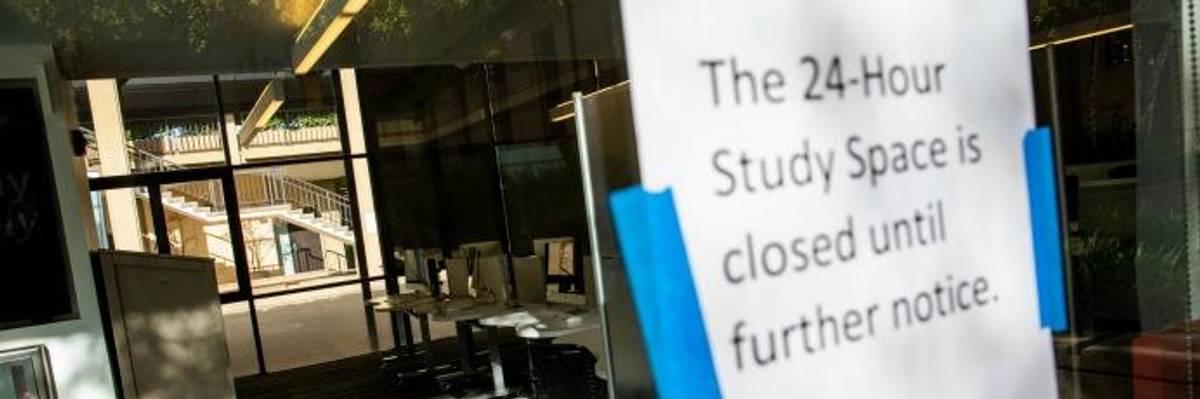
A study space remains closed due to coronavirus fears at Stanford University on March 9, 2020 in Stanford, California. Stanford University announced that classes will be held online for the remainder of the winter quarter after a staff member working in a clinic tested positive for the Coronavirus. (Photo: Philip Pacheco/Getty Images)
Progressives said Friday the Federal Communications Commission must step up its efforts to help communities as the novel coronavirus's spread throughout the nation bolsters the case for progressive policies including universal and affordable broadband access.
With many employers and educational institutions moving operations online, "Broadband will become even more vital for millions of Americans," said Democratic FCC commissioner Geoffrey Starks--a point echoed by Rep. Ro Khanna (D-Calif.).
The call came as FCC chairman Ajit Pai on Friday kicked off the "Keep Americans Connected Pledge," which asks broadband and telephone service providers:
"As the coronavirus outbreak spreads and causes a series of disruptions to the economic, educational, medical, and civic life of our country, it is imperative that Americans stay connected. Broadband will enable them to communicate with their loved ones and doctors, telework, ensure their children can engage in remote learning, and--importantly--take part in the 'social distancing' that will be so critical to limiting the spread of this novel coronavirus," Pai said in a statement Friday, adding that some major servcie providers including AT&T, US Cellular, and Verizon had already signed onto the pledge.
Free Press campaign director Candace Clement welcomed the development but stressed that "there's much more that all internet service providers (ISPs) can and should do."
"While a few large ISPs have decided to drop their arbitrary and unreasonable data caps and overage fees, many have not. Millions of people in the United States are still impacted, including those using smaller ISPs that are not nationally known brands," she said.
Trade organizations representing ISPs should press the companies to take further steps, Clement said, like stopping service cutoffs, getting rid of caps and overage fees, and offering low-cost service packages.
The FCC should step up its own efforts as well, said Clement. She pointed to the Lifetime program, which helps lower the cost of communications services for lower-income customers, as one target of those efforts.
Clement said the federal agency can take actions such as "increasing monthly allotments for Lifeline wireless plans, approving experimental licenses to increase public Wi-Fi capacity, and finally taking seriously the potential for traffic spikes and snarls at internet-exchange points."
Another advocacy group, Common Cause, issued a similarly lukewarm response to Pai's new program.
"Unfortunately, the FCC has spent the last few years stripping much of its authority to oversee the broadband industry, preventing many of the provisions in this pledge from being enforceable," said Michael Copps, a former FCC Commissioner and special advisor with Common Cause. He also address Lifeline, saying the FCC must make certain that "all eligible low-income households are enrolled in the program."
Copps also pointed to an issue that's been a focus of Democratic FCC commissioner Jessica Rosenworcel--the digital divides' impact on students.
"As Commissioner Rosenworcel has repeatedly stated, the 'homework gap' puts students without home broadband at a significant disadvantage," said Copps.
"The coronavirus pandemic will expose many of the gaps in broadband connectivity we face today," he added. "The FCC must do everything it can to close these gaps and fully address the broadband connectivity needs of all Americans during this pandemic."
Dear Common Dreams reader, It’s been nearly 30 years since I co-founded Common Dreams with my late wife, Lina Newhouser. We had the radical notion that journalism should serve the public good, not corporate profits. It was clear to us from the outset what it would take to build such a project. No paid advertisements. No corporate sponsors. No millionaire publisher telling us what to think or do. Many people said we wouldn't last a year, but we proved those doubters wrong. Together with a tremendous team of journalists and dedicated staff, we built an independent media outlet free from the constraints of profits and corporate control. Our mission has always been simple: To inform. To inspire. To ignite change for the common good. Building Common Dreams was not easy. Our survival was never guaranteed. When you take on the most powerful forces—Wall Street greed, fossil fuel industry destruction, Big Tech lobbyists, and uber-rich oligarchs who have spent billions upon billions rigging the economy and democracy in their favor—the only bulwark you have is supporters who believe in your work. But here’s the urgent message from me today. It's never been this bad out there. And it's never been this hard to keep us going. At the very moment Common Dreams is most needed, the threats we face are intensifying. We need your support now more than ever. We don't accept corporate advertising and never will. We don't have a paywall because we don't think people should be blocked from critical news based on their ability to pay. Everything we do is funded by the donations of readers like you. When everyone does the little they can afford, we are strong. But if that support retreats or dries up, so do we. Will you donate now to make sure Common Dreams not only survives but thrives? —Craig Brown, Co-founder |
Progressives said Friday the Federal Communications Commission must step up its efforts to help communities as the novel coronavirus's spread throughout the nation bolsters the case for progressive policies including universal and affordable broadband access.
With many employers and educational institutions moving operations online, "Broadband will become even more vital for millions of Americans," said Democratic FCC commissioner Geoffrey Starks--a point echoed by Rep. Ro Khanna (D-Calif.).
The call came as FCC chairman Ajit Pai on Friday kicked off the "Keep Americans Connected Pledge," which asks broadband and telephone service providers:
"As the coronavirus outbreak spreads and causes a series of disruptions to the economic, educational, medical, and civic life of our country, it is imperative that Americans stay connected. Broadband will enable them to communicate with their loved ones and doctors, telework, ensure their children can engage in remote learning, and--importantly--take part in the 'social distancing' that will be so critical to limiting the spread of this novel coronavirus," Pai said in a statement Friday, adding that some major servcie providers including AT&T, US Cellular, and Verizon had already signed onto the pledge.
Free Press campaign director Candace Clement welcomed the development but stressed that "there's much more that all internet service providers (ISPs) can and should do."
"While a few large ISPs have decided to drop their arbitrary and unreasonable data caps and overage fees, many have not. Millions of people in the United States are still impacted, including those using smaller ISPs that are not nationally known brands," she said.
Trade organizations representing ISPs should press the companies to take further steps, Clement said, like stopping service cutoffs, getting rid of caps and overage fees, and offering low-cost service packages.
The FCC should step up its own efforts as well, said Clement. She pointed to the Lifetime program, which helps lower the cost of communications services for lower-income customers, as one target of those efforts.
Clement said the federal agency can take actions such as "increasing monthly allotments for Lifeline wireless plans, approving experimental licenses to increase public Wi-Fi capacity, and finally taking seriously the potential for traffic spikes and snarls at internet-exchange points."
Another advocacy group, Common Cause, issued a similarly lukewarm response to Pai's new program.
"Unfortunately, the FCC has spent the last few years stripping much of its authority to oversee the broadband industry, preventing many of the provisions in this pledge from being enforceable," said Michael Copps, a former FCC Commissioner and special advisor with Common Cause. He also address Lifeline, saying the FCC must make certain that "all eligible low-income households are enrolled in the program."
Copps also pointed to an issue that's been a focus of Democratic FCC commissioner Jessica Rosenworcel--the digital divides' impact on students.
"As Commissioner Rosenworcel has repeatedly stated, the 'homework gap' puts students without home broadband at a significant disadvantage," said Copps.
"The coronavirus pandemic will expose many of the gaps in broadband connectivity we face today," he added. "The FCC must do everything it can to close these gaps and fully address the broadband connectivity needs of all Americans during this pandemic."
Progressives said Friday the Federal Communications Commission must step up its efforts to help communities as the novel coronavirus's spread throughout the nation bolsters the case for progressive policies including universal and affordable broadband access.
With many employers and educational institutions moving operations online, "Broadband will become even more vital for millions of Americans," said Democratic FCC commissioner Geoffrey Starks--a point echoed by Rep. Ro Khanna (D-Calif.).
The call came as FCC chairman Ajit Pai on Friday kicked off the "Keep Americans Connected Pledge," which asks broadband and telephone service providers:
"As the coronavirus outbreak spreads and causes a series of disruptions to the economic, educational, medical, and civic life of our country, it is imperative that Americans stay connected. Broadband will enable them to communicate with their loved ones and doctors, telework, ensure their children can engage in remote learning, and--importantly--take part in the 'social distancing' that will be so critical to limiting the spread of this novel coronavirus," Pai said in a statement Friday, adding that some major servcie providers including AT&T, US Cellular, and Verizon had already signed onto the pledge.
Free Press campaign director Candace Clement welcomed the development but stressed that "there's much more that all internet service providers (ISPs) can and should do."
"While a few large ISPs have decided to drop their arbitrary and unreasonable data caps and overage fees, many have not. Millions of people in the United States are still impacted, including those using smaller ISPs that are not nationally known brands," she said.
Trade organizations representing ISPs should press the companies to take further steps, Clement said, like stopping service cutoffs, getting rid of caps and overage fees, and offering low-cost service packages.
The FCC should step up its own efforts as well, said Clement. She pointed to the Lifetime program, which helps lower the cost of communications services for lower-income customers, as one target of those efforts.
Clement said the federal agency can take actions such as "increasing monthly allotments for Lifeline wireless plans, approving experimental licenses to increase public Wi-Fi capacity, and finally taking seriously the potential for traffic spikes and snarls at internet-exchange points."
Another advocacy group, Common Cause, issued a similarly lukewarm response to Pai's new program.
"Unfortunately, the FCC has spent the last few years stripping much of its authority to oversee the broadband industry, preventing many of the provisions in this pledge from being enforceable," said Michael Copps, a former FCC Commissioner and special advisor with Common Cause. He also address Lifeline, saying the FCC must make certain that "all eligible low-income households are enrolled in the program."
Copps also pointed to an issue that's been a focus of Democratic FCC commissioner Jessica Rosenworcel--the digital divides' impact on students.
"As Commissioner Rosenworcel has repeatedly stated, the 'homework gap' puts students without home broadband at a significant disadvantage," said Copps.
"The coronavirus pandemic will expose many of the gaps in broadband connectivity we face today," he added. "The FCC must do everything it can to close these gaps and fully address the broadband connectivity needs of all Americans during this pandemic."