

SUBSCRIBE TO OUR FREE NEWSLETTER
Daily news & progressive opinion—funded by the people, not the corporations—delivered straight to your inbox.
5
#000000
#FFFFFF
To donate by check, phone, or other method, see our More Ways to Give page.
Daily news & progressive opinion—funded by the people, not the corporations—delivered straight to your inbox.
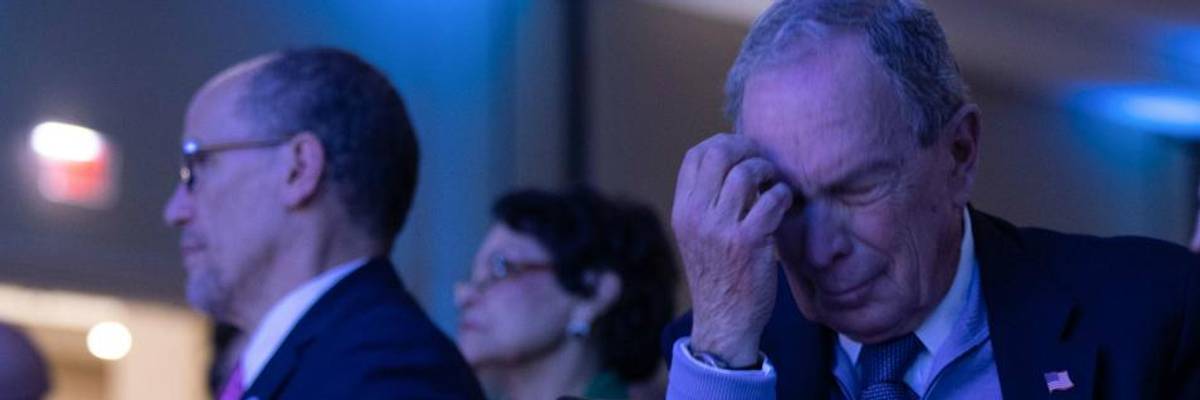
Presidental hopeful Former New York City Mayor Michael Bloomberg scratches his forehead as he waits to speak to attendees at the Blue NC Celebration, a dinner put on by the North Carolina Democratic Party at the Hilton in University City in Charlotte, North Carolina on February 29, 2020. - Former vice president Joe Biden won the South Carolina primary on Saturday, reviving his flagging campaign and positioning himself as the leading rival to frontrunner Bernie Sanders in the race for the Democratic presidential nomination. (Photo: Logan Cyrus / AFP)
With progressives continuing to criticize mega-billionaire Michael Bloomberg for buying his way into the 2020 Democratic primary, the former mayor of New York City has used his nearly endless fortune to purchase a 3-minute ad slot in prime time from major networks Sunday night in order to ostensibly address the growing threat of coronavirus and offer a "presidential contrast" between himself and President Donald Trump.
According to Politico, "Bloomberg will offer himself as a steady leader during a time of crisis. Though his address won't cite Trump by name, it's not hard to tell the point Bloomberg's driving at. In recent days, Bloomberg has been slamming Trump by name over his handling of the public health scare." As the news outlet notes:
The speech, running during commercial airtime about 8:30 Eastern on CBS and NBC, is a remarkable step for a presidential candidate not currently serving in public office, and is likely to cost Bloomberg in the millions to run. It comes three days before his presidential primary debut on Super Tuesday, and seeks to draw a direct comparison between the steady hand his campaign says be offers and the rashness of Trump.
The move was met with derision by progressive critics:
Bruce Mirken, media relations director at the progressive Greenlining Institute, called it a "creepy and totally inappropriate move" by Bloomberg in a tweet from his personal account.
While one unnamed Bloomberg aide told Politico it was "a serious time right now and people need to see what a real leader looks like and someone that has dealt with a crisis before--and that's Mike," critics reminded people that Bloomberg was the mayor of New York City when Hurricane Sandy devastated its residents in 2012--with the region's poorest hit hardest and many critical of Bloomberg's lackluster and unequal response.
As journalist Ted Rall noted in a Common Dreams op-ed early in 2013, just months after Sandy struck, it was notable that even as city residents ravaged by Sandy remained homeless or "shivering under blankets in heatless homes in 15deg weather because restoring electricity and housing storm victims [wasn't] one of the mayor's top priorities," Bloomberg found the time to donate a whopping $345 million to his alma mater, Johns Hopkins University.
While the growing threat of the coronavirus continues to draw concern across the nation, and every presidential candidate has made it a point to chime in about the seriousness of the crisis, Bloomberg's purchase of the ad time on Sunday was seen as just the latest example of the billionaire plutocrat throwing his money around, not in the service of the public interest, but to his own political ambitions.
Public health experts, meanwhile, have urged all the candidates--as well as Trump--to do everything possible not to politicize (to the extent that's possible) the response to the emergency.
In comments to the Guardian published Sunday, Dr. John Ioannidis, chair in disease prevention at Stanford University medical school, said that "both politicians and self-proclaimed experts should talk less" about the coronavirus--suggesting public health officials, frontline healthcare workers, and the appropriate federal and international agencies should be left to perform the proper distribution of information.
Dear Common Dreams reader, It’s been nearly 30 years since I co-founded Common Dreams with my late wife, Lina Newhouser. We had the radical notion that journalism should serve the public good, not corporate profits. It was clear to us from the outset what it would take to build such a project. No paid advertisements. No corporate sponsors. No millionaire publisher telling us what to think or do. Many people said we wouldn't last a year, but we proved those doubters wrong. Together with a tremendous team of journalists and dedicated staff, we built an independent media outlet free from the constraints of profits and corporate control. Our mission has always been simple: To inform. To inspire. To ignite change for the common good. Building Common Dreams was not easy. Our survival was never guaranteed. When you take on the most powerful forces—Wall Street greed, fossil fuel industry destruction, Big Tech lobbyists, and uber-rich oligarchs who have spent billions upon billions rigging the economy and democracy in their favor—the only bulwark you have is supporters who believe in your work. But here’s the urgent message from me today. It's never been this bad out there. And it's never been this hard to keep us going. At the very moment Common Dreams is most needed, the threats we face are intensifying. We need your support now more than ever. We don't accept corporate advertising and never will. We don't have a paywall because we don't think people should be blocked from critical news based on their ability to pay. Everything we do is funded by the donations of readers like you. When everyone does the little they can afford, we are strong. But if that support retreats or dries up, so do we. Will you donate now to make sure Common Dreams not only survives but thrives? —Craig Brown, Co-founder |
With progressives continuing to criticize mega-billionaire Michael Bloomberg for buying his way into the 2020 Democratic primary, the former mayor of New York City has used his nearly endless fortune to purchase a 3-minute ad slot in prime time from major networks Sunday night in order to ostensibly address the growing threat of coronavirus and offer a "presidential contrast" between himself and President Donald Trump.
According to Politico, "Bloomberg will offer himself as a steady leader during a time of crisis. Though his address won't cite Trump by name, it's not hard to tell the point Bloomberg's driving at. In recent days, Bloomberg has been slamming Trump by name over his handling of the public health scare." As the news outlet notes:
The speech, running during commercial airtime about 8:30 Eastern on CBS and NBC, is a remarkable step for a presidential candidate not currently serving in public office, and is likely to cost Bloomberg in the millions to run. It comes three days before his presidential primary debut on Super Tuesday, and seeks to draw a direct comparison between the steady hand his campaign says be offers and the rashness of Trump.
The move was met with derision by progressive critics:
Bruce Mirken, media relations director at the progressive Greenlining Institute, called it a "creepy and totally inappropriate move" by Bloomberg in a tweet from his personal account.
While one unnamed Bloomberg aide told Politico it was "a serious time right now and people need to see what a real leader looks like and someone that has dealt with a crisis before--and that's Mike," critics reminded people that Bloomberg was the mayor of New York City when Hurricane Sandy devastated its residents in 2012--with the region's poorest hit hardest and many critical of Bloomberg's lackluster and unequal response.
As journalist Ted Rall noted in a Common Dreams op-ed early in 2013, just months after Sandy struck, it was notable that even as city residents ravaged by Sandy remained homeless or "shivering under blankets in heatless homes in 15deg weather because restoring electricity and housing storm victims [wasn't] one of the mayor's top priorities," Bloomberg found the time to donate a whopping $345 million to his alma mater, Johns Hopkins University.
While the growing threat of the coronavirus continues to draw concern across the nation, and every presidential candidate has made it a point to chime in about the seriousness of the crisis, Bloomberg's purchase of the ad time on Sunday was seen as just the latest example of the billionaire plutocrat throwing his money around, not in the service of the public interest, but to his own political ambitions.
Public health experts, meanwhile, have urged all the candidates--as well as Trump--to do everything possible not to politicize (to the extent that's possible) the response to the emergency.
In comments to the Guardian published Sunday, Dr. John Ioannidis, chair in disease prevention at Stanford University medical school, said that "both politicians and self-proclaimed experts should talk less" about the coronavirus--suggesting public health officials, frontline healthcare workers, and the appropriate federal and international agencies should be left to perform the proper distribution of information.
With progressives continuing to criticize mega-billionaire Michael Bloomberg for buying his way into the 2020 Democratic primary, the former mayor of New York City has used his nearly endless fortune to purchase a 3-minute ad slot in prime time from major networks Sunday night in order to ostensibly address the growing threat of coronavirus and offer a "presidential contrast" between himself and President Donald Trump.
According to Politico, "Bloomberg will offer himself as a steady leader during a time of crisis. Though his address won't cite Trump by name, it's not hard to tell the point Bloomberg's driving at. In recent days, Bloomberg has been slamming Trump by name over his handling of the public health scare." As the news outlet notes:
The speech, running during commercial airtime about 8:30 Eastern on CBS and NBC, is a remarkable step for a presidential candidate not currently serving in public office, and is likely to cost Bloomberg in the millions to run. It comes three days before his presidential primary debut on Super Tuesday, and seeks to draw a direct comparison between the steady hand his campaign says be offers and the rashness of Trump.
The move was met with derision by progressive critics:
Bruce Mirken, media relations director at the progressive Greenlining Institute, called it a "creepy and totally inappropriate move" by Bloomberg in a tweet from his personal account.
While one unnamed Bloomberg aide told Politico it was "a serious time right now and people need to see what a real leader looks like and someone that has dealt with a crisis before--and that's Mike," critics reminded people that Bloomberg was the mayor of New York City when Hurricane Sandy devastated its residents in 2012--with the region's poorest hit hardest and many critical of Bloomberg's lackluster and unequal response.
As journalist Ted Rall noted in a Common Dreams op-ed early in 2013, just months after Sandy struck, it was notable that even as city residents ravaged by Sandy remained homeless or "shivering under blankets in heatless homes in 15deg weather because restoring electricity and housing storm victims [wasn't] one of the mayor's top priorities," Bloomberg found the time to donate a whopping $345 million to his alma mater, Johns Hopkins University.
While the growing threat of the coronavirus continues to draw concern across the nation, and every presidential candidate has made it a point to chime in about the seriousness of the crisis, Bloomberg's purchase of the ad time on Sunday was seen as just the latest example of the billionaire plutocrat throwing his money around, not in the service of the public interest, but to his own political ambitions.
Public health experts, meanwhile, have urged all the candidates--as well as Trump--to do everything possible not to politicize (to the extent that's possible) the response to the emergency.
In comments to the Guardian published Sunday, Dr. John Ioannidis, chair in disease prevention at Stanford University medical school, said that "both politicians and self-proclaimed experts should talk less" about the coronavirus--suggesting public health officials, frontline healthcare workers, and the appropriate federal and international agencies should be left to perform the proper distribution of information.

