SUBSCRIBE TO OUR FREE NEWSLETTER
Daily news & progressive opinion—funded by the people, not the corporations—delivered straight to your inbox.
5
#000000
#FFFFFF
To donate by check, phone, or other method, see our More Ways to Give page.
Daily news & progressive opinion—funded by the people, not the corporations—delivered straight to your inbox.
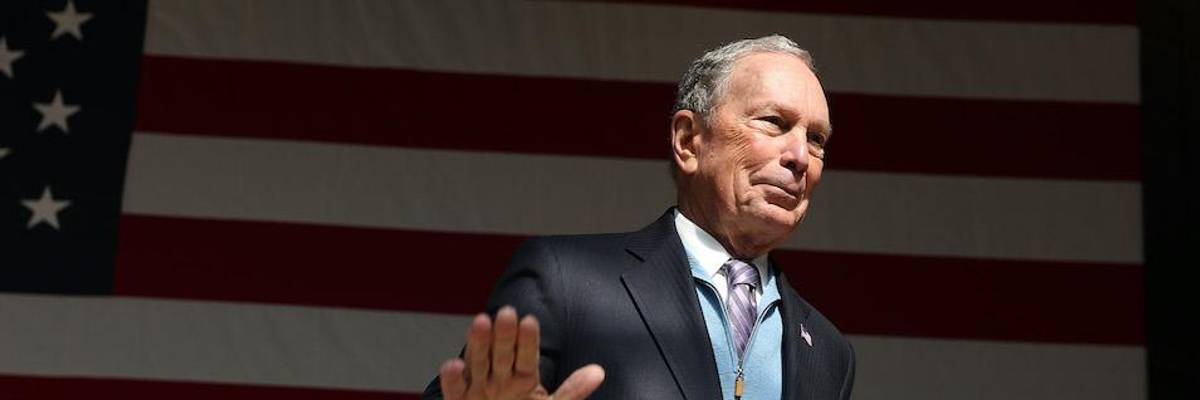
Former New York City Mayor Mike Bloomberg attends his rally held at The Rustic on February 27, 2020 in Houston. (Photo: Joe Raedle/Getty Images)
Former New York City Mayor Michael Bloomberg, the billionaire businessman running for the 2020 Democratic presidential nomination, hired party vice chairs in Texas and California to work on his campaign just before the states prepare to vote in the presidential primaries on March 3--a move that drew charges from progessives of an attempt buy influence from party elites.
"This does seem to fit a longstanding pattern of Bloomberg using his billions to help generate support among political elites," Campaign Legal Center federal reform program director Brendan Fischer told The Intercept.
Intercept reporter Akela Lacy broke the news Friday morning.
"The Democratic Party has a problem," said Jewish Currents writer Joshua Leifer of the reporting.
Texas Democratic Party vice chair Carla Brailey and California State Democratic Party vice chair Alexandra Rooker were hired in December and January, respectively, as senior advisors to the Bloomberg campaign.
According to Lacy's reporting:
Both Brailey and Rooker are superdelegates who will likely vote for the Democratic presidential nominee at the party's national convention this summer. Hiring the leadership of a state party doesn't appear to break any campaign laws.
The apparent legality of the move--despite what was broadly seen as a clear example of corruption--befuddled observers.
"It boggles my mind that this doesn't seem to break any rules," tweeted Lacy's Intercept colleague Alex Emmons.
Bloomberg's hiring of the two vice chairs also struck observers as problematic because of the possibility of a brokered convention in Milwaukee this July which would allow superdelegates to vote from the second round on, giving the unelected party elites an outsized say in the ultimate nominee.
As Lacy reported:
Rooker is one of two members of Bloomberg's campaign staff who also sits on the Democratic National Committee's rules committee, which recommends rules for the convention, the convention agenda, the convention's permanent officers, amendments to the party's charter, and other resolutions. In November, the month he entered the presidential race, Bloomberg gave $320,000 to the DNC, his first contributions to the committee since 1998. (He was a registered Republican from 2001 to 2007, after which he became an independent. He registered as a Democrat in 2018.) He also donated $10,000 to the Texas Democratic Party, where Brailey has been vice chair since June 2018, as well as $10,000 to the California Democratic Party. Brailey, Rooker, and the Bloomberg campaign did not respond to requests for comment on their hiring.
Rumblings of the possiblity party leaders could deliver the nomination to someone other than Sen. Bernie Sanders (I-Vt.), the current frontrunner, if Sanders does not have a clear majority of delegates has sparked outrage from progressives.
"The will of the people should prevail," Sanders said on February 19 at a debate in Las Vegas. "The person who has the most votes should become the nominee."
The optics of superdelegates on the Bloomberg payroll, no matter what the outcome of the convention, raised concerns for progressives. Journalist Michael Tracey referred to an apparent misstatement by Bloomberg during a debate February 25 where the billionaire appeared to almost say he "bought" members of Congress.
"Remember when Bloomberg slipped up at the debate this week and admitted that he has 'bought' Democrats?" said Tracey.
If Bloomberg enters the convention with superdelegates like Brailey and Rooker on his staff, that could wreak havoc on the entire process, said Voter Participation Center communications director Aaron Huertas.
"Let's not play with fire," Huertas tweeted.
Dear Common Dreams reader, It’s been nearly 30 years since I co-founded Common Dreams with my late wife, Lina Newhouser. We had the radical notion that journalism should serve the public good, not corporate profits. It was clear to us from the outset what it would take to build such a project. No paid advertisements. No corporate sponsors. No millionaire publisher telling us what to think or do. Many people said we wouldn't last a year, but we proved those doubters wrong. Together with a tremendous team of journalists and dedicated staff, we built an independent media outlet free from the constraints of profits and corporate control. Our mission has always been simple: To inform. To inspire. To ignite change for the common good. Building Common Dreams was not easy. Our survival was never guaranteed. When you take on the most powerful forces—Wall Street greed, fossil fuel industry destruction, Big Tech lobbyists, and uber-rich oligarchs who have spent billions upon billions rigging the economy and democracy in their favor—the only bulwark you have is supporters who believe in your work. But here’s the urgent message from me today. It's never been this bad out there. And it's never been this hard to keep us going. At the very moment Common Dreams is most needed, the threats we face are intensifying. We need your support now more than ever. We don't accept corporate advertising and never will. We don't have a paywall because we don't think people should be blocked from critical news based on their ability to pay. Everything we do is funded by the donations of readers like you. When everyone does the little they can afford, we are strong. But if that support retreats or dries up, so do we. Will you donate now to make sure Common Dreams not only survives but thrives? —Craig Brown, Co-founder |
Former New York City Mayor Michael Bloomberg, the billionaire businessman running for the 2020 Democratic presidential nomination, hired party vice chairs in Texas and California to work on his campaign just before the states prepare to vote in the presidential primaries on March 3--a move that drew charges from progessives of an attempt buy influence from party elites.
"This does seem to fit a longstanding pattern of Bloomberg using his billions to help generate support among political elites," Campaign Legal Center federal reform program director Brendan Fischer told The Intercept.
Intercept reporter Akela Lacy broke the news Friday morning.
"The Democratic Party has a problem," said Jewish Currents writer Joshua Leifer of the reporting.
Texas Democratic Party vice chair Carla Brailey and California State Democratic Party vice chair Alexandra Rooker were hired in December and January, respectively, as senior advisors to the Bloomberg campaign.
According to Lacy's reporting:
Both Brailey and Rooker are superdelegates who will likely vote for the Democratic presidential nominee at the party's national convention this summer. Hiring the leadership of a state party doesn't appear to break any campaign laws.
The apparent legality of the move--despite what was broadly seen as a clear example of corruption--befuddled observers.
"It boggles my mind that this doesn't seem to break any rules," tweeted Lacy's Intercept colleague Alex Emmons.
Bloomberg's hiring of the two vice chairs also struck observers as problematic because of the possibility of a brokered convention in Milwaukee this July which would allow superdelegates to vote from the second round on, giving the unelected party elites an outsized say in the ultimate nominee.
As Lacy reported:
Rooker is one of two members of Bloomberg's campaign staff who also sits on the Democratic National Committee's rules committee, which recommends rules for the convention, the convention agenda, the convention's permanent officers, amendments to the party's charter, and other resolutions. In November, the month he entered the presidential race, Bloomberg gave $320,000 to the DNC, his first contributions to the committee since 1998. (He was a registered Republican from 2001 to 2007, after which he became an independent. He registered as a Democrat in 2018.) He also donated $10,000 to the Texas Democratic Party, where Brailey has been vice chair since June 2018, as well as $10,000 to the California Democratic Party. Brailey, Rooker, and the Bloomberg campaign did not respond to requests for comment on their hiring.
Rumblings of the possiblity party leaders could deliver the nomination to someone other than Sen. Bernie Sanders (I-Vt.), the current frontrunner, if Sanders does not have a clear majority of delegates has sparked outrage from progressives.
"The will of the people should prevail," Sanders said on February 19 at a debate in Las Vegas. "The person who has the most votes should become the nominee."
The optics of superdelegates on the Bloomberg payroll, no matter what the outcome of the convention, raised concerns for progressives. Journalist Michael Tracey referred to an apparent misstatement by Bloomberg during a debate February 25 where the billionaire appeared to almost say he "bought" members of Congress.
"Remember when Bloomberg slipped up at the debate this week and admitted that he has 'bought' Democrats?" said Tracey.
If Bloomberg enters the convention with superdelegates like Brailey and Rooker on his staff, that could wreak havoc on the entire process, said Voter Participation Center communications director Aaron Huertas.
"Let's not play with fire," Huertas tweeted.
Former New York City Mayor Michael Bloomberg, the billionaire businessman running for the 2020 Democratic presidential nomination, hired party vice chairs in Texas and California to work on his campaign just before the states prepare to vote in the presidential primaries on March 3--a move that drew charges from progessives of an attempt buy influence from party elites.
"This does seem to fit a longstanding pattern of Bloomberg using his billions to help generate support among political elites," Campaign Legal Center federal reform program director Brendan Fischer told The Intercept.
Intercept reporter Akela Lacy broke the news Friday morning.
"The Democratic Party has a problem," said Jewish Currents writer Joshua Leifer of the reporting.
Texas Democratic Party vice chair Carla Brailey and California State Democratic Party vice chair Alexandra Rooker were hired in December and January, respectively, as senior advisors to the Bloomberg campaign.
According to Lacy's reporting:
Both Brailey and Rooker are superdelegates who will likely vote for the Democratic presidential nominee at the party's national convention this summer. Hiring the leadership of a state party doesn't appear to break any campaign laws.
The apparent legality of the move--despite what was broadly seen as a clear example of corruption--befuddled observers.
"It boggles my mind that this doesn't seem to break any rules," tweeted Lacy's Intercept colleague Alex Emmons.
Bloomberg's hiring of the two vice chairs also struck observers as problematic because of the possibility of a brokered convention in Milwaukee this July which would allow superdelegates to vote from the second round on, giving the unelected party elites an outsized say in the ultimate nominee.
As Lacy reported:
Rooker is one of two members of Bloomberg's campaign staff who also sits on the Democratic National Committee's rules committee, which recommends rules for the convention, the convention agenda, the convention's permanent officers, amendments to the party's charter, and other resolutions. In November, the month he entered the presidential race, Bloomberg gave $320,000 to the DNC, his first contributions to the committee since 1998. (He was a registered Republican from 2001 to 2007, after which he became an independent. He registered as a Democrat in 2018.) He also donated $10,000 to the Texas Democratic Party, where Brailey has been vice chair since June 2018, as well as $10,000 to the California Democratic Party. Brailey, Rooker, and the Bloomberg campaign did not respond to requests for comment on their hiring.
Rumblings of the possiblity party leaders could deliver the nomination to someone other than Sen. Bernie Sanders (I-Vt.), the current frontrunner, if Sanders does not have a clear majority of delegates has sparked outrage from progressives.
"The will of the people should prevail," Sanders said on February 19 at a debate in Las Vegas. "The person who has the most votes should become the nominee."
The optics of superdelegates on the Bloomberg payroll, no matter what the outcome of the convention, raised concerns for progressives. Journalist Michael Tracey referred to an apparent misstatement by Bloomberg during a debate February 25 where the billionaire appeared to almost say he "bought" members of Congress.
"Remember when Bloomberg slipped up at the debate this week and admitted that he has 'bought' Democrats?" said Tracey.
If Bloomberg enters the convention with superdelegates like Brailey and Rooker on his staff, that could wreak havoc on the entire process, said Voter Participation Center communications director Aaron Huertas.
"Let's not play with fire," Huertas tweeted.