SUBSCRIBE TO OUR FREE NEWSLETTER
Daily news & progressive opinion—funded by the people, not the corporations—delivered straight to your inbox.
5
#000000
#FFFFFF
To donate by check, phone, or other method, see our More Ways to Give page.
Daily news & progressive opinion—funded by the people, not the corporations—delivered straight to your inbox.
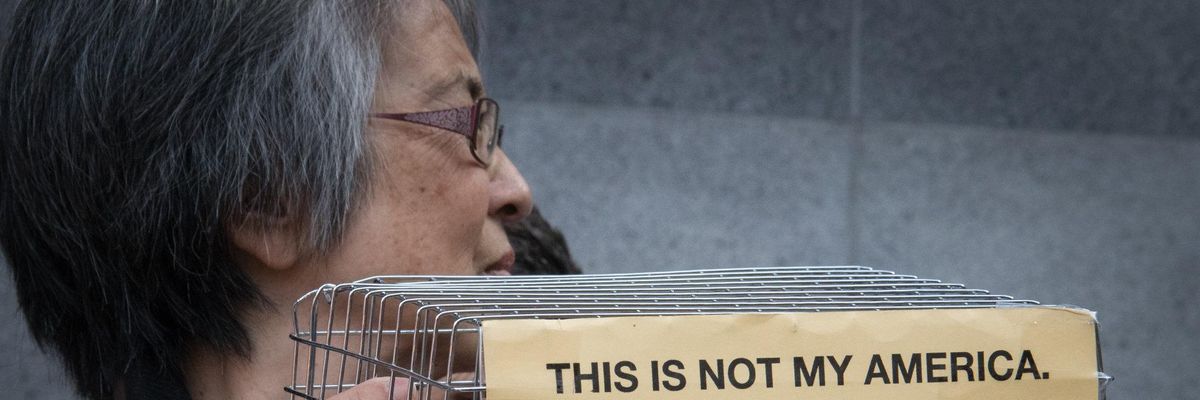
An activist holds a prop portraying incarcerated immigrants at a February 14, 2020 vigil outside the ICE building in San Francisco. (Photo: Peg Hunter/flickr/cc)
Immigrant rights advocates including Japanese American victims of World War II incarceration campas reaffirmed their message that #NeverAgainIsNow on Sunday with a rally outside an immigration prison in Tacoma, Washington.
The action--organized by Tsuru for Solidarity, La Resistencia, Densho, and the Japanese American Citizens League--commemorated the Day of Remembrance, which marks President Franklin D. Roosevelt's Feb. 19, 1942 executive order that forced over 100,000 people of Japanese descent, including American citizens, into incarceration "camps."
Activists targeted the Northwest Detention Center (NWDC), run by the controversial GEO Group for U.S. Immigration and Customs Enforcement. The prison holds roughly 1,500 people and has been targeted by immigrant rights advocates who say prisoners there are held under inhumane conditions.
The Japanese American activists said they cannot separate the injustices they and their families faced in the U.S. from those felt by the current victims of the country's immigration policies.
"We want to be the allies that our community needed on this day during World War II," Tsuru co-chair Carl Takei said last week.
A call-to-action for the rally explained the reason for the protest:
The Northwest Detention Center (NWDC) in Tacoma, WA is one of the largest immigration prisons in the country, with a capacity to hold up to 1575 immigrants per day. Up to 200 people, many of whom are seeking asylum, are transferred from the US-Mexico border to the NWDC each month. Other people held at the NWDC have lived in the US for years, in some cases for the majority of their lives. While some are deported after only weeks, some are held for months and even years awaiting the outcomes of their deportation cases. Few legal protections apply to these civil detainees, and those held are not entitled to an attorney at government expense; approximately 90% of them move forward in their cases unrepresented.
As survivors and descendants of Japanese American WWII incarceration, we stand united with all those who have suffered the atrocities of U.S. concentration camps, past and present, to say, "Stop Repeating History!"
Demonstrators shared images and video of the rally on social media:
Here at NWDC for a Day of Remembranc, Day of Action with @DenshoProject @ResistenciaNW #NeverAgainIsNow
Hearing about hunger strikes happening inside. pic.twitter.com/iuMITBMZMP
-- share the cities (@sharethecities) February 23, 2020
Homer Yasui, who was a teen when U.S. authorities forced his family onto California's Tule Lake camp, told Prism why, at 95 years old, he thought it was important to take part in the action.
"Seventy-eight years ago, my people were being loudly and viciously denounced as being 'disloyal' by the press, the U.S. government, politicians, and the American people in general. Almost nobody stood up for us," he said.
"Quiet Americans were the enablers that allowed the atrocity of the so-called evacuation to happen," Yasui continued. "I learned something from that. So now I am going to stand up for immigrants and people of Islamic faith who have been viciously and wrongfully attacked as being criminals, rapists, and terrorists. If I can do it, so can others."
Dear Common Dreams reader, It’s been nearly 30 years since I co-founded Common Dreams with my late wife, Lina Newhouser. We had the radical notion that journalism should serve the public good, not corporate profits. It was clear to us from the outset what it would take to build such a project. No paid advertisements. No corporate sponsors. No millionaire publisher telling us what to think or do. Many people said we wouldn't last a year, but we proved those doubters wrong. Together with a tremendous team of journalists and dedicated staff, we built an independent media outlet free from the constraints of profits and corporate control. Our mission has always been simple: To inform. To inspire. To ignite change for the common good. Building Common Dreams was not easy. Our survival was never guaranteed. When you take on the most powerful forces—Wall Street greed, fossil fuel industry destruction, Big Tech lobbyists, and uber-rich oligarchs who have spent billions upon billions rigging the economy and democracy in their favor—the only bulwark you have is supporters who believe in your work. But here’s the urgent message from me today. It's never been this bad out there. And it's never been this hard to keep us going. At the very moment Common Dreams is most needed, the threats we face are intensifying. We need your support now more than ever. We don't accept corporate advertising and never will. We don't have a paywall because we don't think people should be blocked from critical news based on their ability to pay. Everything we do is funded by the donations of readers like you. When everyone does the little they can afford, we are strong. But if that support retreats or dries up, so do we. Will you donate now to make sure Common Dreams not only survives but thrives? —Craig Brown, Co-founder |
Immigrant rights advocates including Japanese American victims of World War II incarceration campas reaffirmed their message that #NeverAgainIsNow on Sunday with a rally outside an immigration prison in Tacoma, Washington.
The action--organized by Tsuru for Solidarity, La Resistencia, Densho, and the Japanese American Citizens League--commemorated the Day of Remembrance, which marks President Franklin D. Roosevelt's Feb. 19, 1942 executive order that forced over 100,000 people of Japanese descent, including American citizens, into incarceration "camps."
Activists targeted the Northwest Detention Center (NWDC), run by the controversial GEO Group for U.S. Immigration and Customs Enforcement. The prison holds roughly 1,500 people and has been targeted by immigrant rights advocates who say prisoners there are held under inhumane conditions.
The Japanese American activists said they cannot separate the injustices they and their families faced in the U.S. from those felt by the current victims of the country's immigration policies.
"We want to be the allies that our community needed on this day during World War II," Tsuru co-chair Carl Takei said last week.
A call-to-action for the rally explained the reason for the protest:
The Northwest Detention Center (NWDC) in Tacoma, WA is one of the largest immigration prisons in the country, with a capacity to hold up to 1575 immigrants per day. Up to 200 people, many of whom are seeking asylum, are transferred from the US-Mexico border to the NWDC each month. Other people held at the NWDC have lived in the US for years, in some cases for the majority of their lives. While some are deported after only weeks, some are held for months and even years awaiting the outcomes of their deportation cases. Few legal protections apply to these civil detainees, and those held are not entitled to an attorney at government expense; approximately 90% of them move forward in their cases unrepresented.
As survivors and descendants of Japanese American WWII incarceration, we stand united with all those who have suffered the atrocities of U.S. concentration camps, past and present, to say, "Stop Repeating History!"
Demonstrators shared images and video of the rally on social media:
Here at NWDC for a Day of Remembranc, Day of Action with @DenshoProject @ResistenciaNW #NeverAgainIsNow
Hearing about hunger strikes happening inside. pic.twitter.com/iuMITBMZMP
-- share the cities (@sharethecities) February 23, 2020
Homer Yasui, who was a teen when U.S. authorities forced his family onto California's Tule Lake camp, told Prism why, at 95 years old, he thought it was important to take part in the action.
"Seventy-eight years ago, my people were being loudly and viciously denounced as being 'disloyal' by the press, the U.S. government, politicians, and the American people in general. Almost nobody stood up for us," he said.
"Quiet Americans were the enablers that allowed the atrocity of the so-called evacuation to happen," Yasui continued. "I learned something from that. So now I am going to stand up for immigrants and people of Islamic faith who have been viciously and wrongfully attacked as being criminals, rapists, and terrorists. If I can do it, so can others."
Immigrant rights advocates including Japanese American victims of World War II incarceration campas reaffirmed their message that #NeverAgainIsNow on Sunday with a rally outside an immigration prison in Tacoma, Washington.
The action--organized by Tsuru for Solidarity, La Resistencia, Densho, and the Japanese American Citizens League--commemorated the Day of Remembrance, which marks President Franklin D. Roosevelt's Feb. 19, 1942 executive order that forced over 100,000 people of Japanese descent, including American citizens, into incarceration "camps."
Activists targeted the Northwest Detention Center (NWDC), run by the controversial GEO Group for U.S. Immigration and Customs Enforcement. The prison holds roughly 1,500 people and has been targeted by immigrant rights advocates who say prisoners there are held under inhumane conditions.
The Japanese American activists said they cannot separate the injustices they and their families faced in the U.S. from those felt by the current victims of the country's immigration policies.
"We want to be the allies that our community needed on this day during World War II," Tsuru co-chair Carl Takei said last week.
A call-to-action for the rally explained the reason for the protest:
The Northwest Detention Center (NWDC) in Tacoma, WA is one of the largest immigration prisons in the country, with a capacity to hold up to 1575 immigrants per day. Up to 200 people, many of whom are seeking asylum, are transferred from the US-Mexico border to the NWDC each month. Other people held at the NWDC have lived in the US for years, in some cases for the majority of their lives. While some are deported after only weeks, some are held for months and even years awaiting the outcomes of their deportation cases. Few legal protections apply to these civil detainees, and those held are not entitled to an attorney at government expense; approximately 90% of them move forward in their cases unrepresented.
As survivors and descendants of Japanese American WWII incarceration, we stand united with all those who have suffered the atrocities of U.S. concentration camps, past and present, to say, "Stop Repeating History!"
Demonstrators shared images and video of the rally on social media:
Here at NWDC for a Day of Remembranc, Day of Action with @DenshoProject @ResistenciaNW #NeverAgainIsNow
Hearing about hunger strikes happening inside. pic.twitter.com/iuMITBMZMP
-- share the cities (@sharethecities) February 23, 2020
Homer Yasui, who was a teen when U.S. authorities forced his family onto California's Tule Lake camp, told Prism why, at 95 years old, he thought it was important to take part in the action.
"Seventy-eight years ago, my people were being loudly and viciously denounced as being 'disloyal' by the press, the U.S. government, politicians, and the American people in general. Almost nobody stood up for us," he said.
"Quiet Americans were the enablers that allowed the atrocity of the so-called evacuation to happen," Yasui continued. "I learned something from that. So now I am going to stand up for immigrants and people of Islamic faith who have been viciously and wrongfully attacked as being criminals, rapists, and terrorists. If I can do it, so can others."