SUBSCRIBE TO OUR FREE NEWSLETTER
Daily news & progressive opinion—funded by the people, not the corporations—delivered straight to your inbox.
5
#000000
#FFFFFF
To donate by check, phone, or other method, see our More Ways to Give page.
Daily news & progressive opinion—funded by the people, not the corporations—delivered straight to your inbox.
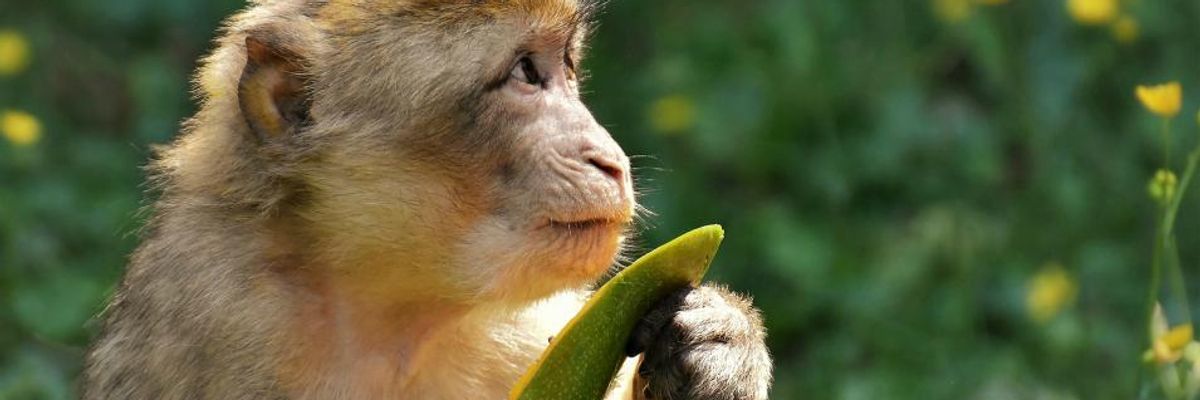
The Barbary macaque (Macaca sylvanus) is classified as "endangered" by the International Union for Conservation of Nature. (Photo: Alexas_Fotos/Pixabay)
Ahead of government negotiations scheduled for next week on a global plan to address the biodiversity crisis, 23 former foreign ministers from various countries released a statement on Tuesday urging world leaders to act "boldly" to protect nature.
"It is clear to us... that climate change, ecosystem degradation, and the excessive exploitation of natural resources are now threatening millions of species with extinction and jeopardizing the health of our planet," says the statement. "The loss and degradation of nature jeopardizes human health, livelihoods, safety, and prosperity. It disproportionately harms our poorest communities while undermining our ability to meet a broad range of targets set by the United Nations Sustainable Development Goals."
"The world has a moral imperative to collaborate on strong actions to mitigate and adapt to the current climate change and biodiversity crisis. Ambitious targets for conservation of land and ocean ecosystems are vital components of the solution," the statement continues. "Humanity sits on the precipice of irreversible loss of biodiversity and a climate crisis that imperils the future for our grandchildren and generations to come. The world must act boldly, and it must act now."
A U.N. report released in May 2019 by the Intergovernmental Science-Policy Platform on Biodiversity and Ecosystem Services (IPBES) warned that, as Common Dreams reported at the time, "human exploitation of the natural world has pushed a million plant and animal species to the brink of extinction--with potentially devastating implications for the future of civilization."
That report and a growing body of scientific research on rapidly declining biodiversity has led scientists and policymakers alike to raise the alarm about the consequences of not acting ambitiously enough to address what experts have called the "sixth mass extinction." U.N. biodiversity chief Elizabeth Maruma Mrema told the Guardian last month that humanity risks being left to contend with an "empty world."
The new statement from diplomats came before the Feb. 24-29 meeting of the Working Group on the Post-2020 Global Biodiversity Framework, which was recently moved from Kunming, China to Rome, Italy due to the ongoing coronavirus disease (COVID-19) outbreak. The event will build on an August 2019 meeting in Nairobi, Kenya. A third meeting in Cali, Colombia is planned for July.
Those three events will culminate in the adoption of a "Paris-style U.N. agreement" to protect nature at the 15th meeting of the Conference of the Parties (COP 15) to the Convention on Biological Diversity (CBD), which is still set to be held in Kunming in October. A 20-point draft plan to stop and reverse biodiversity loss worldwide, which will be a focus of the Rome talks, was unveiled last month.
The foreign ministers' statement specifically expresses support for "setting a global target of strongly protecting at least 30 percent of the land and 30 percent of the ocean by 2030." The 30 percent conservation target, as the statement notes, is backed by "a broad coalition--including youth, the business community, and representatives from the developing world."
"We also support the finalization of a new international legally binding treaty in 2020 for the conservation and sustainable use of marine biodiversity in the high seas currently being negotiated under the U.N . Convention on Law of the Sea," the statement says, noting that nearly two-thirds of the ocean is beyond the legal jurisdiction of any one nation.
The statement was released through the international nonprofit think tank the Aspen Institute by members of the Aspen Ministers Forum, which was founded in 2003 by former U.S. Secretary of State Madeleine Albright.
Along with Albright, the statement was signed by Lloyd Axworthy (Canada), Mohamed Benaissa (Morocco), Maria Eugenia Brizuela de Avila (El Salvador), Erik Derycke (Belgium), Lamberto Dini (Italy), Alexander Downer (Australia), Jan Eliasson (Sweden), Joschka Fischer (Germany), Jaime Gama (Portugal), Ibrahim Gambari (Nigeria), Marina Kaljurand (Estonia), Tzipi Livni (Israel), Susana Malcorra (Argentina), Donald McKinnon (New Zealand), Daniel Mitov (Bulgaria), Amre Moussa (Egypt), Marwan Muasher (Jordan), George Papandreou (Greece), Malcolm Rifkind (United Kingdom), Claudia Ruiz Massieu (Mexico), Javier Solana (Spain), and Knut Vollebaek (Norway).
Dear Common Dreams reader, It’s been nearly 30 years since I co-founded Common Dreams with my late wife, Lina Newhouser. We had the radical notion that journalism should serve the public good, not corporate profits. It was clear to us from the outset what it would take to build such a project. No paid advertisements. No corporate sponsors. No millionaire publisher telling us what to think or do. Many people said we wouldn't last a year, but we proved those doubters wrong. Together with a tremendous team of journalists and dedicated staff, we built an independent media outlet free from the constraints of profits and corporate control. Our mission has always been simple: To inform. To inspire. To ignite change for the common good. Building Common Dreams was not easy. Our survival was never guaranteed. When you take on the most powerful forces—Wall Street greed, fossil fuel industry destruction, Big Tech lobbyists, and uber-rich oligarchs who have spent billions upon billions rigging the economy and democracy in their favor—the only bulwark you have is supporters who believe in your work. But here’s the urgent message from me today. It's never been this bad out there. And it's never been this hard to keep us going. At the very moment Common Dreams is most needed, the threats we face are intensifying. We need your support now more than ever. We don't accept corporate advertising and never will. We don't have a paywall because we don't think people should be blocked from critical news based on their ability to pay. Everything we do is funded by the donations of readers like you. When everyone does the little they can afford, we are strong. But if that support retreats or dries up, so do we. Will you donate now to make sure Common Dreams not only survives but thrives? —Craig Brown, Co-founder |
Ahead of government negotiations scheduled for next week on a global plan to address the biodiversity crisis, 23 former foreign ministers from various countries released a statement on Tuesday urging world leaders to act "boldly" to protect nature.
"It is clear to us... that climate change, ecosystem degradation, and the excessive exploitation of natural resources are now threatening millions of species with extinction and jeopardizing the health of our planet," says the statement. "The loss and degradation of nature jeopardizes human health, livelihoods, safety, and prosperity. It disproportionately harms our poorest communities while undermining our ability to meet a broad range of targets set by the United Nations Sustainable Development Goals."
"The world has a moral imperative to collaborate on strong actions to mitigate and adapt to the current climate change and biodiversity crisis. Ambitious targets for conservation of land and ocean ecosystems are vital components of the solution," the statement continues. "Humanity sits on the precipice of irreversible loss of biodiversity and a climate crisis that imperils the future for our grandchildren and generations to come. The world must act boldly, and it must act now."
A U.N. report released in May 2019 by the Intergovernmental Science-Policy Platform on Biodiversity and Ecosystem Services (IPBES) warned that, as Common Dreams reported at the time, "human exploitation of the natural world has pushed a million plant and animal species to the brink of extinction--with potentially devastating implications for the future of civilization."
That report and a growing body of scientific research on rapidly declining biodiversity has led scientists and policymakers alike to raise the alarm about the consequences of not acting ambitiously enough to address what experts have called the "sixth mass extinction." U.N. biodiversity chief Elizabeth Maruma Mrema told the Guardian last month that humanity risks being left to contend with an "empty world."
The new statement from diplomats came before the Feb. 24-29 meeting of the Working Group on the Post-2020 Global Biodiversity Framework, which was recently moved from Kunming, China to Rome, Italy due to the ongoing coronavirus disease (COVID-19) outbreak. The event will build on an August 2019 meeting in Nairobi, Kenya. A third meeting in Cali, Colombia is planned for July.
Those three events will culminate in the adoption of a "Paris-style U.N. agreement" to protect nature at the 15th meeting of the Conference of the Parties (COP 15) to the Convention on Biological Diversity (CBD), which is still set to be held in Kunming in October. A 20-point draft plan to stop and reverse biodiversity loss worldwide, which will be a focus of the Rome talks, was unveiled last month.
The foreign ministers' statement specifically expresses support for "setting a global target of strongly protecting at least 30 percent of the land and 30 percent of the ocean by 2030." The 30 percent conservation target, as the statement notes, is backed by "a broad coalition--including youth, the business community, and representatives from the developing world."
"We also support the finalization of a new international legally binding treaty in 2020 for the conservation and sustainable use of marine biodiversity in the high seas currently being negotiated under the U.N . Convention on Law of the Sea," the statement says, noting that nearly two-thirds of the ocean is beyond the legal jurisdiction of any one nation.
The statement was released through the international nonprofit think tank the Aspen Institute by members of the Aspen Ministers Forum, which was founded in 2003 by former U.S. Secretary of State Madeleine Albright.
Along with Albright, the statement was signed by Lloyd Axworthy (Canada), Mohamed Benaissa (Morocco), Maria Eugenia Brizuela de Avila (El Salvador), Erik Derycke (Belgium), Lamberto Dini (Italy), Alexander Downer (Australia), Jan Eliasson (Sweden), Joschka Fischer (Germany), Jaime Gama (Portugal), Ibrahim Gambari (Nigeria), Marina Kaljurand (Estonia), Tzipi Livni (Israel), Susana Malcorra (Argentina), Donald McKinnon (New Zealand), Daniel Mitov (Bulgaria), Amre Moussa (Egypt), Marwan Muasher (Jordan), George Papandreou (Greece), Malcolm Rifkind (United Kingdom), Claudia Ruiz Massieu (Mexico), Javier Solana (Spain), and Knut Vollebaek (Norway).
Ahead of government negotiations scheduled for next week on a global plan to address the biodiversity crisis, 23 former foreign ministers from various countries released a statement on Tuesday urging world leaders to act "boldly" to protect nature.
"It is clear to us... that climate change, ecosystem degradation, and the excessive exploitation of natural resources are now threatening millions of species with extinction and jeopardizing the health of our planet," says the statement. "The loss and degradation of nature jeopardizes human health, livelihoods, safety, and prosperity. It disproportionately harms our poorest communities while undermining our ability to meet a broad range of targets set by the United Nations Sustainable Development Goals."
"The world has a moral imperative to collaborate on strong actions to mitigate and adapt to the current climate change and biodiversity crisis. Ambitious targets for conservation of land and ocean ecosystems are vital components of the solution," the statement continues. "Humanity sits on the precipice of irreversible loss of biodiversity and a climate crisis that imperils the future for our grandchildren and generations to come. The world must act boldly, and it must act now."
A U.N. report released in May 2019 by the Intergovernmental Science-Policy Platform on Biodiversity and Ecosystem Services (IPBES) warned that, as Common Dreams reported at the time, "human exploitation of the natural world has pushed a million plant and animal species to the brink of extinction--with potentially devastating implications for the future of civilization."
That report and a growing body of scientific research on rapidly declining biodiversity has led scientists and policymakers alike to raise the alarm about the consequences of not acting ambitiously enough to address what experts have called the "sixth mass extinction." U.N. biodiversity chief Elizabeth Maruma Mrema told the Guardian last month that humanity risks being left to contend with an "empty world."
The new statement from diplomats came before the Feb. 24-29 meeting of the Working Group on the Post-2020 Global Biodiversity Framework, which was recently moved from Kunming, China to Rome, Italy due to the ongoing coronavirus disease (COVID-19) outbreak. The event will build on an August 2019 meeting in Nairobi, Kenya. A third meeting in Cali, Colombia is planned for July.
Those three events will culminate in the adoption of a "Paris-style U.N. agreement" to protect nature at the 15th meeting of the Conference of the Parties (COP 15) to the Convention on Biological Diversity (CBD), which is still set to be held in Kunming in October. A 20-point draft plan to stop and reverse biodiversity loss worldwide, which will be a focus of the Rome talks, was unveiled last month.
The foreign ministers' statement specifically expresses support for "setting a global target of strongly protecting at least 30 percent of the land and 30 percent of the ocean by 2030." The 30 percent conservation target, as the statement notes, is backed by "a broad coalition--including youth, the business community, and representatives from the developing world."
"We also support the finalization of a new international legally binding treaty in 2020 for the conservation and sustainable use of marine biodiversity in the high seas currently being negotiated under the U.N . Convention on Law of the Sea," the statement says, noting that nearly two-thirds of the ocean is beyond the legal jurisdiction of any one nation.
The statement was released through the international nonprofit think tank the Aspen Institute by members of the Aspen Ministers Forum, which was founded in 2003 by former U.S. Secretary of State Madeleine Albright.
Along with Albright, the statement was signed by Lloyd Axworthy (Canada), Mohamed Benaissa (Morocco), Maria Eugenia Brizuela de Avila (El Salvador), Erik Derycke (Belgium), Lamberto Dini (Italy), Alexander Downer (Australia), Jan Eliasson (Sweden), Joschka Fischer (Germany), Jaime Gama (Portugal), Ibrahim Gambari (Nigeria), Marina Kaljurand (Estonia), Tzipi Livni (Israel), Susana Malcorra (Argentina), Donald McKinnon (New Zealand), Daniel Mitov (Bulgaria), Amre Moussa (Egypt), Marwan Muasher (Jordan), George Papandreou (Greece), Malcolm Rifkind (United Kingdom), Claudia Ruiz Massieu (Mexico), Javier Solana (Spain), and Knut Vollebaek (Norway).