

SUBSCRIBE TO OUR FREE NEWSLETTER
Daily news & progressive opinion—funded by the people, not the corporations—delivered straight to your inbox.
5
#000000
#FFFFFF
To donate by check, phone, or other method, see our More Ways to Give page.
Daily news & progressive opinion—funded by the people, not the corporations—delivered straight to your inbox.
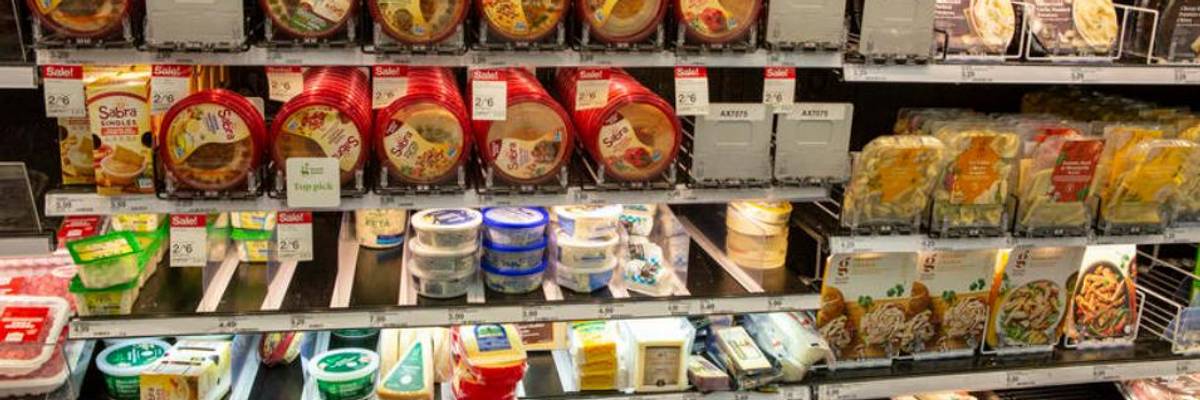
A Greenpeace photographer captures plastic food packaging at a retailer in Virginia on Feb. 6, 2020. (Photo: Tim Aubry/Greenpeace)
A report published Tuesday by Greenpeace concludes that "recyclable" claims and labels on plastic consumer products in the United States are often "misleading," based on a comprehensive survey of conditions from October 2019 to January 2020 and the U.S. Federal Trade Commission's Green Guides requirements.
Circular Claims Fall Flat: Comprehensive U.S. Survey of Plastics Recyclability (pdf) features the findings from a survey of the 367 U.S. material recovery facilities (MRFs). Greenpeace notes that "there have been significant changes" in these facilities' acceptance policies recently, in part due to declining demand resulting from China's restrictions on plastic waste imports.
"This survey confirms what many news reports have indicated since China restricted plastic waste imports two years ago--that recycling facilities across the country are not able to sort, sell, and reprocess much of the plastic that companies produce," independent engineer and the Last Beach Cleanup founder Jan Dell, who led the survey, said in a statement.
Reporting on the survey Tuesday, the Guardian highlighted its own investigation from last year "which revealed that numerous types of plastics are being sent straight to landfill in the wake of China's crackdown on U.S. recycling exports."
Specifically, as the Greenpeace report's executive summary outlines, the survey found:
"Retailers and consumer goods companies across the country are frequently putting labels on their products that mislead the public and harm America's recycling systems," Greenpeace USA oceans campaign director John Hocevar said Tuesday. "Instead of getting serious about moving away from single-use plastic, corporations are hiding behind the pretense that their throwaway packaging is recyclable. We know now that this is untrue. The jig is up."
Some of the commonly used consumer products made of plastics that aren't accepted at a large majority of U.S. MRFs include plastic cups, trays, bags, lids, cutlery, straws, stirrers, and food wrappers.
"Greenpeace has identified numerous examples of U.S. companies using misleading labels. Target, Nestle, Danone, Walmart, Procter & Gamble, Clorox, Aldi, SC Johnson, and Unilever are among the companies that Greenpeace has asked to correct their labels, and some changes are underway," the environmental group said in a statement. "If companies show no willingness to end this deception, the organization plans to file formal FTC complaints."
The report says that "accurate recyclable claims and labels serve three valuable functions: truthful advertising to consumers, prevention of harmful contamination in America's recycling system, and identification of products for elimination or redesign to reduce waste and plastic pollution." Greenpeace on Tuesday reiterated its call for U.S. corporations to move away from single-use plastics and "to invest in reusable, refillable, and package-free approaches."
The Greenpeace report came just a week after Sen. Tom Udall (D-N.M.) along with Reps. Alan Lowenthal (D-Calif.) and Katherine Clark (D-Mass.) introduced the Break Free From Plastic Pollution Act of 2020. The bill would reduce and ban certain single-use plastics, pause new plastic producing facilities, create a nationwide beverage container refund program, standardize recycling and composting labeling, set minimum recycled content requirements, incentivize companies to make reusable products, and require major corporations to take responsibility for their plastic pollution.
"After decades of treating our land, waterways, and oceans as plastic waste dumping grounds, we now face a global plastic pollution crisis," Lowenthal said in a statement last week. "Recent scientific studies show that plastic waste particles are now found everywhere we look--in the soil, in the rainwater, in the food chain, and even inside our own bodies."
"Our legislation applies one of the core principles of environmental law: 'the polluter pays.' It is time for multi-billion-dollar companies to step up and cover the costs of cleaning up the waste from their products," he continued. "As a major exporter of plastics waste, we also have a responsibility and a duty to address this problem. We are running out of time to deal with this crisis of our own creation, and this legislation is a bold first step on the path to implementing lasting solutions."
According to the Break Free From Plastic movement, this is "the first comprehensive bill in Congress to address the plastic pollution crisis." Members of the movement, which includes 1,900 organizations and over 6,100 individuals, provided input on the measure and have welcomed it.
In a statement last week, Greenpeace plastics campaigner Kate Melges called the sweeping legislation "a game-changer because it comprehensively tackles the issue of single-use plastics" and encouraged federal lawmakers and "forward-thinking companies" to support it.
"For too long, corporations have diverted blame for the plastic pollution crisis they have created. They have told us that if we just recycle more or participate in beach cleanups that we can turn this around. That has not worked," said Melges.
"It is time to end our reliance on single-use plastics and prevent petrochemical companies from locking us into decades of additional plastic production," she added. "We must end the era of throwaway plastics and move toward systems of reuse and package-free options immediately."
Dear Common Dreams reader, It’s been nearly 30 years since I co-founded Common Dreams with my late wife, Lina Newhouser. We had the radical notion that journalism should serve the public good, not corporate profits. It was clear to us from the outset what it would take to build such a project. No paid advertisements. No corporate sponsors. No millionaire publisher telling us what to think or do. Many people said we wouldn't last a year, but we proved those doubters wrong. Together with a tremendous team of journalists and dedicated staff, we built an independent media outlet free from the constraints of profits and corporate control. Our mission has always been simple: To inform. To inspire. To ignite change for the common good. Building Common Dreams was not easy. Our survival was never guaranteed. When you take on the most powerful forces—Wall Street greed, fossil fuel industry destruction, Big Tech lobbyists, and uber-rich oligarchs who have spent billions upon billions rigging the economy and democracy in their favor—the only bulwark you have is supporters who believe in your work. But here’s the urgent message from me today. It's never been this bad out there. And it's never been this hard to keep us going. At the very moment Common Dreams is most needed, the threats we face are intensifying. We need your support now more than ever. We don't accept corporate advertising and never will. We don't have a paywall because we don't think people should be blocked from critical news based on their ability to pay. Everything we do is funded by the donations of readers like you. When everyone does the little they can afford, we are strong. But if that support retreats or dries up, so do we. Will you donate now to make sure Common Dreams not only survives but thrives? —Craig Brown, Co-founder |
A report published Tuesday by Greenpeace concludes that "recyclable" claims and labels on plastic consumer products in the United States are often "misleading," based on a comprehensive survey of conditions from October 2019 to January 2020 and the U.S. Federal Trade Commission's Green Guides requirements.
Circular Claims Fall Flat: Comprehensive U.S. Survey of Plastics Recyclability (pdf) features the findings from a survey of the 367 U.S. material recovery facilities (MRFs). Greenpeace notes that "there have been significant changes" in these facilities' acceptance policies recently, in part due to declining demand resulting from China's restrictions on plastic waste imports.
"This survey confirms what many news reports have indicated since China restricted plastic waste imports two years ago--that recycling facilities across the country are not able to sort, sell, and reprocess much of the plastic that companies produce," independent engineer and the Last Beach Cleanup founder Jan Dell, who led the survey, said in a statement.
Reporting on the survey Tuesday, the Guardian highlighted its own investigation from last year "which revealed that numerous types of plastics are being sent straight to landfill in the wake of China's crackdown on U.S. recycling exports."
Specifically, as the Greenpeace report's executive summary outlines, the survey found:
"Retailers and consumer goods companies across the country are frequently putting labels on their products that mislead the public and harm America's recycling systems," Greenpeace USA oceans campaign director John Hocevar said Tuesday. "Instead of getting serious about moving away from single-use plastic, corporations are hiding behind the pretense that their throwaway packaging is recyclable. We know now that this is untrue. The jig is up."
Some of the commonly used consumer products made of plastics that aren't accepted at a large majority of U.S. MRFs include plastic cups, trays, bags, lids, cutlery, straws, stirrers, and food wrappers.
"Greenpeace has identified numerous examples of U.S. companies using misleading labels. Target, Nestle, Danone, Walmart, Procter & Gamble, Clorox, Aldi, SC Johnson, and Unilever are among the companies that Greenpeace has asked to correct their labels, and some changes are underway," the environmental group said in a statement. "If companies show no willingness to end this deception, the organization plans to file formal FTC complaints."
The report says that "accurate recyclable claims and labels serve three valuable functions: truthful advertising to consumers, prevention of harmful contamination in America's recycling system, and identification of products for elimination or redesign to reduce waste and plastic pollution." Greenpeace on Tuesday reiterated its call for U.S. corporations to move away from single-use plastics and "to invest in reusable, refillable, and package-free approaches."
The Greenpeace report came just a week after Sen. Tom Udall (D-N.M.) along with Reps. Alan Lowenthal (D-Calif.) and Katherine Clark (D-Mass.) introduced the Break Free From Plastic Pollution Act of 2020. The bill would reduce and ban certain single-use plastics, pause new plastic producing facilities, create a nationwide beverage container refund program, standardize recycling and composting labeling, set minimum recycled content requirements, incentivize companies to make reusable products, and require major corporations to take responsibility for their plastic pollution.
"After decades of treating our land, waterways, and oceans as plastic waste dumping grounds, we now face a global plastic pollution crisis," Lowenthal said in a statement last week. "Recent scientific studies show that plastic waste particles are now found everywhere we look--in the soil, in the rainwater, in the food chain, and even inside our own bodies."
"Our legislation applies one of the core principles of environmental law: 'the polluter pays.' It is time for multi-billion-dollar companies to step up and cover the costs of cleaning up the waste from their products," he continued. "As a major exporter of plastics waste, we also have a responsibility and a duty to address this problem. We are running out of time to deal with this crisis of our own creation, and this legislation is a bold first step on the path to implementing lasting solutions."
According to the Break Free From Plastic movement, this is "the first comprehensive bill in Congress to address the plastic pollution crisis." Members of the movement, which includes 1,900 organizations and over 6,100 individuals, provided input on the measure and have welcomed it.
In a statement last week, Greenpeace plastics campaigner Kate Melges called the sweeping legislation "a game-changer because it comprehensively tackles the issue of single-use plastics" and encouraged federal lawmakers and "forward-thinking companies" to support it.
"For too long, corporations have diverted blame for the plastic pollution crisis they have created. They have told us that if we just recycle more or participate in beach cleanups that we can turn this around. That has not worked," said Melges.
"It is time to end our reliance on single-use plastics and prevent petrochemical companies from locking us into decades of additional plastic production," she added. "We must end the era of throwaway plastics and move toward systems of reuse and package-free options immediately."
A report published Tuesday by Greenpeace concludes that "recyclable" claims and labels on plastic consumer products in the United States are often "misleading," based on a comprehensive survey of conditions from October 2019 to January 2020 and the U.S. Federal Trade Commission's Green Guides requirements.
Circular Claims Fall Flat: Comprehensive U.S. Survey of Plastics Recyclability (pdf) features the findings from a survey of the 367 U.S. material recovery facilities (MRFs). Greenpeace notes that "there have been significant changes" in these facilities' acceptance policies recently, in part due to declining demand resulting from China's restrictions on plastic waste imports.
"This survey confirms what many news reports have indicated since China restricted plastic waste imports two years ago--that recycling facilities across the country are not able to sort, sell, and reprocess much of the plastic that companies produce," independent engineer and the Last Beach Cleanup founder Jan Dell, who led the survey, said in a statement.
Reporting on the survey Tuesday, the Guardian highlighted its own investigation from last year "which revealed that numerous types of plastics are being sent straight to landfill in the wake of China's crackdown on U.S. recycling exports."
Specifically, as the Greenpeace report's executive summary outlines, the survey found:
"Retailers and consumer goods companies across the country are frequently putting labels on their products that mislead the public and harm America's recycling systems," Greenpeace USA oceans campaign director John Hocevar said Tuesday. "Instead of getting serious about moving away from single-use plastic, corporations are hiding behind the pretense that their throwaway packaging is recyclable. We know now that this is untrue. The jig is up."
Some of the commonly used consumer products made of plastics that aren't accepted at a large majority of U.S. MRFs include plastic cups, trays, bags, lids, cutlery, straws, stirrers, and food wrappers.
"Greenpeace has identified numerous examples of U.S. companies using misleading labels. Target, Nestle, Danone, Walmart, Procter & Gamble, Clorox, Aldi, SC Johnson, and Unilever are among the companies that Greenpeace has asked to correct their labels, and some changes are underway," the environmental group said in a statement. "If companies show no willingness to end this deception, the organization plans to file formal FTC complaints."
The report says that "accurate recyclable claims and labels serve three valuable functions: truthful advertising to consumers, prevention of harmful contamination in America's recycling system, and identification of products for elimination or redesign to reduce waste and plastic pollution." Greenpeace on Tuesday reiterated its call for U.S. corporations to move away from single-use plastics and "to invest in reusable, refillable, and package-free approaches."
The Greenpeace report came just a week after Sen. Tom Udall (D-N.M.) along with Reps. Alan Lowenthal (D-Calif.) and Katherine Clark (D-Mass.) introduced the Break Free From Plastic Pollution Act of 2020. The bill would reduce and ban certain single-use plastics, pause new plastic producing facilities, create a nationwide beverage container refund program, standardize recycling and composting labeling, set minimum recycled content requirements, incentivize companies to make reusable products, and require major corporations to take responsibility for their plastic pollution.
"After decades of treating our land, waterways, and oceans as plastic waste dumping grounds, we now face a global plastic pollution crisis," Lowenthal said in a statement last week. "Recent scientific studies show that plastic waste particles are now found everywhere we look--in the soil, in the rainwater, in the food chain, and even inside our own bodies."
"Our legislation applies one of the core principles of environmental law: 'the polluter pays.' It is time for multi-billion-dollar companies to step up and cover the costs of cleaning up the waste from their products," he continued. "As a major exporter of plastics waste, we also have a responsibility and a duty to address this problem. We are running out of time to deal with this crisis of our own creation, and this legislation is a bold first step on the path to implementing lasting solutions."
According to the Break Free From Plastic movement, this is "the first comprehensive bill in Congress to address the plastic pollution crisis." Members of the movement, which includes 1,900 organizations and over 6,100 individuals, provided input on the measure and have welcomed it.
In a statement last week, Greenpeace plastics campaigner Kate Melges called the sweeping legislation "a game-changer because it comprehensively tackles the issue of single-use plastics" and encouraged federal lawmakers and "forward-thinking companies" to support it.
"For too long, corporations have diverted blame for the plastic pollution crisis they have created. They have told us that if we just recycle more or participate in beach cleanups that we can turn this around. That has not worked," said Melges.
"It is time to end our reliance on single-use plastics and prevent petrochemical companies from locking us into decades of additional plastic production," she added. "We must end the era of throwaway plastics and move toward systems of reuse and package-free options immediately."

