SUBSCRIBE TO OUR FREE NEWSLETTER
Daily news & progressive opinion—funded by the people, not the corporations—delivered straight to your inbox.
5
#000000
#FFFFFF
To donate by check, phone, or other method, see our More Ways to Give page.
Daily news & progressive opinion—funded by the people, not the corporations—delivered straight to your inbox.
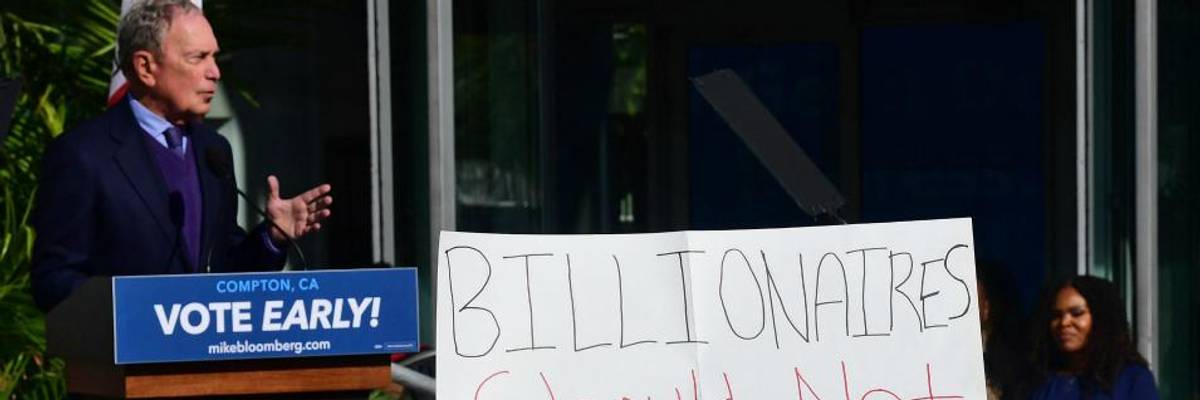
Democratic presidential candidate Mike Bloomberg speaks during the kickoff of his "Get it Done Express" bus tour as a protester holds up a sign reading "Billionaires Should Not Buy Elections" at the Dollarhide Community Center in Compton, California on February 3, 2020. (Photo: Frederic J. Brown/AFP via Getty Images)
In a staggering milestone in what critics have characterized as an effort to buy the Democratic nomination, billionaire businessman Michael Bloomberg has already poured more than $350 million of his own personal wealth into television, digital, and radio advertising since launching his 2020 presidential campaign last November.
"This is what plutocracy looks like," author and environmentalist Naomi Klein tweeted Monday in response to a CNN graphic comparing Bloomberg's ad spending to that of his 2020 Democratic rivals.
"At some point Bloomberg is mass bribing cable/local news."
--Adam Johnson
No other candidate has spent as much on advertising as Bloomberg, the former mayor of New York City whose net worth is estimated to be over $60 billion. Tom Steyer, also a billionaire, is in a distant second with $178 million in total ad spending--around half of what Bloomberg has already dished out.
Sen. Bernie Sanders (I-Vt.), who is leading the Democratic presidential field in individual donations, has spent $37 million, nearly 10 times less than Bloomberg's total.
"Money is not speech," tweeted progressive activist Kai Newkirk. "Bloomberg's attempt to buy the presidency is a corruption of our democracy."
Bloomberg's unprecedented ad blitz has been a boon for broadcasting companies, CNBC reported Monday.
"All that spending has created a windfall for local TV broadcasters, especially in Bloomberg's top target states--California, Texas, Florida, New York, and Pennsylvania," CNBC noted. "California and Texas hold their primaries on March 3, aka Super Tuesday. Florida holds its primary March 17, while New York and Pennsylvania hold theirs April 28."
"He wasn't holding town meetings in Iowa, or New Hampshire, or Nevada, or South Carolina. Those were not important enough for him. He could simply buy the election with hundreds of millions of dollars of ads."
--Sen. Bernie Sanders
Wells Fargo analyst Steven Cahall told CNBC that broadcast companies are "jazzed to have Bloomberg in the fray."
Adam Johnson, writer and host of the Citations Needed podcast, warned in a tweet Monday that "at some point Bloomberg is mass bribing cable/local news."
"Usually this isn't an issue because candidates effectively cancel each other out," wrote Johnson, "but when it gets to $1 billion, $2 billion we'll have one candidate underwriting the whole TV news industry."
Due to his belated entry into the presidential contest, Bloomberg bypassed early-voting states and instead focused his attention and money on delegate-rich Super Tuesday states like California and Texas, as well as battleground states like Michigan and Wisconsin.
"We're in swing states," Nick Alto, a Massachusetts field director for the Bloomberg campaign, told volunteers in Brookline on Saturday. "We're in these important states... and with big staffs. Huge operations."
HuffPost's Kevin Robillard reported Tuesday that Bloomberg's "heavy spending is leading to a rise in the polls."
"A national Quinnipiac University poll of Democrats and Democratic-leaning independents released Monday found Bloomberg earning 15% of the vote in the primary, essentially tied for third with Warren," Robillard noted. Sanders led the poll with 25% support.
The Quinnipiac survey showed that Bloomberg's support among black Democratic primary voters has surged 15 percentage points since late January as Biden's support has cratered.
Sanders, who has been critical of Bloomberg's candidacy from its inception, told CNN contributor Dean Obeidallah in an interview Sunday that "it really is absurd that we have a guy who is prepared to spend, already, many hundreds of millions of dollars on TV ads."
"Meanwhile, he did not do what all of the other Democratic candidates do," Sanders said, referring to Bloomberg. "He wasn't holding town meetings in Iowa, or New Hampshire, or Nevada, or South Carolina. Those were not important enough for him. He could simply buy the election with hundreds of millions of dollars of ads."
"That is wrong," Sanders added. "That is the basic, fundamental problem of American society--is that billionaires have extraordinary wealth and power over the economic and political life of this country."
Dear Common Dreams reader, It’s been nearly 30 years since I co-founded Common Dreams with my late wife, Lina Newhouser. We had the radical notion that journalism should serve the public good, not corporate profits. It was clear to us from the outset what it would take to build such a project. No paid advertisements. No corporate sponsors. No millionaire publisher telling us what to think or do. Many people said we wouldn't last a year, but we proved those doubters wrong. Together with a tremendous team of journalists and dedicated staff, we built an independent media outlet free from the constraints of profits and corporate control. Our mission has always been simple: To inform. To inspire. To ignite change for the common good. Building Common Dreams was not easy. Our survival was never guaranteed. When you take on the most powerful forces—Wall Street greed, fossil fuel industry destruction, Big Tech lobbyists, and uber-rich oligarchs who have spent billions upon billions rigging the economy and democracy in their favor—the only bulwark you have is supporters who believe in your work. But here’s the urgent message from me today. It's never been this bad out there. And it's never been this hard to keep us going. At the very moment Common Dreams is most needed, the threats we face are intensifying. We need your support now more than ever. We don't accept corporate advertising and never will. We don't have a paywall because we don't think people should be blocked from critical news based on their ability to pay. Everything we do is funded by the donations of readers like you. When everyone does the little they can afford, we are strong. But if that support retreats or dries up, so do we. Will you donate now to make sure Common Dreams not only survives but thrives? —Craig Brown, Co-founder |
In a staggering milestone in what critics have characterized as an effort to buy the Democratic nomination, billionaire businessman Michael Bloomberg has already poured more than $350 million of his own personal wealth into television, digital, and radio advertising since launching his 2020 presidential campaign last November.
"This is what plutocracy looks like," author and environmentalist Naomi Klein tweeted Monday in response to a CNN graphic comparing Bloomberg's ad spending to that of his 2020 Democratic rivals.
"At some point Bloomberg is mass bribing cable/local news."
--Adam Johnson
No other candidate has spent as much on advertising as Bloomberg, the former mayor of New York City whose net worth is estimated to be over $60 billion. Tom Steyer, also a billionaire, is in a distant second with $178 million in total ad spending--around half of what Bloomberg has already dished out.
Sen. Bernie Sanders (I-Vt.), who is leading the Democratic presidential field in individual donations, has spent $37 million, nearly 10 times less than Bloomberg's total.
"Money is not speech," tweeted progressive activist Kai Newkirk. "Bloomberg's attempt to buy the presidency is a corruption of our democracy."
Bloomberg's unprecedented ad blitz has been a boon for broadcasting companies, CNBC reported Monday.
"All that spending has created a windfall for local TV broadcasters, especially in Bloomberg's top target states--California, Texas, Florida, New York, and Pennsylvania," CNBC noted. "California and Texas hold their primaries on March 3, aka Super Tuesday. Florida holds its primary March 17, while New York and Pennsylvania hold theirs April 28."
"He wasn't holding town meetings in Iowa, or New Hampshire, or Nevada, or South Carolina. Those were not important enough for him. He could simply buy the election with hundreds of millions of dollars of ads."
--Sen. Bernie Sanders
Wells Fargo analyst Steven Cahall told CNBC that broadcast companies are "jazzed to have Bloomberg in the fray."
Adam Johnson, writer and host of the Citations Needed podcast, warned in a tweet Monday that "at some point Bloomberg is mass bribing cable/local news."
"Usually this isn't an issue because candidates effectively cancel each other out," wrote Johnson, "but when it gets to $1 billion, $2 billion we'll have one candidate underwriting the whole TV news industry."
Due to his belated entry into the presidential contest, Bloomberg bypassed early-voting states and instead focused his attention and money on delegate-rich Super Tuesday states like California and Texas, as well as battleground states like Michigan and Wisconsin.
"We're in swing states," Nick Alto, a Massachusetts field director for the Bloomberg campaign, told volunteers in Brookline on Saturday. "We're in these important states... and with big staffs. Huge operations."
HuffPost's Kevin Robillard reported Tuesday that Bloomberg's "heavy spending is leading to a rise in the polls."
"A national Quinnipiac University poll of Democrats and Democratic-leaning independents released Monday found Bloomberg earning 15% of the vote in the primary, essentially tied for third with Warren," Robillard noted. Sanders led the poll with 25% support.
The Quinnipiac survey showed that Bloomberg's support among black Democratic primary voters has surged 15 percentage points since late January as Biden's support has cratered.
Sanders, who has been critical of Bloomberg's candidacy from its inception, told CNN contributor Dean Obeidallah in an interview Sunday that "it really is absurd that we have a guy who is prepared to spend, already, many hundreds of millions of dollars on TV ads."
"Meanwhile, he did not do what all of the other Democratic candidates do," Sanders said, referring to Bloomberg. "He wasn't holding town meetings in Iowa, or New Hampshire, or Nevada, or South Carolina. Those were not important enough for him. He could simply buy the election with hundreds of millions of dollars of ads."
"That is wrong," Sanders added. "That is the basic, fundamental problem of American society--is that billionaires have extraordinary wealth and power over the economic and political life of this country."
In a staggering milestone in what critics have characterized as an effort to buy the Democratic nomination, billionaire businessman Michael Bloomberg has already poured more than $350 million of his own personal wealth into television, digital, and radio advertising since launching his 2020 presidential campaign last November.
"This is what plutocracy looks like," author and environmentalist Naomi Klein tweeted Monday in response to a CNN graphic comparing Bloomberg's ad spending to that of his 2020 Democratic rivals.
"At some point Bloomberg is mass bribing cable/local news."
--Adam Johnson
No other candidate has spent as much on advertising as Bloomberg, the former mayor of New York City whose net worth is estimated to be over $60 billion. Tom Steyer, also a billionaire, is in a distant second with $178 million in total ad spending--around half of what Bloomberg has already dished out.
Sen. Bernie Sanders (I-Vt.), who is leading the Democratic presidential field in individual donations, has spent $37 million, nearly 10 times less than Bloomberg's total.
"Money is not speech," tweeted progressive activist Kai Newkirk. "Bloomberg's attempt to buy the presidency is a corruption of our democracy."
Bloomberg's unprecedented ad blitz has been a boon for broadcasting companies, CNBC reported Monday.
"All that spending has created a windfall for local TV broadcasters, especially in Bloomberg's top target states--California, Texas, Florida, New York, and Pennsylvania," CNBC noted. "California and Texas hold their primaries on March 3, aka Super Tuesday. Florida holds its primary March 17, while New York and Pennsylvania hold theirs April 28."
"He wasn't holding town meetings in Iowa, or New Hampshire, or Nevada, or South Carolina. Those were not important enough for him. He could simply buy the election with hundreds of millions of dollars of ads."
--Sen. Bernie Sanders
Wells Fargo analyst Steven Cahall told CNBC that broadcast companies are "jazzed to have Bloomberg in the fray."
Adam Johnson, writer and host of the Citations Needed podcast, warned in a tweet Monday that "at some point Bloomberg is mass bribing cable/local news."
"Usually this isn't an issue because candidates effectively cancel each other out," wrote Johnson, "but when it gets to $1 billion, $2 billion we'll have one candidate underwriting the whole TV news industry."
Due to his belated entry into the presidential contest, Bloomberg bypassed early-voting states and instead focused his attention and money on delegate-rich Super Tuesday states like California and Texas, as well as battleground states like Michigan and Wisconsin.
"We're in swing states," Nick Alto, a Massachusetts field director for the Bloomberg campaign, told volunteers in Brookline on Saturday. "We're in these important states... and with big staffs. Huge operations."
HuffPost's Kevin Robillard reported Tuesday that Bloomberg's "heavy spending is leading to a rise in the polls."
"A national Quinnipiac University poll of Democrats and Democratic-leaning independents released Monday found Bloomberg earning 15% of the vote in the primary, essentially tied for third with Warren," Robillard noted. Sanders led the poll with 25% support.
The Quinnipiac survey showed that Bloomberg's support among black Democratic primary voters has surged 15 percentage points since late January as Biden's support has cratered.
Sanders, who has been critical of Bloomberg's candidacy from its inception, told CNN contributor Dean Obeidallah in an interview Sunday that "it really is absurd that we have a guy who is prepared to spend, already, many hundreds of millions of dollars on TV ads."
"Meanwhile, he did not do what all of the other Democratic candidates do," Sanders said, referring to Bloomberg. "He wasn't holding town meetings in Iowa, or New Hampshire, or Nevada, or South Carolina. Those were not important enough for him. He could simply buy the election with hundreds of millions of dollars of ads."
"That is wrong," Sanders added. "That is the basic, fundamental problem of American society--is that billionaires have extraordinary wealth and power over the economic and political life of this country."