SUBSCRIBE TO OUR FREE NEWSLETTER
Daily news & progressive opinion—funded by the people, not the corporations—delivered straight to your inbox.
5
#000000
#FFFFFF
To donate by check, phone, or other method, see our More Ways to Give page.
Daily news & progressive opinion—funded by the people, not the corporations—delivered straight to your inbox.
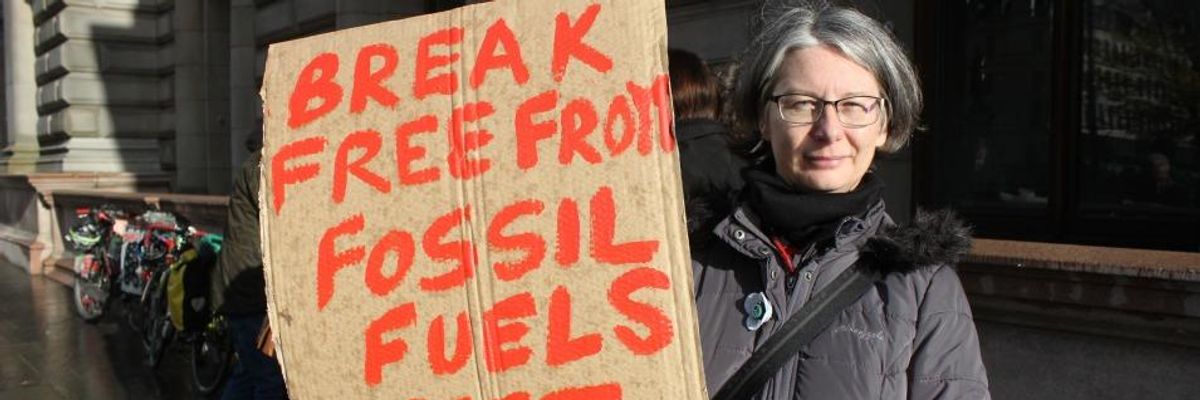
Climate campaigners have been calling for years on companies and shareholders to divest from fossil fuels for the good of the planet, and a new "sell" rating from Goldman Sachs for oil and gas giant Exxon confirms divestment makes good financial sense for investers as well. (Photo: Friends of the Earth Scotland/Flickr/cc)
Three days after CNBC host Jim Cramer pronounced fossil fuel investments as being "in the death knell phase," Goldman Sachs on Monday downgraded its stock assessment for ExxonMobil, advising investors to sell their shares of the oil and gas giant.
The Wall Street firm changed its "neutral" rating to "sell" following its fourth quarter earnings reports which showed Exxon's earnings falling from $6 billion in 2018 to $5.6 billion last year.
The firm found no "compelling case" for holding on to Exxon's stocks, according to CNBC, and advised investors that "more compelling returns opportunities exist both among the global majors and global large cap stocks outside of energy."
As author and 350.org co-founder Bill McKibben tweeted, Goldman Sachs' decision confirms that aside from helping to "preserve a livable planet," another reason to divest fossil fuel stocks is "so that you won't lose your money."
Goldman Sachs predicted that Exxon will meet just half of its targeted returns by 2025.
The firm's prediction is just the latest indication that the financial sector and other profit-driven entities are beginning to see fossil fuels as an impractical investment.
"A reminder that capital often doesn't walk, it runs."
--Nathan Lemphers, Smart Prosperity InstituteAs Common Dreams reported last November, analysts at Toronto-based firm Corporate Knights found that investing in fossil fuels cost pension funds in California and Colorado cost retirees $19 billion collectively over a decade.
A number of cities have divested from Wells Fargo for its funding of fossil fuel projects, and as Common Dreams reported Friday, Cramer announced on CNBC's "Squawk Box" that he is "done" with fossil fuel investments, suggesting oil, gas, and coal have become relics of the past.
"The world's changed," Cramer said. "New money managers want to appease younger people who believe that you can't ever make a fossil fuel company sustainable... You can tell that the world's turned on them, and it's actually kind of happening very quickly."
Mary Sweeters, outreach manager for Insure Our Future, a campaign calling on insurance companies to divest from fossil fuels, was among those who noted Cramer's comments and Goldman Sachs' analysis on Monday.
Environmental policy researcher Nathan Lemphers jokingly referred to Goldman Sachs analysts running from Exxon stocks as "eco-radicals" as he noted on Twitter that other investment banks appear to be following suit.
"It's time for a strategy that's better for the climate and shareholders alike," wrote Edward Mason, head of responsible investment for the Church of England, which voted nearly two years ago to divest from fossil fuels by 2023.
Dear Common Dreams reader, It’s been nearly 30 years since I co-founded Common Dreams with my late wife, Lina Newhouser. We had the radical notion that journalism should serve the public good, not corporate profits. It was clear to us from the outset what it would take to build such a project. No paid advertisements. No corporate sponsors. No millionaire publisher telling us what to think or do. Many people said we wouldn't last a year, but we proved those doubters wrong. Together with a tremendous team of journalists and dedicated staff, we built an independent media outlet free from the constraints of profits and corporate control. Our mission has always been simple: To inform. To inspire. To ignite change for the common good. Building Common Dreams was not easy. Our survival was never guaranteed. When you take on the most powerful forces—Wall Street greed, fossil fuel industry destruction, Big Tech lobbyists, and uber-rich oligarchs who have spent billions upon billions rigging the economy and democracy in their favor—the only bulwark you have is supporters who believe in your work. But here’s the urgent message from me today. It's never been this bad out there. And it's never been this hard to keep us going. At the very moment Common Dreams is most needed, the threats we face are intensifying. We need your support now more than ever. We don't accept corporate advertising and never will. We don't have a paywall because we don't think people should be blocked from critical news based on their ability to pay. Everything we do is funded by the donations of readers like you. When everyone does the little they can afford, we are strong. But if that support retreats or dries up, so do we. Will you donate now to make sure Common Dreams not only survives but thrives? —Craig Brown, Co-founder |
Three days after CNBC host Jim Cramer pronounced fossil fuel investments as being "in the death knell phase," Goldman Sachs on Monday downgraded its stock assessment for ExxonMobil, advising investors to sell their shares of the oil and gas giant.
The Wall Street firm changed its "neutral" rating to "sell" following its fourth quarter earnings reports which showed Exxon's earnings falling from $6 billion in 2018 to $5.6 billion last year.
The firm found no "compelling case" for holding on to Exxon's stocks, according to CNBC, and advised investors that "more compelling returns opportunities exist both among the global majors and global large cap stocks outside of energy."
As author and 350.org co-founder Bill McKibben tweeted, Goldman Sachs' decision confirms that aside from helping to "preserve a livable planet," another reason to divest fossil fuel stocks is "so that you won't lose your money."
Goldman Sachs predicted that Exxon will meet just half of its targeted returns by 2025.
The firm's prediction is just the latest indication that the financial sector and other profit-driven entities are beginning to see fossil fuels as an impractical investment.
"A reminder that capital often doesn't walk, it runs."
--Nathan Lemphers, Smart Prosperity InstituteAs Common Dreams reported last November, analysts at Toronto-based firm Corporate Knights found that investing in fossil fuels cost pension funds in California and Colorado cost retirees $19 billion collectively over a decade.
A number of cities have divested from Wells Fargo for its funding of fossil fuel projects, and as Common Dreams reported Friday, Cramer announced on CNBC's "Squawk Box" that he is "done" with fossil fuel investments, suggesting oil, gas, and coal have become relics of the past.
"The world's changed," Cramer said. "New money managers want to appease younger people who believe that you can't ever make a fossil fuel company sustainable... You can tell that the world's turned on them, and it's actually kind of happening very quickly."
Mary Sweeters, outreach manager for Insure Our Future, a campaign calling on insurance companies to divest from fossil fuels, was among those who noted Cramer's comments and Goldman Sachs' analysis on Monday.
Environmental policy researcher Nathan Lemphers jokingly referred to Goldman Sachs analysts running from Exxon stocks as "eco-radicals" as he noted on Twitter that other investment banks appear to be following suit.
"It's time for a strategy that's better for the climate and shareholders alike," wrote Edward Mason, head of responsible investment for the Church of England, which voted nearly two years ago to divest from fossil fuels by 2023.
Three days after CNBC host Jim Cramer pronounced fossil fuel investments as being "in the death knell phase," Goldman Sachs on Monday downgraded its stock assessment for ExxonMobil, advising investors to sell their shares of the oil and gas giant.
The Wall Street firm changed its "neutral" rating to "sell" following its fourth quarter earnings reports which showed Exxon's earnings falling from $6 billion in 2018 to $5.6 billion last year.
The firm found no "compelling case" for holding on to Exxon's stocks, according to CNBC, and advised investors that "more compelling returns opportunities exist both among the global majors and global large cap stocks outside of energy."
As author and 350.org co-founder Bill McKibben tweeted, Goldman Sachs' decision confirms that aside from helping to "preserve a livable planet," another reason to divest fossil fuel stocks is "so that you won't lose your money."
Goldman Sachs predicted that Exxon will meet just half of its targeted returns by 2025.
The firm's prediction is just the latest indication that the financial sector and other profit-driven entities are beginning to see fossil fuels as an impractical investment.
"A reminder that capital often doesn't walk, it runs."
--Nathan Lemphers, Smart Prosperity InstituteAs Common Dreams reported last November, analysts at Toronto-based firm Corporate Knights found that investing in fossil fuels cost pension funds in California and Colorado cost retirees $19 billion collectively over a decade.
A number of cities have divested from Wells Fargo for its funding of fossil fuel projects, and as Common Dreams reported Friday, Cramer announced on CNBC's "Squawk Box" that he is "done" with fossil fuel investments, suggesting oil, gas, and coal have become relics of the past.
"The world's changed," Cramer said. "New money managers want to appease younger people who believe that you can't ever make a fossil fuel company sustainable... You can tell that the world's turned on them, and it's actually kind of happening very quickly."
Mary Sweeters, outreach manager for Insure Our Future, a campaign calling on insurance companies to divest from fossil fuels, was among those who noted Cramer's comments and Goldman Sachs' analysis on Monday.
Environmental policy researcher Nathan Lemphers jokingly referred to Goldman Sachs analysts running from Exxon stocks as "eco-radicals" as he noted on Twitter that other investment banks appear to be following suit.
"It's time for a strategy that's better for the climate and shareholders alike," wrote Edward Mason, head of responsible investment for the Church of England, which voted nearly two years ago to divest from fossil fuels by 2023.